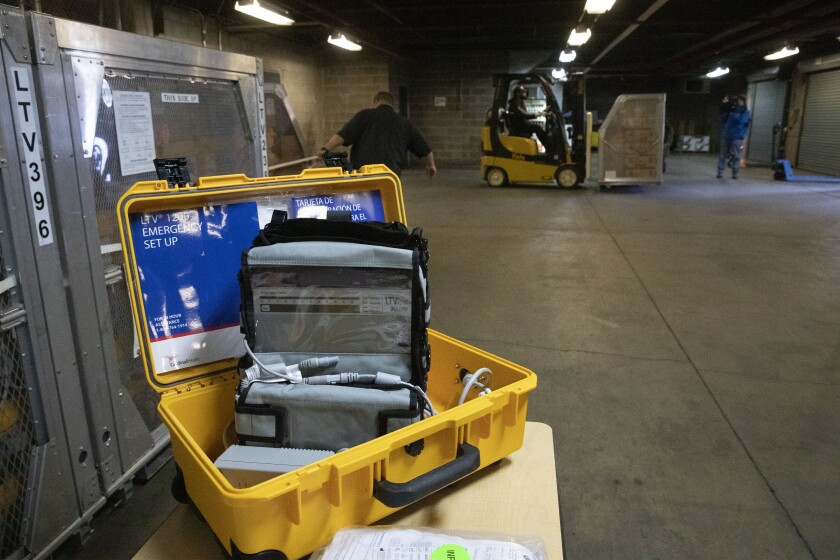
They were ready to roll whenever disaster struck California: three 200-bed mobile hospitals that could be deployed to the scene of a crisis on flatbed trucks and provide advanced medical care to the injured and sick within 72 hours.
Each hospital would be the size of a football field, with a surgery ward, intensive care unit and X-ray equipment. Medical response teams would also have access to a massive stockpile of emergency supplies: 50 million N95 respirators, 2,400 portable ventilators and kits to set up 21,000 additional patient beds wherever they were needed.
In 2006, citing the threat of avian flu, then-Gov. Arnold Schwarzenegger announced the state would invest hundreds of millions of dollars in a powerful set of medical weapons to deploy in the case of large-scale emergencies and natural disasters such as earthquakes, fires and pandemics.
“In light of the pandemic flu risk, it is absolutely a critical investment,” he told a
news conference. “I’m not willing to gamble with the people’s safety.”
The state,
flush with tax revenue, soon sank more than $200 million into the mobile hospital program and a related Health Surge Capacity Initiative to stockpile medicines and medical gear for use in outbreaks of infectious disease, according to former emergency management officials and state budget records.
But the ambitious effort, which would have been vital as the state confronts the new coronavirus today, hit a wall: a brutal recession, a free fall in state revenues — and in 2011, the administration of a fiscally minded Democratic governor, Jerry Brown, who came into office facing a $26-billion deficit.
And so, that year, the state cut off the money to store and maintain the stockpile of supplies and the mobile hospitals. The hospitals were defunded before they’d ever been used.
Much of the medical equipment — including the ventilators, critical life-saving tools that are in short supply in the current pandemic — was given to local hospitals and health agencies, former health officials said. But the equipment was donated without any funding to maintain them. The respirators were allowed to expire without being replaced.
Together, these two programs would have positioned California to more rapidly respond as its COVID-19 cases exploded. The annual savings for eliminating both programs? No more than $5.8 million per year, according to
state budget records, a tiny fraction of the 2011 budget, which totaled
$129 billion.
“When you’re stretched, prevention and readiness, future needs — unfortunately, that’s what gets cut,” said state Sen. Richard Pan of Sacramento, chairman of the Senate Health Committee, who fought the cuts as a first-term assemblyman.
Now, many California hospitals are being
forced to ration their inadequate supply of N95 masks, and hospitals are
rushing to rent ventilators in anticipation of a severe shortage as COVID-19 caseloads grow. A nursing union, National Nurses United, organized a
protest earlier this month over inadequate safety equipment; in a
survey, only 55% of their members said they had access to N95 masks.
Preparing for a pandemic
Dr. Howard Backer spent years preparing the state for a flu pandemic and then watched it all fall apart.
Backer had worked as an emergency room physician for 25 years before becoming the state’s chief medical consultant on disaster preparedness efforts, and later associate secretary for emergency preparedness, under Schwarzenegger.
“We began doing various kinds of disaster planning around infectious agents,” he recalled. First smallpox; then anthrax; then H5N1, or bird flu; and, more broadly, “pandemic influenza.”
As part of that effort, starting in 2006, he helped develop and implement the state’s drive to stockpile emergency medical resources.
After Schwarzenegger left office, Backer was appointed by Brown to head the Emergency Medical Services Authority, the state agency overseeing the mobile hospitals, just as they were defunded.
“It’s the nearsightedness of political decision-making,” said Backer, who
retired last year. “If you talked to the experts, we knew that pandemics were going to come around.”
Now, it’s here, with California under sweeping shelter-in-place orders as one of the global hotspots of the COVID-19 pandemic.
“These supplies were exactly for this scenario,” he said.
Through a spokesperson, Brown, the former governor, declined to be interviewed for this story. Officials in the state Department of Finance declined to comment. Officials with the state Public Health Department declined interviews and provided only brief written answers to some questions, declining to provide a full accounting of the stockpile.