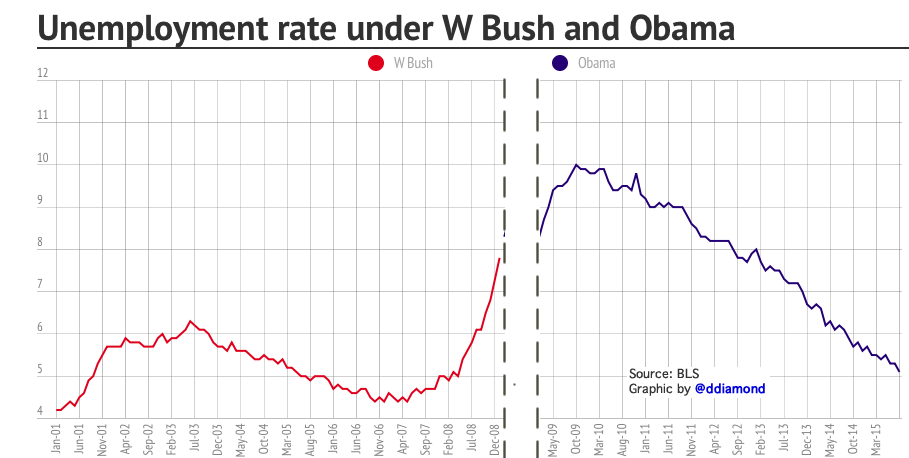
Unemployment falls below 5%

What's happening that's bad with these trends

LABOR FORCE DATA:

The number of people in the labor force decreased by 195k, to 159.7 million.
The overall labor participation rate ticked down 0.1 point to 62.8%.

The number of people not in the labor force, but who want a job, decreased by 176k, to 5.91 million.

The number of people not in the labor force, but who want and are available to work and have looked for a job in the last year, decreased 144k to 1.70 million.

The number of people not counted as unemployed because they dropped out of the workforce decreased by 66k, to 487k.

LOL! Good luck, man. I've gone through these calculations (including showing the progression of those numbers), and it just confuses and enrages them. Employment Truthers are no more reasonable than 9/11 Truthers.
 
LOL, you're the dude bragging about the fact that 14 million people over 8 years leaving the Labor Force, and a 4 point reduction in the percentage of the total population participating in that same labor force (second lowest rate in American history, P.S.) has managed to reduce the unemployment rate a whole 5% from what it was 8 years ago with 14 million more participants participating at a higher rate...... and I'M the one whose shifting goal posts? You couldn't have typed that with a straight face.

Actually I didn't brag about anything, I just don't live in an alternate reality where the US is a worse place to live than hell.

The fact that you bring up Labor Force Participation rate without even bothering to look at Employment-Population Ratio (which btw has been increasing over the past 4 years also) shows that you are just spouting out dishonest talking points.
 
What's happening that's bad with these trends

LABOR FORCE DATA:

The number of people in the labor force decreased by 195k, to 159.7 million.
The overall labor participation rate ticked down 0.1 point to 62.8%.

The number of people not in the labor force, but who want a job, decreased by 176k, to 5.91 million.

The number of people not in the labor force, but who want and are available to work and have looked for a job in the last year, decreased 144k to 1.70 million.

The number of people not counted as unemployed because they dropped out of the workforce decreased by 66k, to 487k.

Did you read the links I posted directly from the BLS? "decreased" as in the Labor Force has shrunk. The sections you've highlighted doesn't mean those people got jobs. It means they've stopped looking for work and have dropped out of the labor force all together. If you have a job, you're in the Labor Force. If you don't have a job and are looking for work, you're counted in the Labor Force. if you're neither of those things, you aren't counted at all. The last section you highlighted is a prime example of how this affects the unemployment rating.

"The number of people not counted as unemployed because they dropped out of the workforce decreased by 66k, to 487k"

Again, this doesn't mean they got jobs. This simply means they stopped counting them against the unemployment rate. You knock 66 thousand people off of anything it's going to raise your numbers. You do this in large chunks, every single month over an 8 year period, you can significantly lower your percentage point numbers without doing anything, then brag about it like it was some sort of achomplishment, which is exactly what the Obama administration is doing.
 
And then there are guys like you who fail to take into consideration that if you've been out of work for so long, for some reason, they stop counting you in the "unemployed" category. You stop factoring into the labor force. This is called the Labor Force Participation Rate. According to the Bureau of Labor Statistics, which is the Federal body in charge of keeping and maintaining those statistics, the number of Americans who just flat out aren't participating in the Labor Force anymore has risen by 14 MILLION people since 2008, while the Labor Participation Rate, the percentage of your population that is either actively employed or actively seeking employment has dropped almost 4 full percentage points since October of 2008 to 62.8%, which has only been beaten a few times. It's only been lower than that a few months last year, earlier this year, and all the way back to December of 1954 when it got all the way down to 58.1%. But tell me some more about how it's below 5% without understanding how it got to be there. It got to be there because they just flat stopped counting some 14 million people who don't have jobs and have given up hope of finding one. It isn't because of some innovative new job creating policies on Obama's part.

http://data.bls.gov/timeseries/LNS15000000

http://data.bls.gov/timeseries/LNS11300000

This deserves a repost. Whether you're talking about something like unemployment or deportations, this administration has been very good at manipulating the numbers to sell a narrative.
 
LOL! Good luck, man. I've gone through these calculations (including showing the progression of those numbers), and it just confuses and enrages them. Employment Truthers are no more reasonable than 9/11 Truthers.

Oh shut the f*ck up Jack. When stone cold facts are against you once again, just act like you've calmly explained it to people, and they're just idiots. You're such a dishonest, ignorant shitstain, if you had even a modicum of class or intelligence you'd have disappeared off of these boards in utter humiliation a long time ago.
 
Actually I didn't brag about anything, I just don't live in an alternate reality where the US is a worse place to live than hell. .

LOL, So citing statistics from the Federal body whose only purpose is to keep track of said statistics is an "alternate reality" to you? I'd love to be capable of the mental gymanstics some of you f**king people pull. It's beyond hilarious.


The fact that you bring up Labor Force Participation rate without even bothering to look at Employment-Population Ratio (which btw has been increasing over the past 4 years also) shows that you are just spouting out dishonest talking points.

Oh, did you mean this one? I did look it up. It's such an insignificant increase, and still significantly down from when Bush left office, that I didn't even bother to post it. So basically you either just outed yourself as a full on koolaide drinker who heard some BS from some talking head somewhere and is ignorantly repeating it without even bothering to find out if it was even true, or you're just an outright liar. You pick.

http://data.bls.gov/timeseries/LNS12300000
 
Yeah, but....Obama is a dirty muslim! It 'feels' like America is circling the drain so we need Trump to save us!
I'm actually a bit surprised more women aren't supporting him , his entire campaign is based on emotion.

Surprised , but then I remember all the stupid shit he's said and done .
 
LOL, So citing statistics from the Federal body whose only purpose is to keep track of said statistics is an "alternate reality" to you? I'd love to be capable of the mental gymanstics some of you f**king people pull. It's beyond hilarious.

You are ignoring literally all of the statistics except for what fits your narrative and then you accuse me of doing mental gymnastics.

Oh, did you mean this one? I did look it up. It's such an insignificant increase, and still significantly down from when Bush left office, that I didn't even bother to post it. So basically you either just outed yourself as a full on koolaide drinker who heard some BS from some talking head somewhere and is ignorantly repeating it without even bothering to find out if it was even true, or you're just an outright liar. You pick.

http://data.bls.gov/timeseries/LNS12300000

I am well aware of the numbers and brought it up because you can't have an honest discussion about labor force participation rate without bringing it up... and now when pointed out with the fact that it has increased (by literally millions of people), your response is its insignificant.
Most importantly those stats are never supposed to be used on their own, and always used in conjunction with other stats to paint the big picture of whats going on with unemployment and the economy.... which you clearly are content with just ignoring.
 
You are ignoring literally all of the statistics except for what fits your narrative and then you accuse me of doing mental gymnastics.


I am well aware of the numbers and brought it up because you can't have an honest discussion about labor force participation rate without bringing it up... and now when pointed out with the fact that it has increased (by literally millions of people), your response is its insignificant.
Most importantly those stats are never supposed to be used on their own, and always used in conjunction with other stats to paint the big picture of whats going on with unemployment and the economy.... which you clearly are content with just ignoring.
You are arguing with somebody that spells Kool Aid with an e on the end of it.
 
Wrong on all statements. How long does reality need to exist before you let go of your conservative conjecture?
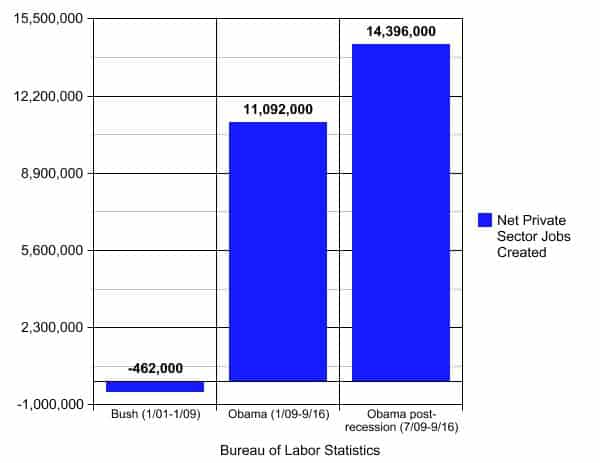
BushvObama_job_0916.jpg

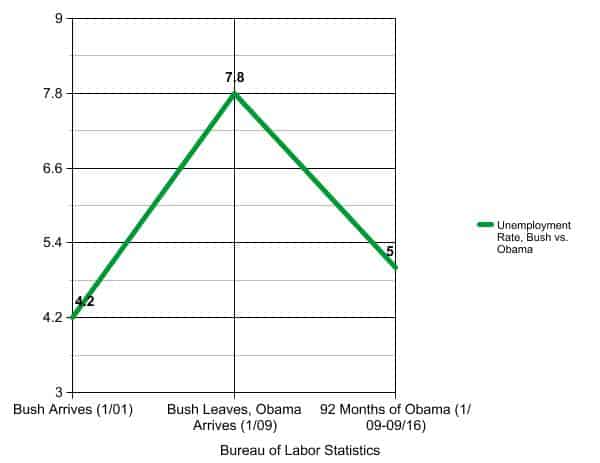
BushvObama_unemp_0916.jpg

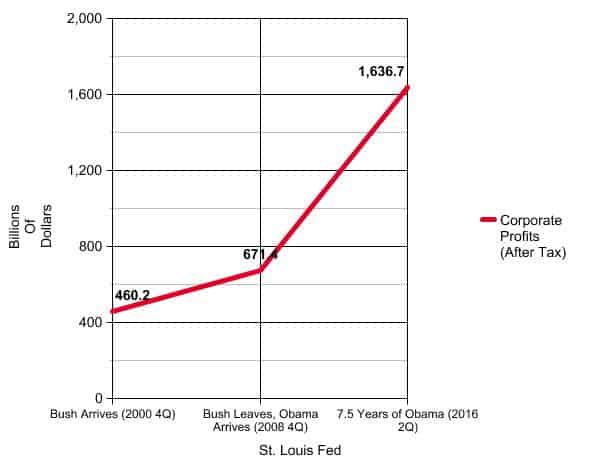
BushvObama_corpprofits_0916.jpg

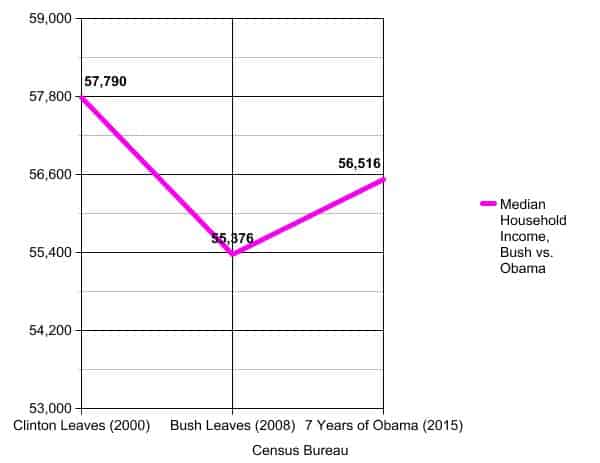
BushvObama_householdincome.jpg

My source is from investors.com, not some news mag.

Also, you pictures are shit, Do you REALLY think it was a smooth line.
Bush from taking office until the recession in 2008 was BETTER than Obama. Obama inherited a recession.
Obama has the worst recovery ever.

You posting Bush vs Obama just shows you do not know what a fucking economic recovery is.
GWB inherited a prosperous economica sitution. He did not inherit a recession. Therefore he had no recovery.

So, you are not disproving the 2 statements I made
1) Obama had the worst recovery ever
2) he left the country as divided as it has been since the civil war

You are not even fucking smart enough to argue my points even and just try to post Obama is better than bush which true or untrue is irrelevant to my 2 points.

PS- you should not use a graph with 3 points of reference like you did for unemployment

UnemploymentBushObama2.png


^ you will note that overall bush had better unemployment rate


Now, I suggest you try to argue with someone without a brain because you will never ever win one against me.
 
You are ignoring literally all of the statistics except for what fits your narrative and then you accuse me of doing mental gymnastics.


I am well aware of the numbers and brought it up because you can't have an honest discussion about labor force participation rate without bringing it up... and now when pointed out with the fact that it has increased (by literally millions of people), your response is its insignificant.
Most importantly those stats are never supposed to be used on their own, and always used in conjunction with other stats to paint the big picture of whats going on with unemployment and the economy.... which you clearly are content with just ignoring.

How am I ignoring it? It's a 1.3 percent increase in 4 years. It isn't some sort of steady rise like you were trying to suggest. That isn't a massive increase percentage wise. It's still a full two points below what it was when Bush left office, and almost 4 below what it was 10 years ago, which if you will remember was the height of the fighting in Iraq and Afghanistan that suppousedly destroyed the economy in the first place. And yes, the dude who just flat out ignored labor force statistics is accusing others of being content with ignoring things he doesn't like. OK, bro....
 
http://www.nytimes.com/2016/11/05/business/economy/jobs-report.html?_r=1

Stole the stats from reddit

Some snippets of data from the BLS Report:

UNEMPLOYMENT RATES:

U3 (headline unemployment rate) ticked down 0.1 to 4.9%.
U4 (includes those who've given up looking for work) ticked down 0.1 point to 5.2%.
U5 (includes "marginally attached") ticked down 0.1 point to 5.9%.
U6 (includes part-timers who'd like to be full-time) ticked down 0.2 points to 9.5%.

LABOR FORCE DATA:

The number of people in the labor force decreased by 195k, to 159.7 million.
The overall labor participation rate ticked down 0.1 point to 62.8%.
The number of people not in the labor force, but who want a job, decreased by 176k, to 5.91 million.
The number of people not in the labor force, but who want and are available to work and have looked for a job in the last year, decreased 144k to 1.70 million.
The number of people not counted as unemployed because they dropped out of the workforce decreased by 66k, to 487k.

FULL- AND PART-TIME EMPLOYMENT:

The number of people employed full-time decreased 103k, to 124.2 million.
The number of people employed part-time increased 90k, to 27.7 million.

JOB GAINS/LOSSES:

Total nonfarm jobs increased by 161k, to 145.0 million.
Of these, 142k came from the private sector.
Federal jobs increased by 12k.
State government jobs increased by 3k.
Local government jobs increased by 4k.

HOURS AND WAGES:

Average hours worked was flat at 34.4 hours per week.
Average hourly wages rose $0.10 to $25.92/hr. This is 2.8% higher than a year ago.
Average weekly wages rose $3.44 to $891.65/week. This is 2.5% higher than a year ago.
Average hours of nonsupervisors was flat at 33.6 per week.
Average hourly wages of nonsupervisors rose $0.04 to $21.72/hr. This is 2.4% higher than a year ago.
Average weekly wages of nonsupervisors rose $1.34, to $729.79/week. This is 2.1% higher than a year ago.

REVISIONS:

August's job numbers were revised up from +167k to +176k.
September's job numbers were revised up from +156k to +191k.
Together, this means that 44k more jobs were created in the last two months than previously estimated.


The government, delivering the last major snapshot of the economy before Election Day, reported on Friday that employers added 161,000 workers in October, a performance that suggested a healthy outlook for the months ahead.

The official unemployment rate dropped to 4.9 percent, from 5 percent. And average hourly earnings rose 2.8 percent year over year, a level not reached since 2008.

“It was pretty positive across the board,” said David Berson, chief economist at Nationwide Insurance, adding that “most importantly, we got a nice jump in average hourly earnings and that actually corresponds with other data.”

While the final weeks of the presidential campaign seemed to be preoccupied with everything but the economy, Friday’s report from the Labor Department refocused attention — at least briefly — on the crucial bread-and-butter issue: jobs. For the candidates, the latest employment report serves as a Rorschach test, allowing each side to offer its own distinctive narrative of the economy’s performance and prospects.


As Vincent Reinhart, chief economist at Standish Mellon, explained, “The main message is from the payroll report: Jobs are being created and earnings are going up.” But a report that goes “right down the middle of the fairway,” he added, “means you can spin it any way you want.”

Advertisement

Continue reading the main story
Donald J. Trump, who was propelled to the top of the Republican ticket in part by nagging economic anxiety and a surge in voter anger among the white working class, has emphasized the negatives.

He has argued that jobs have been disappearing, highlighting the continuing loss of well-paid manufacturing jobs as production moves to other countries. October’s report showed continued decline in that sector, with the loss of 9,000 jobs.

The Democratic candidate, Hillary Clinton, by contrast, has emphasized the progress that President Obama made in digging the country out of the recession, pointing to the creation of roughly 15 million jobs since 2010.

The data on Friday also showed that more jobs were created in August and September than previously estimated. The revisions showed 44,000 more positions had been created, bringing the monthly average over the last three months to 176,000. Even more encouraging was the robust bump in wages, the most concrete sign that the labor market is tightening, and that ordinary workers are finally getting a slice of the rewards.

“This is money in the bank for workers feeling like they’ve been waiting a long time for this piece of the economic recovery puzzle to be added,” said Mark Hamrick, Bankrate.com’s senior economic analyst.

Jed Kolko, chief economist at Indeed, a jobs listing website, noted that the economy “set three post-recession records this month.” Wage growth is at its strongest point; the employment-to-population ratio for prime age workers reached 78.2 percent, its highest level since 2008; and the broadest measure of employment, which includes discouraged and underemployed workers, fell to 9.5 percent.

“These are all signs that the labor market continues to strengthen and is at its strongest point since the crisis,” Mr. Kolko said.

More than seven years after the recession ended, employment gains have been remarkably steady, finally leading to a rise in earnings in the last couple of years. But overall economic growth has remained modest and despite the recent improvements, the recovery has failed to deliver to many Americans the sense of job security and steady advancement that traditionally girds the middle class.

Advertisement

Continue reading the main story
The type of jobs created is one reason. “Where we are creating jobs is in service areas, which are not as productive as manufacturing, and lower paying,” said Mr. Reinhart of Standish Mellon. “So we’ve got a problem.”

At the same time, many employers complain about a shortage of qualified workers.

“It has been tough to hire good people,” especially near cities like Baltimore, Washington and Philadelphia, said Scott Nash, the founder and chief executive of Mom’s Organic Market, which operates 17 grocery stores between Virginia and New Jersey and employs more than 1,000 people. Mr. Nash offers a starting wage of $12 an hour, significantly above the mandated minimums in the areas where his stores are. He said he planned to hire an additional 200 workers, from cashiers to managers, over the next 12 months.

As the recession has receded, the definition of what economists consider a strong or weak employment report has shifted. So what now should be considered normal growth?

Last month, when the government reported that in September, 156,000 additional jobs were created and the unemployment rate was 5 percent, Mr. Trump labeled it “terrible.” By contrast, some members of the Federal Reserve Board argue that the labor market is already close to the goal-post — the lowest level of unemployment that a healthy economy can sustain without igniting inflation.

Taking into account population growth and an aging work force, economists at the San Francisco Fed estimated the “break-even” point — growth that is sufficient to keep the jobless rate from rising — now ranges from 50,000 to 110,000 jobs a month. Additional jobs would most likely push the unemployment rate further down, while fewer could lift it.

Record low participation rates in the labor force, however, suggest that a sizable number of people might be lured back into the work force for the right job at the right wage.

Ian Siegel, chief executive of ZipRecruiter, which distributes job postings primarily from small and midsize businesses, said he saw a substantial jump in listings last month.

“There are more middle-skill jobs at higher salaries,” Mr. Siegel said. His assumption is that rather than seeking talent at the top of the skills ladder, employers are increasingly willing to train new employees. “It’s a great time to be a job seeker,” he said.

Advertisement

Continue reading the main story
ZipRecruiter defines middle-skilled jobs as those that require vocational training, related on-the-job experience or an associate degree.

Mr. Siegel also expects to see a large upswing in temporary hiring of low-skilled workers by retailers and related industries, like parcel delivery, as businesses gear up for the holiday season.

Uncommon Goods, an online retailer located in Brooklyn, plans to add hundreds of temporary employees to its 170-person work force by the end of the year, said Dave Bolotsky, the founder and chief executive. Over the next year, he expects to create 20 to 30 full-time positions, with a starting wage of $14 an hour. “If you can pay above market rate, it’s a sign of appreciation or respect,” said Mr. Bolotsky, who supports an increase in the mandated minimum wage.

As for high-skilled workers, Tara Sinclair, an economist at Indeed, noticed a decline in postings for technology jobs, a closely watched sector that makes up a relatively small portion of the overall labor market.

“It seems there’s a little bit more caution that what we were seeing nine months ago,” Ms. Sinclair said. “For a while every company needed a data scientist, thinking ‘I don’t know what it is, but I want one.’ Now they may be asking ‘What is going to be the business value of hiring these people?’”

This week, the Fed announced it was once again holding off on any increase in its benchmark interest rate, but indicated a December bump was likely. In its statement, the policy-making committee noted that inflation still remained below the target long-run goal of 2 percent annual growth.

Ted Wieseman, an economist at Morgan Stanley, noted the employment picture showed plenty of signs of resilience. “Unemployed workers have been dropping out of the labor force in smaller numbers, and there’s been a pickup in formerly discouraged workers starting to look for work again,” he said in his employment report preview. The rate of workers being fired has also remained low this year.

My state has a better rate then the national average. My mother who is college educated, and held steady employment for over 35 years, has been out of work for over a year. She works at Goodwill for free, because she doesn't want to have a year of unemployment on her resume. She is taking classes to update her skills, and fills out multiple applications everyday for over a year now. She is taking seasonal work at a local department store, because she can't find a job anywhere.

You can tell me all day long that the economy is improving, but all of us that live in the real world, know that is utter BS, and propaganda.
 
People who realize that its simply easier to absorb assistance than to go out and look for work.

Doesn't unemployment assistance run out? I recall news reports mentioned certain states extending the assistance due to the economic collapse. I wonder if these people vote Trump or Hillary?
 
My state has a better rate then the national average. My mother who is college educated, and held steady employment for over 35 years, has been out of work for over a year. She works at Goodwill for free, because she doesn't want to have a year of unemployment on her resume. She is taking classes to update her skills, and fills out multiple applications everyday for over a year now. She is taking seasonal work at a local department store, because she can't find a job anywhere.

You can tell me all day long that the economy is improving, but all of us that live in the real world, know that is utter BS, and propaganda.

Sorry to hear that but there's the structural argument that some states relying on certain industries on on the decline. There's always news about jobs being unfulfilled due to qualified employees. Not sure what state your mom is in or what field she is in. I know certain US cities are booming and friends have moved to those cities.
 
because i dont believe what the liberal media tells me, i must somehow be a racist now. well done, i see you put a lot of thought into this.

Therefore the alternative is to get your news from right wing blogs? Washington Post is not liberal.
 
lol @ anyone who believes unemployment stats. At least 20% of America is unemployed.
 
Back
Top