Social The Future of Humanity in the Age of AI, Automation, and Concentrated Power

I posted this article on AI and jobs in another thread. In general this is how I suspect AI will effect us ~

A Robopocalypse for Jobs? Not Today, and Probably Not Tomorrow, Either​


Imagine a world of human-level artificial intelligence. The job market would probably be a lot different. There’s the “robots take all the jobs” scenario, I suppose. A few folks own all the machines with the rest of us on the dole. Not sure that is the most likely outcome, however, even if artificial general intelligence proves possible.

Here’s another scenario: According to economist Pascual Restrepo of Yale University in his paper “We Won’t be Missed: Work and Growth in the AGI World,” if AGI could perform all economically valuable tasks, work would shift from economic necessity to personal meaning: art, teaching, and personal care. Wages might become pegged to the cost of AI compute. Labor’s share of income could shrink even as absolute living standards rise dramatically.

Sounds better! But where are we right now? Early, early days, I think. Economists usually think about automation not as whole jobs disappearing, but as specific tasks within jobs being replaced or assisted by technology. The economics team at Goldman Sachs, a bank, assumed in a 2023 analysis that generative AI can handle moderately difficult tasks across hundreds of occupations. It estimated that about two-thirds of US jobs are partly exposed, with AI able to ultimately automate roughly one-quarter to one-half of the tasks within those roles. Globally, that translates to about 18 percent of total work being automatable. Even so, Goldman expects AI to replace only about seven percent of US jobs while enhancing 63 percent—a reshaping of work, not a mass wipeout.

A different approach is taken in the new paper “Remote Labor Index: Measuring AI Automation of Remote Work.” The authors, from the Center for AI Safety and Scale AI, decided to treat AI systems as if they were freelance workers on real jobs. They took 240 genuine Upwork-style projects—everything from data dashboards and 3D product designs to marketing videos—and provided the same briefs, files, and deliverables to both humans and AI models such as GPT-5, Claude Sonnet 4.5, and Gemini 2.5 Pro. Human evaluators then judged whether the AI’s submissions would be acceptable to a paying client.

The result: Almost never, with a tiny 2.5 percent success rate “revealing a stark gap between progress on computer use evaluations and the ability to perform real and economically valuable work,” the paper concludes. Even the top-performing model, Chinese AI agent Manus, “earned” only about $1,700 out of $144,000 worth of human labor. Here’s why most of the AI outputs were rejected:

Rejections predominantly cluster around the following primary categories of failure:

  1. Technical and File Integrity Issues: Many failures were due to basic technical problems, such as producing corrupt or empty files, or delivering work in incorrect or unusable formats.
  2. Incomplete or Malformed Deliverables: Agents frequently submitted incomplete work, characterized by missing components, truncated videos, or absent source assets.
  3. Quality Issues: Even when agents produce a complete deliverable, the quality of the work is frequently poor and does not meet professional standards.
  4. Inconsistencies: Especially when using AI generation tools, the AI work often shows inconsistencies between deliverable files.
The failure rate cuts sharply against the dystopian headlines predicting a white-collar wipeout that’s just around the corner. Far from replacing designers, coders, or analysts, today’s AIs are still fumbling at doing the basics correctly. Models can edit text or generate images in seconds, but they crumble when asked to manage complex, multi-step work. That gives policymakers and firms time to adapt through training, not panic through bans or basic-income schemes. And as AI gets better, we’ll be ready.


Learn more: America’s Self-Driving Test of Faith | Anxious About AI? We’ve Been Here Before | How Environmental Virtue Signaling Starves the Poor | AI Ban Backers Risk Freezing Progress
 
its stupid, i dont see how these ai companies are going to make MONEY. it just doesn't click. the only way it works is if the robots take over and become 99% of an economy with less total money in it and they just want a slice of the smaller pie. or hyperinflation from tech bubble. but the whole point of AI is that it makes things easier and CHEAPER. the economy will contract severely and hurt everyone. except for rich ppl who control everything.

tldr we r fucked we need to raise taxes yesterday but THAT AINT GONNA HAPPEN and the democrats have showed time and again they are controlled opposition and wont rock the boat ever ever ever nope aint happening.
 
I been saying this for over a year AI is BS AGI is BS this has been a scam since the beginning. Sam Altman, Elon Musk, Peter Thiel, now Jensen Huang, Mark Zuckerberg, Larry Ellison. The amount of energy and compute is beyond imaginable and the technology is no where near the levels it needs to be. I have talked about this to in the past optical quantum computing is the only way to get there but Jensen has been pushing this narrative to sell billions and billion of chips. Jensen ride the way to 4 trillion plus valuation by playing this game and Wall Street too.
 
I posted this article on AI and jobs in another thread. In general this is how I suspect AI will effect us ~

A Robopocalypse for Jobs? Not Today, and Probably Not Tomorrow, Either​


Imagine a world of human-level artificial intelligence. The job market would probably be a lot different. There’s the “robots take all the jobs” scenario, I suppose. A few folks own all the machines with the rest of us on the dole. Not sure that is the most likely outcome, however, even if artificial general intelligence proves possible.

Here’s another scenario: According to economist Pascual Restrepo of Yale University in his paper “We Won’t be Missed: Work and Growth in the AGI World,” if AGI could perform all economically valuable tasks, work would shift from economic necessity to personal meaning: art, teaching, and personal care. Wages might become pegged to the cost of AI compute. Labor’s share of income could shrink even as absolute living standards rise dramatically.

Sounds better! But where are we right now? Early, early days, I think. Economists usually think about automation not as whole jobs disappearing, but as specific tasks within jobs being replaced or assisted by technology. The economics team at Goldman Sachs, a bank, assumed in a 2023 analysis that generative AI can handle moderately difficult tasks across hundreds of occupations. It estimated that about two-thirds of US jobs are partly exposed, with AI able to ultimately automate roughly one-quarter to one-half of the tasks within those roles. Globally, that translates to about 18 percent of total work being automatable. Even so, Goldman expects AI to replace only about seven percent of US jobs while enhancing 63 percent—a reshaping of work, not a mass wipeout.

A different approach is taken in the new paper “Remote Labor Index: Measuring AI Automation of Remote Work.” The authors, from the Center for AI Safety and Scale AI, decided to treat AI systems as if they were freelance workers on real jobs. They took 240 genuine Upwork-style projects—everything from data dashboards and 3D product designs to marketing videos—and provided the same briefs, files, and deliverables to both humans and AI models such as GPT-5, Claude Sonnet 4.5, and Gemini 2.5 Pro. Human evaluators then judged whether the AI’s submissions would be acceptable to a paying client.

The result: Almost never, with a tiny 2.5 percent success rate “revealing a stark gap between progress on computer use evaluations and the ability to perform real and economically valuable work,” the paper concludes. Even the top-performing model, Chinese AI agent Manus, “earned” only about $1,700 out of $144,000 worth of human labor. Here’s why most of the AI outputs were rejected:


The failure rate cuts sharply against the dystopian headlines predicting a white-collar wipeout that’s just around the corner. Far from replacing designers, coders, or analysts, today’s AIs are still fumbling at doing the basics correctly. Models can edit text or generate images in seconds, but they crumble when asked to manage complex, multi-step work. That gives policymakers and firms time to adapt through training, not panic through bans or basic-income schemes. And as AI gets better, we’ll be ready.


Learn more: America’s Self-Driving Test of Faith | Anxious About AI? We’ve Been Here Before | How Environmental Virtue Signaling Starves the Poor | AI Ban Backers Risk Freezing Progress

it could be , but , from my own exp. with agents, I can confirm they can do a lot.
replit is a good example
just go there an in no time you have a website up an running.
that alone is significant chunk of someones work.
but , how it will be handled , controlled , depends
what i and i guess we all know, corporations are into profits, cost cutting, automation, continuous growth - AI automation agents etc are exactly what they need then
 
irtSEQujguQfXejUD4dvhB-650-80.png.webp


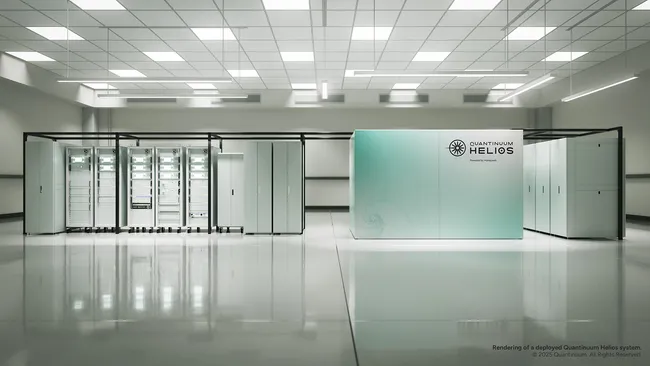
Here we go a new direction that could solve the massive power need equation and make AI far more viable then the sh$t show currently going on and money men are noticing. They company is working it a 98 qbit quantum processor using bariun ions and working towards room temp. superconducting. That explains the company already having a 10 billion dollar valuation without a product.
"
What do you do after building the world’s most powerful quantum computer? Use it to unlock the secrets of room-temperature superconductors, of course.

That’s at least the plan according to a fresh announcement by Quantinuum, a $10 billion company that claims to have made the world's most powerful quantum processing unit. Equipped with 98 physical qubits made of barium ions, the machine, called Helios, can supposedly crunch through specialist problems it would take a traditional supercomputer the total wattage of a jet-spewing black hole to solve.

The researchers set Helios to simulate aspects of the Fermi-Hubbard model — a framework that may yield clues into making room-temperature superconductors a reality."
 
I think over the next decades lot's of people will get fed up with all the tech stuff and go back to more traditional jobs and ways of living.

You can already see a different mentality towards new technologies. 20 years ago everyone was hyped and thinking of all kinds of sci-fi stuff. Now you mainly think of AI slop and big tech companies trying to collect data and stuff ads down your throught every chance they get.
 
While AI does have some usefulness I think this is a tech bubble. Kind of reminds me of 3D TVs when best buy and others were pushing TVs you had to wear glasses to watch in 3D. They provided a neat experience but it never caught on and took over the market. Do they even sell 3D TVs today?

I think AI is kind of like the 3D TVs, but far worse for society. What we call AI, which is mostly language models, can't deliver on the promises made by big AI companies. A LLM isn't going to replace someone that needs to make critical decisions with input from multiple places and requiring instiutional knowledge, experience and nuance. Maybe the next generation of AI will be capable of that, but I am skeptical. It's also scary how much this AI bubble is propping up the world economy. Not good if/when this pops.
 
While AI does have some usefulness I think this is a tech bubble. Kind of reminds me of 3D TVs when best buy and others were pushing TVs you had to wear glasses to watch in 3D. They provided a neat experience but it never caught on and took over the market. Do they even sell 3D TVs today?

I think AI is kind of like the 3D TVs, but far worse for society. What we call AI, which is mostly language models, can't deliver on the promises made by big AI companies. A LLM isn't going to replace someone that needs to make critical decisions with input from multiple places and requiring instiutional knowledge, experience and nuance. Maybe the next generation of AI will be capable of that, but I am skeptical. It's also scary how much this AI bubble is propping up the world economy. Not good if/when this pops.
intentions are clear
3d tv was not able to replace a jp morgan employee, AI's main role in the big corp. environment is exactly that
 
intentions are clear
3d tv was not able to replace a jp morgan employee, AI's main role in the big corp. environment is exactly that
I just don't think it's capable. It requires mass information based on humans... That it's supposed to replace. Do.you see the circular problem this presents? It's already gutting the legacy media space.
 
Back
Top