• Xenforo Cloud is upgrading us to version 2.3.8 on Monday February 16th, 2026 at 12:00 AM PST. Expect a temporary downtime during this process. More info here

Why do accomplished Runners do so poorly at MMA cardio?

Ok. Yeah as everyday sneakers but not sure I d be very keen on running with those though....

Could be done - I ran 30-40 miles/week in them as a kid. But I was a 125 lbs gimp back then. Modern shoes are a lot more plush and as an older guy, yeah I'm running in whatever saves my knees and gives me the most cushioning even if they're ugly af.
 
Could be done - I ran 30-40 miles/week in them as a kid. But I was a 125 lbs gimp back then. Modern shoes are a lot more plush and as an older guy, yeah I'm running in whatever saves my knees and gives me the most cushioning even if they're ugly af.

This. Us old fucks can't get away with stuff like that. Or at least should not risk it...
 
I recently added long Stair Climb runs to my workout routine and regardless of how good your baseline of fitness is you learn quickly that if you are pushing yourself in another activity that involves different motions and muscle groups and pace, there is not a 1:1 translation on the cardio or endurance front.

Just because you run Triathlons of marathons does not mean you should expect to be able to keep pace with a top tennis player playing marathon sessions.

This is what I just stated in the MMA V Boxing Cardio thread and the below article fleshes it out even more.

MikeMcMann said:
Many people mis-understand the term cardio as it pertains to specific sports which would be better identified as endurance.

Cardio in that regard is event specific.

Of course you can have a high level of general cardo. A slow and strong heart rate, etc, but if you simply think you can jump into a specific task or sport and that cardio transfers at the highest levels, you are wrong.

Cardio in that sense involves muscle fatigue and repetition. So because you can run a marathon does not mean you can keep your arms up high and punch effectively for 12 rounds as you have not trained for that repetition. You can take the best trained cyclist or triathlete with the top cardio and they would struggle to push hard and run up flights of stairs, if that is not part of their training.

So if you train MMA you will have good MMA endurance and if you train boxing you will have good boxing endurance but that does not mean you can simply jump from one tot he other and compete at the highest levels unless you play catch up in that specific training area.


Why climbing stairs is always a killer, no matter how fit you are

We run to work. We dutifully attend spin classes. We lift, bro. We’re fit. And yet, give us a flight of stairs to run up and suddenly, we turn into panting puddles. Climbing stairs is ridiculously hard, no matter how much exercise you do...

But why? Why are stairs such a nightmare, and can you ever get better at them?...

Our bodies run on something called Adenosine triphospahte (ATP) – the petrol that keeps us alive and functioning. How much we produce and how quickly, depends on which energy system we use to produce it. When you exercise, your body burns through fuel and it’s clever enough to know when to switch between certain sources of energy. When you’re running a marathon or doing any kind of slow, steady, long workout, you use your aerobic system – burning through carbs and fat. If, say, you’re doing a 400m run, chances are that you’re using your lactic system – not quite a sprint but going at a good lick. That lactic system produces ATP without oxygen and is manufactured from the breakdown of glucose to pyruvic acid in the muscle cells...

The final energy system is our phosphocreatine system – our fastest source and most quickly expendable source of ATP. We access this first and rely on it for sprints, strength weight training and other explosive movements. It’s the system that give us that burst of energy, that raw power. When we climb stairs, we’re tapping into that system first – but it only lasts for 10 seconds (approximately) and comes from the glycogen already in our muscles. So once that 10 seconds is up, we start to transition into our next energy system and after some time, into our aerobic one which is the most sustainable and, arguably, least painful...

Climbing stairs is the ultimate functional fitness test – you teach the body to become more efficient in how it operates. That’s why boxers use running up stairs as a training tool; they’re constantly having to push their lactic threshold with sustained, explosive movements...

 
I recently added long Stair Climb runs to my workout routine and regardless of how good your baseline of fitness is you learn quickly that if you are pushing yourself in another activity that involves different motions and muscle groups and pace, there is not a 1:1 translation on the cardio or endurance front.

Just because you run Triathlons of marathons does not mean you should expect to be able to keep pace with a top tennis player playing marathon sessions.

This is what I just stated in the MMA V Boxing Cardio thread and the below article fleshes it out even more.


Why climbing stairs is always a killer, no matter how fit you are

We run to work. We dutifully attend spin classes. We lift, bro. We’re fit. And yet, give us a flight of stairs to run up and suddenly, we turn into panting puddles. Climbing stairs is ridiculously hard, no matter how much exercise you do...

But why? Why are stairs such a nightmare, and can you ever get better at them?...

Our bodies run on something called Adenosine triphospahte (ATP) – the petrol that keeps us alive and functioning. How much we produce and how quickly, depends on which energy system we use to produce it. When you exercise, your body burns through fuel and it’s clever enough to know when to switch between certain sources of energy. When you’re running a marathon or doing any kind of slow, steady, long workout, you use your aerobic system – burning through carbs and fat. If, say, you’re doing a 400m run, chances are that you’re using your lactic system – not quite a sprint but going at a good lick. That lactic system produces ATP without oxygen and is manufactured from the breakdown of glucose to pyruvic acid in the muscle cells...

The final energy system is our phosphocreatine system – our fastest source and most quickly expendable source of ATP. We access this first and rely on it for sprints, strength weight training and other explosive movements. It’s the system that give us that burst of energy, that raw power. When we climb stairs, we’re tapping into that system first – but it only lasts for 10 seconds (approximately) and comes from the glycogen already in our muscles. So once that 10 seconds is up, we start to transition into our next energy system and after some time, into our aerobic one which is the most sustainable and, arguably, least painful...

Climbing stairs is the ultimate functional fitness test – you teach the body to become more efficient in how it operates. That’s why boxers use running up stairs as a training tool; they’re constantly having to push their lactic threshold with sustained, explosive movements...

The problem with going Full Rocky is that set of stairs long enough to be a challenging workout can be difficult to find. Sure, you can head for the nearest large building, but the people who live or work there might be less than happy to have to dodge some sweaty maniac who looks like he's about to have a heart attack as he charges up the stairs.

Stadiums can be good to train in, but again, you need access when it's not actually being used.
 
The problem with going Full Rocky is that set of stairs long enough to be a challenging workout can be difficult to find. Sure, you can head for the nearest large building, but the people who live or work there might be less than happy to have to dodge some sweaty maniac who looks like he's about to have a heart attack as he charges up the stairs.

Stadiums can be good to train in, but again, you need access when it's not actually being used.
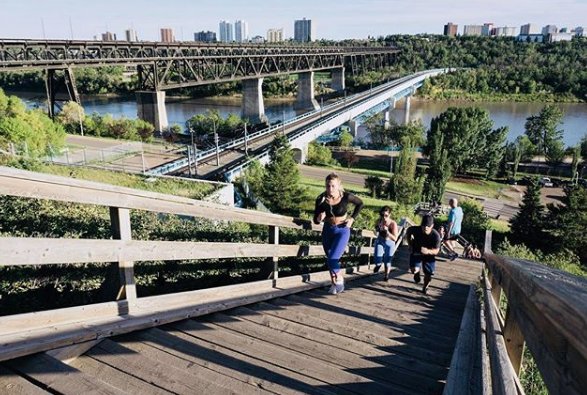
One of the benefits about living in Edmonton (yes there are some) are that because we have a deep River Valley you have all sort of amazing out door stairs you can run.

These are called the Glenora Stairs which I do often at the end of my bike rides.

DjcOwlAX4AAFoBl.jpg


3763012042_feab987679_b.jpg


And there are lots of options up and down the valley

Staircase_North_Saskatchewan_River_Valley_Edmonton_Alberta_Canada_01.jpg


extra_large_b62abb2642e425723cf44d1e76545efc.jpg


And if I move to Vancouver in the next few months I will be doing this climb a few times a week as I love it. It kicks my ass despite the fact I mountain bike and run those stairs to train, but I love it the dozen or so times a year I get to do it now when I travel there.

extra_large_2a88fb402fe6aa98c7ee5c7359073213.jpg


0d81edd16b1d7f6a1816abe24c1a24a9.jpg


Taking on Mother Nature's Stairmaster: The Grouse Grind

How long and how high is the Grouse Grind?
The Grouse Grind is a 2.9-km (1.8-mile) ascent, with an elevation gain of 853 metres (2,800 feet).

How many steps are there?
2,830.

How long does the climb take?
This answer, of course, depends on your fitness level, personal motivation, the group you are with and how busy the trail is. The key is to do it within your personal limits. Some people take two hours or more although an average time is 1.5 hours. The official record holder has done it in 23 minutes and 48 seconds.
https://www.bcliving.ca/taking-on-mother-natures-stairmaster-the-grouse-grind

In the Winter I will do the stairs in my condo every once in a while to keep a base level of shape. I live on the 31 st floor. But I find it claustrophobic and you can taste the light dust you kick up with your steps if you stay in the stairwell too long.
 
One of the benefits about living in Edmonton (yes there are some) are that because we have a deep River Valley you have all sort of amazing out door stairs you can run.

These are called the Glenora Stairs which I do often at the end of my bike rides.

DjcOwlAX4AAFoBl.jpg


3763012042_feab987679_b.jpg


And there are lots of options up and down the valley

Staircase_North_Saskatchewan_River_Valley_Edmonton_Alberta_Canada_01.jpg


extra_large_b62abb2642e425723cf44d1e76545efc.jpg


And if I move to Vancouver in the next few months I will be doing this climb a few times a week as I love it. It kicks my ass despite the fact I mountain bike and run those stairs to train, but I love it the dozen or so times a year I get to do it now when I travel there.

extra_large_2a88fb402fe6aa98c7ee5c7359073213.jpg


0d81edd16b1d7f6a1816abe24c1a24a9.jpg


Taking on Mother Nature's Stairmaster: The Grouse Grind

How long and how high is the Grouse Grind?
The Grouse Grind is a 2.9-km (1.8-mile) ascent, with an elevation gain of 853 metres (2,800 feet).

How many steps are there?
2,830.

How long does the climb take?
This answer, of course, depends on your fitness level, personal motivation, the group you are with and how busy the trail is. The key is to do it within your personal limits. Some people take two hours or more although an average time is 1.5 hours. The official record holder has done it in 23 minutes and 48 seconds.

In the Winter I will do the stairs in my condo every once in a while to keep a base level of shape. I live on the 31 st floor. But I find it claustrophobic and you can taste the light dust you kick up with your steps if you stay in the stairwell too long.

I'm Jelly. I've got nothing like that. There's a hill about 375 yards long with a 9% grade. I sometimes use that for hill repeats(at that distance it can't really be called a sprint).
 
I'm Jelly. I've got nothing like that. There's a hill about 375 yards long with a 9% grade. I sometimes use that for hill repeats(at that distance it can't really be called a sprint).
ya running up stairs are the ultimate cardio imo. Almost immediately after I made that post I went out and did 4 sets of HIIT runs on the Glenora stairs. It only takes me about 35 minutes but it kicks my ass worse than a 3 hour mountain bike ride.
 
I've traveled to Thailand several times for muaythai purposes and one of those times years ago I visited a famous gym called Sitboonmee (notable fighters: Kongsak, Samkor). I went there at a quiet time and because of this I had a lot of alone time with the owner. Although the training there wasn't anything special the knowledge I gained from those conversations were useful.

I spoke to him about many things and one of the questions I asked him was why his fighters ran so much and why they didn't do sprints instead. They would run like 2 hours a day and it didn't make sense to me. He said the fighters do not run for stamina. Stamina is built doing fight specific type training like bag work, pads, sparring etc. If you wanted to increase stamina add minutes and intensity to rounds instead because no matter how many sprints you do or how long you run ultimately there is a limit to how it benefits you in an actual fight because your muscles are working differently to how they work during a run.

Running at a steady pace for at least 45 minutes is an easy safe"ish" way to keep weight down. Its also used for leg endurance and being quick on your feet. Its also a type of meditation and can help with visualization. He said sprints are unnecessary and if you have enough energy to do them you're not doing enough fight specific training. Long distance running on the other hand can be done consistently without effecting other areas and when you're a fighter injuries become an important factor. All the unnecessary bro science strength and conditioning bs is the reason why fighters in the west constantly get injured. Always looking for new ways to improve when the truth is its about keeping it simple and repetition. This is why you see a lot of thais just spam kicks or knees on the pads. Why guys like Floyd will do repetitive punches on the bag and so on. None of these guys do sprints or any real S & C programs. Power is god given. Theres a limit to how much you can increase it (for combat sports). Whats more important is stuff like timing, distance control and foot work that comes with consistency. Combat sports is not like some Kung Fu movie where you learn hundreds of new moves. In Muaythai there are only a few types of kicks you learn but instead of learning new shit you keep spamming the same shit until you get better and better ( Bruce Lee: I fear not the man who has practiced 10,000 kicks once, but I fear the man who has practiced 1 kick 10, 000 times).

These examples are the best way to build fight specific cardio (For striking):


I've traveled to Thailand several times for muaythai purposes and one of those times years ago I visited a famous gym called Sitboonmee (notable fighters: Kongsak, Samkor). I went there at a quiet time and because of this I had a lot of alone time with the owner. Although the training there wasn't anything special the knowledge I gained from those conversations were useful.

I spoke to him about many things and one of the questions I asked him was why his fighters ran so much and why they didn't do sprints instead. They would run like 2 hours a day and it didn't make sense to me. He said the fighters do not run for stamina. Stamina is built doing fight specific type training like bag work, pads, sparring etc. If you wanted to increase stamina add minutes and intensity to rounds instead because no matter how many sprints you do or how long you run ultimately there is a limit to how it benefits you in an actual fight because your muscles are working differently to how they work during a run.

Running at a steady pace for at least 45 minutes is an easy safe"ish" way to keep weight down. Its also used for leg endurance and being quick on your feet. Its also a type of meditation and can help with visualization. He said sprints are unnecessary and if you have enough energy to do them you're not doing enough fight specific training. Long distance running on the other hand can be done consistently without effecting other areas and when you're a fighter injuries become an important factor. All the unnecessary bro science strength and conditioning bs is the reason why fighters in the west constantly get injured. Always looking for new ways to improve when the truth is its about keeping it simple and repetition. This is why you see a lot of thais just spam kicks or knees on the pads. Why guys like Floyd will do repetitive punches on the bag and so on. None of these guys do sprints or any real S & C programs. Power is god given. Theres a limit to how much you can increase it (for combat sports). Whats more important is stuff like timing, distance control and foot work that comes with consistency. Combat sports is not like some Kung Fu movie where you learn hundreds of new moves. In Muaythai there are only a few types of kicks you learn but instead of learning new shit you keep spamming the same shit until you get better and better ( Bruce Lee: I fear not the man who has practiced 10,000 kicks once, but I fear the man who has practiced 1 kick 10, 000 times).

These examples are the best way to build fight specific cardio (For striking):


Very interesting. While obviously the owner knows what works for his fighters, and has forgotten more about conditioning them than I will ever know, that doesn't mean his philosophy works for everyone.

Disclaimer: I suck at LISS running, but I do enjoy it. Running a few miles at a steady pace is physically and mentally relaxing. If I could, LISS would be my go-to GPP conditioning choice year round. The problem is that I'm a fairly big guy - around 225 or so - and middle aged. Running even short to medium distances week in week out for more than five months or so wrecks my knees. No matter how I warm up, how much I fine tune my running technique etc.

That's why I will alternate 5 - 6 months of LISS running with the same amount of time doing hill sprints/repeats. This allows my knees to recover while still giving me a good workout.
 
Running even short to medium distances week in week out for more than five months or so wrecks my knee
Have you tried Brooks Adrenaline Gts running shoes? The reason I asked is because they have been a life saver for my knees and they might help you. However I have read mix reviews on the newer models. Also, doing direct glute works might helped with your knees for running.
 
@Julius_Caesar , I definitely agree with your Kru/owner when it comes to conditioning. What I notice from doing 30-45mins of jogging is that I’m able to put more effort into my high intensity training and doing specific skilled workouts.
 
MMA isn’t just cardio; it is muscular endurance. You aren’t just moving yourself; you are moving another person aswell.
 
Disclaimer: I suck at LISS running, but I do enjoy it. Running a few miles at a steady pace is physically and mentally relaxing. If I could, LISS would be my go-to GPP conditioning choice year round. The problem is that I'm a fairly big guy - around 225 or so - and middle aged. Running even short to medium distances week in week out for more than five months or so wrecks my knees. No matter how I warm up, how much I fine tune my running technique etc.

That's why I will alternate 5 - 6 months of LISS running with the same amount of time doing hill sprints/repeats. This allows my knees to recover while still giving me a good workout.
You're right it wont work for everyone. Although your running form and the surface you run on can effect knees some people unfortunately have problems that wont go away. I was talking more about what works for professional fighters who dont have any issues with their knees. Also the average person with a full time job obviously doesn't have time to run long distances and thats when id recommend sprints instead.
 
SAID principle. Specific Adaptation to Imposed Demands. A runners body has adapted to the specific movement that is running. An MMA fighters body has adapted to specific movements such as punching, kicking, shooting for takedowns etc.
 
There's a theory that regular LISS has a psychological benefit. It strengthens the left ventricle, which lowers the resting heart rate. Which has the effect, everything else being equal, of lowering stress levels as well.
 
On TOP of that - big dudes can be in great shape, but simply not be built for running just by carrying the extra body (short femurs also play into running stride)

Really, it’s apples and oranges.

Athletes should cross train, but if you want to become specific there are sports that you simply are not genetically built to reach any great heights in. Running is still good work, but you can’t simply judge a big or explosive athlete directly by his distance running times.

Funny enough, my old training partner and I, who between the two of us owned every bit of gym equipment and got into all kinds of cardio and resistance training, decided that you could work all systems with no equipment at all.
We never did this, as he moved away, but we wanted to simply run/swim/climb around over a long distance, stopping at good spots of grass or sand for a best of seven takedown contest, possibly throwing in some push-ups, pull-ups, burpees, squats, or lifting a big stone.

I often wonder about body types and the predisposition to running. I feel like I’m kind of a born runner, I’m tall, light and I’ve got long legs. I enjoy running, I like the mental test of pushing yourself, and the lonely meditative aspect. I never get any significant injury from running.

Now if i was a short burly dude I can easily imagine that I’d feel differently.

I dunno, maybe my ancestors hunted Elands on foot accros the savanna and adapted to running, other people may be less well suited for it.

On the flip-side, I kinda suck at powerlifting.
 
I've traveled to Thailand several times for muaythai purposes and one of those times years ago I visited a famous gym called Sitboonmee (notable fighters: Kongsak, Samkor). I went there at a quiet time and because of this I had a lot of alone time with the owner. Although the training there wasn't anything special the knowledge I gained from those conversations were useful.

I spoke to him about many things and one of the questions I asked him was why his fighters ran so much and why they didn't do sprints instead. They would run like 2 hours a day and it didn't make sense to me. He said the fighters do not run for stamina. Stamina is built doing fight specific type training like bag work, pads, sparring etc. If you wanted to increase stamina add minutes and intensity to rounds instead because no matter how many sprints you do or how long you run ultimately there is a limit to how it benefits you in an actual fight because your muscles are working differently to how they work during a run.

Running at a steady pace for at least 45 minutes is an easy safe"ish" way to keep weight down. Its also used for leg endurance and being quick on your feet. Its also a type of meditation and can help with visualization. He said sprints are unnecessary and if you have enough energy to do them you're not doing enough fight specific training. Long distance running on the other hand can be done consistently without effecting other areas and when you're a fighter injuries become an important factor. All the unnecessary bro science strength and conditioning bs is the reason why fighters in the west constantly get injured. Always looking for new ways to improve when the truth is its about keeping it simple and repetition. This is why you see a lot of thais just spam kicks or knees on the pads. Why guys like Floyd will do repetitive punches on the bag and so on. None of these guys do sprints or any real S & C programs. Power is god given. Theres a limit to how much you can increase it (for combat sports). Whats more important is stuff like timing, distance control and foot work that comes with consistency. Combat sports is not like some Kung Fu movie where you learn hundreds of new moves. In Muaythai there are only a few types of kicks you learn but instead of learning new shit you keep spamming the same shit until you get better and better ( Bruce Lee: I fear not the man who has practiced 10,000 kicks once, but I fear the man who has practiced 1 kick 10, 000 times).

These examples are the best way to build fight specific cardio (For striking):


I could never find energy to do hill sprints when doing nearly 100 rounds a week of sparring and pad work.
 
Have you tried Brooks Adrenaline Gts running shoes? The reason I asked is because they have been a life saver for my knees and they might help you. However I have read mix reviews on the newer models. Also, doing direct glute works might helped with your knees for running.


Since I pinged my back I try and consistently do Glute raises @BW and more core work.
I didn't realise, given my deadlift before pinging my back was working sets at 195kg for 5s (at 95kg BW), that my glutes were surprisingly weak.
 
For sure. That was me being petty and immature in public. Most runners do training runs slower than "race pace." When I'm in running shape my race pace (redlining it at anaerobic threshold) is just under 10 mph which is an 18:40 5K time. But my typical training run would average between 8 and 9 mph pace. And during training runs I work in intermittent sprints and always at the end, I sprint all out for the last minute with my GPS watch log showing MAYBE 11.5 mph average over last quarter mile and max speed of 15 to 16 mph for a few seconds.

For more context on just how fast 12 mph pace is, when I was a HS runner my school had won the California state track championship 7 of the previous 8 years and set a National HS record for 4 x 100 (mostly on the backs of 100m sprinters from the inner city). Our 5K cross-country team was not state level elite but was competitive in regional meets. Fastest kid on the team ran a 5K 16:20 PR which is 11.4 mph pace. The coach actually subbed him in for a 4x100m sprint leg when one of the star sprinters was out with an injury. He wasn't as fast as the sprinters but goes to show how respectable his 5K time was.

All time top-10 records for our HS 5K course over 40+ years ranged from 14:40 to 14:59 (12.4 to 12.7 mph pace) and all those guys (and many slower guys) got plum college athletic scholarships. Minimum 5K benchmark for D1 college scholarship is 16:10 (11.5 mph pace) and for D2 it's 17:20 (10.75 mph pace).

But this is a longwinded way of putting more context around the assertion that sustained >12 mph for more than a few minutes is elite pace for dedicated competitive runners. It is IMO unattainable for vast majority of people.


I've got in to running on and off in the last 10 years to supplement what phys I can do due to lack of available fight sport gym time available to me.
About 15lbs (and 10 years) ago I was always sub 6 min miles, with my 1.5 miles being 8 min 30. As time and weight has increased it has gone up to average 8 ish min. HR is a quantity that I also now track.
 
I often wonder about body types and the predisposition to running. I feel like I’m kind of a born runner, I’m tall, light and I’ve got long legs. I enjoy running, I like the mental test of pushing yourself, and the lonely meditative aspect. I never get any significant injury from running.

Now if i was a short burly dude I can easily imagine that I’d feel differently.

I dunno, maybe my ancestors hunted Elands on foot accros the savanna and adapted to running, other people may be less well suited for it.

On the flip-side, I kinda suck at powerlifting.

I always thought it interesting there's such a disparity in bodytype between world class sprinters. You have lanky 6' 5" Usain Bolt and before him a lot of much shorter jacked guys. And you had guys like Kim Collins at 5' 11" 146 lbs.

But every top distance runner has the same physique and I suspect that 100,000 years ago, everyone was built like that. Most evolutionary science points to humans evolving to be distance runners and the ability to sprint or lift heavy objects is really just a curiosity. Theoretically humans came up as scavengers on the African savanna jogging a few miles where the vultures were circling, getting some and then jogging the hell out of there before the hyenas arrived.

Even Usain Bolt who averages 23 mph over 100m gets easily run down by every large predator. He can barely outsprint a chihuahua over 100m. And you'd be hard pressed to find any four legged mammal in the wild that CAN'T sprint faster than 25 mph.

https://active.sweatband.com/fitness/how-fast-can-you-sprint-and-what-animal-could-you-outrun.html


But a fit hobbyist runner (which was everyone >10,000 years ago) can outrun every other land animal over distance.

http://thescienceexplorer.com/humanity/how-evolution-made-humans-best-long-distance-runners-earth
 
Back
Top