Edit: In an earlier iteration of this article we used a screenshot of a YouTube video to illustrate what's being alleged by the whistleblower. We see now that we made an error in judgment, and our intention wasn't to single out any YouTuber, or make the discussion about that particular YouTuber. We have since edited out the illustration and profoundly apologized to that YouTuber. We offer the same apology to our readers.
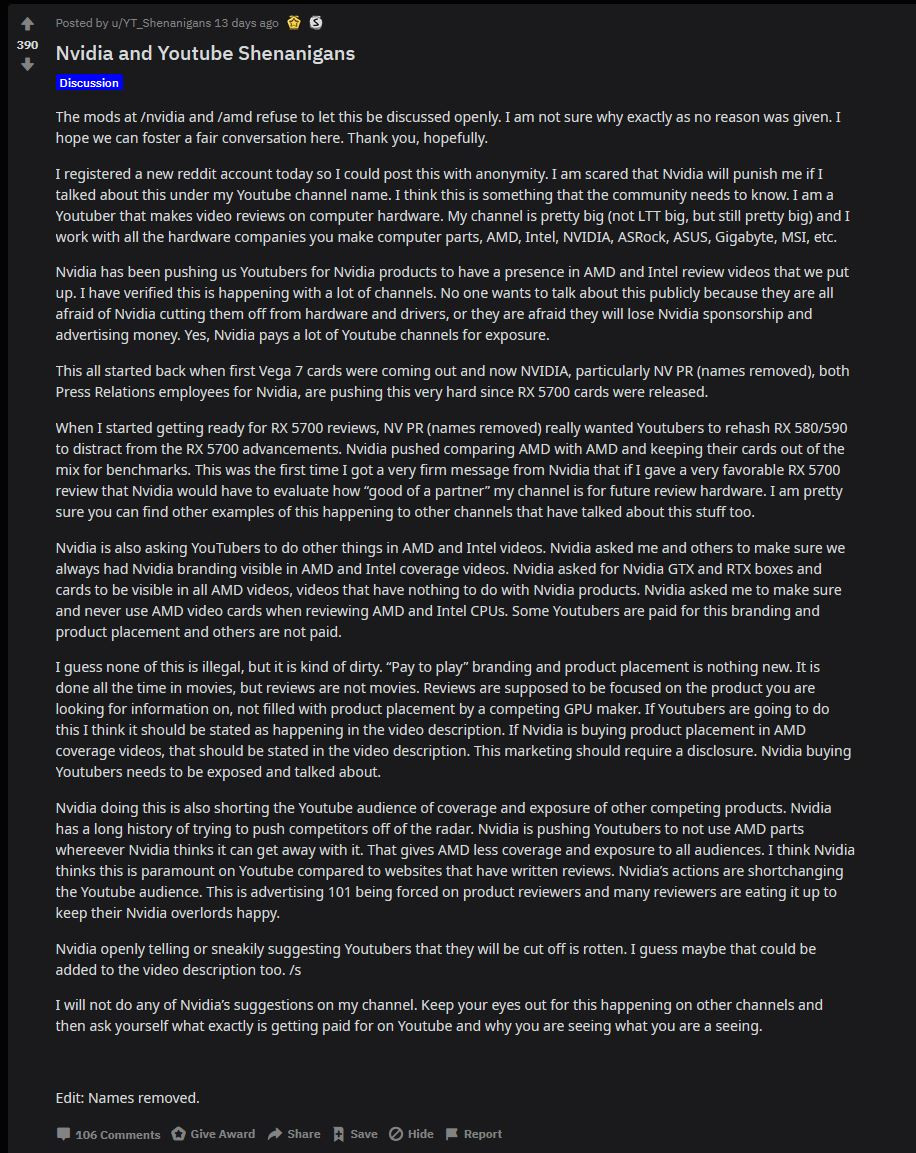
The whistleblower describes NVIDIA's influence over RX 5700-series reviews as follows:
When I started getting ready for RX 5700 reviews, NV PR (names removed) really wanted YouTubers to rehash RX 580/590 to distract from the RX 5700 advancements. NVIDIA pushed comparing AMD with AMD and keeping their cards out of the mix for benchmarks. This was the first time I got a very firm message from NVIDIA that if I gave a very favorable RX 5700 review that NVIDIA would have to evaluate how "good of a partner" my channel is for future review hardware. I am pretty sure you can find other examples of this happening to other channels that have talked about this stuff too.It's alleged that two specific people in NVIDIA PR "handle" YouTube-based journalists. Their influence goes back to the Radeon Vega days (mid-2017), when NVIDIA enjoyed a domination over the market. "This all started back when first Vega 7 cards were coming out and now NVIDIA, particularly NV PR (names removed), both Press Relations employees for NVIDIA, are pushing this very hard since RX 5700 cards were released," they write.
NVIDIA is also pushing for unpaid and sometimes paid product-placement of its reference GeForce RTX and GeForce GTX product boxes on the shelves of reviewers when reviewing AMD and Intel products. "NVIDIA is also asking YouTubers to do other things in AMD and Intel videos. NVIDIA asked me and others to make sure we always had NVIDIA branding visible in AMD and Intel coverage videos. NVIDIA asked for NVIDIA GTX and RTX boxes and cards to be visible in all AMD videos, videos that have nothing to do with NVIDIA products. NVIDIA asked me to make sure and never use AMD video cards when reviewing AMD and Intel CPUs. Some YouTubers are paid for this branding and product placement and others are not paid," they write.
On several YouTube videos, rows of GeForce RTX boxes in the field of view with content related to AMD products are hard to miss. Find examples of these videos yourself. Product placements are a reality, and need not affect the credibility of the reviewer making the content. It's entirely possible that the YouTubers merely want to flaunt their collection of hardware, as the "garage" or "mancave" aesthetic is popular with the PC enthusiast crowd that's relies on DIY (purchasing components and assembling powerful computers with them).
We are yet to find examples of the bigger allegation, that of NVIDIA micro-managing RX 5700-series reviews, but a good place to start would be any exclusive comparison between the $350 RX 5700 and the $400 RTX 2060 SUPER while not comparing the latter to the $400 RX 5700 XT; or worse, comparing the $400 RX 5700 XT to the $500 RTX 2070 SUPER. The whistleblower alleges that some YouTubers have even been influenced to completely keep NVIDIA cards off their comparisons, and pit the RX 5700 against older AMD hardware.
A way forward is being proposed for YouTubers by the whistleblower: full-disclosure in the description. "I guess none of this is illegal, but it is kind of dirty. "Pay to play" branding and product placement is nothing new. It is done all the time in movies, but reviews are not movies. Reviews are supposed to be focused on the product you are looking for information on, not filled with product placement by a competing GPU maker. If YouTubers are going to do this I think it should be stated as happening in the video description. If NVIDIA is buying product placement in AMD coverage videos, that should be stated in the video description. This marketing should require a disclosure. NVIDIA buying YouTubers needs to be exposed and talked about."
Here's the full text of the post on Reddit: