Movies BLADE RUNNER 2049 Thread v.2

If you have seen BLADE RUNNER 2049, how would you rate it?


  • Total voters
    216
That's what I understand from these movies too. Replicants are genetically engineered humans.

Which is why the discussion about the nature of Deckard is kinda missing the point...or rather it's a pointless discussion.

But if this is true it begs the question:
Why is Wallace having so much trouble making them fertile?
I just don't think Wallace is the genius Tyrell was. He's Jobs to Tyrell's Woz.
I get the impression that Rachel was Tyrell's magnum opus, and was one of a kind. I'm sure he intended on living long enough to see if his experiment would "bear fruit", but he died and I think the blueprints for her design died with him, or, if not, in the 2020 Blackout.
 
After one viewing I certainly found it interesting but also I was kind of left thinking that more could have been done with it, the similarities to Her for example that obviously did that were pretty obvious. The typical "fade to black" inferred sex scene to me felt very out of place, I mean you don't especially have to show anything that graphic but it felt like a lot of buildup that didn't really lead to much dramatically.

I didn't even notice the fade to black. However that scene ended, it didn't sit strange with me when I saw it.

I'd say there was overlap with Her in that it looks at a relationship between a human (more or less) and purely technological AI. But Her was entirely a study of that subject, and went down alleys like exploring monogamy in general, and whether "cheating" is a problem at all if it doesn't take anything away from the "primary" relationship.

With BR2049, the effect of this relationship on Ryan Gosling's character arc is itself enough to justify the sideplot to me, but it also raised a few minor questions that didn't really come up in Her...

One thing I haven't really heard mentioned is the parallel between...

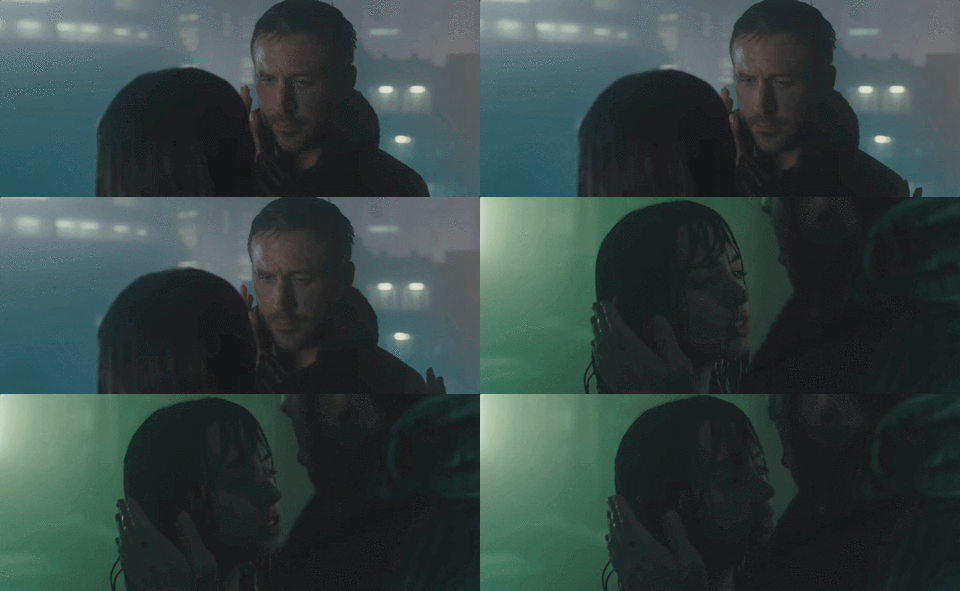
...Luv destroying Joi and Jared Leto killing that prototype Replicant in front of her. It seemed to me that Joi had her own arc, and was learning from Leto's example a little bit. As she saw Leto kill something lesser than him, she wanted to kill something lesser than her. And then the question raised is whether Joi was real at all, and if she felt fear and loss in those final moments, or if that was (essentially) just a highly advanced video game cut scene.
 
Joi is just a program. She is nothing like K, or Rachel, or Samantha from Her. She is just a fluffer and offers very superficial companionship.
This was made pretty clear a couple of times. The first time was when the hooker Replicant told her she knew how shallow her OS was.

Joi dying was no more tragic than your PS2 dying. There was no real romance, no real loss. Realizing that was also what helped K decide to go the other way on the cults request that he kill Deckard (I think; have to pay closer attention to that on the second viewing).

Are we still going with spoilers?

I'm not quite sure what to take from that scene myself on one had it shows Joi's intended nature revealed yet that obviously differs very significantly from the interaction K had with her. What would the motivation be behind him realising her limitations and then desiding not to kill Deckard?

The whole thing just felt rather indistinct to me and again lacking in depth. By that I don't automatically mean it would have to show a stronger connection between them, that she was ultimately unable to give that is certainly an interesting direction to take things but that could equally have been made more dramatically impactful IMHO.
 
Last edited by a moderator:
I didn't even notice the fade to black. However that scene ended, it didn't sit strange with me when I saw it.

I'd say there was overlap with Her in that it looks at a relationship between a human (more or less) and purely technological AI. But Her was entirely a study of that subject, and went down alleys like exploring monogamy in general, and whether "cheating" is a problem at all if it doesn't take anything away from the "primary" relationship.

With BR2049, the effect of this relationship on Ryan Gosling's character arc is itself enough to justify the sideplot to me, but it also raised a few minor questions that didn't really come up in Her.]

I spose it does really go back to what I think are the fundamentally different natures of the original film and 2049. The former was I would argue actually more similar to something like Her in that reguard, obviously big differences in terms of plotting but the focus was very much on a handful of characters(Deckard, Rachael, Roy) dramatic arcs, the plot such as it is was incredible simple. 2049 to me though felt more akin to something like say Minority Report(albeit not as heavy on the schmaltz ending), an action thriller much more focused on a complex plot unfolding.

Really that's what still makes the original so unique to me, its one of the very few examples(2001 being another) of a large scale Hollywood budget being used to create an arthouse film. Not that 2049 isn't artier than your average blockbuster of course but I think its still naturally closer to them.
 
Last edited by a moderator:
Are we still going with spoilers?

I'm not quite sure what to take from that scene myself on one had it shows Joi's intended nature revealed yet that obviously differs very significantly from the interaction K had with her. What would the motivation be behind him realising her limitations and then desiding not to kill Deckard?

The whole thing just felt rather indistinct to me and again lacking in depth. By that I don't automatically mean it would have to show a stronger connection between them, that she was ultimately unable to give that is certainly an interesting direction to take things but that could equally have been made more dramatically impactful IMHO.
It's Wednesday so we can stop using spoilers. K went from thinking he was special and a real boy with a real relationship to realizing it was all a lie, but that there was a special person out there, and, just like his horse, he was willing to risk himself so that she could be happy/safe.
 
I spose it does really go back to what I think are the fundamentally different natures of the original film and 2049. The former was I would argue actually more similar to something like Her in that reguard, obviously big differences in terms of plotting but the focus was very much on a handful of characters(Deckard, Rachael, Roy) dramatic arcs, the plot such as it is was incredible simple. 2049 to me though felt more akin to something like say Minority Report(albeit not as heavy on the schmaltz ending), an action thriller much more focused on a complex plot unfolding.

Really that's what still makes the original so unique to me, its one of the very few examples(2001 being another) of a large scale Hollywood budget being used to create an arthouse film. Not that 2049 isn't artier than your average blockbuster of course but I think its still naturally closer to them.
He realized it was fake and that he actually lost nothing. He decides to go back because it gives his life meaning.
 
I agree with that.


The main difference between Theodore/Samantha vs K/Joi is HER is about relationships and 2049 is about the self.

giphy.gif


Joi represents K's soul -- what he thinks, what he wants, who he is inside, and why we like him. K is who he is to everyone else; but when he's with Joi he is himself. He knows she's only a program and he reminds us of this when he offers her a cup of coffee or tells her to buckle up; there's always the ironic smile. He knows he's eating bland noodles and that she's nothing but laser beams, but the variety is enough for him. It also allows him the illusion of choice, and the illusion of a life. Her tragedy is his tragedy: discovering that he is Joi.

maxresdefault.jpg


giphy.gif

Discovering he is not special, that he has been following a sort of programming the entire time. First his job, then his "dream," then the resistance, to finally the truth. Now, without Joi, he is faced with having to make a choice. A real one. Not just laser beams.

It is at this point he is born, because here he finally makes his own decision based on the truth.

That's the importance of Joi and her demise and the in-story realization she isn't anything more than her programming. But as @europe1 mentioned earlier -- at the same time she is more than her programming .... to K, which gets into the Truth vs Meaning. It's the whole replicant metaphor: does it really matter if you're not real?

What's great about the last act is even though we believe in the goodness of Ryan Gosling, we're not sure what K's intentions are until he commits to them. Even midway into the fight with Luv there's still that inkling K just might kill Deckard.

@Anung Un Rama: I was still saddened by Joi's death because while it's true she is basically a fluffer PS2, the time we spent with her built significance for me.

@moreorless87: Spike Jonze subverts the typical fade-to-black love scene in reframing it as virtual space in which Samantha develops into her own being; it's not really a fade because the black space means something. Their relationship is an exploration of what it means to be in relationship, expectation, attachment, etc. The 2049 scene doesn't have the same purpose, and it surprises me you would want to see more after the marvelous sync-sequence. I'm curious what more you would like to see there. The other function of that scene is to plant the tracking device.

@BisexualMMA: I didn't get too much of an arc to Luv, but I did like how subtly she moved at the beginning. I liked how she bristled when K mentioned with amusement that she was named, and then her furtive flirting.
 
Last edited:
I agree with that.


The main difference between Theordore/Samantha vs K/Joi is HER is about relationships and 2049 is about the self.

Joi represents K's soul -- what he thinks, what he wants, who he is inside, and why we like him. He knows she's only a program and he reminds us of this when he offers her a cup of coffee or tells her to buckle up; there's always the ironic smile. Her tragedy is his tragedy: discovering that he is Joi.

maxresdefault.jpg


giphy.gif

Discovering he is not special, that he has been following a sort of programming the entire time. First his job, then his "dream," then the resistance, to finally the truth.

It is at this point he is born, because here he finally makes his own decision based on the truth.

That's the importance of Joi and her demise and the in-story realization she isn't anything more than her programming. But as @europe1 mentioned earlier -- at the same time she is more than her programming .... to K, which gets into the Truth vs Meaning. It's the whole replicant metaphor: does it really matter if you're not real?

What's great about the last act is even though we believe in the goodness of Ryan Gosling, we're not sure what K's intentions are until he commits to them. Even midway into the fight with Luv there's still that inkling K just might kill Deckard.

@Anung Un Rama: I was still saddened by Joi's death because while it's true she is basically a fluffer PS2, the time we spent with her built significance for me.

@moreorless87: Spike Jonze subverts the typical fade-to-black love scene in reframing it as virtual space in which Samantha develops into her own being; it's not really a fade because the black space means something. Their relationship is an exploration of what it means to be in relationship, expectation, attachment, etc. The 2049 scene doesn't have the same purpose, and it surprises me you would want to see more after the marvelous sync-sequence. I'm curious what more you would like to see there. The other function of that scene is to plant the tracking device.

@BisexualMMA: I didn't get too much of an arc to Luv, but I did like how subtly she moved at the beginning. I liked how she bristled when K mentioned with bemusement that she was named, and then her furtive flirting.

Outstanding insight per usual.

I too was saddened real time for Joi & K, but when I realized that it was just the illusion of love (at the same time K did), and that he was just being placated, I no longer felt anything for Joi's character. I did still felt bad for K, because, real or not, he thought he loved her. I think we've all been der, and I'm not just talking about Mjoll the Lioness from Skyrim.
 
It's Wednesday so we can stop using spoilers. K went from thinking he was special and a real boy with a real relationship to realizing it was all a lie, but that there was a special person out there, and, just like his horse, he was willing to risk himself so that she could be happy/safe.

That seems a bit of an iffy link to me, the choice wasn't to keep Deckards daughter safe but actually the reverse, to put her at risk but allow her to see her father, his own relationship being "fake" seems like a strange motivator there, especially as he ultimately ends up taking revenge on Luv who "killed" her.

Surely he would have known Joi's nature before that point as well? it just seems to me that the whole thing would have been far better served by having this revealed in his interaction with her, that doesn't mean the relationship needs to go the same direction as Her but actually having her limited nature shown and him react to it would for me have been far more effective than what we got.

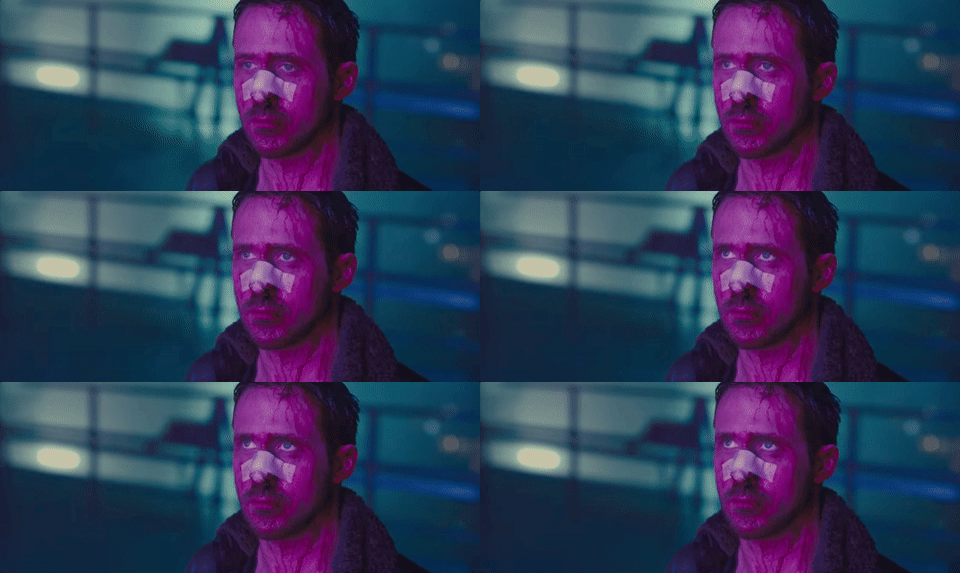
I'm judging by high standards here due to the Bladerunner name and those involved but honestly I did feel like Gosling was somewhat wasted. In Drive he gives a terrific performance, stoic but obviously showing repressed emotion, here though I honestly think he verges on dull at points with simply not enough reaction to his position
 
The difference of course is gosling is playing a replicant whose entire purpose is singular. Any emotional deviation in public is a sign he might be defective, and needs termination.


In drive, he was a top autist trying to be a tough guy
 
The difference of course is gosling is playing a replicant whose entire purpose is singular. Any emotional deviation in public is a sign he might be defective, and needs termination

As with Joi this to for me is really not pushed as hard as I think it could have been, the idea that K is having to keep a lid on his emotions to avoid termination just didn't seem to be explored much at all, I never really got the sense of the character being under tension to do so or letting his hair down outside of that environment.
 
Again I think it is strangely ironic that Villeneuve ended up directing this film as I would argue part of what made him stand out previously is that he's one of the few modern sci fi directors who does not owe an obvious debt to early Ridley Scott in his style. The likes of Duncan Jones, Gareth Edwards, Rupert Sanders, etc all seem to draw pretty heavily on him for me where as Villeneuve has a much more minimalistic and harsh style.
 
I'm going to have to re-watch this film I was hammered drunk when I saw it and only caught 40%of he film and fell asleep.

the cinematography on that 40% was a masterpiece though.
 
@BisexualMMA: I didn't get too much of an arc to Luv, but I did like how subtly she moved at the beginning. I liked how she bristled when K mentioned with amusement that she was named, and then her furtive flirting.

Maybe I am looking for more in Luv than was there because otherwise the Jared Leto scenes and performance are just a pretentious annoyance to me. But I see Luv as going through something like a high school jilted lover sort of thing with adolescent emotions, condensed into her task as Wallace's heavy.

She went from eyes watering upon seeing a newborn replicant eviscerated, to mimicking that act by crushing Joi, a less real person than her. And I felt like Gosling's not being receptive to her flirtations and advances early on motivated her to pursue and try to kill him with a little extra passion that wouldn't have been there otherwise.

But, perhaps most of all, if Wallace wasn't killing that replicant in front of her as part of her development over the course of the movie, then it was mostly just Leto delivering a bunch of self-indulgent lines for the benefit of nobody but the audience...
 
Went and dusted off my Blade Runner collection to rewatch before heading out to see this. Enjoyed the new one quite a bit. Thought The Gos did a very good job, liked his supposed chosen one arc ending up with him just working as a vessel. Super adorable AI girl had some really good scenes. Movie looked great, still one of the cooler looking cityscapes even though the Blackout did leave the city much less dynamic. Liked it more than the original.

It was too long and like the first one had many LONG establishing shots that could be trimmed down.

I wonder how fast Felicity Jones was on the phone to find someone to bury Ana de Armas since having a cuter and younger version of you in Hollywood usually doesn't end well.
 
Back
Top