Economy Study: Middle Class Is Over

Enableists

You're a ruthless capitalist War Lord Palis. Empathizer* though. I've been at the bottom before, the safety net must exist.

There's levels to the "leftist" thing. ID politics without a class critique can suck my pink dong, don't care for multikulti at all (multiethnic yes), illegal immigration is illegal (you still treat people with human dignity), and I'm down with Trump's trade war and tech protectionism (in regards to China, not Allies). That isn't a crazed leftist, it's someone who cares about America and its future.

That includes the socioeconomic well-being of our citizens, if not first and foremost. There's far too much upward predistribution of wealth, the depth of inequality has approached 1929 levels, it isn't sustainable and it's going to cause serious societal discontent if it isn't corrected and that's going to be bad for everyone.
 
OTOH, at the same time...

Bloomberg: The US Social Safety Net Has Improved A Lot

ext


There’s a common misperception that the U.S. is the land of small government, where the poor receive little assistance. To many on the left, the U.S. is a uniquely bad actor, eschewing the enlightened social democracy of Western Europe and leaving the economically unfortunate to suffer. Those on the right tend to take a more positive view of the same notion, trumpeting the U.S.’s small welfare state as evidence of a commitment to free markets and self-reliance.

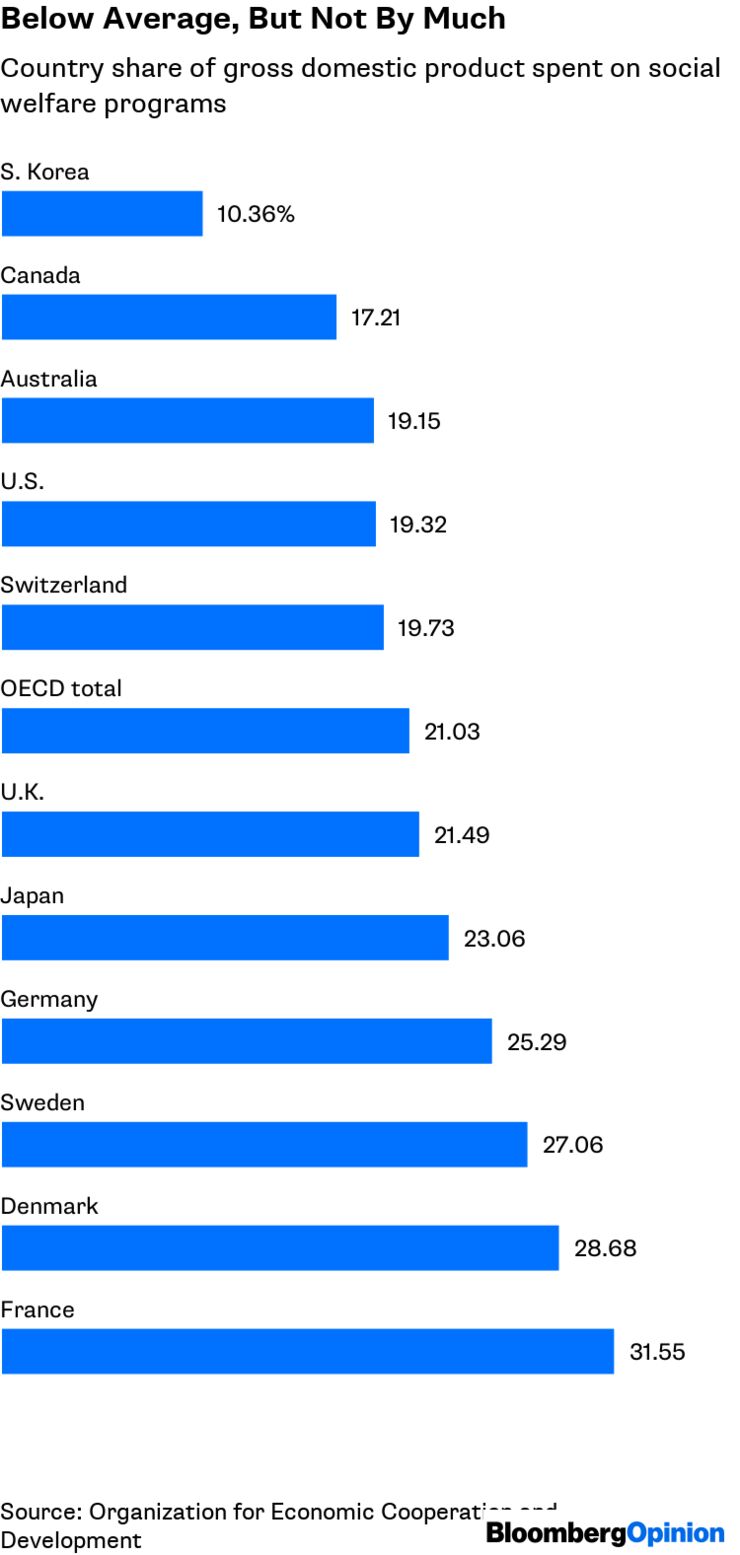
As with most myths, there is a grain of truth to the idea. With the repeal of the individual health-care mandate, the U.S. has returned to its status as one of the only developed countries not to provide some form of universal health care. The U.S. spends a bit less of its gross domestic product on social spending than the Organization for Economic Cooperation and Development as a whole:

740x-1.png


But already it’s apparent that the U.S.’s reputation as a bastion of cutthroat capitalism is exaggerated. Its social safety net is only a couple of percentage points below the OECD total, and larger than that of Canada, Australia and South Korea.

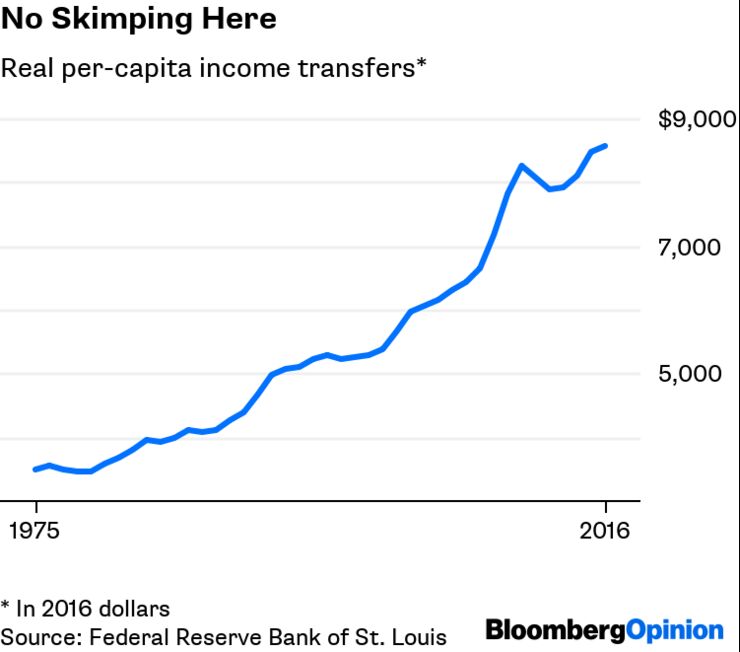
Furthermore, U.S. government transfers have been increasing over time. The U.S. system of taxation and spending has become more progressive during the past two decades. Per-capita government transfers were about $8,567 a person in 2016, up from about $5,371 at the turn of the century (adjusted for inflation) — an increase of 60 percent:

740x-1.png


The increasing generosity of the U.S. safety net in the 21st century began under President George W. Bush. Although mostly remembered for the war in Iraq, Bush in many ways fulfilled his promise to be a compassionate conservative. Major expansions of the Supplemental Nutrition Assistance Program, commonly known as food stamps, were carried out in 2002 and 2008.

Bush’s Medicare reform added prescription-drug benefits to the government’s premier health-care program. And Bush’s so-called housing-first policy reduced homelessness dramatically during his second term. Overall, real per-capita government transfers increased by about 38 percent during the eight years of the Bush administration.

Under President Barack Obama the pace of welfare expansion slowed a bit, probably as a result of the Great Recession. But it didn’t stop. Food stamps continued to expand, extended unemployment insurance helped many during the recession, and homelessness kept declining. Obama also implemented a number of tax credits for low-income families and passed the Affordable Care Act, which subsidizes health insurance.

After 16 years of expansions in the safety net under Republican and Democratic presidents alike, the U.S. has a much more robust welfare state than people seem to realize. The left-leaning Center on Budget and Policy Priorities, using the U.S. Census Bureau’s new comprehensive poverty measure, estimates that government transfers have driven child poverty to a record low. Thanks mostly to government aid, the number of American children in poverty has fallen from more than one in four in the early 1990s to about one in seven today.

Meanwhile, recent research shows that U.S. antipoverty programs are more effective than had been realized. In a new paper, the University of Chicago’s Bruce Meyer and Derek Wu analyze five major means-tested programs — Social Security, food stamps, public assistance, the earned income tax credit and housing assistance — in terms of how much they actually increase poor people’s income.
 
You are either rich or try to be rich. I dont want to be rich so i just hide down here with the peasants
 
OTOH, at the same time...

Bloomberg: The US Social Safety Net Has Improved A Lot

ext


There’s a common misperception that the U.S. is the land of small government, where the poor receive little assistance. To many on the left, the U.S. is a uniquely bad actor, eschewing the enlightened social democracy of Western Europe and leaving the economically unfortunate to suffer. Those on the right tend to take a more positive view of the same notion, trumpeting the U.S.’s small welfare state as evidence of a commitment to free markets and self-reliance.

As with most myths, there is a grain of truth to the idea. With the repeal of the individual health-care mandate, the U.S. has returned to its status as one of the only developed countries not to provide some form of universal health care. The U.S. spends a bit less of its gross domestic product on social spending than the Organization for Economic Cooperation and Development as a whole:

740x-1.png


But already it’s apparent that the U.S.’s reputation as a bastion of cutthroat capitalism is exaggerated. Its social safety net is only a couple of percentage points below the OECD total, and larger than that of Canada, Australia and South Korea.

Furthermore, U.S. government transfers have been increasing over time. The U.S. system of taxation and spending has become more progressive during the past two decades. Per-capita government transfers were about $8,567 a person in 2016, up from about $5,371 at the turn of the century (adjusted for inflation) — an increase of 60 percent:

740x-1.png


The increasing generosity of the U.S. safety net in the 21st century began under President George W. Bush. Although mostly remembered for the war in Iraq, Bush in many ways fulfilled his promise to be a compassionate conservative. Major expansions of the Supplemental Nutrition Assistance Program, commonly known as food stamps, were carried out in 2002 and 2008.

Bush’s Medicare reform added prescription-drug benefits to the government’s premier health-care program. And Bush’s so-called housing-first policy reduced homelessness dramatically during his second term. Overall, real per-capita government transfers increased by about 38 percent during the eight years of the Bush administration.

Under President Barack Obama the pace of welfare expansion slowed a bit, probably as a result of the Great Recession. But it didn’t stop. Food stamps continued to expand, extended unemployment insurance helped many during the recession, and homelessness kept declining. Obama also implemented a number of tax credits for low-income families and passed the Affordable Care Act, which subsidizes health insurance.

After 16 years of expansions in the safety net under Republican and Democratic presidents alike, the U.S. has a much more robust welfare state than people seem to realize. The left-leaning Center on Budget and Policy Priorities, using the U.S. Census Bureau’s new comprehensive poverty measure, estimates that government transfers have driven child poverty to a record low. Thanks mostly to government aid, the number of American children in poverty has fallen from more than one in four in the early 1990s to about one in seven today.

Meanwhile, recent research shows that U.S. antipoverty programs are more effective than had been realized. In a new paper, the University of Chicago’s Bruce Meyer and Derek Wu analyze five major means-tested programs — Social Security, food stamps, public assistance, the earned income tax credit and housing assistance — in terms of how much they actually increase poor people’s income.

Interesting read.

I would argue that a significant portion of that increase is effectively corporate welfare in the form of an unlivable minimum wage which requires government support to enable them to work.
 
I don't know why some people struggle so hard with the concept that wages aren't keeping up with inflation. And the employment stats are lies. Because they count all these jobs that don't pay people shit, or under employ people.

Anyone middle class or below has known this is the case for decades.
 
That “study” sounds like some hot bullshit to me.


The economy here, a decidedly middle class city is kicking ass.
 
OTOH, at the same time...

Bloomberg: The US Social Safety Net Has Improved A Lot

ext


There’s a common misperception that the U.S. is the land of small government, where the poor receive little assistance. To many on the left, the U.S. is a uniquely bad actor, eschewing the enlightened social democracy of Western Europe and leaving the economically unfortunate to suffer. Those on the right tend to take a more positive view of the same notion, trumpeting the U.S.’s small welfare state as evidence of a commitment to free markets and self-reliance.

As with most myths, there is a grain of truth to the idea. With the repeal of the individual health-care mandate, the U.S. has returned to its status as one of the only developed countries not to provide some form of universal health care. The U.S. spends a bit less of its gross domestic product on social spending than the Organization for Economic Cooperation and Development as a whole:

740x-1.png


But already it’s apparent that the U.S.’s reputation as a bastion of cutthroat capitalism is exaggerated. Its social safety net is only a couple of percentage points below the OECD total, and larger than that of Canada, Australia and South Korea.

Furthermore, U.S. government transfers have been increasing over time. The U.S. system of taxation and spending has become more progressive during the past two decades. Per-capita government transfers were about $8,567 a person in 2016, up from about $5,371 at the turn of the century (adjusted for inflation) — an increase of 60 percent:

740x-1.png


The increasing generosity of the U.S. safety net in the 21st century began under President George W. Bush. Although mostly remembered for the war in Iraq, Bush in many ways fulfilled his promise to be a compassionate conservative. Major expansions of the Supplemental Nutrition Assistance Program, commonly known as food stamps, were carried out in 2002 and 2008.

Bush’s Medicare reform added prescription-drug benefits to the government’s premier health-care program. And Bush’s so-called housing-first policy reduced homelessness dramatically during his second term. Overall, real per-capita government transfers increased by about 38 percent during the eight years of the Bush administration.

Under President Barack Obama the pace of welfare expansion slowed a bit, probably as a result of the Great Recession. But it didn’t stop. Food stamps continued to expand, extended unemployment insurance helped many during the recession, and homelessness kept declining. Obama also implemented a number of tax credits for low-income families and passed the Affordable Care Act, which subsidizes health insurance.

After 16 years of expansions in the safety net under Republican and Democratic presidents alike, the U.S. has a much more robust welfare state than people seem to realize. The left-leaning Center on Budget and Policy Priorities, using the U.S. Census Bureau’s new comprehensive poverty measure, estimates that government transfers have driven child poverty to a record low. Thanks mostly to government aid, the number of American children in poverty has fallen from more than one in four in the early 1990s to about one in seven today.

Meanwhile, recent research shows that U.S. antipoverty programs are more effective than had been realized. In a new paper, the University of Chicago’s Bruce Meyer and Derek Wu analyze five major means-tested programs — Social Security, food stamps, public assistance, the earned income tax credit and housing assistance — in terms of how much they actually increase poor people’s income.

How badly are you spending that money to be spending MORE than Canada, and getting absolutely nothing? <{walkerwhut}>

Canada: Single-payer healthcare, cheap universities, cheap daycare, maternity + paternity leave, school supplies subsidies, cash welfare, generous pensions for elders, etc.

US: Lol, here's your 100$/month food card, idiot
 
Move farther from the city. I moved 15 miles out and saved 150k on a mortgage. Cities and city suburbs are not for the middle class anymore.
 
How badly are you spending that money to be spending MORE than Canada, and getting absolutely nothing? <{walkerwhut}>

Canada: Single-payer healthcare, cheap universities, cheap daycare, maternity + paternity leave, school supplies subsidies, cash welfare, generous pensions for elders, etc.

US: Lol, here's your 100$/month food card, idiot
The middle class and poor pay more for everything and get nothing so the super rich can get a tax cut, the Republican way.
 
How badly are you spending that money to be spending MORE than Canada, and getting absolutely nothing? <{walkerwhut}>

Canada: Single-payer healthcare, cheap universities, cheap daycare, maternity + paternity leave, school supplies subsidies, cash welfare, generous pensions for elders, etc.

US: Lol, here's your 100$/month food card, idiot
*Unless you work, in which case you automatically make too much for food stamps, housing benefits, or welfare. Unless you pop out kids like a moron.
 
The death of the middleclass coincided with the introduction of Republican style trickle down-supply side economics, just a coincidence?

It also coincided with automation, globalization, and a large, never ending influx of low wage immigrants
 
I'm buying some of that data, but I'd like to know the number of kids per household in relation to reporting financial hardships. Guess what? Kids are really fucking expensive. If you have a household income of less than 150K, maybe it's not smart to have 4 kids. My office does these charity drives twice a year where they pick a couple of low income families each time, and it always appears to be the same story: single mother (or two parents but one can't work), 6 kids, live in a 2 bedroom apartment, car is on its last legs, etc. It's heartbreaking, but I always think "Why in the fuck do you have 6 kids??" Everyone at my office is at least middle class, if not upper, management are 1%ers. Guess how many have more than 3 kids? Fucking zero, because it's piss-poor planning. And the fucking wage gap shit again the article references...yea, because men make it to upper management positions by rolling in at 9 and leaving as soon as the clock strikes 5. Fuck that. Every single person - man or woman - who's even mid management works minimum 50 hours/week. That's going to be extremely challenging with 3 kids, and basically impossible with more than that.

I'm not insensitive to the fact that wages haven't gone up in proportion to the price of housing, services and consumer goods. Something should be done there. But the reality is that too many kids will hold you back, and it's not fair to the kids either. You don't need to have 4, 5 or 6 kids. 2 is plenty to sap all your energy and attention, and if you're really feeling up to it, go for 3. Anything above that, like I said, poor planning.

EDIT: then there's also the fact that there are too many of us already. We don't need more, we need less. If everyone could just understand that, our governments would be forced to take a good hard look at their systems that stop functioning properly once the population levels off - or god forbid - starts to decline.

I agree, and in that case contraception should be free and easy to access, can you point this out to the religious morons to the south of you,thanks
 
It is tough when you have kids. I've got three. And you don't know how much it costs until you go through that stage in life. But despite the times of financial hardship, you've got to look at how God has entrusted you with raising them to know the truth about who they are, who God is and what he's done for us, and how raise them to be a man or a woman.
I would laugh so hard if they rebel by running off to join a rock band
 
Bernie all the way man. People just don't pay attention. This has been going on for years little by little.

I would vote for Bernie over Trump any day.

However, the main article highlights that the cost of healthcare is one of the main issues. Funny that with the Affordable Health Care Act, people are being pushed into food insecurity.

Kind of fucked up, considering the curve on the graphs for a company like Humana insurance, since the passing of Obama care.

From 1993 until 2004, it went up 10 dollars. Then it spiked to 80 during the height of the bubble that lead to the 2008 crash.

Then it crashed to 24 dollars. Since Obama care passed, it has risen to 334 dollars, a gain of almost 1400% lol.

Meanwhile, the Dow Jones went from about 6600 at the crash to now almost 26000, a growth of about 400%.

Why are healthcare companies growing at a rate 1000% more than the rest of the stock market?


edit: What I am getting at, is unless he can come out with an actual, tangible plan... Universal Health Care is not going to sell anyone that matters (Moderate voters).
 
Last edited:
America needs more illegal immigrants, and people with social justice degrees. That will fix everything.
 
Back
Top