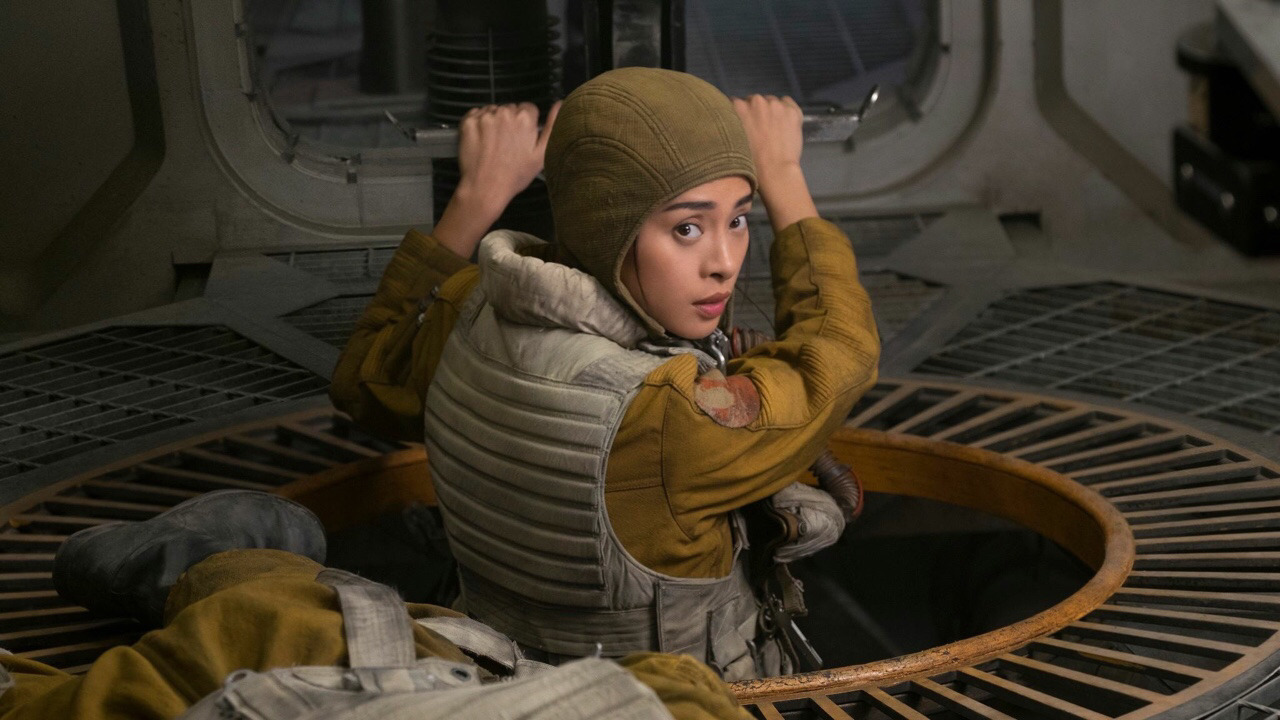
Actually some arc from being a cynical loner to committing to the cause by the end of the film by way of several well done dramatic climaxs rather than just showing competence beating badguys.
A mix of Luke and Han I would say, really it did show to me that stranght of the originals wasn't just having Jedi onscreen(as we saw with the prequels) but rather decent characters.
Jyn Erso unfolded a lot like Luke minus the Jedi stuff. Discovering a cause greater than herself.
I think ROGUE ONE had a very easy job, due to its familiar plot and trappings -- not to mention, most importantly, getting to use Darth Vader (who is, without a doubt, the main character of STAR WARS). With so much exposition already lined up for it, ROGUE ONE was free to explore more character moments, especially since none were meant to last.
I am still puzzled by what I'm hearing, but I might be mistaken. It sounds like you guys like Jyn because she's a lot like Luke, or Han. But I think you're referring more to the twists and turns she overcomes, rather than her personality. Personally I wasn't really all that impressed with Jyn, even though I really like ROGUE ONE. I never got that she wasn't committed to a cause; maybe I'm overlooking some element of resistance from that scene when Mon Mothma convinces her to go to Bodhi/Saw. Maybe there was a crucial moment when Cassian argues he could have killed her father but didn't.
As I recall she was always willing, and willing to keep going. I never got the sense she'd ever cut and run, and the only resistance she exhibited was either focused on her issues of abandonment or against the Rebellion's own passivity.
She was like all the other characters, who were decent people but ... well, rogues in their own way. While they do find it in themselves to commit to the central tragic cause, I never really doubted their resolve. The closest was Baze who started chanting "The Force is with me, I am one with the Force" after spending the entire film denigrating Chirrut for it.
When it comes to Rey, and definitely with Luke, I agree with moreorless87 TLJ had some tough ground to make up due to TFA. It wasn't TLJ who set Luke up to be missing for decades. TLJ was left to answer two things (among many): Not just a good explanation why Luke Skywalker of all people would hide away for so long but
also an equally good reason to return from self-exile. If someone can come up with something better than what went down, I'd really like to hear it. I won't hold my breath though. It's not easy coming up with a good reason a character goes against type, and then an even better reason for the character to return. Case in point: not many bought the joke scene with Luke tossing the lightsaber away. Mainly because we know our avatar for STAR WARS isn't going to rid himself of his symbolic weapon. It was too against type, and thus we realize it was done only for the joke of it. And some people were like "No way. " Not even one smile.
The suggestion that Rey should have closed this film with more ambiguity seems to overlook that throughout the movie Rey was conflicted. The entire time her path was ambiguous. She had the wrong idea about the Force, self-doubt, a yearning for answers, a penchant for darkness, she went from hair-trigger fight mode to empathizing with Kylo, from believing in the legend of Luke to risking herself to the dark side when his answers prove insufficient, to being ensnared inside a trap and when she comes out of it you think there's a new order in town (but nope -- which, btw, ends in a draw not Kylo's defeat), to finding it inside herself to carry on the Jedi principles without the contradictory strictures. While yes Rey starts off positive and ends positive, she was in the movie Changed through finding her voice and making her own decisions. And unlike Jyn, we don't know where she's going to go -- which makes her path more potentially exciting.
In case you're wondering about Finn's development -- Finn is a character who is inherently questionable. Not only is he formerly Empire he has a habit of doing his own thing (which often means leaving). The path of his narrative will be about going back and forth from the expectation
he will succumb to weakness (I have to get out of here, so my friend has someone to come back to) to the realization
he's made of steely resolve (Correction: "
Rebel Scum"). Throughout the course of TFA he cements his commitment to the Rebellion but his epiphany (the twist) is that dying for the cause is the wrong way to go about it.