Movies Serious Movie Discussion

Uncut Gems (2019)
77c72df61e02d30dd72f560b48be525dbdf74121.jpg


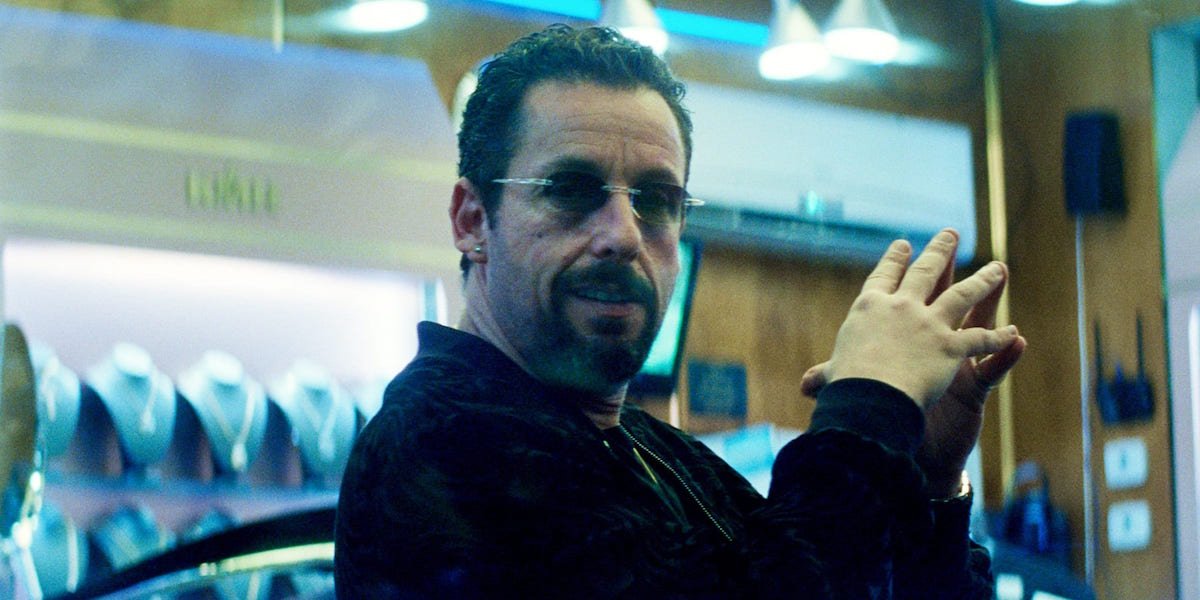
For almost the totality of it's run-time Uncut Gems is a protracted, anxiety-inducing assault on the senses. Adam Sandler is extremely impressive as Howard Ratner, a sleazy but sympathetic jeweller up to his neck in gambling debts. The film follows Ratner as he attempts to claw his way out of this hole and satisfy his loan-shark creditors. To this end he hatches a plan involving the sale of a rare Black Opal which he thinks will be his salvation... However, the circumstances Ratner has found himself in are clearly beyond his control. External forces, along with his own personal failings and compulsive gambling, leads to an increasingly desperate situation.

An excellent crime drama, full of psychological depth and told with punishing intensity.

Excellent cast in this one too. Sandler does an awesome job but really all the others too- Lakeith, Bogosian, Julia Fox, Judd Hirsch, Menzel- all of them deliver the type of performances where they essentially completely disappear into the character. It’s one of those films where it struck me that the actors were genuinely embodying characters that seemed like real people, whose personalities were showcased, warts and all.

For years, Sandler has been the type of guy who more or less just has an onscreen persona to the extent that any character is really interchangeable with the others he routinely plays, so it was refreshing to see him do something very different.

Really liked the gritty style of the Safdie brothers as well. I’ll look out for more of their work moving forward.
 
Parasite (2019)
25425-e1581309650194.jpg

A flawlessly crafted film, dense with meaning. Parasite looks at the gross inequality of the class system and the manner in which our lives are interwoven in arbitrary and intangible ways.

In Parasite, Bong Joo-ho satirizes the social norms of the upper-classes. In this respect, it might be seen in the same light as the work of Luis Buñuel. He portrays their concerns and social graces with the same sort of absurdity as something like The Exterminating Angel - "they are nice because they are rich". From the semi-basement of Ki-taek’s family (our poor, working-class protagonists) to the extravagant home of their rich employers it is a film about the differing levels of the class system. Even the house itself - situated in the hills high above the city, with its paradoxical staircases and basements - seems to mirror this theme.

Yet as much as the film deals with this inequality, Ki-taek's family are not merely some valiant, downtrodden working-class heroes. They are intelligent and resourceful in their own way, but also exploitative and self-centred. The Park's are rich, but have they personally done anything wrong? Of course, Bong is on the side of the working-class, but there is a degree of nuance and ambiguity which adds to the depth.

With this the film seems to question whether the Parasite is the working-class family encroaching into this extravagant home (much as their own semi-basement is infested by insects), or whether the Parasite is really the upper-class who enjoy their lifestyle by profiting off the labour of those they consider beneath them...

An excellent film, full of black humour along with shocking twists and turns.
 
Ali: Fear Eats The Soul (1974)
Ali-Fear-Eats-the-Soul-1600x900-c-default.jpg


"Emmi, a sixty-year-old German woman, falls in love with Ali, a Moroccan immigrant, twenty-five years her junior. The couple faces rejection from friends and this puts a strain on their relationship."

In many respects, Ali: Fear Eats The Soul plays out much like an old Hollywood melodrama. Individuals are characterized in an extremely theatrical, almost overwrought fashion. It is an extremely tender film, full of emotional resonance. After all it is a love story, albeit an unusual one. Yet, while it makes use of the trappings of melodrama, it's unflinching reflection on racial discrimination and social hostility enables it to transcend mere genre.

Everything in the film from it's visual language, to it's mise en scène, serves to emphasise the isolation of our two protagonists - whether social or emotional. The two lovers are able to find solace in one another, yet tragically this is both the cause of, and remedy for, their social ostracism and the petty injustices they face.

Extremely melancholic and bittersweet, it is ultimately still a beautiful, moving film which manages to end on a note of, if not happiness, then at least some degree of hope.
 
Excellent cast in this one too. Sandler does an awesome job but really all the others too- Lakeith, Bogosian, Julia Fox, Judd Hirsch, Menzel- all of them deliver the type of performances where they essentially completely disappear into the character. It’s one of those films where it struck me that the actors were genuinely embodying characters that seemed like real people, whose personalities were showcased, warts and all.

For years, Sandler has been the type of guy who more or less just has an onscreen persona to the extent that any character is really interchangeable with the others he routinely plays, so it was refreshing to see him do something very different.

Really liked the gritty style of the Safdie brothers as well. I’ll look out for more of their work moving forward.
If I didn't know any better, I would have guessed Uncut Gems was an Abel Ferrara movie.
 
Lads....was out for dinner last night, and Robert Eggers was literally sitting at the table beside me talking about the next film, about The Witch, The Lighthouse etc. On the way out I was just like "...sorry to disturb but love your work!!", he looked slightly taken aback but think I just startled him haha.
 
Last edited:
The Lighthouse (2019)
lighthouse-1.jpg


Following up The Witch was never going to be an easy task, but Eggers has done it again with this brilliantly mad, delirious tale of maritime horror. I absolutely loved it. The bare outline of the story is that of two men - one older, one younger - who become trapped on a remote island outpost in the 1890s. This at least is actually inspired by a real incident known as the Smalls Lighthouse Tragedy, which happened off the coast of Wales at the beginning of the 19th century. Eggers takes some of the ideas suggested by such a tale - the psychological impact of this remote setting - and develops it into something much, much weirder. The Lighthouse follows the two men as they struggle to contend with the island, with the profound isolation and with themselves. Tom Wake (Dafoe) is a craggy auld former seaman with a gammy leg, and the the man in charge of his junior 'wickie', Ephraim Winslow (Pattinson). For his part, Winslow is a hard-working, straight-faced ex-logger with an ambiguous past. Wake spends much of the film giving orders to Winslow, who toils away at all the manual tasks which need attended to on the island. All the while Wake warily guards The Light itself. Within this bleak and claustrophobic space, the relations between the two men are already strained, but it soon becomes clear that something mysterious is going on. As the film goes on Wake and Winslow slip further and further into madness....

Eggers is a master of mood and atmosphere and The Lighthouse perfectly captures the salty, windswept earthiness of this remote Nova Scotian outpost. This is greatly helped by the cinematography. Shot in black and white on old analog cameras and making use of a 1.19:1 aspect ratio, it feels old and primitive. The aspect ratio and nautical setting made me think of Bait (2019) which is an interesting crossover, clearly both directors were aiming for a similarly aged effect. Of course, it also deliberately harks back to older black and white films as a result...I am particularly thinking of the likes of Bergman's Persona (1966) (there are certainly some interesting thematic/psychological parallels there too), or other Bergman films, as well as early horror films like Nosferatu (1921) and Vampyr (1932). The cinematography also serves to emphasise and enhance the claustrophobia of the plot. It was a very effective and inspired choice in my opinion. At this point the incredibly creepy and unsettling score should also be praised as well.

Thematically there is a lot to unpack in The Lighthouse, although it is extremely ambiguous. Naturally this will be off putting to a lot of people (I suspect @Bullitt68 will not be/was not a fan), but I was thoroughly engaged with it. It is a strange, wonderful film which is equally dense in old maritime folklore, Jungian archetypes, psychology, and ancient mythology. Indeed, it has a very elemental, folkloric vibe in general - something which fascinates me. In this respect it is definitely a fitting follow-up to The Witch. And I would be remiss if I didn't mention the spectacular performances from both Dafoe and Pattinson.

@MoiraL7 let's actually discuss then, if you would like. Your main issue is with the ending then yes?
 
Ok, yawn. Clearly not someone who is actually interested in a discussion. Work away big lad.
each of your replies could have been spent justifying the lightbulb ending

I don't see you saying anything
 
Ok, yawn. Clearly not someone who is actually interested in a discussion

Eggers is a master of mood and atmosphere and The Lighthouse perfectly captures the salty, windswept earthiness of this remote Nova Scotian outpost. This is greatly helped by the cinematography. Shot in black and white on old analog cameras and making use of a 1.19:1 aspect ratio, it feels old and primitive. The aspect ratio and nautical setting made me think of Bait (2019) which is an interesting crossover, clearly both directors were aiming for a similarly aged effect. Of course, it also deliberately harks back to older black and white films as a result...I am particularly thinking of the likes of Bergman's Persona (1966) (there are certainly some interesting thematic/psychological parallels there too), or other Bergman films, as well as early horror films like Nosferatu (1921) and Vampyr (1932). The cinematography also serves to emphasise and enhance the claustrophobia of the plot. It was a very effective and inspired choice in my opinion. At this point the incredibly creepy and unsettling score should also be praised as well.

Thematically there is a lot to unpack in The Lighthouse, although it is extremely ambiguous. Naturally this will be off putting to a lot of people (I suspect @Bullitt68 will not be/was not a fan), but I was thoroughly engaged with it. It is a strange, wonderful film which is equally dense in old maritime folklore, Jungian archetypes, psychology, and ancient mythology. Indeed, it has a very elemental, folkloric vibe in general - something which fascinates me. In this respect it is definitely a fitting follow-up to The Witch. And I would be remiss if I didn't mention the spectacular performances from both Dafoe and Pattinson.

I see you didn't go anywhere near distilling meaning out of the film other than to evoke its aesthetic parallels, kiddo

Everyone agrees it's a beautifully shot thing, that's not a particularly insightful observation to make. The real puzzle lies in the ending which bears zero resemblance to the welsh origin story.
 
each of your replies could have been spent justifying the lightbulb ending

I don't see you saying anything

I have already explained to you in literally my first reply to your question, but perhaps you didn't get the point. The film is deliberately ambiguous and mysterious - there are several ways to read the ending of the film from a mythological and metaphorical point of view. The most clear parallel obviously being between the myth of Prometheus (Ephraim/Pattinson) and the fire (The Light), Pattinson's character subsequently having his liver eaten by seagulls clearly mirrors this. Yet, that's just one element to it, there is so much there. It is a film which makes you think, makes you reflect. There is a lot to it which will reward multiple watches, as well as simply thinking about it. This is what makes it far more interesting than if they had took one single element - the cyclical suggestion - and spelled it out as the only answer. How would that have made it a better film in your eyes?
 
Last edited:
I see you didn't go anywhere near distilling meaning out of the film other than to evoke its aesthetic parallels, kiddo

Everyone agrees it's a beautifully shot thing, that's not a particularly insightful observation to make. The real puzzle lies in the ending which bears zero resemblance to the welsh origin story.

That's my review, who said it was a particularly insightful observation? Jesus wee man you are full of shite.

The welsh origin story bears resemblance to the film only in the most bare bones sense.
 
I would have personally liked to see
Dafoe lashed to the outside of the lighthouse tormenting Pattinson as he dangles
even if it wasn't the penultimate shot, but instead we got a bit of a lazy
axing, leaving him splayed unceremoniously on the floor out in the open, despite the burial attempt earlier. The killing loses its value when the body doesn't even bother the guy. It abandons the guilt parable Telltale Heart approach of its source to go somewhere else entirely

where does it decide to go instead?

mermaids and "sirens" drawing connotations to the "siren" of the light bulb itself
which isn't particularly deep considering you're dealing with characters who operated in isolation for the majority of their jobs. Pattinson comes from logging in deep woods, working the odd grueling lonely job, but we're supposed to sympathize with him feeling hallucinatory "loneliness" for the touch of a woman during a four week deployment. He does this type of isolated work all the time. Even if
the totem was cursing him to start losing it
he looks silly for showing signs of cracking before the storm hits. By messing with the timeline and suggesting he's corrupted by multiple fronts
the mermaid totem/the power dynamic/the gull curse/the magic 'moths to a flame' lightbulb/possible schizophrenia/storm deprivation/possible alcoholism
the plot doesn't really pack a solid punch in the direction of what unravels him enough to meditate on its corrupting influence
 
Lads....was out for dinner last night, and Robert Eggers was literally sitting at the table beside me talking about the next film, about The Witch, The Lighthouse etc. On the way out I was just like "...sorry to disturb but love your work!!", he looked slightly taken aback but think I just startled him haha.
Woah :eek:

This was in Belfast? He's there scouting locations perhaps?
 
so if the film had committed to its name reversal hints it could have
tied Pattinson to the "murdered Second" from earlier as an older version of himself: Dafoe, killing the next person stationed and basking naked in the lightbulb
 
That's my review, who said it was a particularly insightful observation? Jesus wee man you are full of shite.

The welsh origin story bears resemblance to the film only in the most bare bones sense.
I take you fully to task for blustering all that time in the other thread swearing you "already covered" the meaning behind the ending, only to come here and discover you barely unpacked this thing further than to demonstrate you know other black and white films this pays homage to.
 
I would have personally liked to see
Dafoe lashed to the outside of the lighthouse tormenting Pattinson as he dangles
even if it wasn't the penultimate shot, but instead we got a bit of a lazy
axing, leaving him splayed unceremoniously on the floor out in the open, despite the burial attempt earlier. The killing loses its value when the body doesn't even bother the guy. It' abandons the guilt parable Telltale Heart approach of its source to go somewhere else entirely

where does it decide to go instead?

mermaids and "sirens" drawing connotations to the "siren" of the light bulb itself
which isn't particularly deep considering you're dealing with characters who operated in isolation for the majority of their jobs. Pattinson comes from logging in deep woods, working the odd grueling lonely job, but we're supposed to sympathize with him feeling hallucinatory "loneliness" for the touch of a woman during a four week deployment. He does this type of isolated work all the time. Even if
the totem was cursing him to start losing it
he looks silly for showing signs of cracking before the storm hits. By messing with the timeline and suggesting he's corrupted by multiple fronts
the mermaid totem/the power dynamic/the gull curse/the magic mothstoaflame lightbulb/possible schizophrenia/storm deprivation/possible alcoholism
the plot doesn't really pack a solid punch in the direction of what unravels him enough to meditate on its corrupting influence

Ok, this seems like it could be the start of a discussion perhaps. I will say that in the SMD I wouldn't worry about spoilers (not as much discussion as we got a few years ago anyway, ever since the cursed sherdog movie club stole it's thunder and got it unstickied ). Just make sure you bold the film we are talking about, The Lighthouse and others will know to expect spoilers as we discuss.

It seems like you simply wanted a level of closure that the film is deliberately unwilling to provide. For me, the ending you are after, or the scene anyway of "Dafoe lashed to the outside of the lighthouse tormenting Pattinson as he dangles" would be more in keeping with the original Welsh inspiration, or indeed Poe. That would work if the film was solely operating on the level of a kind of murder-revenge tale which eventually drives Pattinson mad. Egger's tale is, I feel, a much more metaphorical tale. You say he abandons the source "to go somewhere else entirely", but that's the point...there were many different things which feed into the Lighthouse. He has already made a short film of The Tell-Tale Heart, it may have been an influence among many other things (along with the unfinished Light-House story that Max Eggers was originally attempting to finish), but it's not a literal adaption of that story. So I just think that's not a fair criticism, though of course you are welcome to say you would have preferred he went that route. But going somewhere else entirely is the point.

I also don't agree the end doesn't pack a punch. For much of the film we witness essentially the same scene over and over - the same dinner scene - intercut with Pattinson toiling away on the island. Yet the changes in the dinner reflect what is happening to Pattinson. At first, Pattinson is completely rational, doesn't want to take a drink or even indulge in the niceties. He simply wants to do his time and get off the island. Each time the dinner scene takes place there is increasing hints of a pyschological break, until eventually he drinks and it all goes to shit...Yet from the very beginning of the film, when he finds the scrimshaw figure, he begins to have deeply unsettling dreams of mermaids. We learn about his own emotional and psychological baggage later on, but the figure, the island and the Lighthouse itself clearly suggest something mysterious even beyond that. It is not simply that Pattinson breaks from some kind of psychological loneliness; yes the isolation and cabin fever is clearly an element, but that strikes me as an extremely reductive reading of the film to say that it is only the isolation. Whether it is his own brain tormented by the murder of the real Ephraim Winslow, or else genuine supernatural, mythical elements within the Lighthouse itself there is something else going on with his increasingly manic mental state. All this is of course exacerbated by being forced to work like a dog by Defoe's character - further themes of submission, indeed even of a sexual dominance almost... But it is a slow deterioration before the storm hits, there are strange things happening and things playing on his mind. Yet there is hope that it is only 4 weeks after all. That is, until they become trapped... The storm breaks everything wide open because suddenly they are trapped, and trapped without the hope that they will soon be relieved from their duty. He showed signs of breaking because of everything that was taking place, but he didn't crack because he only had to last for a bit. His steely veneer and refusal to drink was only that, a thin veneer which is soon destroyed. edit: and of course, the storm hits just after the seagull is killed...and killed by a sudden explosion of rage from Winslow, built up from his treatment by Defoe's character.

Like you rightly say there is a lot going in terms of what was the ultimate cause of this unravelling - "the mermaid totem/the power dynamic/the gull curse/the magic mothstoaflame lightbulb/possible schizophrenia/storm deprivation/possible alcoholism" - but for me this is a strength of Egger's work. I like the ambiguity, the mysteriousness. If everything was wrapped up neatly with one interpretation it would not be nearly as satisfying or as thought-provoking. Those are the psychological interpretations of Pattinson's character too (Jungian psychological is undoubtedly a theme) without even touching on the allegorical and mythological readings of the film.
 
Last edited:
I take you fully to task for blustering all that time in the other thread swearing you "already covered" the meaning behind the ending, only to come here and discover you barely unpacked this thing further than to demonstrate you know other black and white films this pays homage to.

Yawn. I take you fully to task for thinking you've improved the ending by rendering an overly literal version of the film. I've been enjoying discussing films and having back and forth in here for years, so either have a discussion or don't.

I already covered my problem with your ending, ie. a complete lack of interest.
 
so if the film had committed to its name reversal hints it could have
tied Pattinson to the "murdered Second" from earlier as an older version of himself: Dafoe, killing the next person stationed and basking naked in the lightbulb

And what would the point of that have been? Why would you find this more satisfying? To me, this is a completely reductive ending.
 
Back
Top