- Joined
- Jun 13, 2005
- Messages
- 66,602
- Reaction score
- 38,503
Based on leaks it's looking shaky for Intel. Here was my previous post on the leaks for AMD's upcoming processor specs which turned out to be entirely accurate. I've re-pasted the chart below:Intel looks to bounce back into CPU market.
At the same time I am looking to get something new for myself along with ram. My 11 year old i7 3820 served me well, never had problems with it but its finally time to move on.
I will be looking to get 24 cores 13900k. Not sure how future proof this is going to be but I will be looking for something to serve me for another 10+ years.
Thoughts?
https://forums.sherdog.com/posts/169098010/

Now compare the most recent leak for Intel's Raptor Lake which carried disappointing specs on the frequencies:
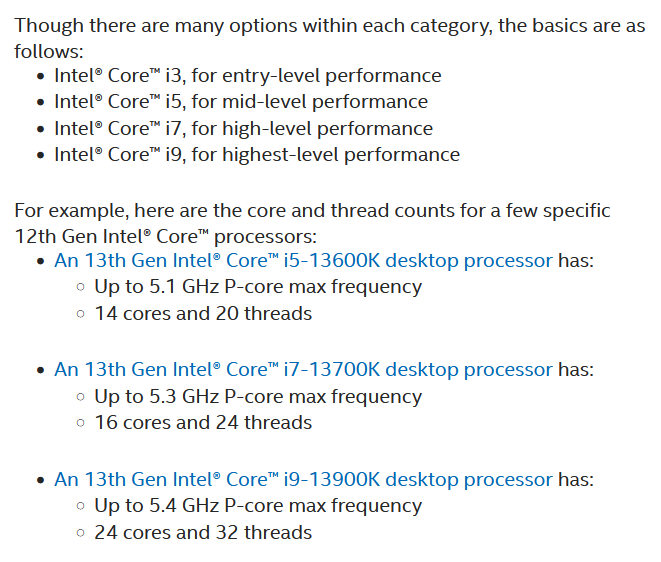
Extrapolating from the nature of the recent Alder Lake design, this means:
- i9-13900K = 8 power cores + 16 efficiency cores @5.4GHz turbo (up to 5.7GHz Turbo Boost 3.0; up to 5.8GHz TVB)
- i7-13700K = 8 power cores + 8 efficiency cores @5.3GHz turbo
- i5-13600K = 6 power cores + 8 efficiency cores @5.1GHz turbo
So let's look closer at the flagship 7950X and 13900K processors even though almost nobody will be buying those. I will designate what we have always traditionally called a "core" as a pC = power core, and the newer efficiency cores Intel is using as eC = efficiency cores. T = threads.
- 7950X = 16pC / 32T (4.4GHz base frequency; 5.1GHz all-core frequency; 5.7GHz single-core max frequency)
- 13900K = 8pC+16eC / 32T (3.0GHz base frequency; ?? all-core frequency; 5.7GHz single-core max frequency)
We don't know what the all-core frequency will be for Intel, but it will undoubtedly be far lower than 5.1GHz because the efficiency cores can't run at nearly as high a frequency. The trade-off is that there are more total cores, and since presently there are almost no games that will meaningfully benefit from such a high frequency past 8 cores, the Intels will still probably be okay, but the 10nm process's inferiority is showing in those base frequency figures even if we typically ignore those as gamers (3.0GHz vs. 4.4GHz despite having half the power cores is enormous). Their processors simply aren't as comfortable running at higher frequencies which is why this leak appears to indicate the Raptor Lake i9 will only have 8 power cores. It suggests Intel made this compromise in order to achieve higher frequencies. So it's a near certainty their processors will be less power efficient whether or not their many efficiency cores means the processors consume less total energy in most real-world compute tasks.
Because the Intel power cores might be able to run all-core at 5.4GHz, but I doubt that. Consistent with the turbo figure quoted in past generations, I suspect this figure conveys 5.4GHz will be the sustained peak of the top few cores while the other power cores run at a lower turbo. Finally, ignore the TVB for Intel. That lasts for fractions of a second. The peak single-core turbo for both processors appears to be ~5.7GHz based on leaks. So there's parity there.
Meaning, ultimately, the AMD processors appear capable of running at a much higher overall frequency across the entire chip despite having fewer cores. The i5 and i7 might find appeal among editors due to having so many more total cores than their counterparts, but don't expect them to win the gaming benchmarks in any class. And the 7900X or 7950X will be topping the gaming charts.