Tech Gaming Hardware discussion (& Hardware Sales) thread

Intel looks to bounce back into CPU market.

At the same time I am looking to get something new for myself along with ram. My 11 year old i7 3820 served me well, never had problems with it but its finally time to move on.

I will be looking to get 24 cores 13900k. Not sure how future proof this is going to be but I will be looking for something to serve me for another 10+ years.

Thoughts?
Based on leaks it's looking shaky for Intel. Here was my previous post on the leaks for AMD's upcoming processor specs which turned out to be entirely accurate. I've re-pasted the chart below:
https://forums.sherdog.com/posts/169098010/
full


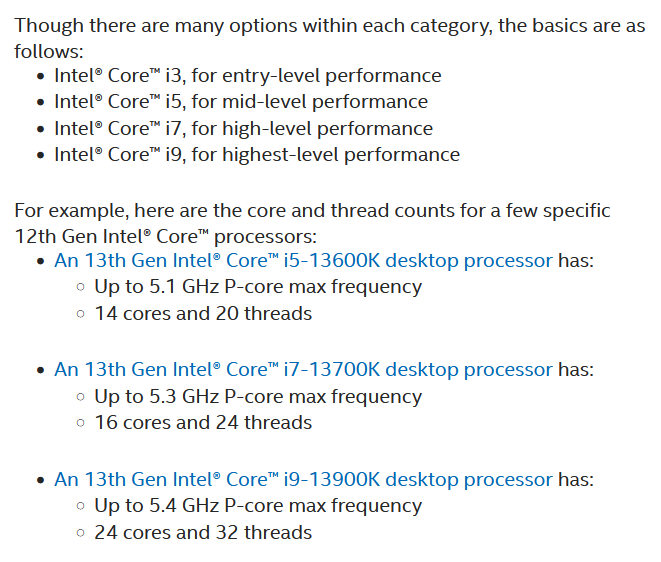
Now compare the most recent leak for Intel's Raptor Lake which carried disappointing specs on the frequencies:
Fcd3Jh9aUAA3_ai


Extrapolating from the nature of the recent Alder Lake design, this means:
  • i9-13900K = 8 power cores + 16 efficiency cores @5.4GHz turbo (up to 5.7GHz Turbo Boost 3.0; up to 5.8GHz TVB)
  • i7-13700K = 8 power cores + 8 efficiency cores @5.3GHz turbo
  • i5-13600K = 6 power cores + 8 efficiency cores @5.1GHz turbo

So let's look closer at the flagship 7950X and 13900K processors even though almost nobody will be buying those. I will designate what we have always traditionally called a "core" as a pC = power core, and the newer efficiency cores Intel is using as eC = efficiency cores. T = threads.
  • 7950X = 16pC / 32T (4.4GHz base frequency; 5.1GHz all-core frequency; 5.7GHz single-core max frequency)
  • 13900K = 8pC+16eC / 32T (3.0GHz base frequency; ?? all-core frequency; 5.7GHz single-core max frequency)

We don't know what the all-core frequency will be for Intel, but it will undoubtedly be far lower than 5.1GHz because the efficiency cores can't run at nearly as high a frequency. The trade-off is that there are more total cores, and since presently there are almost no games that will meaningfully benefit from such a high frequency past 8 cores, the Intels will still probably be okay, but the 10nm process's inferiority is showing in those base frequency figures even if we typically ignore those as gamers (3.0GHz vs. 4.4GHz despite having half the power cores is enormous). Their processors simply aren't as comfortable running at higher frequencies which is why this leak appears to indicate the Raptor Lake i9 will only have 8 power cores. It suggests Intel made this compromise in order to achieve higher frequencies. So it's a near certainty their processors will be less power efficient whether or not their many efficiency cores means the processors consume less total energy in most real-world compute tasks.

Because the Intel power cores might be able to run all-core at 5.4GHz, but I doubt that. Consistent with the turbo figure quoted in past generations, I suspect this figure conveys 5.4GHz will be the sustained peak of the top few cores while the other power cores run at a lower turbo. Finally, ignore the TVB for Intel. That lasts for fractions of a second. The peak single-core turbo for both processors appears to be ~5.7GHz based on leaks. So there's parity there.

Meaning, ultimately, the AMD processors appear capable of running at a much higher overall frequency across the entire chip despite having fewer cores. The i5 and i7 might find appeal among editors due to having so many more total cores than their counterparts, but don't expect them to win the gaming benchmarks in any class. And the 7900X or 7950X will be topping the gaming charts.
 
Based on leaks it's looking shaky for Intel. Here was my previous post on the leaks for AMD's upcoming processor specs which turned out to be entirely accurate. I've re-pasted the chart below:
https://forums.sherdog.com/posts/169098010/
full


Now compare the most recent leak for Intel's Raptor Lake which carried disappointing specs on the frequencies:
Fcd3Jh9aUAA3_ai


Extrapolating from the nature of the recent Alder Lake design, this means:
  • i9-13900K = 8 power cores + 16 efficiency cores @5.4GHz turbo (up to 5.7GHz Turbo Boost 3.0; up to 5.8GHz TVB)
  • i7-13700K = 8 power cores + 8 efficiency cores @5.3GHz turbo
  • i5-13600K = 6 power cores + 8 efficiency cores @5.1GHz turbo

So let's look closer at the flagship 7950X and 13900K processors even though almost nobody will be buying those. I will designate what we have always traditionally called a "core" as a pC = power core, and the newer efficiency cores Intel is using as eC = efficiency cores. T = threads.
  • 7950X = 16pC / 32T (4.4GHz base frequency; 5.1GHz all-core frequency; 5.7GHz single-core max frequency)
  • 13900K = 8pC+16eC / 32T (3.0GHz base frequency; ?? all-core frequency; 5.7GHz single-core max frequency)

We don't know what the all-core frequency will be for Intel, but it will undoubtedly be far lower than 5.1GHz because the efficiency cores can't run at nearly as high a frequency. The trade-off is that there are more total cores, and since presently there are almost no games that will meaningfully benefit from such a high frequency past 8 cores, the Intels will still probably be okay, but the 10nm process's inferiority is showing in those base frequency figures even if we typically ignore those as gamers (3.0GHz vs. 4.4GHz despite having half the power cores is enormous). Their processors simply aren't as comfortable running at higher frequencies which is why this leak appears to indicate the Raptor Lake i9 will only have 8 power cores. It suggests Intel made this compromise in order to achieve higher frequencies. So it's a near certainty their processors will be less power efficient whether or not their many efficiency cores means the processors consume less total energy in most real-world compute tasks.

Because the Intel power cores might be able to run all-core at 5.4GHz, but I doubt that. Consistent with the turbo figure quoted in past generations, I suspect this figure conveys 5.4GHz will be the sustained peak of the top few cores while the other power cores run at a lower turbo. Finally, ignore the TVB for Intel. That lasts for fractions of a second. The peak single-core turbo for both processors appears to be ~5.7GHz based on leaks. So there's parity there.

Meaning, ultimately, the AMD processors appear capable of running at a much higher overall frequency across the entire chip despite having fewer cores. The i5 and i7 might find appeal among editors due to having so many more total cores than their counterparts, but don't expect them to win the gaming benchmarks in any class. And the 7900X or 7950X will be topping the gaming charts.

In 2 weeks or so Intel will do official reveal. Hopefully soon after Passmark benches will appear. Then I will make up my mind I guess.
 
In 2 weeks or so Intel will do official reveal. Hopefully soon after Passmark benches will appear. Then I will make up my mind I guess.
FYI, that's not really how to use Passmark. Some of the earliest leaks sometimes show up on there, specifically with engineering samples, or even pre-review retail samples, and you can scrutinize that score, by studying the specific hardware and frequencies registered, but this isn't ideal for assessing gaming power. That isn't the strength of aggregate benchmark compilers like Passmark.

For gaming, the best comparison will come from reviewers comparing CPUs on the exact same test bench by benching a full suite of different, actual games.

For a general all-in-one benchmark, 3DMark's "3DMark 11 Physics Score" and the "Time Spy Extreme CPU Score" will offer more insight into general gaming power than Passmark, or any other benchmarks. 3DMark maintains a rankings chart for CPUs based on aggregate scores from real-world users with disparate setups, just as Passmark does, but also just like Passmark, this isn't reliable until at least several thousand samples have been compiled due to the variable nature of the other hardware in any user's setup:
https://benchmarks.ul.com/compare/b...E&reverseOrder=true&types=DESKTOP&minRating=0

And, if you are after a synthetic benchmark that tests these CPUs overall processing power more comprehensively than any other, that's SPEC2017. Look to Anandtech for those scores.
 
Well I just bought another RTX 3090Ti board for 1049.00. Unbelievable these cards where over 2 grand at peak.
 
Well I just bought another RTX 3090Ti board for 1049.00. Unbelievable these cards where over 2 grand at peak.

What do you do with all of these GPUs?
 
FYI, that's not really how to use Passmark. Some of the earliest leaks sometimes show up on there, specifically with engineering samples, or even pre-review retail samples, and you can scrutinize that score, by studying the specific hardware and frequencies registered, but this isn't ideal for assessing gaming power. That isn't the strength of aggregate benchmark compilers like Passmark.

For gaming, the best comparison will come from reviewers comparing CPUs on the exact same test bench by benching a full suite of different, actual games.

For a general all-in-one benchmark, 3DMark's "3DMark 11 Physics Score" and the "Time Spy Extreme CPU Score" will offer more insight into general gaming power than Passmark, or any other benchmarks. 3DMark maintains a rankings chart for CPUs based on aggregate scores from real-world users with disparate setups, just as Passmark does, but also just like Passmark, this isn't reliable until at least several thousand samples have been compiled due to the variable nature of the other hardware in any user's setup:
https://benchmarks.ul.com/compare/b...E&reverseOrder=true&types=DESKTOP&minRating=0

And, if you are after a synthetic benchmark that tests these CPUs overall processing power more comprehensively than any other, that's SPEC2017. Look to Anandtech for those scores.

https://wccftech.com/intel-core-i9-...ti-threaded-performance-decent-gaming-uplift/

Some gaming benchmarks are in. Can you draw some conclusions from that and compare with AMD?
 
How long is the delay (if any) typically between the release of Nvidia GPUs and their mobile laptop counterparts?

I know people are awaiting the release of the RTX 4000 series GPUs and I’ve heard the rumours that they’re possibly only going to release a 4090 to start, with 4080/70/60/50 (and Ti variants) to come out sometime after later down the road. Obviously no one knows what the release schedule.

Anyway, my question is how long after say a 4060 or 4070 releases would it take for the laptop versions of the 4060 or 4070 to come out.

Just trying to decide if I look at a picking up a gaming laptop with a 3060/3070/Ti now as opposed to waiting for a 4060/4070 but not if the desktop versions won’t come out for say 4-6 months from now and the laptop version to come out say a further 4-6 months after that.
 
https://wccftech.com/intel-core-i9-...ti-threaded-performance-decent-gaming-uplift/

Some gaming benchmarks are in. Can you draw some conclusions from that and compare with AMD?

Just wait until launch and watch independent reviews. Drivers and such can change multiple times before launch, even the day before.
Make sure to watch multiple reviews as well, sometimes there can be things that throw off numbers. An example would be the 8700k release. Jayz2cents and Linus had a lot higher numbers than Bitwit and Paul's Hardware. There was a setting in the mobo bios, I think it was multi-core enhancement, that made over a 1000 point difference in Cinebench.
 
Yea will wait and see, really im looking for something to future proof myself with. Had this CPU for the last 10 years, looking for something to last another 10 for reasonable price also.
 
https://wccftech.com/intel-core-i9-...ti-threaded-performance-decent-gaming-uplift/

Some gaming benchmarks are in. Can you draw some conclusions from that and compare with AMD?
I don't really see what is gained by more unreliable speculation than I've already offered above according to hardware pipelines & frequencies, especially when you won't be able to buy any of these CPUs before actual reviews are out.

So far, for Cinebench20, leaks have put the Zen 4 uplift at ~23%-29% over its Zen 3 predecessor series core-for-core: meaning for either single core or multi-core. Meanwhile, that Intel Raptor Lake leak put single core uplift at 12% while multicore uplift was a whopping 46% due to the higher number of total cores. Single core scores give us more insight into probable gaming performance, and Intel's are obviously far less impressive, but Raptor Lake's predecessor also held a significant advantage in single core performance on rendering tests like Cinebench over Zen 3, and as would be expected, also in gaming performance.

Looks a touch more promising for Intel's gaming performance than I would have estimated, but it doesn't change my expectations, and the power draw is just silly. Intel's just pushing the pedal into the red line.
 
$4090 Ti - $1699
$4090 - $1499 [confirmed]
$4080 Ti - $1099
$4080 - $899 [confirmed]
$4070 - $699 [confirmed]
 
I'm sitting on a 10GB 3080 so there'd need to be a lot of incentive to upgrade in this generation, especially when I mostly play 10+ year old games...

Let's see if the new and shiny gets me
 
Huh? How is anything confirmed yet?
I saw someone posted who is pretty reliable and said it will come in surprisingly lower then the previous generation RTX 3090. They said NVidia was good at locking in their manufacturing early on before the chip shortage for manufacturing them. They spent 7 billion upfront to secure production volume of them and now with eth mining going away they are going to be more aggressive in pricing. I am kinda bummed because I bought RTX 3090ti for only a little less they the higher performance 4090. He was the one who predicted a massive drop in price of the 30X0 board after it was announced that Etherium was moving away from mining. He point blank said GPU's will be on fire sale before the end of the year and hold off.
 
I saw someone posted who is pretty reliable and said it will come in surprisingly lower then the previous generation RTX 3090. They said NVidia was good at locking in their manufacturing early on before the chip shortage for manufacturing them. They spent 7 billion upfront to secure production volume of them and now with eth mining going away they are going to be more aggressive in pricing. I am kinda bummed because I bought RTX 3090ti for only a little less they the higher performance 4090. He was the one who predicted a massive drop in price of the 30X0 board after it was announced that Etherium was moving away from mining. He point blank said GPU's will be on fire sale before the end of the year and hold off.
The CEOs been known to change the price minutes before going on stage...
 
That's not what "confirmed" means, derp.
He said it was confirmed an it will be announced soon. AMD an Intel are pressing this move as they are concerned rightly so that people will not be buying 1999.00 cards.

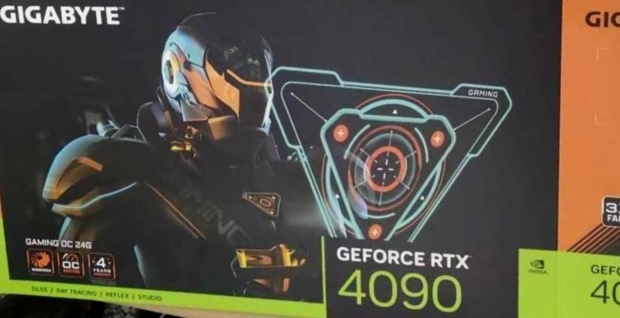
88436_03_gigabytes-new-geforce-rtx-4090-gaming-oc-spotted-ada-isnt-far-away.jpg
 
I know the XX90 is basically the new Titan now but $2k is ridiculous considering the original Maxwell Titan launched at $1k and that was only 7 years ago.
 
Back
Top