
-
Xenforo Cloud is upgrading us to version 2.3.8 on Monday February 16th, 2026 at 12:00 AM PST. Expect a temporary downtime during this process. More info here
You are using an out of date browser. It may not display this or other websites correctly.
You should upgrade or use an alternative browser.
You should upgrade or use an alternative browser.
Tech Gaming Hardware discussion (& Hardware Sales) thread
- Thread starter Madmick
- Start date


- Joined
- Aug 6, 2004
- Messages
- 19,055
- Reaction score
- 9,809
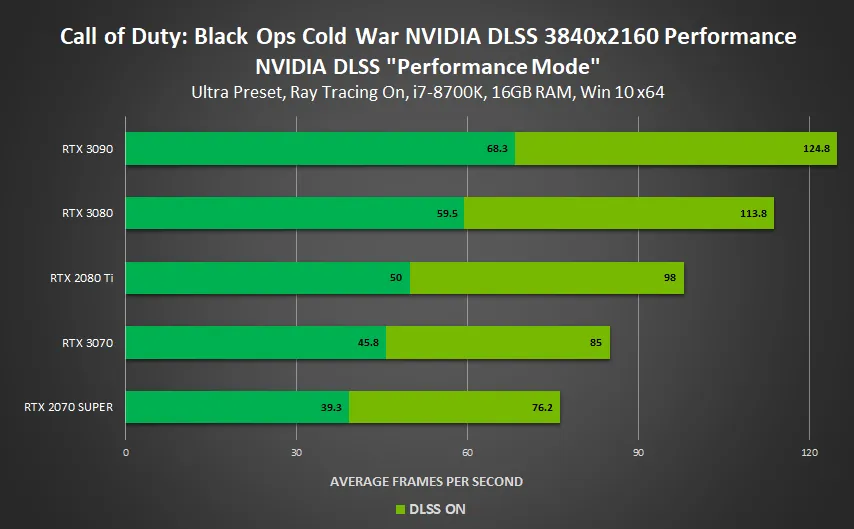
20 series aging like fine wine.


- Joined
- Sep 25, 2015
- Messages
- 24,404
- Reaction score
- 37,359
Add this to the mix
Based on how shitty those benchmarks look for Minecraft RTX I’m going to guess that Quake II RTX would be the same, if it even works at all on an RDNA 2 card.

- Joined
- Jun 13, 2005
- Messages
- 66,844
- Reaction score
- 38,941
*Sigh*. Keep in mind they're quoting the "Performance" modes (the fastest of three modes). In past testing the gains in "Quality" mode, the one that doesn't sacrifice graphical quality for higher framerates, the improvements have been ~1/3rd as great. Control averaged a 16% gain. More importantly, at a pace of 29 games added to the service per year (worse than where it was 2 months ago), maybe they'll mature from bucket mold to rotten cheese. Possibly the worst value generation of GPUs at launch in the past decade.20 series aging like fine wine.
It's helping, but the 20 series is still decidedly an inferior value to their RX 5000 series counterparts.

- Joined
- Jul 23, 2011
- Messages
- 34,972
- Reaction score
- 26,252
Benchmarks prove otherwise*Sigh*. Keep in mind they're quoting the "Performance" modes (the fastest of three modes). In past testing the gains in "Quality" mode, the one that doesn't sacrifice graphical quality for higher framerates, the improvements have been ~1/3rd as great. Control averaged a 16% gain. More importantly, at a pace of 29 games added to the service per year (worse than where it was 2 months ago), maybe they'll mature from bucket mold to rotten cheese. Possibly the worst value generation of GPUs at launch in the past decade.
It's helping, but the 20 series is still decidedly an inferior value to their RX 5000 series counterparts.


- Joined
- Nov 14, 2016
- Messages
- 4,657
- Reaction score
- 6,586
so i finally upgraded my old as shit Acer monitor to a 27" Curved Asus Gaming one. I know nothing about monitors, but the price looked right in my price range on what i wanted to spend and the specs seemed decent enough for me for the gaming i do:
165Hz (supports 144Hz, whatever that means. I know its refresh rate)
1ms Response Time
FreeSync
1920x1080
i just hope my rx580/1700x can push decent settings...
165Hz (supports 144Hz, whatever that means. I know its refresh rate)
1ms Response Time
FreeSync
1920x1080
i just hope my rx580/1700x can push decent settings...
- Joined
- Jun 13, 2005
- Messages
- 66,844
- Reaction score
- 38,941
Benchmarks prove otherwise

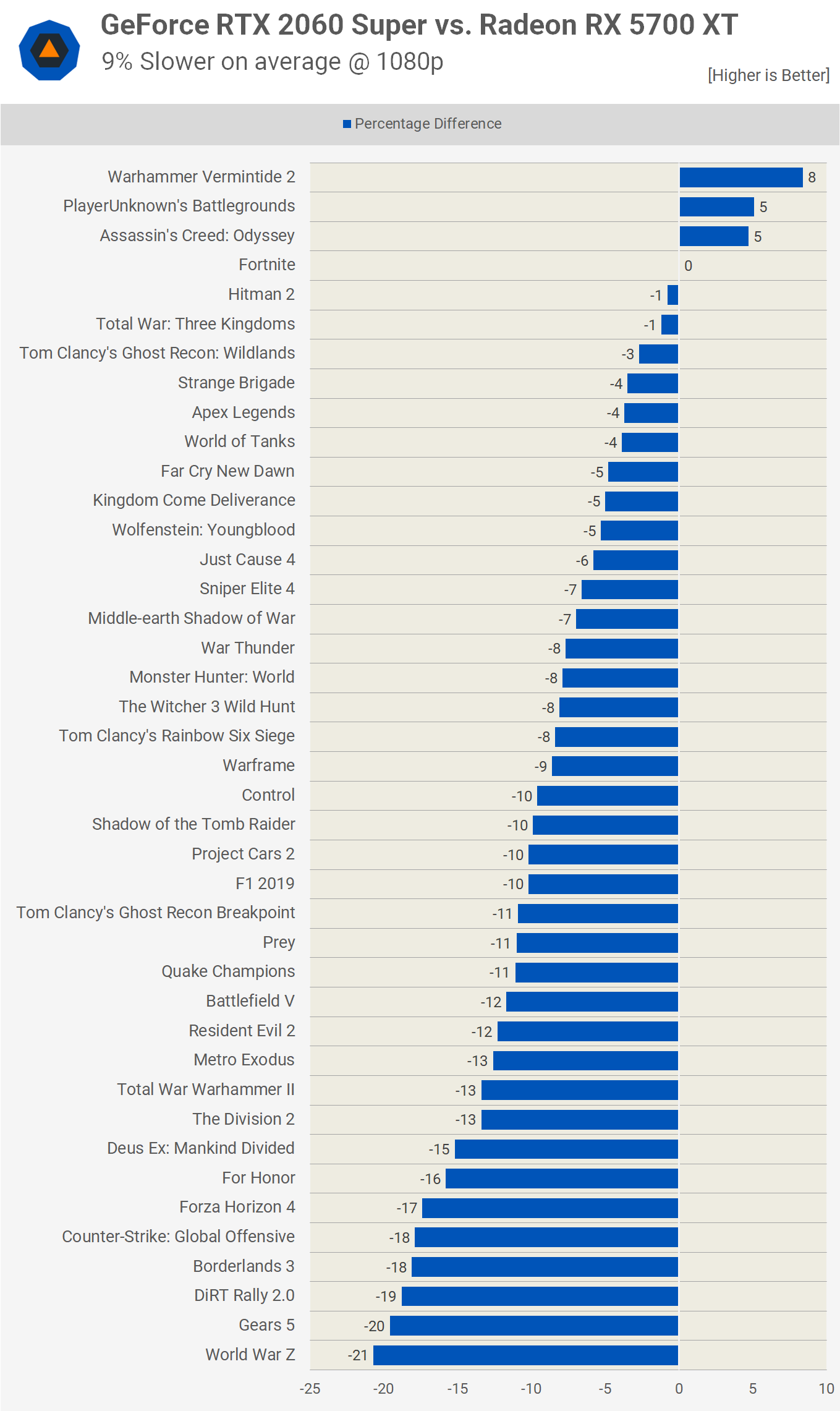
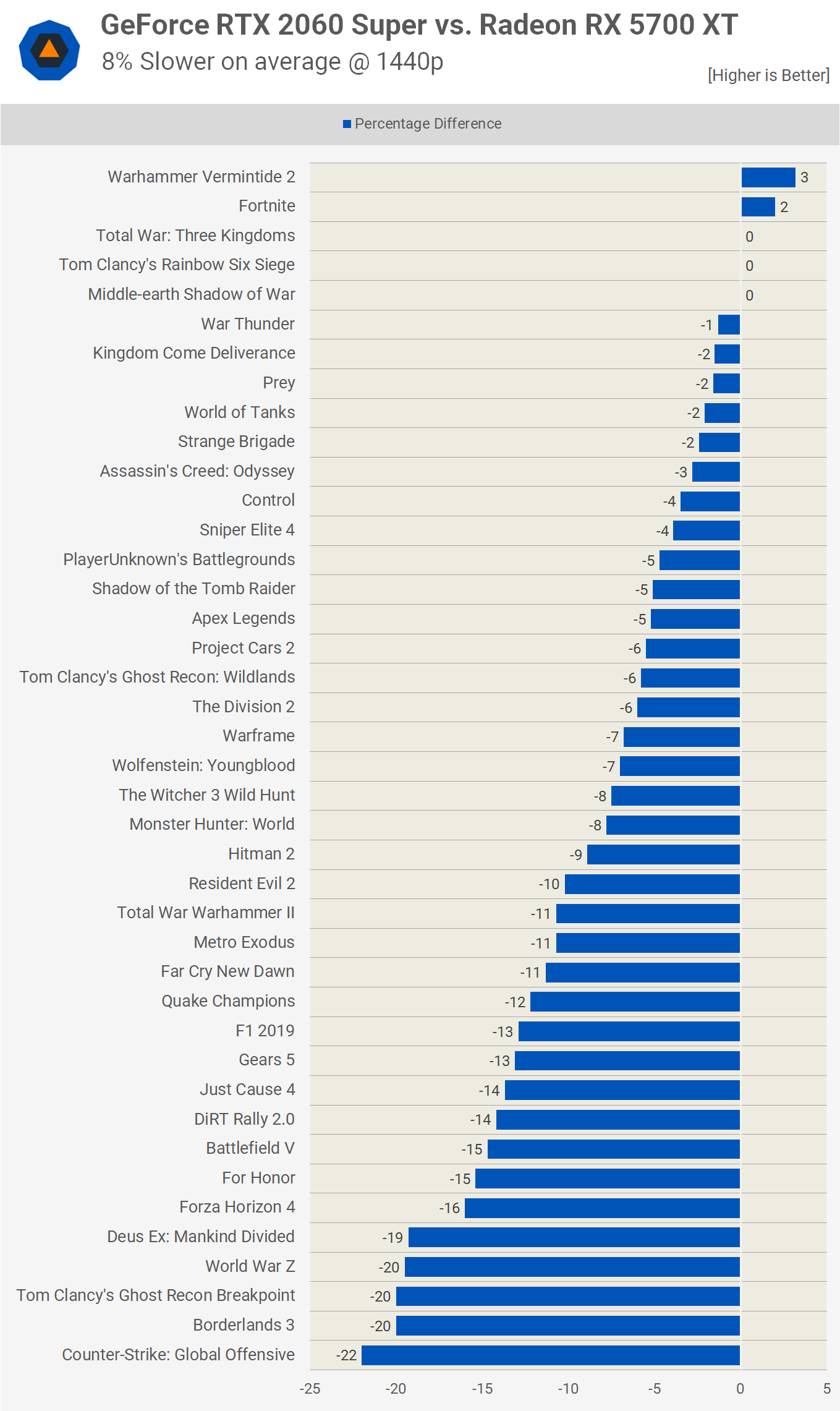
Result? Unchanged.
Techspot / Hardware Unboxed didn't implement DLSS 2.0 when testing, but of the 41-game suite, Control is one of only three games currently with DLSS 2.0 support, already one of the multiple NVIDIA-optimized titles on the list that has been fastidiously patched since the first roundup, and the "Quality" mode (i.e. the one that doesn't sacrifice graphical quality) only gained ~16% performance in that game. Steve has said they'll add these to the summaries in the future, but they would have had a nominal effect on the updated suite's outcome if all games had been re-benched: approximately 1%-2% overall.
Cost per frame analysis for the Original Game Benchmark Roundup
(with exact RX 5700 XT Performance = +8%@1080p; +9%@1440p)
RX 5700 XT = +10%-11% frames per dollar

Except... that's assuming an equal price of $400. In reality:
RTX 2060 Super

RX 5700 XT

RTX 2060 Super has averaged ~$20-$40 more, even at the baseline or for sales, despite being ~8%-9% slower in games.
RX 5700 XT
RTX 2060 Super has averaged ~$20-$40 more, even at the baseline or for sales, despite being ~8%-9% slower in games.
Adjusted cost-per-frame corresponding to the pricing reality, not the MSRP, even assuming a few percent improvement due to DLSS 2.0 overall among AAA games for the RTX 2060 Super, would be 15%-20% in favor of the RX 5700 XT.
- Joined
- Jul 23, 2011
- Messages
- 34,972
- Reaction score
- 26,252
Radeon RX 5700XT vs. GeForce RTX 2060 Super: 2020 Update
Unchanged.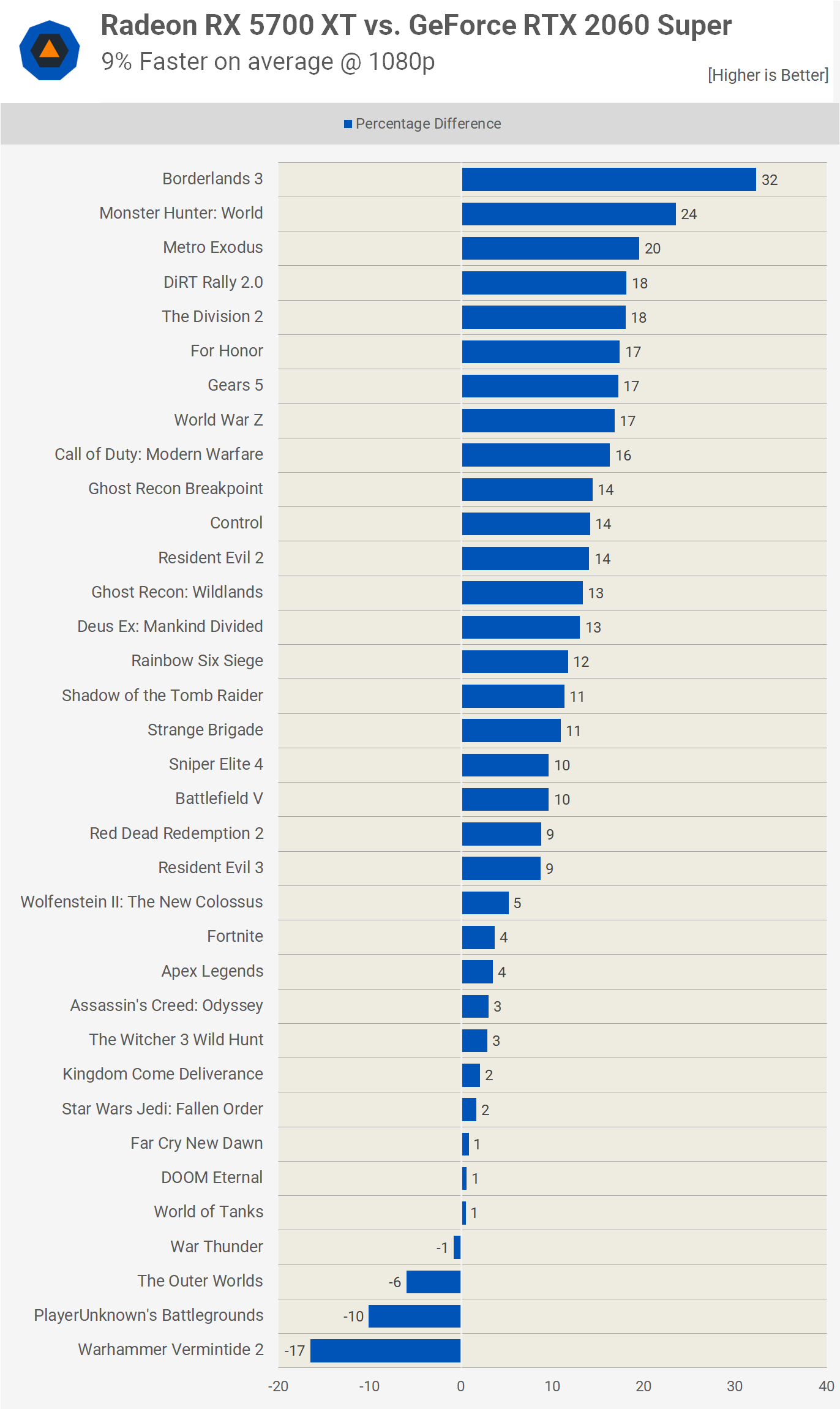
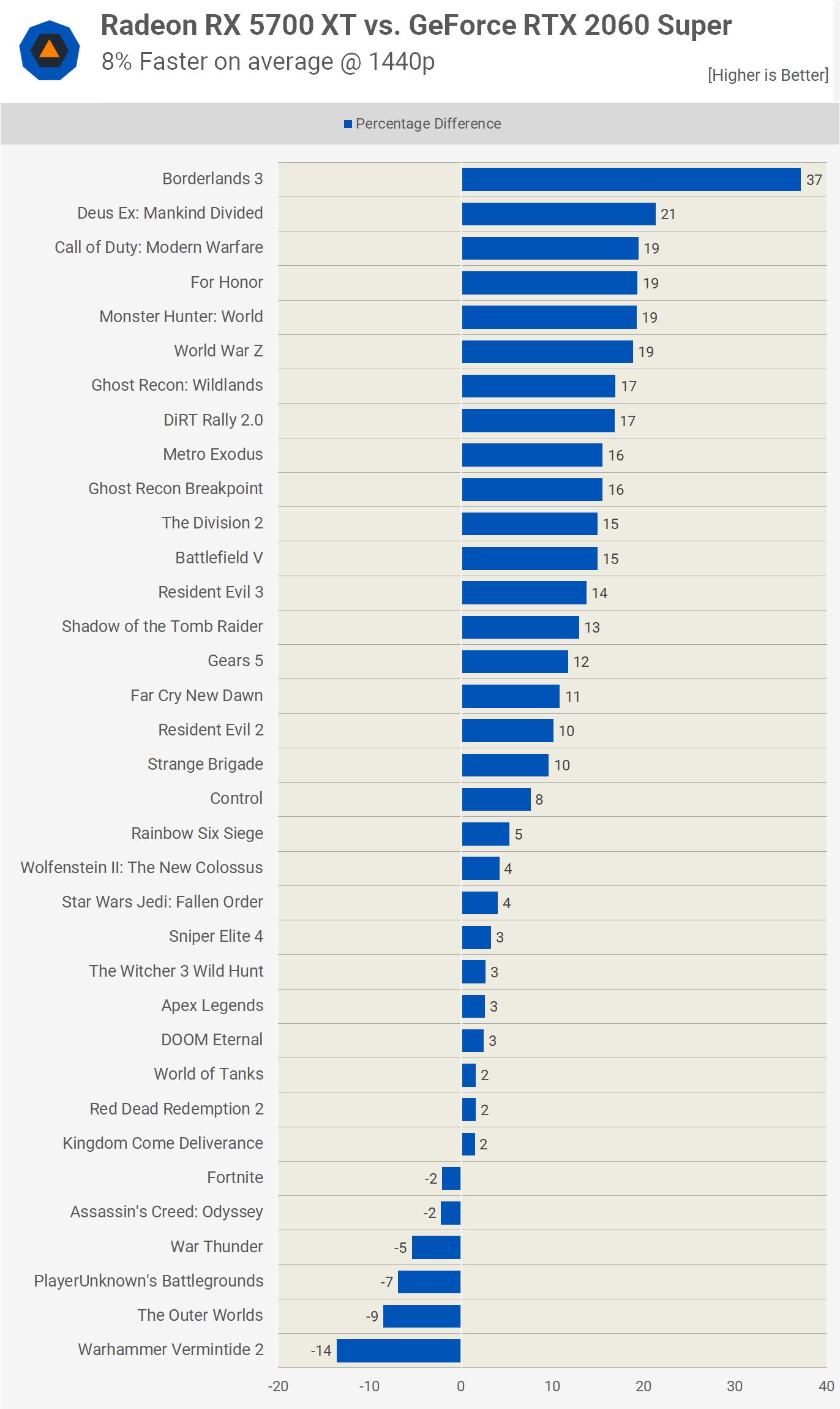
Techspot / Hardware Unboxed didn't implement DLSS 2.0 when testing, but of the 41-game suite, Control is one of only three games currently with DLSS 2.0 support, already one of the multiple NVIDIA-optimized titles on the list that has been fastidiously patched since the first roundup, and the "Quality" mode (i.e. the one that doesn't sacrifice graphical quality) only gained ~16% performance in that game. Steve has said they'll add these to the summaries in the future, but they would have had a nominal effect on the updated suite's outcome if all games had been re-benched: approximately 1%-2% overall.
Cost per frame analysis for the Original Game Benchmark Roundup
(with exact RX 5700 XT Performance = +8%@1080p; +9%@1440p)
RX 5700 XT = +10%-11% frames per dollar
Except... that's assuming an equal price of $400. In reality:
RTX 2060 Super
RX 5700 XT
RTX 2060 Super has averaged ~$20-$40 more, even at the baseline or for sales, despite being ~8%-9% slower in games.
Adjusted cost-per-frame corresponding to the pricing reality, not the MSRP, even assuming a few percent improvement due to DLSS 2.0 overall among AAA games for the RTX 2060 Super, would be 15%-20% in favor of the RX 5700 XT.
I like how you have to "adjust" prices to pull out the win.
- Joined
- Aug 6, 2004
- Messages
- 19,055
- Reaction score
- 9,809
I like how you have to "adjust" prices to pull out the win.
after already moving the goalposts (previous to this one), too.
- Joined
- Jun 13, 2005
- Messages
- 66,844
- Reaction score
- 38,941
I can't tell...are you adopting a new gimmick as a troll, or are you genuinely incapable of discerning what that final chart conveys? My adjustment doesn't "pull out the win" for AMD-- it increases the win that AMD already enjoys in a metric that is dependent on cost itself. AMD is superior both in raw average gaming framerate, and in terms of value (cost per frame).I like how you have to "adjust" prices to pull out the win.
RX 5700 XT
- Raw Performance
- @1080p = 8% superior to RTX 2060 Super
- @1440p = 9% superior to RTX 2060 Super
- Cost-per-Frame (without adjustment: $400 for each card)
- @1080p = $2.77 per frame (vs. $3.05 per frame for RTX 2060S)
- @1440p = $3.84 per frame (vs. $4.25 per frame for RTX 2060S)
If you adjust for true pricing, where the RTX 2060S has been more expensive (whether you define by best sale price, best entry pricing, best average pricing overall, or even best average pricing for 2+ fan variants), then the cost-per-frame advantage for the RX 5700 XT becomes even greater. That is true even if we adjusted with an assumed +16% improvement to "Quality Mode" for all DLSS 2.0 titles currently supported from the original 41-game suite since the difference in actual pricing between the cards exceeds the gain in framerate yielded for the RTX 2060S's overall performance by DLSS.
My apologies, I took it for granted these charts were remedial. It appears I was mistaken.
- Joined
- Jul 23, 2011
- Messages
- 34,972
- Reaction score
- 26,252
I can't tell...are you adopting a new gimmick as a troll, or are you genuinely incapable of discerning what that final chart conveys? My adjustment doesn't "pull out the win" for AMD-- it increases the win that AMD already enjoys in a metric that is dependent on cost itself. AMD is superior both in raw average gaming framerate, and in terms of value (cost per frame).
RX 5700 XT
- Raw Performance
- @1080p = 8% superior to RTX 2060 Super
- @1440p = 9% superior to RTX 2060 Super
- Cost-per-Frame (without adjustment: $400 for each card)
- @1080p = $2.77 per frame (vs. $3.05 per frame for RTX 2060S)
- @1440p = $3.84 per frame (vs. $4.25 per frame for RTX 2060S)
If you adjust for true pricing, where the RTX 2060S has been more expensive (whether you define by best sale price, best entry pricing, best average pricing overall, or even best average pricing for 2+ fan variants), then the cost-per-frame advantage for the RX 5700 XT becomes even greater. That is true even if we adjusted with an assumed +16% improvement to "Quality Mode" for all DLSS 2.0 titles currently supported from the original 41-game suite since the difference in actual pricing between the cards exceeds the gain in framerate yielded for the RTX 2060S's overall performance by DLSS.
My apologies, I took it for granted these charts were remedial. It appears I was mistaken.
so anyone that disagrees with you is a troll. you're going down that Oeshon route my man.
- Joined
- Jun 13, 2005
- Messages
- 66,844
- Reaction score
- 38,941
This feels like more trolling.so anyone that disagrees with you is a troll. you're going down that Oeshon route my man.
Interpretation of those charts isn't an agree-to-disagree matter. It's objective. Their benchmark suite objectively showed the RX 5700 XT to be superior in gaming performance across 41 tested games. It affirmed this six months later with an identical advantage at both resolutions. It objectively establishes a superior value based on equal cost.
Do you comprehend this?
- Joined
- Jul 23, 2011
- Messages
- 34,972
- Reaction score
- 26,252
This feels like more trolling.
Interpretation of those charts isn't an agree-to-disagree matter. It's objective. Their benchmark suite objectively showed the RX 5700 XT to be superior in gaming performance across 41 tested games. It affirmed this six months later with an identical advantage at both resolutions. It objectively establishes a superior value based on equal cost.
Do you comprehend this?
Here's the chart you posted.
I don't see the 2060 Super on that chart.
- Joined
- Jun 13, 2005
- Messages
- 66,844
- Reaction score
- 38,941
No. This comment...Here's the chart you posted.
I don't see the 2060 Super on that chart.
...specifically addressed a post that did not include that chart. Your comment also concerns my discussion of cost-per-frame analysis which isn't a subject of the above chart.I like how you have to "adjust" prices to pull out the win.
I've been at this too long to be distracted with this sort of deflection, but now I know you genuinely failed to comprehend the Techspot benchmark charts comparing the two cards. Oof. That's embarrassing. They're not abstruse.
- Joined
- Jul 23, 2011
- Messages
- 34,972
- Reaction score
- 26,252
No. This comment...
...specifically addressed a post that did not include that chart. Your comment also concerns my discussion of cost-per-frame analysis which isn't a subject of the above chart.
I've been at this too long to be distracted with this sort of deflection, but now I know you genuinely failed to comprehend the Techspot benchmark charts comparing the two cards. Oof. That's embarrassing. They're not abstruse.
And I've been at this long enough to recognize your bull shit.
- Joined
- Aug 6, 2004
- Messages
- 19,055
- Reaction score
- 9,809
i heard rumours that next week will have a lot more from the aibs, but beats me. even a lot of the amd cultists don't understand why they wouldn't just wait an extra week, if that's true.
tsmc can't expand fast enough


