
Ancient megalithic structures and sites.

The place to get into where those “bull sarcophagi” are located doesn’t actually fit the boxes. We couldn’t take those things out of there even if we wanted to without digging them out.

I guess it comes down to either them placing the stones first and building the rest of the temple after, or teleportation, then.

Yes, I read that too, but both dates are actually in question. So, I would put it between 15,000 B.C. and 500 A.D.
Yeah, since google and wikipedia don't that mention the dates are in question, I'm gonna go with circa 500 AD.

Btw, the wikipedia page also describes that how they worked the rocks: "Some of the stones are in an unfinished state, showing some of the techniques used to shape them. They were initially pounded by stone hammers, which can still be found in numbers on local andesite quarries, creating depressions, and then slowly ground and polished with flat stones and sand."
https://en.wikipedia.org/wiki/Pumapunku#Engineering


I don't think you'll find this at the 'Parthenon'. The 'Tiwanaku' people were a much different culture than the Greeks, even for 500 A.D.

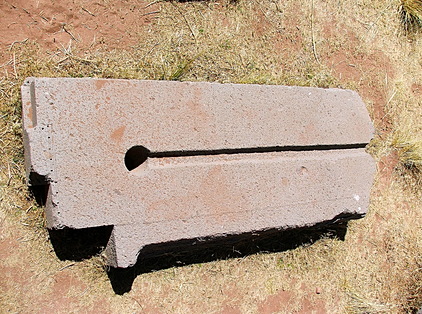

Surprisingly enough, Greeks could drill holes into rocks, too:
columndrums.jpg

1101.jpg


When it came to rocks, turns out they could do a bit more than drill holes and cut right corners to them:
grcke-skulpture.jpg
 
Last edited:
I guess it comes down to either them placing the stones first and building the rest of the temple after, or teleportation, then.


Yeah, since google and wikipedia don't that mention the dates are in question, I'm gonna go with circa 500 AD.

Btw, the wikipedia page also describes that how they worked the rocks: "Some of the stones are in an unfinished state, showing some of the techniques used to shape them. They were initially pounded by stone hammers, which can still be found in numbers on local andesite quarries, creating depressions, and then slowly ground and polished with flat stones and sand."
https://en.wikipedia.org/wiki/Pumapunku#Engineering


Surprisingly enough, Greeks could drill holes into rocks, too:
columndrums.jpg

1101.jpg


When it came to rocks, turns out they could do a bit more than that with them:
grcke-skulpture.jpg

Egyptians knew how to drill holes as well
Unfinished_obelisk_at_Aswan_with_holes_showing_how_the_granite_would_be_split_with_logs.JPG

c3720ff6052b.jpg
 
Egyptians knew how to drill holes as well
Unfinished_obelisk_at_Aswan_with_holes_showing_how_the_granite_would_be_split_with_logs.JPG

c3720ff6052b.jpg
Egyptian masonry was obviously also very advanced. I'm just using the ancient greeks as an example, because it is the oldest civilisation for which we have extremely reliable historical records. Anything older than classical Greece (Sumerians, Babylonians, Egyptians, Persians, Chinese, etc.) we don't have concrete historiographies of.

If there were no reliable written records from their time, you can bet your ass people would think greek architecture/art/science was millennia older and/or built by ultra advanced ancient aliens. Because, you know, they drilled/cut/sanded/chiseled rocks in an extremely precise manner, etc.
 
It’s borderline racist. The Inca’s controlled millions of people, had a huge road system, a safety net, and a centrally planned economy. They were technologically inferior to Europeans because they were isolated from the old world and all of their technology and ideas but they were clearly very smart and not “primitive”

You would think that they were cavemen building huge structures
Hey man the guy had an honest opinion. Respond with facts and ideas like the rest of your post. Don't resort to childish name calling like "racist" and shit.
 
Modern technology has a hard time recreating the precise stone work. Look into those black boxes found in Egypt. You're not doing that with hand tools.

Yes the ancients (not the Inca or Egyptians) knew how to cut them and move them. It was a civilization that was killed off in a cataclysmic event.
That's like saying that doing a slam dunk from the free throw line is impossible because in 100 years from now, people only play basketball recreationally and they just can't imagine someone being that fucking good.

4000 years ago, stone carving was a top notch profession that people went to school for and dedicated their lives to. Now, of course all 5 guys in the world that do it do it self-taught an part time as a hobby can't imagine people being that good at it.

9gAdk.gif
 
4000 years ago, stone carving was a top notch profession that people went to school for and dedicated their lives to. Now, of course all 5 guys in the world that do it do it self-taught an part time as a hobby can't imagine people being that good at it.
What is your reference for the bolded above?
 
What is your reference for the bolded above?
They spent like half their economies building these structures that took 50-100+, so multiple lifetimes, years to build. They weren't hiring amateurs to do this shit. The level of detail and planning would have been the same as we use on cutting edge aircraft, CERN, nuclear tech, etc. It would have been their best and brightest devoting their entire lifetimes doing stuff in intricate planning and detail.

So of course they would have had stone carvers and guys who could shit that we can't even believe.
 
They spent like half their economies building these structures that took 50-100+, so multiple lifetimes, years to build. They weren't hiring amateurs to do this shit. The level of detail and planning would have been the same as we use on cutting edge aircraft, CERN, nuclear tech, etc. It would have been their best and brightest devoting their entire lifetimes doing stuff in intricate planning and detail.

So of course they would have had stone carvers and guys who could shit that we can't even believe.
Ok. So no reference.

And where did the "half their economies" come from? We have no idea what their resource allocation was.

The fact is, most of the megalithic sites are attributed via "guilt by association"...meaning we arbitrarily pick the oldest people's in a know area and attribute undatable stone works to them.

Does it not give you a little pause that there is literally no mention until the new kingdom thousands of years after construction regarding the Great Pyramid? Seems like something they would have been bragging about left and right if they had any clue as to what they were even looking at.

It's lack of reference almost makes it seem as if it had "always" been there or that it was common enough or confusing enough to be avoided.
 
Ok. So no reference.

And where did the "half their economies" come from? We have no idea what their resource allocation was.

The fact is, most of the megalithic sites are attributed via "guilt by association"...meaning we arbitrarily pick the oldest people's in a know area and attribute undatable stone works to them.

Does it not give you a little pause that there is literally no mention until the new kingdom thousands of years after construction regarding the Great Pyramid? Seems like something they would have been bragging about left and right if they had any clue as to what they were even looking at.

It's lack of reference almost makes it seem as if it had "always" been there or that it was common enough or confusing enough to be avoided.


Also to add to that aren't most pyramids built after the Great pyramids of a lower quality? Like they were trying to recreate them but didn't have the knowledge or technique to replicate them.
 
Also to add to that aren't most pyramids built after the Great pyramids of a lower quality? Like they were trying to recreate them but didn't have the knowledge or technique to replicate them.
The great pyramid is by far the most sophisticated known Pyramid of the 80 or so in Egypt...or anywhere else for that matter. And yes, most of the stuff after and before it are DRASTICALLY inferior. The timelines in place for construction of the old kingdom stuff is based on extremely flimsy evidence and generally poor logic.
 
The great pyramid is by far the most sophisticated known Pyramid of the 80 or so in Egypt...or anywhere else for that matter. And yes, most of the stuff after and before it are DRASTICALLY inferior. The timelines in place for construction of the old kingdom stuff is based on extremely flimsy evidence and generally poor logic.
If a civilisation doesn't suffer complete annihilation right at the moment when it has reached its greatest glory (like it happened with the Assyrian and Aztec civilisations due to catastrophic military defeat, or the Minoan civilisation due to massive volcanic eruption), then one would expect it to gradually decline after reaching its zenith. Similarly to the Egyptian pyramids, later Roman buildings were inferior to the Colosseum and the Pantheon (built in around 70-120 AD). Same goes for buildings from the Greek golden age, etc.

Having said that, it is possible the timeline of ancient Egypt might be off, even by millennia (see the academic debate surrounding Sphinx's dating). And is it possible we underestimate the cultural and technological sophistication of pre-historic peoples (see Gobekli Tepe). That doesn't mean that the best explanation for large rocks with flat surfaces and right angles is super-ancient, completely unknown, laser-using civilisations.
 
"Some of the stones are in an unfinished state, showing some of the techniques used to shape them. They were initially pounded by stone hammers, which can still be found in numbers on local andesite quarries, creating depressions, and then slowly ground and polished with flat stones and sand."

"Due to the complexity and regularity of many of Pumapunku's stone forms, a number of authors have suggested that they're not stones at all, but rather concrete that was cast into forms. We don't have any record that such technology was known to pre-Incan cultures, but that doesn't prove it wasn't. What can be proven, and proven quite easily, is that there is no concrete at Pumapunku or anywhere else in Tiwanaku."
 
"Due to the complexity and regularity of many of Pumapunku's stone forms, a number of authors have suggested that they're not stones at all, but rather concrete that was cast into forms. We don't have any record that such technology was known to pre-Incan cultures, but that doesn't prove it wasn't. What can be proven, and proven quite easily, is that there is no concrete at Pumapunku or anywhere else in Tiwanaku."
Mate, you just quoted an article whose title is:
"The Non-Mystery of Pumapunku: Though some claim the stone structures at Pumapunku were alien, archaeologists find no real mysteries there."

The very next sentences from the text you quoted read:
"Contrary to the suppositions of paranormalists, modern geologists are, in fact, quite able to discern rock from concrete. Petrographic and chemical analyses are relatively trivial to carry out, and even allowed us to determine exactly where the rocks were quarried. Pumapunku’s large blocks are a common red sandstone that was quarried about 10 kilometers away."

Source: https://skeptoid.com/episodes/4202
 
If a civilisation doesn't suffer complete annihilation right at the moment when it has reached its greatest glory (like it happened with the Assyrian and Aztec civilisations due to catastrophic military defeat, or the Minoan civilisation due to massive volcanic eruption), then one would expect it to gradually decline after reaching its zenith. Similarly to the Egyptian pyramids, later Roman buildings were inferior to the Colosseum and the Pantheon (built in around 70-120 AD). Same goes for buildings from the Greek golden age, etc.

Having said that, it is possible the timeline of ancient Egypt might be off, even by millennia (see the academic debate surrounding Sphinx's dating). And is it possible we underestimate the cultural and technological sophistication of pre-historic peoples (see Gobekli Tepe). That doesn't mean that the best explanation for large rocks with flat surfaces and right angles is super-ancient, completely unknown, laser-using civilisations.

all very rational. However the laser using comment just muddies the conversation and escapes an obvious middle ground that can be reached. I would say some pretty advanced machining was taking place with a non man power based source at places like Baalbeck, the Giza plateau pyramids, the Oserion, the Serapeum, the Valley Temple, etc...

Just from a logical perspective, it seems pretty convenient that we have all this architecture in the "ancient world", some of it astounding even by today's technological standards (of course we could do it all, but it would be an exceptional challenge in some instances) and it all starts to come together at the beginning of recorded history (about 6k years ago) which also happens to be only about 6k years AFTER the greatest extinction event on planet earth in the last several million years. In specificity, this event would be the period of time bookended by the dates 12,800 years ago and 11,600 years ago, otherwise known as the Younger Dryas, and both those days are characterized by extreme/catastrophic climate change.

https://en.wikipedia.org/wiki/Younger_Dryas

So we're left with this. in the literal direct backyard of what we call "History", the biggest mass extinction event of the last several million years occurred. That should be telling to everyone. It's very unlikely that human beings were unaffected if literally half the rest of the mammals on planet earth above 125lbs in body weight went extinct. We know from the climate record the world was fucked sideways for 1200 years and sea level rose drastically at periods from 17,000 years ago to 7 years ago in the range of 400 feet in total (intermittent events could have been 10's of feet literally in days).

What do you think people were doing for those other thousands and thousands of generations if 4 generations ago the main method of transportation was horseback? Either we don't understand something about our planet or something has drastically changed about our planet in the last 10k years that has allowed civilization and techonlogy to grow at the current rate. What hasn't changed is the make up of human beings in the last 200k years, those people 200k years ago were identical to us, same brain case, presumably the same exact ability for mental activity.
 
Mate, you just quoted an article whose title is:
"The Non-Mystery of Pumapunku: Though some claim the stone structures at Pumapunku were alien, archaeologists find no real mysteries there."

Yes, I understand that. I did it on purpose. Just like the dating of Pumapunku, there are different views on both. Why is that?
 
They spent like half their economies building these structures that took 50-100+, so multiple lifetimes, years to build. They weren't hiring amateurs to do this shit. The level of detail and planning would have been the same as we use on cutting edge aircraft, CERN, nuclear tech, etc. It would have been their best and brightest devoting their entire lifetimes doing stuff in intricate planning and detail.

So of course they would have had stone carvers and guys who could shit that we can't even believe.
Just playing devil's advocate...but there probably about as many people in ancient Egypt as there are in Kansas today. And they probably lived to be 40, on average. Combine that with the fact the majority of people would've in agriculture, and it's hard to imagine that an entire class of Rembrandt-level craftsmen existed.
 
all very rational. However the laser using comment just muddies the conversation and escapes an obvious middle ground that can be reached. I would say some pretty advanced machining was taking place with a non man power based source at places like Baalbeck, the Giza plateau pyramids, the Oserion, the Serapeum, the Valley Temple, etc...

Just from a logical perspective, it seems pretty convenient that we have all this architecture in the "ancient world", some of it astounding even by today's technological standards (of course we could do it all, but it would be an exceptional challenge in some instances) and it all starts to come together at the beginning of recorded history (about 6k years ago) which also happens to be only about 6k years AFTER the greatest extinction event on planet earth in the last several million years. In specificity, this event would be the period of time bookended by the dates 12,800 years ago and 11,600 years ago, otherwise known as the Younger Dryas, and both those days are characterized by extreme/catastrophic climate change.

https://en.wikipedia.org/wiki/Younger_Dryas

So we're left with this. in the literal direct backyard of what we call "History", the biggest mass extinction event of the last several million years occurred. That should be telling to everyone. It's very unlikely that human beings were unaffected if literally half the rest of the mammals on planet earth above 125lbs in body weight went extinct. We know from the climate record the world was fucked sideways for 1200 years and sea level rose drastically at periods from 17,000 years ago to 7 years ago in the range of 400 feet in total (intermittent events could have been 10's of feet literally in days).

What do you think people were doing for those other thousands and thousands of generations if 4 generations ago the main method of transportation was horseback? Either we don't understand something about our planet or something has drastically changed about our planet in the last 10k years that has allowed civilization and techonlogy to grow at the current rate. What hasn't changed is the make up of human beings in the last 200k years, those people 200k years ago were identical to us, same brain case, presumably the same exact ability for mental activity.

That's a whole lot of subjective circumstantial inferences with any type of actual evidence, there.

It's large rocks with flat surfaces and holes drilled in them. I'd need a shitload more evidence than that before I conclude technology comparable to modern day.


Btw, the "biggest mass extinction event of the last several million years" is still ongoing (and accelerating), and is for the greatest part attributed to human activity: https://en.wikipedia.org/wiki/Holocene_extinction
 
Back
Top