• We are currently experiencing technical difficulties. We sincerely apologize for the inconvenience.

Regimen Alexander Karelin - Resistance Bands?

Take this with a grain of salt. In my opinion mental health is almost completely fake and doctors have figured out a way to profit off people by making them believe they have problems that do not actually exist.

If you give up a home run I doubt you are going to feel good about it because that wouldnt be normal unless it was actually good pitch you threw and just got outclassed. Brad Lidge had that problem in the playoffs one year he gave up a grand slam to Albert Pujols to lose a playoff game and then he got actually put in a mental institution for a bit.

Mindfulness and meditation for an athlete kind of goes without saying IMO. I have never met a good athlete that doesn't think about what they are trying to accomplish while not currently in the physical act of accomplishing it or even during the act. Breathe control is a physical act as well. If you breathe out of control you obviously cant focus especially during the act.

Let's take for example a hitter. What should you be thinking about in the act of seeing a pitch and then attempting to hit it? Well you should trust in your training first of all while you are at the plate. Secondly, you should see ball and hit ball. If you focus on those two things you will be more successful than if you are thinking about an old nude picture of Pamala Anderson while trying to hit a 99 mph fastball or a Ohatni Sweeper. You take each pitch and moment as they come to you.

If you make it simple in your mind you will be far more successful.

Just like what Chael told Rumble you can choose to fail or you can choose to succeed. Success to you is entirely subjective though. Success to judges or your employer in the case of a professional baseball team is obviously your statistics. Failure is the most readily option available art all times.

If you actually let your emotions control your behavior then you will not be successful because you will be so focused on controlling your emotion that you wont be able to perform.

It is like obese people that eat with their emotions and get into a habit they never end up breaking whereas if they trusted principled sane food choices and diets they would be successful.


here it again so you dont even have to go back and search for it


While humans are not rats, there's a lot we can draw from such an experiment. I don't know if the mental side of things is 1% or 99% but what I do know is that it's far more important than you're making it out to be.


"Dr. Richter placed rats into buckets of water and timed their ability to swim. Rats, who are apparently known for their strong swimming skills, lasted an average of 15 minutes before drowning. In a second experiment, Richter rescued the rats when he saw them begin to stop swimming and sink. When he took them out, he dried them off and gave them a short period of rest (I like to picture him doing this with a mini, yet plush, rat-size towel). And then, just as they were dry and rested, Richter put them back into the water. However, this time Richter identified a substantial behavioral change. The rescued rats swam longer than 15 minutes. In fact, they swam for nearly 60 hours."

I am not a baseball player and barely watch the game but what I do know is that there's a ton of information that goes through a baseball player's head whether they are at the plate batting or on the mound pitching. Both batters and pitchers look for patterns. You of course know all this. The pitcher just threw two fast balls in a row. You as the batter know he typically throws off speed/change up or slider after that and to specific location of the plate. He's missing the strike zone so perhaps it's better to take a walk to get on base or perhaps advance the player on 1st. Maybe you know where the ball is going off the plate and you still choose to chase to try to drive home a player on 2nd. Or perhaps as a pitcher you know the batter can't hit a slider to save his life so you're going to throw it more often. So even in my very limited knowledge of the game I know that it's more than simply 'seeing the ball' and 'relying on training'(I understood this to mean good fundamental pitching/batting mechanics). Those aspects are true of course but it's also not as simple as that. I've always known baseball to be an incredibly mental game.
 
Last edited:
While humans are not rats, there's a lot we can draw from such an experiment. I don't know if the mental side of things is 1% or 99% but what I do know is that it's far more important than you're making it out to be.


"Dr. Richter placed rats into buckets of water and timed their ability to swim. Rats, who are apparently known for their strong swimming skills, lasted an average of 15 minutes before drowning. In a second experiment, Richter rescued the rats when he saw them begin to stop swimming and sink. When he took them out, he dried them off and gave them a short period of rest (I like to picture him doing this with a mini, yet plush, rat-size towel). And then, just as they were dry and rested, Richter put them back into the water. However, this time Richter identified a substantial behavioral change. The rescued rats swam longer than 15 minutes. In fact, they swam for nearly 60 hours."

I am not a baseball player and barely watch the game but what I do know is that there's a ton of information that goes through a baseball player's head whether they are at the plate batting or on the mound pitching. Both batters and pitchers look for patterns. You of course know all this. The pitcher just threw two fast balls in a row. You as the batter know he typically throws off speed/change up or slider after that and to specific location of the plate. He's missing the strike zone so perhaps it's better to take a walk to get on base or perhaps advance the player on 1st. Maybe you know where the ball is going off the plate and you still choose to chase to try to drive home a player on 2nd. Or perhaps as a pitcher you know the batter can't hit a slider to save his life so you're going to throw it more often. So even in my very limited knowledge of the game I know that it's more than simply 'seeing the ball' and 'relying on training'(I understood this to mean good fundamental pitching/batting mechanics). Those aspects are true of course but it's also not as simple as that. I've always known baseball to be an incredibly mental game.
Here is why you are wrong. It doesn't matter what pitch he throws the only thing that matters is recognizing the pitch thrown with your eyes. A blind man cannot be a hitter. Once you understand the actions you are supposed to take in sport the only thing left is execution and you take those actions actions physically.

We were talking about golf earlier. If you try to play golf with your emotions or feelings you will shoot abysmal and why? Say you drive a shot where you didn't want to hit and and now you get pissed off and even hit a worse approach shot because you were focused on your feelings instead of executing the next shot in a textbook format.

If you truly care to hit that errant shot well with the next approach shot then you would physically do what is necessary to knock the ball on the green.

This is what makes great athletes great in that they can block out everything going on around them and execute.

One of my favorite movies is Kevin Costner's For the love of the game. What he does is actually what a pitcher in real life would do by zoning out the fans in the stand and even the umpire to only focus on throwing the ball through the glove.

When it comes to fighting every single person has a freeze, flight or fight response and your reaction is mostly genetic however you can learn to overcome your natural reaction through training kind of like what Chael is talking about in the above vids. Also that is somewhat similar to your experiment. If a rat can train themselves with just one redo imagine what a human can do.
 
Last edited:
And to add to that. Im glad you got me thinking. Yes a good pitcher is going to change their approach on a lot of things such as if the batter is a step in the bucket pull hitter or he likes to punch the ball the other way or if he can hit a breaking a pitch well or not a vice versa the batter is going to adjust to how the pitcher is throwing that day. A good leadoff hitter could strike out but still have it be a good at bat by relaying information to the rest of the team about how the pitcher is executing pitches on that day. No matter which way I slice it though the actions that must be taken are physical.

Of course you could even go deeper than that in calculating the pitchers spin rate so that you can use the correct launch angle with the swing to influence a better outcome. All of that is calculated before you reach plate though. The only thing left at that point is execution.

There is old trick in football where teams will "ice" the field goal kicker by calling a timeout just to purposefully give the kicker more Time that he has to think before the kick. The best kickers aren't bothered by it because they take the same approach each and every time Ala Adam venteri, Gostawski etc.
 
What may tie in with the whole mental aspect discussion: at some point I realized that an incredibly high percentage of world class wrestlers (and most of my coaches) are deeply religious in one way or another. You have Muslims, Orthodox Christians (like Karelin), Born Again Christians, Hindus... very few atheists in the trenches, it seems. Me being an agnostic, that was weird sometimes. But when I think about it, it kind of makes sense to me: religion (or any deep-seated ideology) takes away some of the mental challenges that you may face in a sport that is as demanding and often enough painful, and includes the necessity of putting your opponent through a lot of hurt up to and including ending his career (been there, done that, didn't get a T-shirt). If you can tell yourself that you're doing the Lord's work and you are part of a community that reinforces that belief, you arguably don't have to face certain challenges that you have if you are, say, the agnostic son of deeply catholic parents who abhor any form of competitve sport in general, any form of violence in particular and keep telling you you should focus on your work more (maybe marry and settle dwon), and go on to work in an academic environment where everyone looks funny at your bull-neck, cauliflower ears, routinely black eyes and shaved head - not that that is describing anyone I know :D No wonder I hang out with my coaches so much, even though I have to carefully evade the subject of religion with most of them ;)
 
What may tie in with the whole mental aspect discussion: at some point I realized that an incredibly high percentage of world class wrestlers (and most of my coaches) are deeply religious in one way or another. You have Muslims, Orthodox Christians (like Karelin), Born Again Christians, Hindus... very few atheists in the trenches, it seems. Me being an agnostic, that was weird sometimes. But when I think about it, it kind of makes sense to me: religion (or any deep-seated ideology) takes away some of the mental challenges that you may face in a sport that is as demanding and often enough painful, and includes the necessity of putting your opponent through a lot of hurt up to and including ending his career (been there, done that, didn't get a T-shirt). If you can tell yourself that you're doing the Lord's work and you are part of a community that reinforces that belief, you arguably don't have to face certain challenges that you have if you are, say, the agnostic son of deeply catholic parents who abhor any form of competitve sport in general, any form of violence in particular and keep telling you you should focus on your work more (maybe marry and settle dwon), and go on to work in an academic environment where everyone looks funny at your bull-neck, cauliflower ears, routinely black eyes and shaved head - not that that is describing anyone I know :D No wonder I hang out with my coaches so much, even though I have to carefully evade the subject of religion with most of them ;)
That's a good study to be had. Some people even take it as far a political affiliation having to do with your sporting performance. I wouldnt go that far tbh. Your personality could be a factor as well. Listen to somebody like a Brock lesnar who Is Anti social until it's time for him to compete. Then you have more personable people Like Lebron or John Jones.
 
That's a good study to be had. Some people even take it as far a political affiliation having to do with your sporting performance. I wouldnt go that far tbh. Your personality could be a factor as well. Listen to somebody like a Brock lesnar who Is Anti social until it's time for him to compete. Then you have more personable people Like Lebron or John Jones.
Personality, character... it's a very complex subject, and to some degree will come down to questions like whether you believe that these are mostly based on surroundings, mostly on genetics or a bit on both. My anecdotical evidence would suggest it's a package, because many of the best wrestlers all over the world (regardless of whether it's Iowa, Oklahoma, Dagestan, Bulgaria, India or Mongolia - I don't know enough about the Japanese team tbh) come from rural areas, so you typically have the combination of farm work from an early age (builds work ethic and tolerance to volume), often a more religious upbringing, tighter-knit communities and often a certain tolerance towards scrapping. I'd argue all of these will influence personality/character to some degree.
Apart from that, yes, you will have a range of personalities among top fighters. You will have people who are popular, people who are stage hogs and start glowing whenever they step up for a match, people who are more quiet and philosophical, and you will have people who are loners and borderline depressed (that's the impression I got from the interviews of one of the all-time greats, who shall not be named in this context). However, in my experience most of them have a "switch" - regardless of how they behave in public, when it's go-time they will make things happen.
Some aspects are also cultural influence I think; for example, most if not all of the Dagestani wrestlers I had the pleasure of meeting had extremely "fishy" handshakes - no pressure, because they don't have anything to prove (despite being some of the most explosive guys on the mat). A former Austrian teammate of mine told me he once fell for that at the Junior Worlds - his opponent was "a Russian" (probably a guy from the Caucasus, since it was Freestyle), tall, lanky guy, no visible muscle tone - in contrast to my teammate, who is stocky to the degree of looking almost square at around 80 kg. So they shake hands, the "Russian" with the limpest handshake ever. Then the match started, and according to my teammate "And when he touched you, you thought he was g*y." Well - 30 seconds in, he hit the hardest snapdown my teammate had ever experienced, and got the finish right away (he didn't say how, my guess would be a cradle).
 
Personality, character... it's a very complex subject, and to some degree will come down to questions like whether you believe that these are mostly based on surroundings, mostly on genetics or a bit on both. My anecdotical evidence would suggest it's a package, because many of the best wrestlers all over the world (regardless of whether it's Iowa, Oklahoma, Dagestan, Bulgaria, India or Mongolia - I don't know enough about the Japanese team tbh) come from rural areas, so you typically have the combination of farm work from an early age (builds work ethic and tolerance to volume), often a more religious upbringing, tighter-knit communities and often a certain tolerance towards scrapping. I'd argue all of these will influence personality/character to some degree.
Apart from that, yes, you will have a range of personalities among top fighters. You will have people who are popular, people who are stage hogs and start glowing whenever they step up for a match, people who are more quiet and philosophical, and you will have people who are loners and borderline depressed (that's the impression I got from the interviews of one of the all-time greats, who shall not be named in this context). However, in my experience most of them have a "switch" - regardless of how they behave in public, when it's go-time they will make things happen.
Some aspects are also cultural influence I think; for example, most if not all of the Dagestani wrestlers I had the pleasure of meeting had extremely "fishy" handshakes - no pressure, because they don't have anything to prove (despite being some of the most explosive guys on the mat). A former Austrian teammate of mine told me he once fell for that at the Junior Worlds - his opponent was "a Russian" (probably a guy from the Caucasus, since it was Freestyle), tall, lanky guy, no visible muscle tone - in contrast to my teammate, who is stocky to the degree of looking almost square at around 80 kg. So they shake hands, the "Russian" with the limpest handshake ever. Then the match started, and according to my teammate "And when he touched you, you thought he was g*y." Well - 30 seconds in, he hit the hardest snapdown my teammate had ever experienced, and got the finish right away (he didn't say how, my guess would be a cradle).
The thing is though as all of that is supposed to be calculated before you step onto the mat in the case of wrestling. It is your job to take whatever knowledge you have available to you and physically apply it.

It a kind of like a performer like Freddie Mercury. His private/personal life didnt matter once he stepped on stage and once he did if you didnt know anything else about him you never would have even realized he actually did have terrible issues in his life. You could argue that having aids is what propelled him to have one of the greatest performances of all time but he still had to go out there and physically perform the set and if you didnt have any other information while watching him you never even would have known that he had aids based on that performance. That is the focus and mindset a great athlete has before they even step into the arena.
 
The thing is though as all of that is supposed to be calculated before you step onto the mat in the case of wrestling. It is your job to take whatever knowledge you have available to you and physically apply it.
Yes and no imho.
Yes, you are supposed to have automatized all your skills ideally to the point where you can do it all without thinking.
However, there's still always people in there, and they will react to stimulus. For example, both my Greco coach and me had wrestling styles that were designed to wear prople out until they break (basically "Iowa style"). And they do break, you can see it in their eyes that they've given up. Then you finish them.
Also, there are reasons why various athletes like to get into a certain mindset before competition, whatever gets them into flow. Some people need to chill out, other people need to get slapped. Some people need longer to warm up, others can go right away. Interrupt that process and you are messing with the person's performance. You can see it in tournaments a lot, especially if matches move a lot faster or slower than expected. Other people will perform badly if a certain person is or isn't there, respectively if they notice that. We had a Chechnyan kid on our team (Saitiev's nephew, lots of family pressure) and he always wrestled shitty if his dad was ringside. We had to remove the dad from ringside and shut him up, then everything was like in training.

Also, your life situation will always have some degree of influence on your performance. Yes, there are physical factors such as less sleep, no appetite and whatnot. But it will mentally affect people differently. Me, I actually wrestle better when I am down, because I turn stone cold, what few inhibitions to violence I have go totally out of the window, my willingness to accept pain and suffering increases and I honestly don't care anymore if they have to carry me off the mat. Fortunately, I don't insult or assault referees in that state (seen that often enough, cost a number of people quite a few matches). However, I really need to watch out for my training partners in such times, so it's a double-edged sword. On the other hand, I wrestle a lot more cautiously when I'm happy, because the back of my mind says I want to be able to walk back out into my life. I am a much more likeable training partner in those times.
So I'd say it is technically possible to turn any circumstance into fuel for your performance, but I don't think everybody is necessarily equally good at doing that with every situation.
 
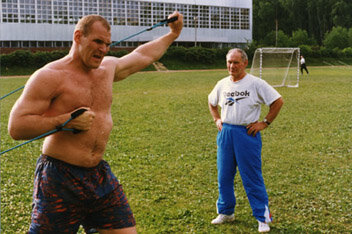
scan007.jpg
Also, to answer the first question in this thread: on this picture from his website, we see Karelin pummeling with the bands. He's using a Deuser Zugseil, medium resistance (30 kg max per hand). We had these at our club for ten years, they just wouldn't die, although I abused them quite a bit - they were still alive when I left. I got myself the grey one (50 kg max per hand) later, but I broke that quite quickly. I should get another one at some point to see if that was a fluke, they still make them and they cost like 20€.
 
Yes and no imho.
Yes, you are supposed to have automatized all your skills ideally to the point where you can do it all without thinking.
However, there's still always people in there, and they will react to stimulus. For example, both my Greco coach and me had wrestling styles that were designed to wear prople out until they break (basically "Iowa style"). And they do break, you can see it in their eyes that they've given up. Then you finish them.
Also, there are reasons why various athletes like to get into a certain mindset before competition, whatever gets them into flow. Some people need to chill out, other people need to get slapped. Some people need longer to warm up, others can go right away. Interrupt that process and you are messing with the person's performance. You can see it in tournaments a lot, especially if matches move a lot faster or slower than expected. Other people will perform badly if a certain person is or isn't there, respectively if they notice that. We had a Chechnyan kid on our team (Saitiev's nephew, lots of family pressure) and he always wrestled shitty if his dad was ringside. We had to remove the dad from ringside and shut him up, then everything was like in training.

Also, your life situation will always have some degree of influence on your performance. Yes, there are physical factors such as less sleep, no appetite and whatnot. But it will mentally affect people differently. Me, I actually wrestle better when I am down, because I turn stone cold, what few inhibitions to violence I have go totally out of the window, my willingness to accept pain and suffering increases and I honestly don't care anymore if they have to carry me off the mat. Fortunately, I don't insult or assault referees in that state (seen that often enough, cost a number of people quite a few matches). However, I really need to watch out for my training partners in such times, so it's a double-edged sword. On the other hand, I wrestle a lot more cautiously when I'm happy, because the back of my mind says I want to be able to walk back out into my life. I am a much more likeable training partner in those times.
So I'd say it is technically possible to turn any circumstance into fuel for your performance, but I don't think everybody is necessarily equally good at doing that with every situation.
Eventually you will either reach a point where you understand that emotions and feelings do not matter or you will never reach your potential. Saying that life will get you down doesn't mean anything because life gets everybody down at some point in time and provided you are not gravely ill you can physically do what you are supposed to do no matter how you feel about it.

Nobody on this earth just walks around happy all the time and if they are telling you they are they are lying.
 
Eventually you will either reach a point where you understand that emotions and feelings do not matter or you will never reach your potential. Saying that life will get you down doesn't mean anything because life gets everybody down at some point in time and provided you are not gravely ill you can physically do what you are supposed to do no matter how you feel about it.

Nobody on this earth just walks around happy all the time and if they are telling you they are they are lying.
That's one way to look at it. And yet, everyone has performance fluctuations apart from injuries etc. The mental influences the physical just like the physical influences the mental. Some people deal with mental fluctuations better than others, just like some people deal with injuries better than others. Some people seek both to a certain extent, others aim for more of a flat curve. Bernard Hopkins once said the he attributed his unusually long career to the fact that other fighters went out to party after their big events, while he was lying in an ice bath afterwards. And yet, you have both top fighters who are party animals (and in fact, I've met some who partied routinely the night before fights and performed much worse if they didn't) and fighters who aren't. Dan John once stated that in his opinion, the problem of most amateurs in training was that "their highs are too low ant their lows are too high" - meaning, they tried to do too much all the time and never slacked off to build to a higher peak. The mental side can be the same.

So, in the end, everyone will end up doing what they feel works best for them. Yes, everyone will face adversity to some degree at some point, and if they don't do that in sport, they may have aimed too low for their potential (in the words of Breaux Greer: "If you've never been injured, you probably suck!"), and the question is how well they overcome it.
 
That's one way to look at it. And yet, everyone has performance fluctuations apart from injuries etc. The mental influences the physical just like the physical influences the mental. Some people deal with mental fluctuations better than others, just like some people deal with injuries better than others. Some people seek both to a certain extent, others aim for more of a flat curve. Bernard Hopkins once said the he attributed his unusually long career to the fact that other fighters went out to party after their big events, while he was lying in an ice bath afterwards. And yet, you have both top fighters who are party animals (and in fact, I've met some who partied routinely the night before fights and performed much worse if they didn't) and fighters who aren't. Dan John once stated that in his opinion, the problem of most amateurs in training was that "their highs are too low ant their lows are too high" - meaning, they tried to do too much all the time and never slacked off to build to a higher peak. The mental side can be the same.

So, in the end, everyone will end up doing what they feel works best for them. Yes, everyone will face adversity to some degree at some point, and if they don't do that in sport, they may have aimed too low for their potential (in the words of Breaux Greer: "If you've never been injured, you probably suck!"), and the question is how well they overcome it.
This is why you NEED auto regulation in an athletic training program. Auto regulation doesn't give you a license to go drink 20 beers on a plane ride from one state to another but rather gives you outs for bad days or to even take advantage of good training days.
 
This is why you NEED auto regulation in an athletic training program. Auto regulation doesn't give you a license to go drink 20 beers on a plane ride from one state to another but rather gives you outs for bad days or to even take advantage of good training days.
So there IS a mental aspect ;)
Again, some people will be to auto-assess well, others will benefit more from pushing through, and still others need to be kicked off the mat by their coach from time to time. It's the coach's job to understand what you need. I doubt AI will be able to fit that role any time soon, unless you fall in the first category to begin with.
 
So there IS a mental aspect ;)
Again, some people will be to auto-assess well, others will benefit more from pushing through, and still others need to be kicked off the mat by their coach from time to time. It's the coach's job to understand what you need. I doubt AI will be able to fit that role any time soon, unless you fall in the first category to begin with.
No this is where a good coach or AI comes into play. You could even say that a good coach is like a PED in many respects.
 
So you "have to reach a point where emotions don't matter" (although of course you may find that they do matter a inopportune times, when the shitstorm you face is bigger than you're used to), but you still have bad days in training - but you may also have very bad days in competition, where supposedly it doesn't matter. So why is it that you then need to auto-regulate? Too much of a challenge for discipline, not enough return for the effort...?
But I wholeheartedly agree on the importance of a good coach.
 
So you "have to reach a point where emotions don't matter" (although of course you may find that they do matter a inopportune times, when the shitstorm you face is bigger than you're used to), but you still have bad days in training - but you may also have very bad days in competition, where supposedly it doesn't matter. So why is it that you then need to auto-regulate? Too much of a challenge for discipline, not enough return for the effort...?
But I wholeheartedly agree on the importance of a good coach.
Like Louie Simmons used to say. Your 90% has to better than your competitions 100%.
 
So you "have to reach a point where emotions don't matter" (although of course you may find that they do matter a inopportune times, when the shitstorm you face is bigger than you're used to), but you still have bad days in training - but you may also have very bad days in competition, where supposedly it doesn't matter. So why is it that you then need to auto-regulate? Too much of a challenge for discipline, not enough return for the effort...?
But I wholeheartedly agree on the importance of a good coach.
Auto regulation allows for bad days and to take advantage of good days. Even the best discipline in the world doesn’t allow for everything to go to plan either in or outside of training. The goal should be for that to happen though.
 
Auto regulation allows for bad days and to take advantage of good days. Even the best discipline in the world doesn’t allow for everything to go to plan either in or outside of training. The goal should be for that to happen though.
Different strategies, then - playing down the mental side could be a strategy you employ to help keeping yours in check. Just saying.
As written before, my experience is that for me, different mental states require different countermeasures in training. In matches, it doesn't really matter too much in terms of procedure, since I always use the same strategies to get myself ready, and I only have to care about the ruleset, not whether or not my opponent is willing to ever compete against me again.
 
Back
Top