
Opinion What's the deal with layman(s) questioning the credentials and scientific ability of actual experts?

Idk I think there are 2 things at play here.

#1 - People simply don't seem to understand that any study is not the be-all-end-all, but simply weighted evidence. That goes from everything from COVID vax studies to the Cass Report. Some evidence is obviously weighted heavier and more credible than others, but nothing should be considered gospel.

#2 - There is a difference between being skeptical and blatantly refusing evidence because it comes from a distrusted source. This is the issue I think OP is referencing.

Like, a true skeptic would say "How was the study conducted? How many people were involved? What are other critics saying about this study?" etc. They would attack the study itself, not necessarily the source. And even if it does come from an obviously biased source, that still doesn't necessarily mean it's not a valid take, it just means we need to scrutinize it much more.

----

The problem is we have people saying "X and Y has been PROVEN by these studies (that often really just say x + y might be more likely)" or we get folks saying "I don't trust that study BECAUSE it's from the CDC" (or insert source) while simultaneously accepting evidence from fuckin YouTube lol.
To emphasize your point, there are different types of skeptics.

There is skepticism based on knowledge and skepticism from ignorance.

An expert questioning the conclusion of other experts.

vs.

The 9th grade drop out who doesn't believe evidence because they dont understand it and found something to the contrary, on tik tok.

I think much of what we encounter as a society (atleast in the US) is unfortunately the latter.
 
To emphasize your point, there are different types of skeptics.

There is skepticism based on knowledge and skepticism from ignorance.

An expert questioning the conclusion of other experts.

vs.

The 9th grade drop out who doesn't believe evidence because they dont understand it and found something to the contrary, on tik tok.

I think much of what we encounter as a society (atleast in the US) is unfortunately the latter.


As usual, there's a middle ground between these two extremes.
 
As usual, there's a middle ground between these two extremes.
Eh I dont know man.
I think the more established something is by experts, the skepticism comes from the polar opposite, people who are supremely unqualified

At least that I can think of?

ie. Astronomers vs Flat Earthers.

I dont think there are somewhat qualified people (or of middle ground) that believe the Earth is flat.
 
Eh I dont know man.
I think the more established something is by experts, the skepticism comes from the polar opposite, people who are supremely unqualified

At least that I can think of?

ie. Astronomers vs Flat Earthers.

I dont think there are somewhat qualified people (or of middle ground) that believe the Earth is flat.
Sure but that's one example.

Put it another way. Most people criticizing economic decisions are not economists. That doesn't mean their argument isn't worth listening to. The War Room is filled with people who have zero academic standing in whatever topic they're criticizing, and it isn't just "those other guys" either. At some point or another, everyone disagrees with "the experts" on something.

But it can happen the opposite way too. Neil Degrasse Tyson is definitely a scientist, and smarter than the vast majority of people. But he also talks out of his ass on certain topics and sometimes says some stuff that's borderline batshit insane. But because he's a "scientist" his opinion can hold more worth to some people, even though he isn't an expert.

Basically, everything is a case by case basis. Its too easy to sweep everything under the rug of generalization. Arguments against experts should be weighed the same way as arguments against anything else. Look at whatever they're saying and why, then compare it to whatever it is they're criticizing. Yes, you'll get some crazy shit like covid vaccines have nano bots or that people can't tell the difference between a man and a woman, but those aren't the only type that you'll hear.
 
Eh I dont know man.
I think the more established something is by experts, the skepticism comes from the polar opposite, people who are supremely unqualified

At least that I can think of?

ie. Astronomers vs Flat Earthers.

I dont think there are somewhat qualified people (or of middle ground) that believe the Earth is flat.
The guy you're talking to doesn't really get it. He is the inevitable result and what is always going to happen if scientists and politicians and the corporations who fund scientists are not honest.

As soon as you get scientists and corporations lying, you're going to get crackpots who think their ideas are just as good as education in general and the scientists opinions.specificaly.

The only way to fix it is to have scientists and corporations and politicians stop lying about things and then the tin foil hat people would never gain any purchase of any kind.


Since the solution is so simple and easy, we will never ever implement it.
 
To emphasize your point, there are different types of skeptics.

There is skepticism based on knowledge and skepticism from ignorance.

An expert questioning the conclusion of other experts.

vs.

The 9th grade drop out who doesn't believe evidence because they dont understand it and found something to the contrary, on tik tok.

I think much of what we encounter as a society (atleast in the US) is unfortunately the latter.
FoUSNFwaQAAlDVS
 
Pretty funny, someone thinking they don't exist.

Out of curiosity, do you have a sense for how it came to be that there was no term or research into or acknowledgement by scientists of their existence until 2004?

Seems like it would have been a pretty "no shit" type of hypothesis and reality, but was missed or ignored for many many decades by the scientific community?

Is it because of the funding captivity and narrow scope of what scientists reasearch based on only looking at what someone will pay them to look at? And a severe lack of "free-range" research at any moderate or high level of sophistication and technological resource?
Hey @Brampton_Boy not sure if you missed this?

Also I eanted to share somethingnon topic I found really funny...

After reading this thread CBS radio did a piece on microplastics and they said that chewing a stick of gum once every 2 days could results in a person ingesting 30,000... "microplastics"

I laugher my ass off since it seems like such a stretch of how that term applies to physical objects, and since there's a huge range of sizes of the particle size of plastics now referred to as microplastics. Hearing a reference to a specific number of them just sounded so wrong hahah!
 
Hey @Brampton_Boy not sure if you missed this?

Also I eanted to share somethingnon topic I found really funny...

After reading this thread CBS radio did a piece on microplastics and they said that chewing a stick of gum once every 2 days could results in a person ingesting 30,000... "microplastics"

I laugher my ass off since it seems like such a stretch of how that term applies to physical objects, and since there's a huge range of sizes of the particle size of plastics now referred to as microplastics. Hearing a reference to a specific number of them just sounded so wrong hahah!
 
Take the profiteering out of science and people will trust it again. Tell us why things are bad, don't give us lies and hyperbole that will make you look like a liar in 5 years.

But then how will they get funding?

They're fighting over grant money. Being reasonable would just lead to them being drowned out by the alarmists.

Science is just as much a part of the idiocracy as any other part of our society.

It's just like with the race hustlers. If they fixed the problem, they wouldn't need funding any more, so they'd be out of a job. So it has to go on forever with increasingly hysterical claims to justify more money.
 
Sure but that's one example.

Put it another way. Most people criticizing economic decisions are not economists. That doesn't mean their argument isn't worth listening to. The War Room is filled with people who have zero academic standing in whatever topic they're criticizing, and it isn't just "those other guys" either. At some point or another, everyone disagrees with "the experts" on something.

But it can happen the opposite way too. Neil Degrasse Tyson is definitely a scientist, and smarter than the vast majority of people. But he also talks out of his ass on certain topics and sometimes says some stuff that's borderline batshit insane. But because he's a "scientist" his opinion can hold more worth to some people, even though he isn't an expert.

Basically, everything is a case by case basis. Its too easy to sweep everything under the rug of generalization. Arguments against experts should be weighed the same way as arguments against anything else. Look at whatever they're saying and why, then compare it to whatever it is they're criticizing. Yes, you'll get some crazy shit like covid vaccines have nano bots or that people can't tell the difference between a man and a woman, but those aren't the only type that you'll hear.

Everyone has an opinion, we mostly talk shit up in the War Room (as far as I can surmise)

Most of us probably came here to chop it up and give our opinions on MMA, none (or infinitesimally few) of us are fighters or experts.

If we had a discussion on the best training regiment for a fighter preparing for a d1 wrestler, and Daniel Cormier stepped in the room, it would be idiotic for us to think our jibber jabber has the same weight or even significance compared to Cormier

Its human nature to have an opinion and share it, thats not what TS is talking about. Its people who think their opinion has any value without basis against people with expertise.


Degrasse Tyson like say Sam Harris, Noam Chomsky or Richard Dawkins are public intellectuals. In addition to being scientists, they weigh in on many more issues with some merit , more than say a shoe salesman, on a variety issue.
 
Everyone has an opinion, we mostly talk shit up in the War Room (as far as I can surmise)

Most of us probably came here to chop it up and give our opinions on MMA, none (or infinitesimally few) of us are fighters or experts.

If we had a discussion on the best training regiment for a fighter preparing for a d1 wrestler, and Daniel Cormier stepped in the room, it would be idiotic for us to think our jibber jabber has the same weight or even significance compared to Cormier

Its human nature to have an opinion and share it, thats not what TS is talking about. Its people who think their opinion has any value without basis against people with expertise.


Degrasse Tyson like say Sam Harris, Noam Chomsky or Richard Dawkins are public intellectuals. In addition to being scientists, they weigh in on many more issues with some merit , more than say a shoe salesman, on a variety issue.

Re: Cormier. I get your point, and you're right. But it isnt quite an apples to apples comparison. I think I know pretty much what your position is, and we probably agree more than not. That there are experts and it's much more likely that they know what theyre talking about over non experts. Fair. No argument there. But theres some topics where it does get a little bit muddled like, say, almost anything where a political bent is involved or a large amount of donors that on might argue have an agenda. Like I said, I think a case by case basis is better than generalizations.

And I agree about Harris, Chomsky, etc. At the same time the same could be said of someone like Jordan Peterson, who gets tons of counter arguments from the left side of the aisle, despite being smarter than the vast majority of them. I can admit that Chomsky is 100 times smarter than Ill ever be, but I also think the man is a batshit lunatic and has insane positions. So what Im saying is, again, case by case. I'll listen to almost anyones argument to anything. Then I can weigh it against whatever the opposing side has to say and go from there.
 
Re: Cormier. I get your point, and you're right. But it isnt quite an apples to apples comparison. I think I know pretty much what your position is, and we probably agree more than not. That there are experts and it's much more likely that they know what theyre talking about over non experts. Fair. No argument there. But theres some topics where it does get a little bit muddled like, say, almost anything where a political bent is involved or a large amount of donors that on might argue have an agenda. Like I said, I think a case by case basis is better than generalizations.

And I agree about Harris, Chomsky, etc. At the same time the same could be said of someone like Jordan Peterson, who gets tons of counter arguments from the left side of the aisle, despite being smarter than the vast majority of them. I can admit that Chomsky is 100 times smarter than Ill ever be, but I also think the man is a batshit lunatic and has insane positions. So what Im saying is, again, case by case. I'll listen to almost anyones argument to anything. Then I can weigh it against whatever the opposing side has to say and go from there.
I'll agree it depends on the subject and the participants

But if the subject is say Astro-physics (or closely/somewhat related) it makes sense to defer to Tyson
is the subject is linguistics/global politics (or closely/somewhat related) , it makes sense to defer to Chomksy
if its Neuroscience, Harris etc.


If the debate is, Is Star Wars better than Star Trek, everyones opinion probably has the same weight
 
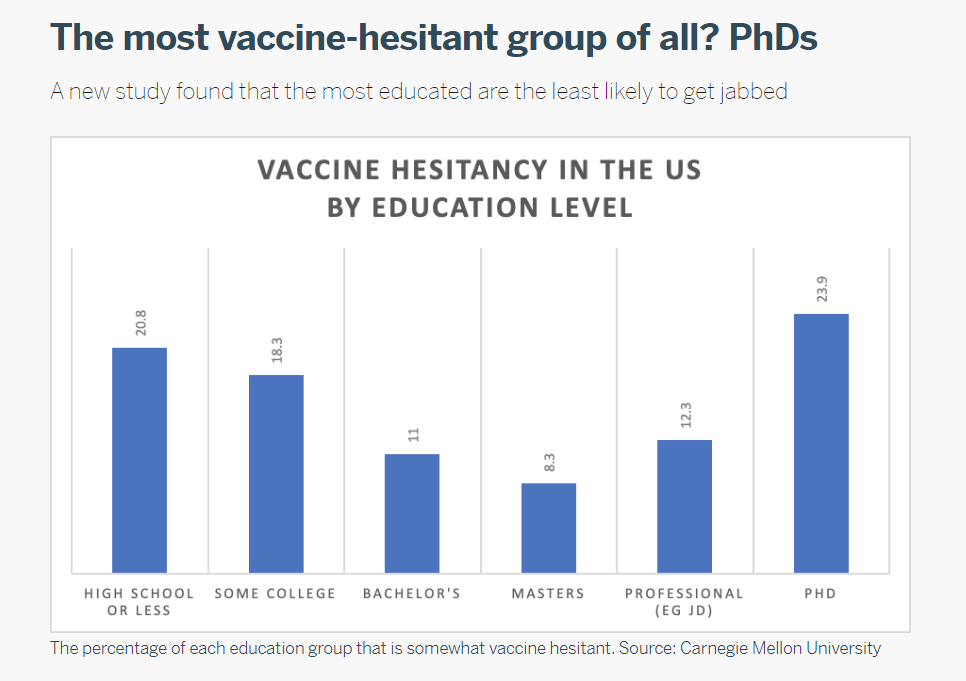
This is an interesting stat thats news to me.


Yeah this could illustrate skepticism , potentially from knowledge, ie. PHds in microbiology, biology, bio-medicine virology. ( The PHds aren't identified)

Not the latter which TS is talking about, skepticism from ignorance.
 
Back
Top