clear
clc
% you need to have this script, the stlread function (by Eric Johnson
% https://www.mathworks.com/matlabcentral/fileexchange/22409-stl-file-reader),
% and the file to be analyzed all in the same working directory.

% The output rotations should be applied one at a time, in the order of
% Z then X.

% Choose your file.
filename='your_model_here.stl';

% Acceptable overhang angle (in degrees).  Must be between 0-90 with 45
% generally considered the standard.
acceptable_angle=45;

% Choose how many iterations you want to test.  This will be automatically
% rounded if it does not produce equaly sized steps.  4050 will produce
% orientations in four degree increments; 16200 for two degrees; 64800
% for one degree.
iterations=64800;

% Choose the radius (in degrees) used to exclude nearby local minimums when
% culling the results.  This prevents a noisy plot from producing many
% local minimums all within a small range to the exclusion of candiates
% in other orientations.
search_radius=30;

% Choose maximum number of local minimums to consider for refinement after
% culling is completed.
minimum_limit=10;

% Choose refinement iterations.  Set to zero to not run refinement.  This
% should be at least 50 to be worth the time.  Like with iterations this
% will be rounded if necessary to produce even spacing.
refinements=225;

% Show graphs?  1 or 0.
show_graphs=1;


% % % From here on is the functional code.  DO NOT CHANGE.
% Import the file
[F,V,N]=stlread(filename);
F=F';
V=V';
N=N';
[whatever,faces]=size(F);

% define steps
Rx_steps=round(sqrt(iterations/2));
Rz_steps=Rx_steps*2;
[Rx,Rz]=meshgrid(0:180/Rx_steps:180, 0:360/Rz_steps:360-360/Rz_steps);

% Define storage matrix
N_temp=N;
overhang_factor=zeros(Rx_steps+1,Rz_steps)';

% Find each face area
vector1=zeros(3,faces);
vector2=zeros(3,faces);
for x=1:faces
    vector1(:,x)=(V(:,x*3)-V(:,x*3-1))';
    vector2(:,x)=(V(:,x*3)-V(:,x*3-2))';
end
temp=cross(vector1,vector2);
Area=(sqrt(temp(1,:).^2+temp(2,:).^2+temp(3,:).^2)/2);

% Set plane vectors for finding angles
plane=zeros(size(N));
plane(3,:)=-1;


%do top orientation, all z rotations will be the same
N_temp=N;
% find angles, setting anything above the threshold to 90 so they
% don't count towards the area calculation
plate_angle=acosd(dot(N_temp,plane));
angle_modified=plate_angle;
angle_modified(angle_modified(:,:)>acceptable_angle)=90;
projected_factor=sum(abs(cosd(angle_modified).*Area));
overhang_factor(:,1)=projected_factor;

%do bottom orientation, all z rotations will be the same
% rotate to bottom
Ty=[cosd(180),0,sind(180);0,1,0;-sind(180),0,cosd(180)];
N_temp=Ty*N;
% angles
plate_angle=acosd(dot(N_temp,plane));
angle_modified=plate_angle;
angle_modified(angle_modified(:,:)>acceptable_angle)=90;
projected_factor=sum(abs(cosd(angle_modified).*Area));
overhang_factor(:,Rx_steps+1)=projected_factor;

%do the rest of the orientations
for X=2:Rx_steps
    % show the progam is doing work
    clc
    Initial_Iteration_Progress=X/Rx_steps*100
    for Z=1:Rz_steps
        % do the rotations in sequence, z then x
        Tz=[cosd(Rz(Z,X)),-sind(Rz(Z,X)),0; sind(Rz(Z,X)),cosd(Rz(Z,X)),0; 0,0,1];
        Tx=[1,0,0; 0, cosd(Rx(Z,X)),-sind(Rx(Z,X)); 0,sind(Rx(Z,X)),cosd(Rx(Z,X))];
        N_temp=Tz*N;
        N_temp=Tx*N_temp;
        % angles, again
        plate_angle=acosd(dot(N_temp,plane));
        angle_modified=plate_angle;
        angle_modified(angle_modified(:,:)>acceptable_angle)=90;
        projected_factor=sum(abs(cosd(angle_modified).*Area));
        overhang_factor(Z,X)=projected_factor;
    end
end


% % % Reduce Data
% vectorize
Rx_vector=Rx(:);
Rz_vector=Rz(:);
overhang_factor_vector=overhang_factor(:);
% sort
[overhang_factor_vector,order]=sort(overhang_factor_vector);
Rx_vector=Rx_vector(order);
Rz_vector=Rz_vector(order);

% initialize 'while' count data
[reduced_size,whatever]=size(overhang_factor_vector);
reduce_index=1;
% loop through the whole thing, need while loop because data it is
% dynamically resized
while reduce_index<=reduced_size
    deleteme=zeros(size(overhang_factor_vector));
    % set all points within range of current point to be deleted
    deleteme(Rx_vector<=Rx_vector(reduce_index)+search_radius ...
        & Rx_vector>=Rx_vector(reduce_index)-search_radius ...
        & Rz_vector<=Rz_vector(reduce_index)+search_radius ...
        & Rz_vector>=Rz_vector(reduce_index)-search_radius)...
        =1;
    deleteme(reduce_index)=0; %don't delete yourself, dummy
    % delete candidates
    overhang_factor_vector(deleteme==1)=[];
    Rx_vector(deleteme==1)=[];
    Rz_vector(deleteme==1)=[];
    % move on to next step
    reduce_index=reduce_index+1;
    [reduced_size,whatever]=size(overhang_factor_vector);
    % show the program is doing work
end

% keep only the best candidates
if reduced_size>minimum_limit
    overhang_factor_vector=overhang_factor_vector(1:minimum_limit);
    Rx_vector=Rx_vector(1:minimum_limit);
    Rz_vector=Rz_vector(1:minimum_limit);
end


if refinements~=0
    % find the array of sub-angles to test at each location
    sides=round((sqrt(refinements)-1)/2);
    [basic_square_x,basic_square_z]=meshgrid(-sides:sides,-sides:sides);
    basic_square_x=basic_square_x*(180/Rx_steps/(sides+1));
    basic_square_z=basic_square_z*(180/Rx_steps/(sides+1));

    % do the refining
    [points_to_refine,whatever]=size(overhang_factor_vector);
    for refine=1:points_to_refine
        refine_square_x=basic_square_x+Rx_vector(refine);
        refine_square_z=basic_square_z+Rz_vector(refine);
        refined_overhang_factor=zeros(size(refine_square_x));
        for X=1:sides*2+1
            for Z=1:sides*2+1
                % do the rotations in sequence, z then x
                Tz=[cosd(refine_square_z(Z,X)),-sind(refine_square_z(Z,X)),0; sind(refine_square_z(Z,X)),cosd(refine_square_z(Z,X)),0; 0,0,1];
                Tx=[1,0,0; 0, cosd(refine_square_x(Z,X)),-sind(refine_square_x(Z,X)); 0,sind(refine_square_x(Z,X)),cosd(refine_square_x(Z,X))];
                N_temp=Tz*N;
                N_temp=Tx*N_temp;
                % angles, again
                plate_angle=acosd(dot(N_temp,plane));
                angle_modified=plate_angle;
                angle_modified(angle_modified(:,:)>acceptable_angle)=90;
                projected_factor=sum(abs(cosd(angle_modified).*Area));
                refined_overhang_factor(Z,X)=projected_factor;
            end
        end
        % vectorize
        refine_square_x=refine_square_x(:);
        refine_square_z=refine_square_z(:);
        refined_overhang_factor=refined_overhang_factor(:);
        % sort
        [refined_overhang_factor,order]=sort(refined_overhang_factor);
        refine_square_x=refine_square_x(order);
        refine_square_z=refine_square_z(order);
        % save
        Rx_vector(refine)=refine_square_x(1);
        Rz_vector(refine)=refine_square_z(1);
        overhang_factor_vector(refine)=refined_overhang_factor(1);

        clc
        refining_progress=refine/points_to_refine*100
    end
end


% Give output of candidates
clc
ordered_canditates_Rx_Rz=[Rx_vector,Rz_vector]

if show_graphs==1
    % Plot the Candidates
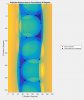
    figure('name','Results and Candidates','units','normalized','outerposition',[0 0.05 0.6 0.9])
    hold on
    surf(Rx,Rz,overhang_factor,'linestyle','none');
    title(['Projected Surface Area for Faces Below ',num2str(acceptable_angle),' Degrees'])
    xlabel('X Rotation (Degrees)')
    ylabel('Z Rotation (Degrees)')
    axis equal
    axis([0 180 0 360])
    view(0,-90)
    h1=scatter3(Rx_vector,Rz_vector,overhang_factor_vector,'black','filled');
    h2=scatter3(Rx_vector(1),Rz_vector(1),overhang_factor_vector(1),'red','filled');
    legend([h2,h1],'Best Candidate','Other Minimum Candidates','Location','eastoutside')

    % Show the best orientations
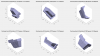
    orientations_to_plot=6;
    if minimum_limit<6
        orientations_to_plot=minimum_limit;
    end

    figure('name',['Top ',num2str(orientations_to_plot),' Candidates'],'units','normalized','outerposition',[0.05 0.05 0.9 0.9])
    for x=1:orientations_to_plot
        Tz=[cosd(Rz_vector(x)),-sind(Rz_vector(x)),0; sind(Rz_vector(x)),cosd(Rz_vector(x)),0; 0,0,1];
        Tx=[1,0,0; 0, cosd(Rx_vector(x)),-sind(Rx_vector(x)); 0,sind(Rx_vector(x)),cosd(Rx_vector(x))];
        V_temp=Tz*V;
        V_temp=Tx*V_temp;
        subplot(2,3,x)
        patch('Faces',F','Vertices',V_temp','FaceColor',       [0.8 0.8 1.0], ...
                 'EdgeColor',       'none',        ...
                 'FaceLighting',    'gouraud',     ...
                 'AmbientStrength', 0.15);
        camlight('headlight');
        material('dull');
        axis('image');
        title(['Overhang Area (',num2str(round(overhang_factor_vector(x))),') Orientation (Z ',num2str(round(Rz_vector(x))),' Degrees, X ',num2str(round(Rx_vector(x))),' Degrees)'])
        view([45 45]);
    end
end