I honestly don't understand why Conor is such a huge draw. Is it just because he's white and talks shit?
If it's just that, I'll watch Nate Diaz, or heaven forbid his GOAT brother, fight any day over Conor. They're more exciting and their trash talk is genuine.
He's white, he talks shit, he has a fun style, and he's a legitimately outstanding fighter, plus luck is a huge factor because it kind of snowballs at some point (the hype itself becomes part of the draw, which then builds the hype more, etc.).
Well, even if you suppose that receiving (or rather soliciting) donations has no effect on policy stances, which I frankly think is a little obtuse to how fundraising and how politicking works, that doesn't change the effect of allowing more money to go to persons with certain positions on an issue and amplifying already-disproportionate political speech towards advocacy of positions helping large aggregations of power and capital.
Yes, that's not relevant to my dispute with Viva (which is about the mechanism by which money affects politics) but it's a fair point in response to my response to Lead. That said, what actual changes have we seen since CU? And which of them can be attributed to that effect? Regressive tax cuts and deregulation is happening, but it's not popular among anyone--even Republican voters tend to acquiesce to that agenda in exchange for sending a message to minorities and coastal professionals. As I pointed out to
@JudoThrowFiasco in another thread, the GOP tax bill wasn't sold to the public as a tax break for overburdened rich people; it was sold as boosting middle-class incomes. The fact that they feel the need to lie about it tells you all you need to know about who is winning the war of ideas.
Even if you deny the "corrupting" argument, it still has the same end result of bending the democratic process towards arguably non-democratic results.
Non-democratic results = less-popular ideas winning rather than bad ideas being popular. That can be attributed to gerrymandering, the electoral college, consistently poor turnout by left-leaners (voter suppression is part--but only part--of that), and natural sorting. I don't think it can be attributed to CU.
You could make an argument about the optics, but I think its detrimental effect is undeniable. And I think the data on the rise in campaign spending reflects that. Campaign spending has continued to balloon even though disposal income per capita has plateaued.
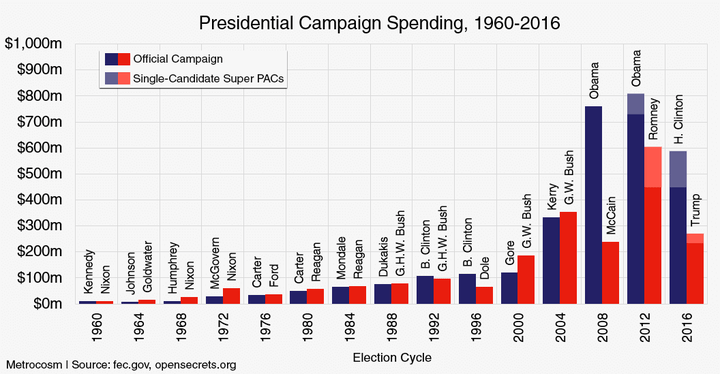
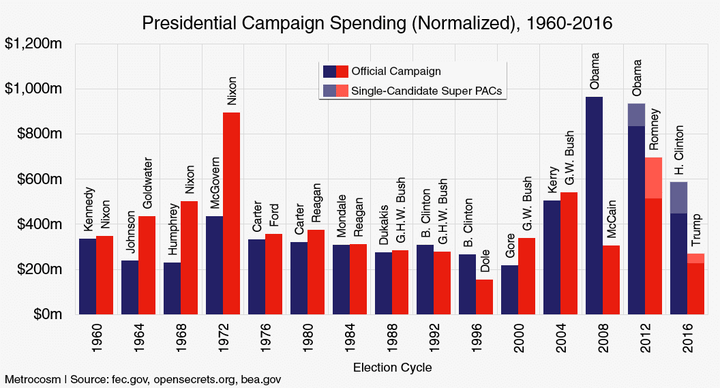
The factual basis for that this is off. Look at presidential elections:
https://www.huffingtonpost.com/entr...spending-how-2016_us_5820bf9ce4b0334571e09fc1
Here's nominal spending:
Here's spending adjusted for real GDP growth:
Obama might have by himself given the impression of a trend, but he just appears to be an outlier.
BTW, that doesn't go back before 1960, but 1896 was far higher than 2012 if you adjust for GDP.
Lobbying spending has been falling since 2009 (2010 in *nominal* terms). And I think that's because of research increasingly showing that it's wasted.