I agree on its defined by "Principles" Karate by design is based on Form, Balance and Center of Gravity.
Where in say Wing Chun by design its based on Centreline Theory.
Then for Boxing by design is based on physical preparation, close quarter techniques and tactics.
However one could argue they overlap and are transferable with modifications.
I don't know enough would need to be a sports science professor holding a Phd and Doctorate to dig deeper into the core and variances.
This is a nice comment. We don't see this thinking in MMA. I'll break it down to make some overall contribution. What's good here, is just as you advocate, you are delving into the nature of the styles and the principles behind them.
Where in say Wing Chun by design its based on Centreline Theory.
The BAsis for TMA
All the TMAs are based off the same fundamental underlying human potentials. Body, mind, spirit. The caveat is that this is all complex compared to boxing, normal Muay Thai practice, etc.
Wing Chun & the Centerline
Wing Chun is very specific about it's centerline theory. This serves multiple purposes. The tactical one most voiced is to protect the vital parts & organs of the body. Wing chun stands square on because it relies on active blocking, striking w countering more than the karates and especially more than boxing. This is one of the reasons Wing chun fails all over YT because the active application of these techniques take a very great measure of mental discipline compared to lesser arts like karate, boxing. IOW, people can't do it.
Traditional Karate & Centerline.
Traditional karate also employs the centerline... but is not so absolute in it's emphasis. The kihon or basic techniques are learned & practiced 1st from the square on horse stance, and the essentially square on lunge stance or front or forward stance. Technique wise, one is at first striking to the centerline just as in Wing Chun. So technically, they both start out the same. Then karate varies off the centerline in application some what more. That variation, however, is still center oriented often times.
Linearity of Strikes.
Both of these tie into the linearity of strikes. The shortest distance between two points, hence inherently quickest & efficient at reaching the target.
TMA Body Mechanics.
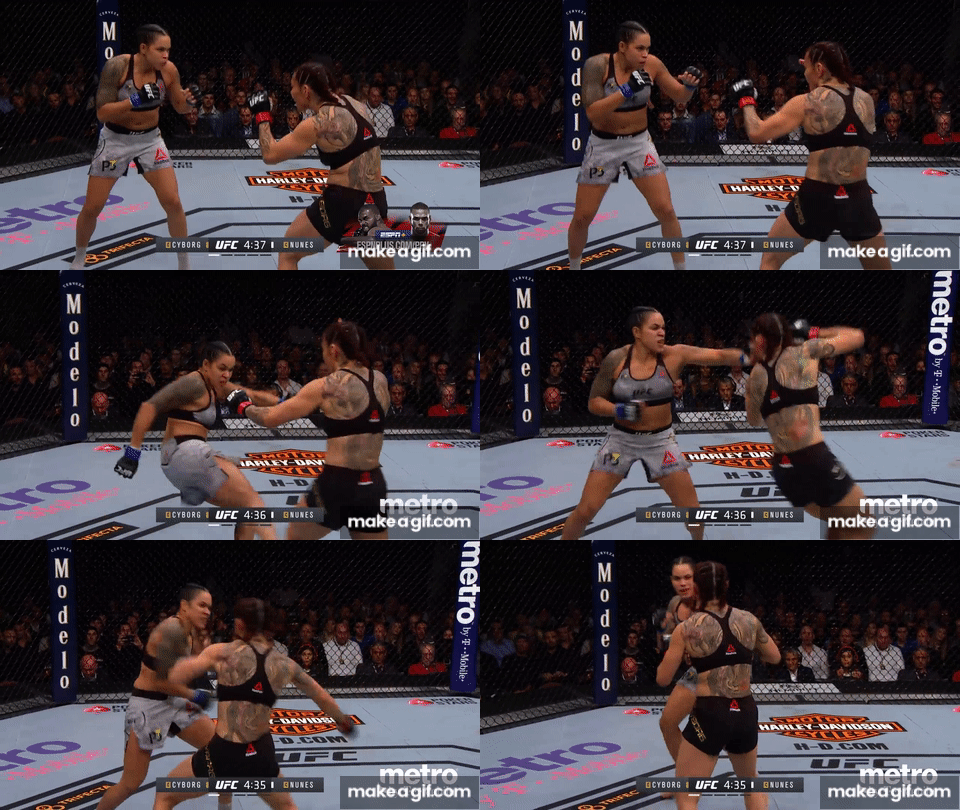
Targeting to the center also has important basic structural purposes. This is made very plain by the lunge or front or forward stance in Shotokan, karate generally, & kung fu. TMA body mechanics. These body mechanics directed at the center facilitate the transmission of power. Don't believe it? Just look @ the gifs I posted of the Cyborg strikeout against Nunes. For bottom line practical purposes, useless martial arts striking.
Differences in Body Mechanics.
These body mechanics and the importance of them is made plain & much easier to grasp in a simple karate like Shotokan, with the deeper stances and physical strength utilized in them. In Wing Chun, we are talking great reliance on internal kinds of strength,,, which MMA claims doesn't exist or is a fraud... so now you know why Wing Chun will never ever work for MMA. Ever. Never, ever. However, the conditioning exercises & training in Shotokan, if done mindfully, will also develop strength inside. Not to the same degree as Wing Chun by any means.
I'll post the Taikyoku kata (you know that stupid, baby kata) fo illustrate centerline theory.
EDIT:
Boxing & the Centerline.
Boxing is also centerline oriented, but also non-centerline oriented. My layman understanding of this by Boxing Science is that boxers are primarily interested in landing heavy physical blows to the opponent's body by varying avenues from a fairly standard set of punching strikes. And all quite effective. That's what boxers have always done against me.
Boxing is very mindful of blows coming into the person via centerline. Hence the basic boxing stance is tilted or bladed to reduce striking & aid deflection for defensive purposes all of which makes perfect sense. The hands up guard to protect the head same general reason. All completely thought out boxing science.
p.s. all this about karate is evident in the traditional curriculum as far as karate is concerned.





 Physical form alone in karate means nothing, in principle.

 Man, you are right, but when I make a thread, because there is very old thread on the topic, there are always guys who say- that such thread already exists.