Economy The [Wall / Government Shutdown] Megathread

Would you approve of Trump using emergency powers to build his wall?


  • Total voters
    92
  • Poll closed .
Rasmussen has never been accurate regardless of what anyone says or has said. It's pretty widely known that this is so and a simple google search will confirm this.

serveimage


Where was this post during all the times that Trump's approval ratings were below 50%?

Yet you NOW decide to put this "information" up when he's finally above 50%?

Keep on spinning, buddy. <Jaime01>
 
serveimage


Where was this post during all the times that Trump's approval ratings were below 50%?

Yet you NOW decide to put this "information" up when he's finally above 50%?

Keep on spinning, buddy. <Jaime01>

Sorry but it's been about five or six years since I was consistently posting on here. Historically speaking, Rasmussen polling has been one of the least accurate major polling firms and was actually founded by Scott Rasmussen who used to be a GOP operative. I thought this was common knowledge but apparently not.
 
Yeah...about that "GOP Operative" thing :


If Rasmussen Reports is a "Republican-leaning pollster," then what exactly does that make everyone else? While it's true that they consistently find more favorable approval ratings for the president than other polls, including Gallup, it's also true that they have established a more accurate track record of gauging his true level of support among the electorate.


Gallup tracks adults, not the voting electorate.


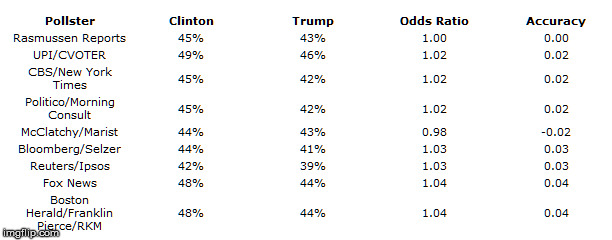
Let's take a look at the top 10 pollsters aggregated by Real Clear Politics (RCP) in 2016 regarding the national popular vote, using a measure of accuracy proposed by Martin, Traugott and Kennedy and used by the American Association for Public Opinion Research to rank accuracy.


2thlqc.jpg


Why aren't those who performed more poorly than Rasmussen referred to as "Democrat-leaning pollsters"? How about "less accurate-leaning pollsters"?


After its monumental failure in 2016, we had high hopes the polling industry would finally engage in a long overdue exercise in introspection. The 2016 presidential election wasn’t the first major polling blunder in U.S. politics, but it does appear to be the one in which media pollsters lost the public trust.


A meager 26% say they trust most political polls, while 55% do not.


Rather than show a little humility for the greater good of the industry, "Democrat-leaning" pollsters had a conversation among themselves, excluding those of us who polled the election correctly. The same pundits and glorified poll-readers (forecasters) who trashed Gallup during and after the 2012 presidential election now turn to them to validate their own biases and preconceived notions.


Gallup has been polling since before I was in diapers, and I get no pleasure from criticizing them. Over the course of decades, they were wrong only one time before they underestimated Barack Obama's support in 2012. In 1948, Gallup had incumbent Democratic President Harry S. Truman trailing Republican Thomas E. Dewey by final survey, 49.5% to 44.5%.


That's undeniably a solid track record. But the fact remains Gallup's political polling has been unverifiable since they quit the horserace business after their misfire in 2012. If you don't have confidence enough in your own data to test it against actual Election Day results, I'm not sure how much you can or should contribute to the conversation.


Trump easily defeated Hillary Clinton in the Electoral College by carrying states Republicans haven’t carried since the 1980s. The PPD Big Data Poll, which was not aggregated and considered to use an experimental online methodology, ended up one of only two state-level surveys that predicted his victory, the other being Trafalger Group.


In several states including Wisconsin, Michigan and Pennsylvania, Trump trailed outside the average margin of error in "Gold Standard" polls.


It's not only "Republican-leaning pollsters” arguing that results matter.


Mark Penn, the co-director of the Harvard-Harris Poll and former pollster for Bill Clinton during six years of his presidency, has repeatedly mirrored my criticisms of the industry. His poll eliminates undecided voters, tracks likely voters and consistently pegs Trump's approval around 45%, very similar to Rasmussen.


Mr. Penn warned that "reality versus research will again be tested, and reality always wins."

http://www.rasmussenreports.com/pub...can_leaning_what_does_that_make_everyone_else


>>> And consider that this "GOP-biased" Polling system consistently had Trump BELOW 50% up till recently.

Their "credibility" wasn't in question THEN.

Gee...what changed, I wonder? o_Oo_Oo_O
 
Seriously, you're posting an article from Rasmussen defending itself against accusations of bias and inaccuracy ?
 
Seriously, you're posting an article from Rasmussen defending itself against accusations of bias and inaccuracy ?

Because they bring up actual statistics instead of "Google it".

I tend to trust actual Proof backed up by stats, thank you. <LordRoose>
 
Sorry but it's been about five or six years since I was consistently posting on here. Historically speaking, Rasmussen polling has been one of the least accurate major polling firms and was actually founded by Scott Rasmussen who used to be a GOP operative. I thought this was common knowledge but apparently not.


Convenient excuse. You have been posting somewhat often (I see posts from January, for example) so you were well aware of where his approval rating was.

Yet, the moment someone put up the Positive poll (a rarity these days for Trump), here you come to try and pour cold water over it. Pathetic. <Prem973>
 
Last edited:
‘It will create a firestorm’: Mulvaney’s border wall cash grab sparks dissent in White House
The pitfalls of a plan for Trump to shift federal dollars without an emergency declaration are coming into clearer view.

The White House is firming up plans to redirect unspent federal dollars as a way of funding President Donald Trump’s border wall without taking the dramatic step of invoking a national emergency.

Done by executive order, this plan would allow the White House to shift money from different budgetary accounts without congressional approval, circumventing Democrats who refuse to give Trump anything like the $5.7 billion he has demanded. Nor would it require a controversial emergency declaration.


The emerging consensus among acting chief of staff Mick Mulvaney and top budget officials is to shift money from two Army Corps of Engineers’ flood control projects in Northern California, as well as from disaster relief funds intended for California and Puerto Rico. The plan will also tap unspent Department of Defense funds for military construction, like family housing or infrastructure for military bases, according to three sources familiar with the negotiations.

“There are certain sums of money that are available to the president, to any president,” Mulvaney said on “Meet the Press” Sunday. “So you comb through the law at the president's request ... And there's pots of money where presidents, all presidents, have access to without a national emergency.”

But the strategy is far from a cure-all for a president with no good options, and it has already sparked debate within the White House. Moving funds by executive order is virtually certain to draw instant court challenges, with opponents, including some powerful members of Congress, arguing the president is encroaching on the legislative branch’s constitutional power to appropriate funds.

Some Trump officials, including those aligned with senior adviser Stephen Miller, have argued internally that the gambit might be even more vulnerable to court challenges than a national emergency declaration. And in a sign of the political fallout, the top Republican on the House Armed Services Committee has argued that tapping military construction money would hurt the armed forces’ potential readiness.

Until now, Trump officials had focused on the drawbacks of a possible national emergency declaration. But as the alternative option of moving money by executive order has come into clearer relief ahead of a Feb. 15 deadline for a spending deal with Congress that could avert a new government shutdown, so have the risks of that alternative option.

“It will create a firestorm, once you start taking money that congressmen think is in their districts,” said Jim Dyer, a former staff director for the House Appropriations Committee. “You will cause yourself a problem if that money was directed away from any type of project or activity because I guarantee it has some constituency on Capitol Hill.”

Inside the White House, the president’s lawyers have for weeks grappled with the question of how to defend Trump should he choose to assert broad executive powers to build the wall. While the phrase “national emergency” has an extreme ring, some administration attorneys note that it is a well-established power under a 1976 law that has been invoked 58 times by past presidents. They call it uncontroversial that presidents have broad discretion to declare a national emergencies and similarly broad authority to deal with them.

“President is on sound legal ground to declare a National Emergency … this is hardly unprecedented,” Trump tweeted on Sunday, quoting comments by Rep. Tom McClintock (R-Calif.)

“The appeal of the national emergency is really the hope that, by just declaring it, by mouthing the words ‘national defense,’ what they would be doing is saying to the courts, ‘Hands off, this is a military determination and you can’t touch it,’” said David French, a senior fellow at the National Review Institute and a former JAG attorney. (Trump has said he would invoke emergency powers in the name of national defense against drugs, criminals and even terrorists.)

A national emergency declaration, however, does not unlock unlimited powers and would be subject to court challenges. The White House counsel’s office has been studying two statues in detail that Trump could invoke under national emergency circumstances — and both come with problems.

One, 10 USC Section 2808, authorizes military construction projects that support the use of the armed forces. Those are typically things like barracks, helipads and other military fortifications. The other, 33 USC Section 2293, allows the Secretary of the Army to redirect funds from the Army’s civil works program for projects including “authorized civil works.” White House lawyers, however, expect to be challenged about whether the wall truly supports the armed forces or is an authorized civil work.


Neither the White House press office nor a spokeswoman for the Office of Management and Budget responded to requests for comment.


While White House officials still hope Congress can work out a deal to keep the government open, a bipartisan committee hit roadblocks over the weekend that dimmed hopes for a compromise, and Trump officials continue to sift through the alternatives — well aware of polls that showed Trump took most of the blame for the unpopular 35-day shutdown that began in late December.


“My guess is the president ends up using executive authority to try to reprogram funds,” said one Republican close to the White House, who stressed that no one knew exactly what the president would do over the next five days. “Then, in the coming months through some form of military funds, they start building parts of the physical barrier. He can start claiming that, despite Democrats’ intransigence, he has done something on the wall.”


Another Republican close to the administration predicted that Trump would cobble together money for his wall from multiple sources. That could mean signing a congressional deal likely to include only a fraction of the $5.7 billion he seeks while supplementing it with executive action that accesses billions more.


>>> Very good read. He's got two options in getting funds for the Wall but both of those options are not without Risk.
 
‘It will create a firestorm’: Mulvaney’s border wall cash grab sparks dissent in White House
The pitfalls of a plan for Trump to shift federal dollars without an emergency declaration are coming into clearer view.

The White House is firming up plans to redirect unspent federal dollars as a way of funding President Donald Trump’s border wall without taking the dramatic step of invoking a national emergency.

Done by executive order, this plan would allow the White House to shift money from different budgetary accounts without congressional approval, circumventing Democrats who refuse to give Trump anything like the $5.7 billion he has demanded. Nor would it require a controversial emergency declaration.


The emerging consensus among acting chief of staff Mick Mulvaney and top budget officials is to shift money from two Army Corps of Engineers’ flood control projects in Northern California, as well as from disaster relief funds intended for California and Puerto Rico. The plan will also tap unspent Department of Defense funds for military construction, like family housing or infrastructure for military bases, according to three sources familiar with the negotiations.

“There are certain sums of money that are available to the president, to any president,” Mulvaney said on “Meet the Press” Sunday. “So you comb through the law at the president's request ... And there's pots of money where presidents, all presidents, have access to without a national emergency.”

But the strategy is far from a cure-all for a president with no good options, and it has already sparked debate within the White House. Moving funds by executive order is virtually certain to draw instant court challenges, with opponents, including some powerful members of Congress, arguing the president is encroaching on the legislative branch’s constitutional power to appropriate funds.

Some Trump officials, including those aligned with senior adviser Stephen Miller, have argued internally that the gambit might be even more vulnerable to court challenges than a national emergency declaration. And in a sign of the political fallout, the top Republican on the House Armed Services Committee has argued that tapping military construction money would hurt the armed forces’ potential readiness.

Until now, Trump officials had focused on the drawbacks of a possible national emergency declaration. But as the alternative option of moving money by executive order has come into clearer relief ahead of a Feb. 15 deadline for a spending deal with Congress that could avert a new government shutdown, so have the risks of that alternative option.

“It will create a firestorm, once you start taking money that congressmen think is in their districts,” said Jim Dyer, a former staff director for the House Appropriations Committee. “You will cause yourself a problem if that money was directed away from any type of project or activity because I guarantee it has some constituency on Capitol Hill.”

Inside the White House, the president’s lawyers have for weeks grappled with the question of how to defend Trump should he choose to assert broad executive powers to build the wall. While the phrase “national emergency” has an extreme ring, some administration attorneys note that it is a well-established power under a 1976 law that has been invoked 58 times by past presidents. They call it uncontroversial that presidents have broad discretion to declare a national emergencies and similarly broad authority to deal with them.

“President is on sound legal ground to declare a National Emergency … this is hardly unprecedented,” Trump tweeted on Sunday, quoting comments by Rep. Tom McClintock (R-Calif.)

“The appeal of the national emergency is really the hope that, by just declaring it, by mouthing the words ‘national defense,’ what they would be doing is saying to the courts, ‘Hands off, this is a military determination and you can’t touch it,’” said David French, a senior fellow at the National Review Institute and a former JAG attorney. (Trump has said he would invoke emergency powers in the name of national defense against drugs, criminals and even terrorists.)

A national emergency declaration, however, does not unlock unlimited powers and would be subject to court challenges. The White House counsel’s office has been studying two statues in detail that Trump could invoke under national emergency circumstances — and both come with problems.

One, 10 USC Section 2808, authorizes military construction projects that support the use of the armed forces. Those are typically things like barracks, helipads and other military fortifications. The other, 33 USC Section 2293, allows the Secretary of the Army to redirect funds from the Army’s civil works program for projects including “authorized civil works.” White House lawyers, however, expect to be challenged about whether the wall truly supports the armed forces or is an authorized civil work.


Neither the White House press office nor a spokeswoman for the Office of Management and Budget responded to requests for comment.


While White House officials still hope Congress can work out a deal to keep the government open, a bipartisan committee hit roadblocks over the weekend that dimmed hopes for a compromise, and Trump officials continue to sift through the alternatives — well aware of polls that showed Trump took most of the blame for the unpopular 35-day shutdown that began in late December.


“My guess is the president ends up using executive authority to try to reprogram funds,” said one Republican close to the White House, who stressed that no one knew exactly what the president would do over the next five days. “Then, in the coming months through some form of military funds, they start building parts of the physical barrier. He can start claiming that, despite Democrats’ intransigence, he has done something on the wall.”


Another Republican close to the administration predicted that Trump would cobble together money for his wall from multiple sources. That could mean signing a congressional deal likely to include only a fraction of the $5.7 billion he seeks while supplementing it with executive action that accesses billions more.


>>> Very good read. He's got two options in getting funds for the Wall but both of those options are not without Risk.
You are cool with him taking money from disaster relief funds for California and Puerto Rico to build a wall?
 
Because they bring up actual statistics instead of "Google it".

I tend to trust actual Proof backed up by stats, thank you. <LordRoose>

No you don't. You post threads about 4 year old articles with dead links, which you then abandon once it's pointed out to you.
 
Seriously, you're posting an article from Rasmussen defending itself against accusations of bias and inaccuracy ?

You're arguing with the worst poster here. You can only expect so much.
 
Last edited:
Will 1.4 billion be enough for Trump to not shut the government down? The new bill should easily pass, but will Trump sign it and make the concession?
 
No you don't. You post threads about 4 year old articles with dead links, which you then abandon once it's pointed out to you.

Is this a dead link?

http://www.rasmussenreports.com/pub...can_leaning_what_does_that_make_everyone_else

Is this a dead link?

https://www.politico.com/story/2019/02/11/mick-mulvaney-border-wall-funds-1163996


Get the fuck out of my face and business, alright?
I was posting to steve, not you, Mr. Helsinki person. <DisgustingHHH>

(in fact....Let me escort you to my list. Enjoy your stay.)
 
Will 1.4 billion be enough for Trump to not shut the government down? The new bill should easily pass, but will Trump sign it and make the concession?

He said he is not happy with it but I think what he might do is sign it just to continue to fund the government and then from there, go the Emergency Powers thing.
 
He said he is not happy with it but I think what he might do is sign it just to continue to fund the government and then from there, go the Emergency Powers thing.

The thing we know and he knows won't work.

So all he's done is get less of what he wanted.
 
Is our piece of shit dumb shit pres going to let his FOX News puppet masters make him make another gov't shutdown?
 
I'm predicting the wall will be built...I just get the vibe the way republicans are talking. He's gonna take whatever he can through the budget and then move forward with either the emergency or executive order options or both is one gets held up on court...maybe they both will.
 
I'm predicting the wall will be built...I just get the vibe the way republicans are talking. He's gonna take whatever he can through the budget and then move forward with either the emergency or executive order options or both is one gets held up on court...maybe they both will.

That's what I see happening.

The question is : Which option will he choose?

Both are doable but not without risk.

And both are almost certainly going to be challenged in the Courts.

Though to be quite honest, it would be a better Idea to go the Emergency Route 'cause I heard some Republicans like Cruz aren't real fans of the other option.

I don't know. It's a tough decision for Trump.
 
The thing we know and he knows won't work.

So all he's done is get less of what he wanted.
I don't think anyone could defend his shutting down the government again. Declaring an emergency or taking money from other places will at least keep most of his base happy.
 
Back
Top