Economy Study: Middle Class Is Over

I’m ignoring your basic calculation because it does not explain the data presented. Your math by definition does not explain why 1% (rather than your .007) is doing so much better than the rest.

The .007% is just an example of how having different birth rates between socio-economic classes throws off a ratio over the course of generations. It is honestly a lot more stark than the example I provided. It specifically shows how the lowest socio-economic group out reproducing the other two groups (middle and upperclass) further pushes the divide.

All over the map here. A very specific point about the USA over the last 50 years is being made. Not the world and not civilization since cave man days. You seem to have acknowledged it already so this response seems a little silly.

What is your specific point? That the 1% gets better ONLY because they are the 1%? The bottom 99% has all the same, static habits over decades? It does not have higher birth rates?

Simple math bro.
 
Well, mo' money and mo' problems. It's not like it's profitable to have more kids if you're on welfare. You're just offsetting some of the costs.

Are you somehow suggesting that the government doesn't hand people 100% of the costs of raising a child when a poor person has a kid? <Eek2.0>
 
The .007% is just an example of how having different birth rates between socio-economic classes throws off a ratio over the course of generations. It is honestly a lot more stark than the example I provided. It specifically shows how the lowest socio-economic group out reproducing the other two groups (middle and upperclass) further pushes the divide.

What is your specific point? That the 1% gets better ONLY because they are the 1%? The bottom 99% has all the same, static habits over decades? It does not have higher birth rates?

Simple math bro.

It’s does not matter what the .007 actually is, it’s not relevant because of the reasons repeated ad infinitum.

The results are due to a specific set of policy choices in the USA / west combined with technology. Globalization and technology have provided productivity improvements and wealth increases that the market system has failed to distribute evenly. Fiscal policy (ie changes in taxation levels) have made the problems worse. You listed a bunch of the reason why (capital accumulation, etc.), I would echo those.

As I have said before I do think the overal impacts are positive (reduction of global poverty on a scale not seen before). I just don’t think a market system address distribution issues adequately. However there is a careful balance required here (incentives vs. marginal untility from redistribution).

Birth rates might help explain why the very bottom stays low but it does not explain why an ever expanding 1% is continueing to pull away from everyone else. Again we are talking about increases in population and increases in wealth, the increases in wealth has vastly outstripped the increases in the population, it’s just that all the increases have been weighted to the top earners. You can’t mathematically explain that by saying poor people breed more, that’s the simple math, bro.
 
The .007% is just an example of how having different birth rates between socio-economic classes throws off a ratio over the course of generations. It is honestly a lot more stark than the example I provided. It specifically shows how the lowest socio-economic group out reproducing the other two groups (middle and upperclass) further pushes the divide.


What is your specific point? That the 1% gets better ONLY because they are the 1%? The bottom 99% has all the same, static habits over decades? It does not have higher birth rates?

Simple math bro.
Maybe this will help you with your error. Birth rates are not going to matter here. Do you understand? Incomes are not inherited.

The top 1% of incomes. Poor people having more kids doesn't change how many people comprise the 1% of incomes.

And people might inherit wealth but they don't inherit incomes. So the top 1% of incomes is taking home a larger percentage of the overall incomes. That means that the bottom 99% of incomes are not growing in line with the top 1% of incomes.

So, maybe this will make more sense to you if you transition to thinking about this in terms of what jobs pay. Because that's what the income inequality issue is actually discussing - what jobs pay.

The bottom 99% of income earners should make less money compared to the top 1% of income earners but the ratio should not swing dramatically unless the jobs at the bottom have failed to increase in pay to the bottom 99%.

top-400-earners-1992-2014-2-768x424.png


That's a simple graph with a much shorter time period to illustrate the problem with pointing to birthrates. That's the top 400 earners. They are the ideal representatives of your rich people as a smaller portion of the population theory.

Notice that in 1992-1994, their income remained relatively flat ($50 Million/yr.). Then it started spiking. It increased by 500% in 20 years. That is not a factor of birth rates. The U.S. population did not increase anywhere near enough between 1992 and 2014 to explain why the incomes of the top 400 earners went up by a factor of 6.

Ok now this:

after-tax-income-768x424.png


Notice the peaks and valleys. If this was a product of birth rate differentials then you would expect a much smoother trend line because we haven't had corresponding population spikes and dips.

So, again -

Populations birth rate differentials don't matter because we are talking about incomes and incomes are the results of what jobs pay, not what people's parents earned 50 years ago. Jobs today vs. jobs tomorrow.

If birth rate differentials were influential, we would not see the top 400 earners have their income increase by 500% in 20 years without a corresponding population spike. There isn't one.

If birth rate differential were influential, we would not see spikes and dips in the top 1% earning rates without corresponding population spikes and dips. Again, there are no corresponding population fluctuations.

Your theory is bunk. The population changes and the incomes changes don't correspond with each other.

 
I
Birth rates might help explain why the very bottom stays low but it does not explain why an ever expanding 1% is continueing to pull away from everyone else. A

Well, if you follow this train of logic, which you are now saying help explain the trend, you will see how it indeed leads to the 1% pulling away. You just have to get a step or two further. It is ok tho, I am trying to hold your hand.

Maybe this will help you with your error. Birth rates are not going to matter here. Do you understand? Incomes are not inherited.

The top 1% of incomes. Poor people having more kids doesn't change how many people comprise the 1% of incomes.

Take a minute and just look at these statements you made. How does poorer people having more kids than the 1% not directly change the number and % of people who comprise that 1%? THAT MAKES NO SENSE lol.

Also, income is not inherited to an extent. But wealth is, and that wealth includes trust funds, stocks, commercial and residential property that leads to residual income. There are people who have never worked a day in their lives who make more per year than we will in our life times, simply because of property their great great great grandparents bought. But that still counts as income.

Now if those people have 100000 more poor people around them than their great great great grand parents had around them, then it kind of changes things.

<Huh2>
 
Maybe this will help you with your error. Birth rates are not going to matter here. Do you understand? Incomes are not inherited.

The top 1% of incomes. Poor people having more kids doesn't change how many people comprise the 1% of incomes.

And people might inherit wealth but they don't inherit incomes. So the top 1% of incomes is taking home a larger percentage of the overall incomes. That means that the bottom 99% of incomes are not growing in line with the top 1% of incomes.

So, maybe this will make more sense to you if you transition to thinking about this in terms of what jobs pay. Because that's what the income inequality issue is actually discussing - what jobs pay.

The bottom 99% of income earners should make less money compared to the top 1% of income earners but the ratio should not swing dramatically unless the jobs at the bottom have failed to increase in pay to the bottom 99%.

top-400-earners-1992-2014-2-768x424.png


That's a simple graph with a much shorter time period to illustrate the problem with pointing to birthrates. That's the top 400 earners. They are the ideal representatives of your rich people as a smaller portion of the population theory.

Notice that in 1992-1994, their income remained relatively flat ($50 Million/yr.). Then it started spiking. It increased by 500% in 20 years. That is not a factor of birth rates. The U.S. population did not increase anywhere near enough between 1992 and 2014 to explain why the incomes of the top 400 earners went up by a factor of 6.

Ok now this:

after-tax-income-768x424.png


Notice the peaks and valleys. If this was a product of birth rate differentials then you would expect a much smoother trend line because we haven't had corresponding population spikes and dips.

So, again -

Populations birth rate differentials don't matter because we are talking about incomes and incomes are the results of what jobs pay, not what people's parents earned 50 years ago. Jobs today vs. jobs tomorrow.

If birth rate differentials were influential, we would not see the top 400 earners have their income increase by 500% in 20 years without a corresponding population spike. There isn't one.

If birth rate differential were influential, we would not see spikes and dips in the top 1% earning rates without corresponding population spikes and dips. Again, there are no corresponding population fluctuations.

Your theory is bunk. The population changes and the incomes changes don't correspond with each other.
Maybe this will help you with your error. Birth rates are not going to matter here. Do you understand? Incomes are not inherited.

The top 1% of incomes. Poor people having more kids doesn't change how many people comprise the 1% of incomes.

And people might inherit wealth but they don't inherit incomes. So the top 1% of incomes is taking home a larger percentage of the overall incomes. That means that the bottom 99% of incomes are not growing in line with the top 1% of incomes.

So, maybe this will make more sense to you if you transition to thinking about this in terms of what jobs pay. Because that's what the income inequality issue is actually discussing - what jobs pay.

The bottom 99% of income earners should make less money compared to the top 1% of income earners but the ratio should not swing dramatically unless the jobs at the bottom have failed to increase in pay to the bottom 99%.

top-400-earners-1992-2014-2-768x424.png


That's a simple graph with a much shorter time period to illustrate the problem with pointing to birthrates. That's the top 400 earners. They are the ideal representatives of your rich people as a smaller portion of the population theory.

Notice that in 1992-1994, their income remained relatively flat ($50 Million/yr.). Then it started spiking. It increased by 500% in 20 years. That is not a factor of birth rates. The U.S. population did not increase anywhere near enough between 1992 and 2014 to explain why the incomes of the top 400 earners went up by a factor of 6.

Ok now this:

after-tax-income-768x424.png


Notice the peaks and valleys. If this was a product of birth rate differentials then you would expect a much smoother trend line because we haven't had corresponding population spikes and dips.

So, again -

Populations birth rate differentials don't matter because we are talking about incomes and incomes are the results of what jobs pay, not what people's parents earned 50 years ago. Jobs today vs. jobs tomorrow.

If birth rate differentials were influential, we would not see the top 400 earners have their income increase by 500% in 20 years without a corresponding population spike. There isn't one.

If birth rate differential were influential, we would not see spikes and dips in the top 1% earning rates without corresponding population spikes and dips. Again, there are no corresponding population fluctuations.

Your theory is bunk. The population changes and the incomes changes don't correspond with each other.

Just look at your second graph also. It shows it is pretty even at the start, until the 1970s. That is around when the first and second generation of baby boomers are reaching adulthood and being counted in financial statistics. Shockingly, that start the trend in disparity.

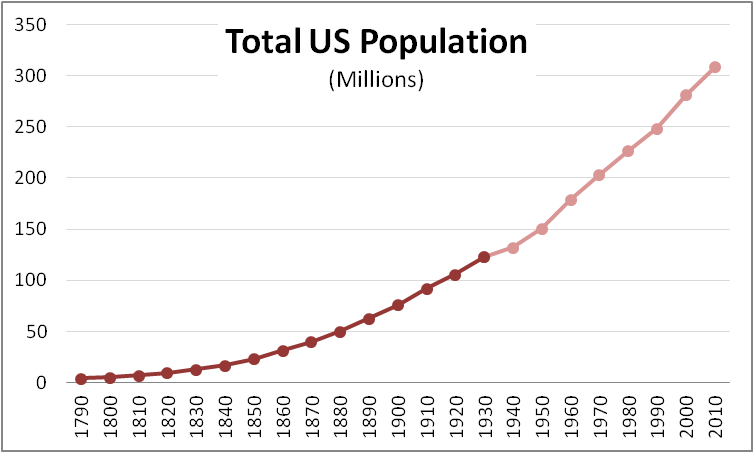
Total-US-Population.png


See the difference in the SLOPE of the graph pre and post world war 2? Now use that increase in population, and divide it into the total wealth.

just look at the graph I posted before, it also coincides with the first generation of baby boomers reaching adulthood.

4646277_orig.png
 
Well, if you follow this train of logic, which you are now saying help explain the trend, you will see how it indeed leads to the 1% pulling away. You just have to get a step or two further. It is ok tho, I am trying to hold your hand.


Take a minute and just look at these statements you made. How does poorer people having more kids than the 1% not directly change the number and % of people who comprise that 1%? THAT MAKES NO SENSE lol.

Also, income is not inherited to an extent. But wealth is, and that wealth includes trust funds, stocks, commercial and residential property that leads to residual income. There are people who have never worked a day in their lives who make more per year than we will in our life times, simply because of property their great great great grandparents bought. But that still counts as income.

Now if those people have 100000 more poor people around them than their great great great grand parents had around them, then it kind of changes things.

<Huh2>

LOL until you figure out the difference between the .007 and the 1% you should not embarrass yourself by pretending to be able to help anyone with anything.

Silly formulas notwithstanding, you are still not getting that if the 1% stays static in absolute terms and everyone else doubles in size then some of those poorer people will then be needed to make up the new 1%. Again, each group (1%, each quintile) is growing at the exact same rate as the population. That should bring the average down for the new 1%. That’s not what has happened, not even close.

Your comments about inherited wealth are similarily jumbled but I don’t want to jump down anymore rabbit holes with you if you can’t get a basic fraction right.
 
Average monthly car payment in this country is $515. The average monthly credit card payment in this country is $189. That's $704 leaving the house every month for shit thats losing value. Another problem Americans have is financial illiteracy.

Person#1: How much did it cost?
Person#2:. It's $3000. The paymets are only $50 a month! I can afford that easily.

End result: $3000 flat screen is going to cost $6k.
 
It really isn't. Here is one example why.

I paid all my debt off about 5 years ago, went 3 years with no credit activity. Checked my credit, and it was below 600. Apparently I had no credit after 3 years of inactivity.

I get a credit card, to build credit.

I bank at a credit union because big box banks are cunts.

I go to set up a automatic payment. I want a 50$ payment to be automatically withdrawn. They can't do that. I ask, can I have a % of my balance set up as a auto pay? Nope.

I get 2 choices. Paid in full, or minimum payment.

The proper way to build credit with a credit card is to keep your balance at 25%.

So I attempt to make monthly payments manually. I forget one month, and now I missed a payment. Definitely not helping to build credit now, and they charged me a 25$ fee.

So I set up the auto pay, but I'm trying to build credit, so I have to set it at minimum payment, because paying it all off doesn't help my credit.

Do people see what the banks have done here?

They have set up a system where you need debt to have credit, and made the most convenient payment method that builds credit, the one that profits them the most.

Corporate America isn't stealing through violence, but they are stealing from people.

You don't need a credit score . A credit score for what? To buy more stuff on credit?
 
Average monthly car payment in this country is $515. The average monthly credit card payment in this country is $189. That's $704 leaving the house every month for shit thats losing value. Another problem Americans have is financial illiteracy.

Person#1: How much did it cost?
Person#2:. It's $3000. The paymets are only $50 a month! I can afford that easily.

End result: $3000 flat screen is going to cost $6k.

I heard the car payment stat and that makes me almost feel physically ill. I got a fairly new car lately and pay 183/month for it. Anything over 200 would've bothered me. 500 is fucking crazy to waste on a car.
 
Are you somehow suggesting that the government doesn't hand people 100% of the costs of raising a child when a poor person has a kid? <Eek2.0>

It's got to be lot. When I read a thread on here that some schools in their state give kids free breakfast lunch and dinner that is basically people demanding other tax payers feed their children for them. Add section 8 housing, add EBT cards, and there has got to be some other types of assistance.

I don't get by easily at all, but I'd rather mop floors all day with dignity than be so pathetic, so Fucking pathetic that I need other people to basically support my life and my families lives. If I need my neighbors to feed my children every breakfast, lunch and dinner I'd simply end my life outta shame. Just shame.

How are people comfortable in that situation? Boggles my mind.

Question, what costs are the poor covering for their own children?
 
The “Middle Class” may officially be a thing of the past.

.
channelling my inner Alex Jonesism. It's too hard for the elites to get the top earners money but the middle class was/is an easy target
 
I heard the car payment stat and that makes me almost feel physically ill. I got a fairly new car lately and pay 183/month for it. Anything over 200 would've bothered me. 500 is fucking crazy to waste on a car.

Add to that, about 1/3 of auto purchases are a lease, and many of these get turned in at the end of three years. So people are just buying new car after new car and paying for the most expensive depreciation of the asset and then starting the process again after three years.
 
Well, mo' money and mo' problems. It's not like it's profitable to have more kids if you're on welfare. You're just offsetting some of the costs.
That was very well thought out. The people that are on welfare and food stamps having multiple broken home children don't have the same analytical skills that you do. They do not see the costs they see more money. A lot of them are on drugs and truly do not give a s*** about the welfare of the children. It's one of the unintended consequences of the welfare state.
 
Average monthly car payment in this country is $515. The average monthly credit card payment in this country is $189. That's $704 leaving the house every month for shit thats losing value. Another problem Americans have is financial illiteracy.

Person#1: How much did it cost?
Person#2:. It's $3000. The paymets are only $50 a month! I can afford that easily.

End result: $3000 flat screen is going to cost $6k.

Damn! 515

Oh Well, not surprised
 
Back
Top