
Economy Study: Middle Class Is Over

your math is still off, by virtue of the argument of wealth being disproportionate.

Even if there is equal population growth among social classes, you have a 1%, a middle class and a lower class. By your argument, this is not 1/1/1 ratio. It is a 1/3/9 ratio at best. So each generation you have 1*2/3*2/9*2, which leads to 2/6/18. After another generation it would be 4/12/36. The 2-6-18 ratio is not entirely accurate, but it easily shows the fallacy of this entire argument.

edit: the age of of being a parent throws off that ratio further. Average lower class person being a teenager or early 20s, as you highlighted, vs the older, upper class person.

edit:
FT_15.01.15_firstBirthAge-1.png


None of which supports your earlier argument about why income distribution is skewing more heavily to the top 1%.
 
why are you posting graphs about TEEN birth rates and fertility? Those are just one facet lol... that is a REAL STRETCH.

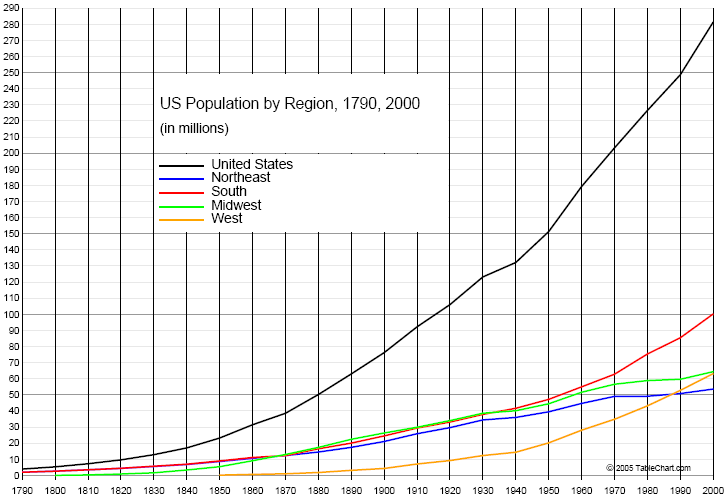
This is a much more accurate graph, as it is total people actually having kids. Not teenagers, not potential to have kids (fertility)

pop-us-1790-2000.png


Again, the math is simple. You have 1% of people with the money in 1950. Even if those people experience the same growth rate as the other people, that still exponentially reduces that 1%. That is simple math.

1% of the population today and their income share today is vastly greater than the 1% of yesterday’s population. A fixed percentage can not shrink in relative terms over time, that makes no sense from a simple math definition.


sorry, add into the edit of my post about:

FT_15.01.15_firstBirthAge-1.png


I knew something was missing in my math lol. That adds a factor over each generation. One generation is multiplying 6 years faster, multiple that over a number of decades, and you see how poor people are breeding faster. This is proven by panamericans poster about teen birth rates representing uneducated/poor people

Again What is missing from your math is that 1% of the population today can not be relatively
smaller than 1% of the population yesterday. You are taking a fixed population from history and then looking at birth rates but that is NOT what the data is doing.
 
None of which supports your earlier argument about why income distribution is skewing more heavily to the top 1%.

it does, because people are not going to willingly give up their wealth. They are going to entrust it to their families through wills. So the money stays in one group, while another group is exponentially increasing. I left out the exponent (age of having kids) in my other post on accident, but have since edited it in.


1% of the population today and their income share today is vastly greater than the 1% of yesterday’s population. A fixed percentage can not shrink in relative terms over time, that makes no sense from a simple math definition.


Again What is missing from your math is that 1% of the population today can not be relatively
smaller than 1% of the population yesterday. You are taking a fixed population from history and then looking at birth rates but that is NOT what the data is doing.

Nope. Because the people who were not in the 1% before, but were in the 2-20% are being pushed into a smaller bracket, due to the increase in the people in the lower class. So even people who were 2-5 percent before, are now considered 1%

Again, look at this.

we have a 1/3/9 wealth gap. Each has the same population growth, but the 1 percent has their growth at 30 years. the 3 has it at 25 years, the 9 has it at 20 years. That further offsets the reproduction rate per social class.

So the new equation would be (1x2 ^ .7) / (3x2 ^ .75) and (9x2 ^ .8). The exponent simply meaning (100 - age of having kids), as an example of showing the exponential value of age of having kids.
 
it does, because people are not going to willingly give up their wealth. They are going to entrust it to their families through wills. So the money stays in one group, while another group is exponentially increasing. I left out the exponent (age of having kids) in my other post on accident, but have since edited it in.


Nope. Because the people who were not in the 1% before, but were in the 2-20% are being pushed into a smaller bracket, due to the increase in the people in the lower class. So even people who were 2-5 percent before, are now considered 1%

Again, look at this.

we have a 1/3/9 wealth gap. Each has the same population growth, but the 1 percent has their growth at 30 years. the 3 has it at 25 years, the 9 has it at 20 years. That further offsets the reproduction rate per social class.

So the new equation would be (1x2 ^ .7) / (3x2 ^ .75) and (9x2 ^ .8). The exponent simply meaning (100 - age of having kids), as an example of showing the exponential value of age of having kids.

As the population grows, the new 1% group would also grow. If the reproduction rate of the old 1% is lower than everyone else’s that would suck new people into the 1% from the lower tiers. Again you are not dealing with the simple way a % works. I am going to leave it here as we are sorta going in circles here.
 
Social welfare is theft? No, it's decency.

In a civilized society, anyway.
Actually, the need for welfare in it's current form is all you need to look at to know the system does not do its job.

It's a symptom of failure by the ruling class.
 
I make a 130000 and have no problem. When I was making 60000 I had less stuff but lived just fine. When I was making 30000 I had a two bedroom apartment I shared and never went without anything. Wtf are you guys doing

Agreed...If you live within and/or below your means...you’ll be fine
 
Lol i think you guys are purposely missing the Cottage Cheese man's point. What you guys are replying is not what he is saying, and what he is saying is simple.

https://www.statista.com/statistics/241530/birth-rate-by-family-income-in-the-us/

^ Here we can see that the lower the income, the higher the birth rate. Any explanation beyond that is beside the fact of the statistics. The lowest income has around a 6/4 difference to the highest income's birth rate. This is a proven fact correct? If yes, let's proceed to what Cheese is saying. If no, explain how this is inaccurate based on the data provided.

So based on this gap, if you have 2 rich people and 8 poor people, there is a 20% ratio of rich. Based on the statistical ratio, if the rich couple have 2 kids who become rich adults as well, and the 8 poor people have 3 kids per couple, then the ratio is no longer 20% rich. It is now changed, to 14% rich as opposed to 86% poor. This is over time can increase the gap more and more. This is what Cottage is trying to illustrate.

I'm not gonna say that there may not be more factors to account for besides the kids, but at least address the man on the merits of his argument.

thank god someone understands. I even tried to edit my post, and made an additional post including the age of moms per education level.. which most people associate with income, and factored that exponent into the equation i was trying to illustrate. Granted there are several facets to the equation we all are missing, but that shows a general trend. Your graph shows that much better.

If you include those factors, over multiple generations, it is exponential.

I actually am for univerisal everything, it just simply doesn't work in a capitalist economy, with a society that promotes unsustainable birth rates and socialism. It is a direct contrast.

edit: I would be in favor of all these social programs, but I would also be in favor of birthing licenses and what not, if we want everything to be equal, and maintain that equality, in a sustainable way.
 
Lol i think you guys are purposely missing the Cottage Cheese man's point. What you guys are replying is not what he is saying, and what he is saying is simple.

https://www.statista.com/statistics/241530/birth-rate-by-family-income-in-the-us/

^ Here we can see that the lower the income, the higher the birth rate. Any explanation beyond that is beside the fact of the statistics. The lowest income has around a 6/4 difference to the highest income's birth rate. This is a proven fact correct? If yes, let's proceed to what Cheese is saying. If no, explain how this is inaccurate based on the data provided.

So based on this gap, if you have 2 rich people and 8 poor people, there is a 20% ratio of rich. Based on the statistical ratio, if the rich couple have 2 kids who become rich adults as well, and the 8 poor people have 3 kids per couple, then the ratio is no longer 20% rich. It is now changed, to 14% rich as opposed to 86% poor. This is over time can increase the gap more and more. This is what Cottage is trying to illustrate.

I'm not gonna say that there may not be more factors to account for besides the kids, but at least address the man on the merits of his argument.

Except that the definition of "rich" is relative, not absolute. It's not that 20% of the people are "rich", it's that in a group of 10 people the top 2 people will be always be the top 20% and thus by definition "rich".

His example is even worse because the allocation of the income to the top 2 people remained relatively constant until recently. He can't arbitrarily say people from 1950 or people from 1960 or 1970 or 1980. Historically, the allocations have fluctuated. If his argument was mathematically sound then the income allocation to the top 1% of the population would not arbitrarily spike in the last 30 years.

We could get into all the aspects of economies that explain why the richest people from 40 years ago are not the richest people today but that's secondary to his basic misunderstanding of what the "1%" actually means in this conversation about income/wealth allocation.
 
7500 people is a significant sample... surveys, polls, statistics... how do they work?

They found that 40% of households struggled to make timely payments in one of the four basic expenses-- housing, healthcare, food, utilities-- mentioned at least once during 2017.

You can speculate as to why that is, but that is the basic fact of the matter. And if you have data to suggest "keeping up with the Jonses" is the main factor, I'd like to see it. Otherwise, you are just talking.
I disagree that 7500 is signicant sample to come to the conclusion that the middle class has gone the way side.

I live in Atlanta and the results would be starkly contrasted if they surveyed 7500 people in SouthATL vs NorthATL.

Sample size, geography and demographics matter...especially if you want to make a valid and logical conclusion
 
plus it is pretty easy to make parameters that lend to the result the people performing the study would like to find in their research.

What even is "food insecurity", it isn't starving, that is for sure. The term itself is only like 20 years old, so what data are they comparing it to?

Obviously not the data that Time Magazine uses, since they report that food insecurity is down.

http://time.com/4477157/hunger-america-history/

Just look at the article in the OP, the search is done by the "Ubran Institue", of course they have an agenda. Of course the USDA doesn't have their 2017 statistics, but 2016 numbers are HALF of what the Urban Institute has, furthering the downward trend that TIME magazine reported.

https://www.ers.usda.gov/topics/foo...curity-in-the-us/key-statistics-graphics.aspx

Seems like a bunch of conflicting research is going on, wasting money that could be used to feed people experiencing food insecurity.

Perhaps, I’m biased in that I think this survey and subsequent conclusion are as meaningful as tits on a bull
 
I swear that every time I see these graphs, especially the first one, I cannot fathom how people can continue to struggle with understanding what is happening with our economy. It's as if some people simply want to believe that the problem is anything and everything except an economic system that no longer rewards the average American.

We're left with a lot of people who don't want to help put out a fire just because their home isn't burning yet.

You’re a solid poster Pan...but your conclusion is flawed...my house isn’t on fire but I am well aware that the rich(filthy rich) are getting richer...but that doesn’t mean I don’t want to help...but other than a bastille day uprising...shit ain’t gonna get better....I have been telling my employees since the early 2000’s that you should focus on getting your finances in order...live within/under your budget...it’s a logical and practical way to protect yourself...
 
it does, because people are not going to willingly give up their wealth. They are going to entrust it to their families through wills. So the money stays in one group, while another group is exponentially increasing. I left out the exponent (age of having kids) in my other post on accident, but have since edited it in.

Again, you are wrong. 70% of the wealthy lose their fortune by the 2nd generation. 90% within 3 generations.

https://www.forbes.com/sites/toddga...ilies-make-and-lose-their-money/#4f9992f577d6
 
With a family or solo?

My wages were similar.....actually went from $135 with 30% bonus and RSU’s..to $62 no bonus and RSU’s...to the highest salary in my 30 year career...all with family, a divorce and a new family

It really comes down to living within or below your means
 
Except that the definition of "rich" is relative, not absolute. It's not that 20% of the people are "rich", it's that in a group of 10 people the top 2 people will be always be the top 20% and thus by definition "rich".

His example is even worse because the allocation of the income to the top 2 people remained relatively constant until recently. He can't arbitrarily say people from 1950 or people from 1960 or 1970 or 1980. Historically, the allocations have fluctuated. If his argument was mathematically sound then the income allocation to the top 1% of the population would not arbitrarily spike in the last 30 years.

We could get into all the aspects of economies that explain why the richest people from 40 years ago are not the richest people today but that's secondary to his basic misunderstanding of what the "1%" actually means in this conversation about income/wealth allocation.

Lol what? People argue that the rich are getting richer, so it IS the same people as 40 years ago. There may be a few exceptions like Jeff Bezos. But the wealthier upper-middle class who got APPLE stocks in the 1990s are now being pushed into the 1% because they are drowned by the number of people in the lower classes having to many babies and not setting up a financial future that is sustainable (too much credit).


Again, you are wrong. 70% of the wealthy lose their fortune by the 2nd generation. 90% within 3 generations.

https://www.forbes.com/sites/toddga...ilies-make-and-lose-their-money/#4f9992f577d6

Yea, 70% do, probably from blowing their money like the rest of the population, and having to many kids. What about those 30%. Those 30% are they to be penalized from the other people not being financially responsible?

Moreover, that is what is considered "new wealth". And has nothing to do with the overall wealth trend. That just shows that there are people who are given every opportunity, and blow it.

We, and I think everyone in this thread, is talking about rich people who do not blow there money within 1-3 generations. If not, isn't just a lottery of who will be rich per generation. Does that erase all arguments of institutionalized economic inequality?
 
I call bullshit, look around, is it all poor people and extremely rich? No it’s not
 
The rich are rich cause they're good at making money. If they appeal for tax breaks and get lower taxes, maybe that's why the rich are hiring more people today. And there are more jobs available.

I agree with some of what you say BUT....legal corruption in the form of lobbying is deplorable and need to stop
 
Lol what? People argue that the rich are getting richer, so it IS the same people as 40 years ago. There may be a few exceptions like Jeff Bezos. But the wealthier upper-middle class who got APPLE stocks in the 1990s are now being pushed into the 1% because they are drowned by the number of people in the lower classes having to many babies and not setting up a financial future that is sustainable (too much credit).


Yea, 70% do, probably from blowing their money like the rest of the population, and having to many kids. What about those 30%. Those 30% are they to be penalized from the other people not being financially responsible?

Moreover, that is what is considered "new wealth". And has nothing to do with the overall wealth trend. That just shows that there are people who are given every opportunity, and blow it.

We, and I think everyone in this thread, is talking about rich people who do not blow there money within 1-3 generations. If not, isn't just a lottery of who will be rich per generation. Does that erase all arguments of institutionalized economic inequality?

Yea. I was confused what he was even arguing. It’s like he was arguing something completely different than what you were talking about
 
I hear you. But we as Americans need to watch every dollar like our great grandparents. That would help. I'm just stating all the luxuries that we live with every single day, flat screens, iphones, air jordans, and then some people send their kids to school for 3 meals a day.

Pretend you have a word quota and just say...people need to live within or below their means Rip!!!
 
Leftists enable people to have a shit ton of kids and getting carried by the rest of us.

Leftists absolutely suck.
And religion and restricting access to birth control and banning abortion does what?

<TheDonald>
 
Back
Top