Movies Serious Movie Discussion

I have been hoping for years Nostos would get more of a rediscovery and a better release, it does I think still feel very contempory.

Yes it definitely feels like it's ripe for rediscovery, a blu ray release would be brilliant.
 
The Marquis of Grillo (1981)
6ef916e27be4a4e9b115c200715bc3581489ce4772b7f772ed07b7648327f778.png


“Lo sò io, e voi non siete un cazzo (I am who I am, and you are fucking nobody)”

A wonderfully droll comedy about an Italian nobleman in Rome at the turn of the 19th century. Specifically the setting is 1809, during the French occupation of Italy and Napoleon’s annexation of the Papal States. Our eponymous Marquis however does not seem the least concerned. An affable man of leisure he fills his idle days by playing tricks on his household, abusing poor commoners and bribing jury’s simply to prove that he can, and generally seeing what he can get away with. It’s a lively, lighthearted comedy which was a joy to watch. Albert Sordi puts in a great turn as the charismatic marquis, who is partly based on a real historical figure.

Despite being a breezy comedy there are some more serious issues at play too. With the political developments depicted in the film comes not just French soldiers, but also the ideals of the Enlightenment. In contrast to Liberté, égalité, fraternité the Marquis clearly represents the old world of abusive aristocratic power. The film is so great because of the way in which it parodies these real processes in a witty, clever way. Ultimately it’s still a comedy though, and a very enjoyable one at that. Though I have no doubt there were probably some Italian jokes I missed in translation.
 
Undine (2020)
Undine-2020-2-featured.jpg


A contemporary fairytale which twists the classic German story of the same name into something unusual; a very modern love-story with a supernatural undercurrent. “Magic realism” comes to mind in terms of the approach. The myth of Undine constantly rubs against the formal style and the realistic aspects of the narrative in strange, ambiguous ways.

I wasn’t all that familiar with the original myth: Undine is a water spirit who can only gain a human soul through marriage to a man, but if betrayed she is forced to kill him and return to the water. Along with various other kinds of water nymph and mermaid figures in folklore, they are often heavily sexualised. It is significant therefore that this film is from the female perspective.

Our Undine is, at first glance, not in fact an ancient water spirit but rather a historian who spends her time lecturing on urban development and the architectural history of Berlin. We first meet her on her break at a café beside Berlin City Museum, where she is going through a difficult break-up. “If you leave me, I’ll have to kill you. You know that.” she tells him. But leave her he does, leaving Undine in a state of distress. She is not alone for long however. Almost immediately another man, an industrial diver called Christoph, introduces himself to her. The two of them fall head over heels into a genuinely sweet romance. Though as befits a genuine fairytale, there is some suggestion that things won’t end happily ever after.

It’s an interesting film which weaves a fairly simple boy-meets-girl tale of romance within various layers of myth, memory and history. Even architectural theory. It can be somewhat frustrating at times, in terms of trying to piece together the mythic from the literal. But it soon becomes apparent that attempting to rationalise and reconcile these two components, though natural, is the wrong approach to take. Of course, that doesn’t necessarily make for a great film either and I think there were points at which it all felt a bit disconnected.

In the end though, I think what really carries this film is the wonderful chemistry and emotional connection between Paula Beer (Undine) and Franz Rogowski (Christoph). Their performances, and of course the direction, transforms what might have been a bit of intellectual exercise, into something genuinely heartfelt and moving. The other aspects - Mythology, the history of Berlin, architectural theory, and so on - are thus able to take a back-seat, while still being present. It’s not a cheap love-story, but it is a deeply genuine one.

Not without some flaws, but a great wee movie on the whole.
 
The Card Counter (2021)
merlin_194009259_c99df4d3-2a38-4e7c-b128-b444fe7c34c8-superJumbo.jpg


“Imprisonment is the dominant metaphor in Bresson’s films, but it is a two-faced metaphor: his protagonists are both escaping from prison of one sort and surrendering to a prison of another.”
- Paul Schrader, ‘Transcendental Style in Cinema’

Firmly in Schrader-land with this one, featuring a psychologically damaged and emotionally isolated protagonist who spends a large portion of his time writing in his diary. The Card Counter pretty clearly follows on from First Reformed (2017) in terms of Schrader starting to channel his most profoundly Bressonian influences into his own work. Through the film's formal, distant style, and the use of “Transcendental” techniques such as doubling and visual flatness, he very clearly evokes those films which he once wrote about.

Our protagonist here is William Tell, an ascetic gambler who drifts from casino to casino counting cards and playing poker. It is revealed that William is a former interrogator (ie. government-sponsored torturer) at Abu Ghraib prison. He has done time in prison for his crimes, but remains haunted by his crimes. There are many others though, including those most responsible, who have not yet faced up to their crimes during the “War on Terror”.

Much like how Michel’s “Will to Pickpocket” in Pickpocket (1959) disguises a hidden, overburdening passion, William seemingly has a “Will to Gamble”. He doesn’t gamble for thrills, or high-stakes. Despite his intellectual approach and obvious skill, he only bets small amounts for modest winnings; he is addicted to gambling only insofar as it enables him to lead a life of numb detachment from normal society. In turn, this self mortification reflects William’s profound desire for atonement for his past sins.

However, William sees a possible chance at redemption when he is approached by Cirk, an angry young man who intends to take revenge against a former military officer who avoided prosecution for his role in Abu Ghraib. I won’t go into specifics, but this was my main issue with The Card Counter. While I could really appreciate all the stylistic choices I just found the narrative itself a bit lacking and much too overly contrived to chime well with the profound themes that Schrader is grappling with. Now it’s far from a bad film; any Schrader fan will still find a lot to like here I think, but just not quite on the level it could have been in my opinion.
 
Last Night in Soho (2021)
Last-Night-in-Soho-Official-Poster-cropped.jpg


Absolutely fucking terrible, pretty much from start to finish. Starts off with the most horrendously cliched depiction of a shy country girl, called Ellie, moving to the big smoke (it’s 2021…not 1921). She moves to London to study fashion, where it turns out that all the girls are a bunch of nasty slags. Not like her of course. She listens to music from the 1960s so she’s not like other girls.

Following her initial unpleasant encounters Ellie decides to move out of her student halls, renting a room in an old-fashioned house in Soho. Once she falls asleep she discovers that she is mysteriously able to travel back to the Swinging Sixties, the period which she loves so vicariously through its music and fashion. In her dream she encounters Sandie, a supremely confident singer who represents everything that Ellie is not. However, it becomes apparent that all is not as it seems. As the darker reality of 1960s Soho begins to reveal itself, her dreams begin to bleed into the present day with frightening consequences…

So Last Night in Soho is a thriller, or a psychological horror, at its core. Unfortunately I found it mind numbingly boring at every turn. The only element I can find to praise is some of the film's visuals and stylistic choices in terms of how it brought the ‘60s to life. Everything else was incredibly poor - dull, cardboard-cutout characters and a plot which was in equal turns absurd and crushingly banal. I love Edgar Wright’s comedy’s (at least the Cornetto trilogy), but this was just shocking.
 
Local Hero (1983)
local-hero-1.jpg


A big-shot Houston oil executive called MacIntyre (“Mac” for short) is sent by his plutocratic boss to acquire the village of Ferness on the West coast of Scotland. This is an area of outstanding natural beauty, as well as a site of particular oceanographic and astronomical interest. However, Mac - who has been selected solely on the basis of his “Scottish” name but who is actually of Hungarian descent - has been tasked with buying up the town and the surrounding land in order to turn the whole place into a massive petrochemical refinery. His boss, the sickeningly rich owner of Knox Oil and Gas, is also a touch eccentric to put it mildly. He gives Mac one additional task: watch the skies and “keep an eye on Virgo”.

From this starting point Local Hero delivers a wonderfully deadpan comedy touching on climate change, Scottish culture, modernisation, and so on. There is of course the humour provided by the main ‘culture-clash’ component, that of a hot-shot Yank arriving in a remote Highland fishing village. However, it’s not quite what you would expect initially. Mac, the representative of American capitalism, falls in love with the people and the way of life in Ferness.

Yet, one thing the film does so well is invert twee “monarch of the glen” sort of depictions of Scotland. Far from culturally pure, whisky-swilling, kilt-wearing Gaels who pine for their historic homeland, the film portrays the locals as all too happy to sell if it’ll make them a few quid. The negotiations which ensue simply arise from their feigned reluctance as a method of driving up the price. While Mac succumbs to the charms of the Highlands, the people who actually live there are plotting to seize their chance to escape. The tone is humorous of course, and there are some fantastically dry moments throughout, but with these ironies Local Hero also hints at more profound themes.

There are of course many other aspects of the story which unfold out from this basic premise. As we witness life unfolding in Ferness we are introduced to a range of wonderful characters including a drunken Russian sailor, a Mermaid with a PhD, and a beach-dwelling hermit who seems to be something like a Scottish Diogenes. It is a brilliant cast and the performances are perfect as well (including Burt Lancaster and a young Peter Capaldi). It’s an easy watch, but at the same time it is much more than simply an easy-going comedy. There is a touch of whimsy in the way the story is told, but equally there are moments where it is practically philosophical.

An absolutely delightful hidden gem; sincere and genuinely charming, but with a melancholic undercurrent. Highly recommended.

f6d0575b5c8af9e3c11be10b80e9dae8.jpeg

0e4b8bab48f777de9daf95cfbfcb4e27.jpeg

d886cc63cc9aa70df2ac63db25e4203f.jpeg

9d5faec42cd35298706ee99d4f46e935.jpeg
 
Just watched "Chaos Walking" on Amazon Prime, based on a young adult fiction series by American author Patrick Ness. Ness wrote the screenplay with collaborator Christopher Ford, best known for writing Spider-Man, Homecoming.

chaos1-superJumbo.jpg


If the smell of a sewer were a movie, this is it.

It starts by explaining that, on another planet, all the women are dead and it's just men left. The women died about 20 years ago. And on this planet, creatively called "New World", the men can hear one anothers thoughts. At this point I assumed I was in for some kind of allegory on prison life among straight men. Maybe it would get into how aggressive male sexuality could destroy a community without women to have sex with? A prescient issue, considering popular news stories that come out of India and China, where the male to female ratio is creating a population crunch.

No such luck. "New World" is actually full of women. The premise falls apart quickly. But before we the audience learn that the world does have women on it, Daisy Ridley crash-lands on "New World" in her space ship. At that point, I'm thinking to myself, "this is like a single beautiful movie star being thrown into a jail with sex-starved men. Things are about to get intense!"

Once again, no such luck. Daisy, whose characters name is Viola, is exceptionally gifted at combat, is intelligent, speaks the local language and prevails against the attempts of an entire community full of men who want to capture her. Eventually Tom Holland's apparent sexiness wins her over and they go off alone, where she explains that her parents are dead. She doesn't seem to care much. I definitely didn't care much. Tom Holland did seem to care. A bit.

Why is the town trying to capture her, you might ask? Surely, for sex?

No, actually. Not at all. Doesn't even come up.

They want to kidnap anyone who might come to rescue her! To get a space ship! Unfortunately for them, Viola is more than capable enough to take on the entire community. Strangely, her near super-human ability to defend herself does not persuade the mayor of the town, played by Sherdog favorite Mads Mikkelsen (whose presence the movie would have been unwatchable without) that attacking an entire ship of people just like her probably won't go well. Her crew (according to her) is 4,000 people strong and while evading the town, she uses advanced modern weapons. Madds on the other hand is the sheppard of yokels who seem to posses horses and basic rifles. Oh well, capturing a whole ship it is!

As the movie progresses we discover that planet "New World" is actually full of women and men living in normal communities. The reason Holland believed the whole planet was absent women is because Mayor Madds insular community killed all their women in a rage 20 years ago. Ok then. The film throws its premise in the trash to make Madds look a bit more evil. But he seems so dumb that adding evil onto his character doesn't really do anything.

The plot then contrives a few more ways for Daisy and Tom Holland to have some alone time. But they have virtually no sexual chemistry at all. Holland is playing a literal virgin who is now friends with a movie star-looking woman and he can't seem to show the audience he's even a little bit horny.

In the end, Tom Holland has a fight with Mads and wins. Daisy and him don't even touch each other, and it seems to be for the best. I guess? What the fuck.

I have no-one to blame but myself for watching this. It isn't like anyone recommended it.

1/5

 
Last edited:
Just watched "Chaos Walking" on Amazon Prime, based on a young adult fiction series by American author Patrick Ness. Ness wrote the screenplay with collaborator Christopher Ford, best known for writing Spider-Man, Homecoming.

chaos1-superJumbo.jpg


If the smell of a sewer were a movie, this is it.

It starts by explaining that, on another planet, all the women are dead and it's just men left. The women died about 20 years ago. And on this planet, creatively called "New World", the men can hear one anothers thoughts. At this point I assumed I was in for some kind of allegory on prison life among straight men. Maybe it would get into how aggressive male sexuality could destroy a community without women to have sex with? A prescient issue, considering popular news stories that come out of India and China, where the male to female ratio is creating a population crunch.

No such luck. "New World" is actually full of women. But before we learn that, Daisy Ridley crash-lands on "New World" in her space ship. At this point, I'm thinking to myself, "this is like a single beautiful movie star being thrown into a jail with sex-starved men. Things are about to get intense!"

Once again, no such luck. Daisy, whose characters name is Viola, is exceptionally gifted at combat, is intelligent, speaks the local language and prevails against the attempts of an entire community full of men who want to capture her. Eventually Tom Holland's apparent sexiness wins her over and they go off alone, where she explains that her parents are dead. She doesn't seem to care much. I definitely didn't care much. Tom Holland did seem to care. A bit.

Why is the town trying to capture her, you might ask? Surely, for sex?

No, actually. Not at all. Doesn't even come up.

They want to kidnap anyone who might come to rescue her! To get a space ship! Unfortunately for them, Viola is more than capable enough to take on the entire community. Strangely, her near super-human ability to defend herself does not persuade the mayor of the town, played by Sherdog favorite Mads Mikkelsen (whose presence the movie would have been unwatchable without) that kidnapping an entire ship of people just like her probably won't go well. Her crew (according to her) is 4,000 people strong and while evading the town, she uses advanced modern weapons. Madds on the other hand is the sheppard of yokels who seem to posses horses and basic rifles. Oh well, kidnapping a whole ship it is!

As the movie progresses we discover that planet "New World" is actually full of women and men living in normal communities. The reason Holland believed the whole planet was absent women is because Mayor Madds insular community killed all their women in a rage 20 years ago. Ok then. The film throws its premise in the trash to make Madds look a bit more evil. But he seems so dumb that adding evil onto his character doesn't really do anything.

The plot then contrives a few more ways for Daisy and Tom Holland to have some alone time. But they have virtually no sexual chemistry at all. Holland is playing a literal virgin who is now friends with a movie star-looking woman and he can't seem to show the audience he's even a little bit horny.

In the end, Tom Holland has a fight with Mads and wins. Daisy and him don't even touch each other, and it seems to be for the best. I guess? What the fuck.

I have no-one to blame but myself for watching this. It isn't like anyone recommended it.

1/5

<45><45><45>

Sounds absolutely wonderful
 
Lamb (2021)
Lamb%2B-%2BCover.jpg


A weird folk horror....drama....thing.

Well, there are elements of 'folk horror' but it's certainly not what most people would expect in a horror film. Likewise there are aspects which are much more fitting of a tight family drama and there are themes which are pretty clear from this point of view: the confines of marriage, the pain of the past, the anxiety of motherhood, and so on. I guess this is what people mean by 'genre-defying' huh.

For me the most effective element was the visual framing and the use of pace. The director (Valdimar Jóhannsson) manages to frame things in such a way that they are imbued with a kind of unnatural menace, even where the scene is seemingly mundane and inert. Perhaps unnatural is the wrong word too. There is something eerie, lurking underneath the images of quiet domesticity…but so often the emphasis is on the vast Icelandic landscape, always visible through windows and open doors of their small farmhouse. In contrast to the house and the the farm in general, the wilderness outside becomes awfully and immensely natural. All-too-natural.

I wasn't sure whether to read Lamb allegorically, as a commentary on man's relationship with nature (certainly the ending hints at something like that), or whether to just give in to the uncanny strangeness of it all. I think you'll find more enjoyment if you go in expecting the latter, though the former does provide something to mull over afterwards, along with the other themes. It didn't quite blow me away, but certainly interesting enough.
 
The Card Counter (2021)

Ugh, that movie SUCKED so much ass. That felt like Schrader accidentally made a parody of himself. It's got the story structure, themes, and aesthetics that define Schrader's style...but in their silliest, most ineffective form. Just garbage.

And on the subject of garbage featuring Oscar Isaacs, did you ever try the HBO Max remake of Scenes from a Marriage? I'll save you the trouble: Don't. It's embarrassing. Not only was nothing of significance changed with respect to plot or character, which begs the question of why they bothered to remake it, but the stuff that was changed was just woke window dressing. They really should've called it Scenes from a Woke Marriage, as it would've captured the way that instead of Liv Ullmann's friend from school doing a story on Ullmann's and Erland Josephson's marriage for a women's magazine, one of Isaacs' non-binary-looking PhD students in gender studies wanted to use his and Jessica Chastain's marriage as a case study for her dissertation on gender roles in contemporary relationships and asked them before beginning her interview what their pronouns are, and the way that instead of having dinner with another white married couple after the interview they have dinner with an interracial couple, and the way that when they reunite in the final episode instead of the former husband picking up and driving the former wife to their old house it's the former wife picking up and driving the former husband, etc. Other than those superfluous woke changes, it's the same, just obviously nowhere near as good. They also started with a Bergman-esque - but significantly not Scenes from a Marriage-esque - fourth-wall-breaking type of "behind-the-scenes" thing with Chastain arriving on set and then "walking into" the first scene, which not only made no sense - whereas shit like Persona, Hour of the Wolf, and The Passion of Anna are explicitly concerned with questions of medium, artistic integrity, and the like - but for which there was no payoff. Once again, just garbage.

On a more positive note, I not only finally had an excuse to rewatch Scenes from a Marriage for the first time since my initial viewing back in the day, I also rewatched Sarabande, also making for only the second time that I'd ever seen it. Richard Linklater's "Before" films seem more coherent, but I do love the way that Bergman spends so much time with those characters and following the strange routes their lives take individually and in relation to one another.

Anyway, just wanted to pop my head in and let you know that I see you posting in here even if I don't always have the time to post myself ;)
 
Arracht (2019)
2a93b358876e018d249fc7fe5bc30e9d6051d9c4.jpg

Arracht_Poster_1_1920x1080.jpg

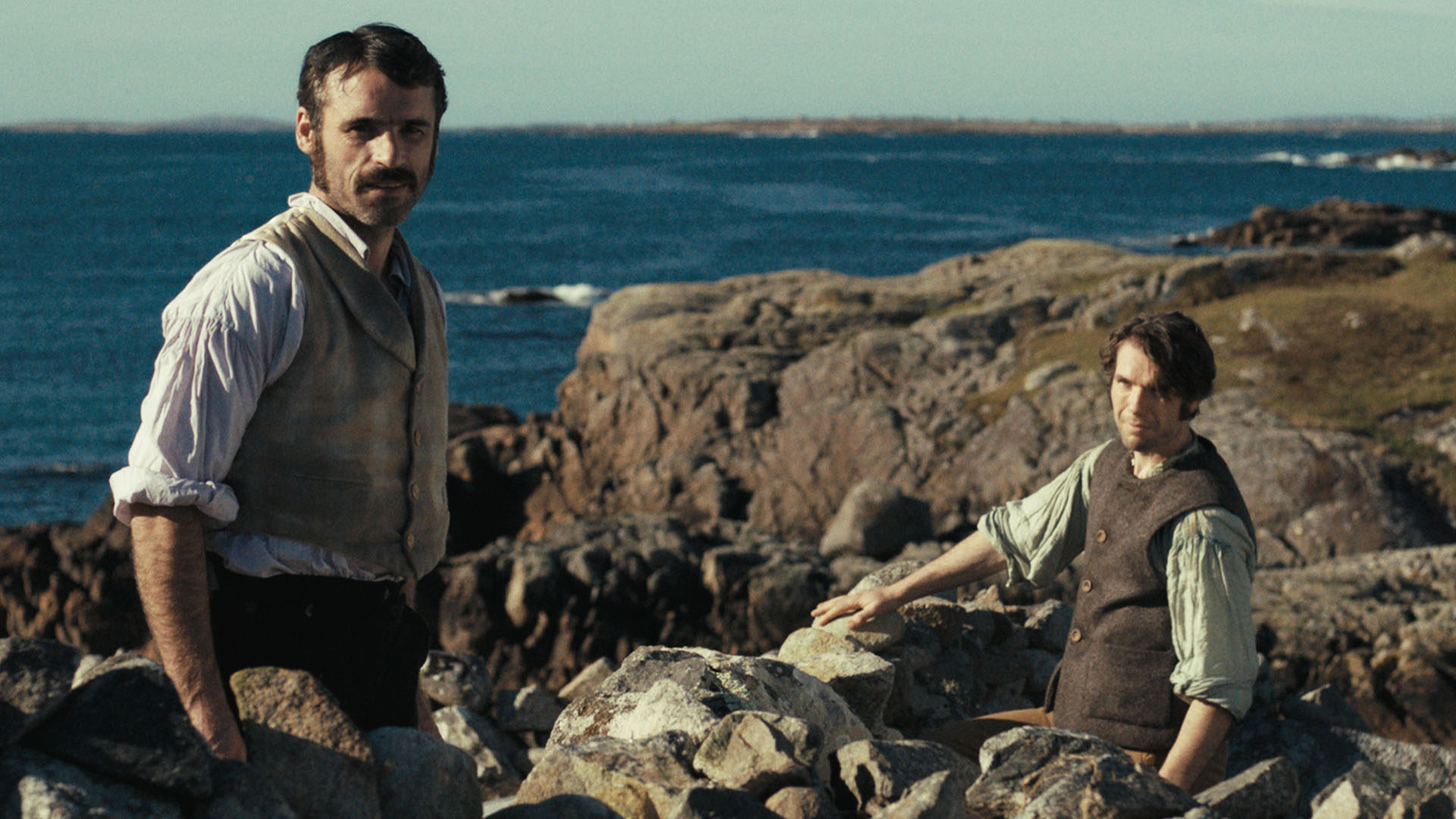
A lean Irish language drama depicting the struggle of one Connemara fisherman during an Gorta Mór, or the Great Famine as it is known in English. In contrast to the more bombastic Black ‘47 from 2018 which was essentially a “Potato Western”, Arracht is a considerably quieter, more brooding affair.

Colman Sharkey, our main character, is a fisherman in the west of Ireland in the 1840s. Living in a remote cottage with his wife and daughter, he supplements his income by distilling illicit poitín in the many hideaways along this rugged Atlantic coast. However, two malevolent forces are soon to bring tragedy to Colman’s hard but peaceful existence. First is the arrival of Patsy, a bitter veteran of the Napoleonic campaigns rumoured to be a deserter. At the behest of the local priest, Colman takes on Patsy as a helping hand…an action which will have unintended consequences. Following close behind is the potato blight itself which will bring such ruin and abject misery to the entirety of the country.

Linked to both of these events is the cruel logic of Anglo-Irish landlordism; combined with the overarching ideologies of British imperialism, cultural superiority and laissez-faire capitalism. Arracht doesn’t necessarily revel in these anti-Britsh or anti-imperial themes, and actually much of it is taken up by a much more personal story and a more narrow focus. Nonetheless, it naturally doesn’t shy away from these realities either, particularly in the early portions.

There are films in the past that I have described as “folkloric” and I would say that Arracht also fits that bill. By ‘folkloric’ I mean that similar to a folktale or murder ballad there is a certain sparseness to the plot, along with characters which are developed in such a way to be almost archetypal. A large part is also the mood and tone and Arracht is suitably austere on that front as well.

Of course, you could argue that this is just a polite way of describing an undercooked plot and poorly developed characters. This film does somewhat toe the line with that I think. For instance, Colman is a bit too saintly for my taste; he doesn’t even drink his own poitín for god’s sake. Likewise, attempts to weave the more obviously political components of the narrative with various metaphysical flourishes were not entirely successful. When it works, it worked very well but there are times where it had somewhat of a disjointed feel.

Nonetheless, while not without its flaws, I think that Arracht is still a fine film on the whole, and particularly a fine example of Irish language cinema. Maith thú‎!
 
Last edited:
Track of the Cat (1954)
R7ckzX4.jpg


Listed as a Western, but other than that it happens to be set in the American West I don’t think it does it much good to put it in that category. Instead we have a strange melodrama with some lightly supernatural flourishes. The story concerns the Bridges family, a hateful bunch who live on an isolated homestead in Northern California at the turn of the 20th century. The father is a drunken fool and the mother a hypocritical zealot. Thus the family is dominated by the presence of the middle son, Curt, a cruel bully who belittles and controls his other siblings. There is also the family servant Joe Sam, an elderly native american (actually a white fella in incredibly distasteful make-up, but as it was the 1950s I digress…).

Track of the Cat opens during a heavy snowstorm. When the youngest son takes a fiance from a neighbouring farm, he threatens to tear the family holdings apart. The arguments that ensue mirror the violent storm outside. At the same time, a mythical black panther (or “painter” as they say in the local dialect) has been heard menacing the livestock and so Curt sets off to “put a bullet between its eyes”. This panther clearly represents something of a supernatural threat, lurking at the edges of the homestead in the wilderness outside. Along with a small dose of John Keats poetry and quasi-native mythology.

It has some interesting ideas, but in execution not as good as I was hoping in all honesty. Dreyer is a comparison which comes to mind in terms of the attempts to blend family drama with broader metaphysical themes, but I didn’t find it anywhere near as effective. I will say that it was strongest in terms of the hunting scenes in wilderness, and there was some very effective imagery. The rest of the dramatic elements just landed a bit flat to me; melodramatic in the most genuine sense of the word. A somewhat interesting curio, but really there seems to be a reason that it isn’t more well known.
 
Ugh, that movie SUCKED so much ass. That felt like Schrader accidentally made a parody of himself. It's got the story structure, themes, and aesthetics that define Schrader's style...but in their silliest, most ineffective form. Just garbage.

And on the subject of garbage featuring Oscar Isaacs, did you ever try the HBO Max remake of Scenes from a Marriage? I'll save you the trouble: Don't. It's embarrassing. Not only was nothing of significance changed with respect to plot or character, which begs the question of why they bothered to remake it, but the stuff that was changed was just woke window dressing. They really should've called it Scenes from a Woke Marriage, as it would've captured the way that instead of Liv Ullmann's friend from school doing a story on Ullmann's and Erland Josephson's marriage for a women's magazine, one of Isaacs' non-binary-looking PhD students in gender studies wanted to use his and Jessica Chastain's marriage as a case study for her dissertation on gender roles in contemporary relationships and asked them before beginning her interview what their pronouns are, and the way that instead of having dinner with another white married couple after the interview they have dinner with an interracial couple, and the way that when they reunite in the final episode instead of the former husband picking up and driving the former wife to their old house it's the former wife picking up and driving the former husband, etc. Other than those superfluous woke changes, it's the same, just obviously nowhere near as good. They also started with a Bergman-esque - but significantly not Scenes from a Marriage-esque - fourth-wall-breaking type of "behind-the-scenes" thing with Chastain arriving on set and then "walking into" the first scene, which not only made no sense - whereas shit like Persona, Hour of the Wolf, and The Passion of Anna are explicitly concerned with questions of medium, artistic integrity, and the like - but for which there was no payoff. Once again, just garbage.

On a more positive note, I not only finally had an excuse to rewatch Scenes from a Marriage for the first time since my initial viewing back in the day, I also rewatched Sarabande, also making for only the second time that I'd ever seen it. Richard Linklater's "Before" films seem more coherent, but I do love the way that Bergman spends so much time with those characters and following the strange routes their lives take individually and in relation to one another.

Anyway, just wanted to pop my head in and let you know that I see you posting in here even if I don't always have the time to post myself ;)


Ha, you know I'm several years behind on SNL, so I have no idea what they've been doing or who's even on it now, but that was a funny sketch. The spooning crying was the funniest part :D
 
The Card Counter (2021)
merlin_194009259_c99df4d3-2a38-4e7c-b128-b444fe7c34c8-superJumbo.jpg


“Imprisonment is the dominant metaphor in Bresson’s films, but it is a two-faced metaphor: his protagonists are both escaping from prison of one sort and surrendering to a prison of another.”
- Paul Schrader, ‘Transcendental Style in Cinema’

Firmly in Schrader-land with this one, featuring a psychologically damaged and emotionally isolated protagonist who spends a large portion of his time writing in his diary. The Card Counter pretty clearly follows on from First Reformed (2017) in terms of Schrader starting to channel his most profoundly Bressonian influences into his own work. Through the film's formal, distant style, and the use of “Transcendental” techniques such as doubling and visual flatness, he very clearly evokes those films which he once wrote about.

Our protagonist here is William Tell, an ascetic gambler who drifts from casino to casino counting cards and playing poker. It is revealed that William is a former interrogator (ie. government-sponsored torturer) at Abu Ghraib prison. He has done time in prison for his crimes, but remains haunted by his crimes. There are many others though, including those most responsible, who have not yet faced up to their crimes during the “War on Terror”.

Much like how Michel’s “Will to Pickpocket” in Pickpocket (1959) disguises a hidden, overburdening passion, William seemingly has a “Will to Gamble”. He doesn’t gamble for thrills, or high-stakes. Despite his intellectual approach and obvious skill, he only bets small amounts for modest winnings; he is addicted to gambling only insofar as it enables him to lead a life of numb detachment from normal society. In turn, this self mortification reflects William’s profound desire for atonement for his past sins.

However, William sees a possible chance at redemption when he is approached by Cirk, an angry young man who intends to take revenge against a former military officer who avoided prosecution for his role in Abu Ghraib. I won’t go into specifics, but this was my main issue with The Card Counter. While I could really appreciate all the stylistic choices I just found the narrative itself a bit lacking and much too overly contrived to chime well with the profound themes that Schrader is grappling with. Now it’s far from a bad film; any Schrader fan will still find a lot to like here I think, but just not quite on the level it could have been in my opinion.

To me, this was a movie that lacked all the "connective-tissue" of character development. It's so focused on being numb and detatched that it forgets to nail all the arches a character is supposed to go through.

Like, I honestly wasn't sure what William thought of Cirk for much of the movie. I *thought* the movie was trying to play their relationship ambigiously, somehow, as to maybe set up a twist or a reveal later on. The node of William feeling responsible for Cirk felt so thin and weak that it just didn't register as critically impactful. Isac and Schrader just didn't *sell* this as the focal point of the film. So when that became the main focus of the film it felt kind of hollow.

Likewise, Cirk making his decision in the end felt like a coin flip. What motivated him to go either way, I honestly couldn't tell you. His motivation is so undersold that it doesn't have impact.

The movies best parts... were anything that had to do with torture. That was when the film finally had some puissance. But as said, it's so focused on strumming this *mood* that it forgets everything else.


I also couldn't get over how much Oscar Isac reminded me of Fat Tony facially

the-card-counter-oscar-isaac-1108x0-c-default-scaled.jpeg


The-Simpsons-Fat-Tony-2.jpg


So Last Night in Soho is a thriller, or a psychological horror, at its core. Unfortunately I found it mind numbingly boring at every turn. The only element I can find to praise is some of the film's visuals and stylistic choices in terms of how it brought the ‘60s to life. Everything else was incredibly poor - dull, cardboard-cutout characters and a plot which was in equal turns absurd and crushingly banal. I love Edgar Wright’s comedy’s (at least the Cornetto trilogy), but this was just shocking.

Having watched Edgar Wright, the guy is super into old giallo movies and various 60's flick. He's always seemed like one of those fans who can't translate their fandom into a directorial strenght when it comes to this genre. I suspect that... Wright as a person and a director is simply to different from those old giallo directors to competently ape their genre.


A wonderfully biting satire of a TV news industry obsessed with ratings and profits over anything else. The film is prophetic in it's depiction of a world in which actually delivering the news is entirely secondary to providing entertainment. Far from a bastion of truth, the news becomes simply one aspect of an Adorno-esque culture industry which reinforces "one holistic system of systems, one vast and immane, interwoven, interacting, multivariate, multinational dominion of dollars".

Excellent direction from Sidney Lumet and with fine performances across the board as well. A sharp, clever film, albeit almost disturbing in how accurate it's predictions would turn out to be. Very good, should have definitely got round to this one sooner!

I always remember this as the movie that: "Not only predicted reality TV, it also predicted that reality TV was going to be faked"<45>

Lumet has always been a master at drawing fantastic performances. But on this movie I remember only the performances and nothing about what the film was trying to say (well, remembering it, but not *feeling* it). So I suspect he kind of faltered on that part. Still, fantastic performances is not small thing to see.
 
Last edited:
Song of Granite (2017)
song-of-granite+poster+2.jpg


Easily one of the finest Irish films ever made. I somehow missed this when it was first released despite having a real love for folk music and sean-nós singing, but when it popped up on MUBI I was drawn to it immediately. I went in expecting something of a conventional docudrama or biopic dealing with the life of Joe Heaney, one of Ireland’s greatest but most self-destructive singers. However, the film far exceeded all my expectations.

Song of Granite thankfully strays far from the conventions and cliches that typically make music biopics such a profoundly dull genre. The structure itself follows the classic mould of first depicting the artist as a young man, including the initial stirrings of his musical talent. However, while it traces Joe Heaney’s life chronologically it is actually rather light on biographical details. The focus is very much on the music itself. Shot in striking monochrome it takes a more poetic, evocative approach to its subject matter. The black-and-white landscapes look absolutely haunting and are almost enough reason to watch on their own.

It is a moody, introspective film which delivers a moving portrait of Joe Heaney as a tortured artist. Though it certainly makes no bones about the fact that he was no saint either, highlighting the manner in which he cruelly abandoned his family in Glasgow. Yet while it isn’t a hagiography, it nonetheless paints him in a fairly sympathetic light. Song of Granite casts Heaney as something of a tragic figure, doomed to a life of profound isolation in spite of his musical gifts.

However, I think what makes this film so brilliant is the manner in which it weaves the particular story of Joe Heaney together with a much broader rumination on the nature and purpose of art in general and, along with this, a reflection on Ireland’s cultural traditions, it’s folklore, and it’s language. Pat Collins, the director, draws these various strands together with a wonderfully composed, lyrical style. Seriously impressive stuff.

SongOfGranite.jpg
 
The Northman (2022)
the%20northman-1200-1200-675-675-crop-000000.jpg


Veers much closer to standard blockbuster epics than Eggers previous works, but absolutely still has his distinctive visionary approach running through it. There have been some suggestions of studio interference, but we certainly aren’t dealing with Braveheart here either. It is a furiously intense odyssey across the Medieval North Atlantic, imbued with Old Norse spirituality and brutal violence.

The narrative here is a very simple one - a murdered king and his sons revenge. Of course, the broad strokes will be familiar to anyone who has ever read Hamlet, or indeed who has watched The Lion King or Conan the Barbarian. It is an adaptation of the older legend of Amleth (which served as the prototype for Hamlet), but it doesn’t stick too close to Saxo Grammatcius’ version either. It is deliberately a rather primitive, mythic version of the story and Eggers tells it with a propulsive energy and brilliant visual style. The cinematography is absolutely beautiful.

That’s not to say that Eggers and Sjón (his Icelandic co-writer) don’t introduce any new elements either, or that it is poorly written. But they don’t overcomplicate things and they know what kind of story they are writing. In drawing together a range of influences from Norse myth, and other revenge narratives such as Hrólfs saga kraka and the Icelandic Sagas in general, they have created a story which possesses an elemenality and a deep rootedness in the Medieval literature. It takes its influences seriously, as opposed to some half-baked Hollywood nonsense.

A large part of this is Egger’s renowned meticulousness and eye for detail when it comes to historical authenticity. This isn’t The Witch (2015) and naturally with a bigger budget and a different style of film comes different demands, but it is still very much apparent here. This is obvious in terms of the costumes, but perhaps even more important is how this impacts the overall approach. It’s clear that close attention was paid to archaeology and mythology. Even where the film deals with things outside the realm of strict historical evidence - ie. Norse religion - it is still apparent that he has done plenty of research to ensure that everything feels plausible.

Of course Eggers isn’t recreating history, rather he is drawing from saga literature in order to make an action film, so where there is some historical debate he naturally falls on the side of what is cool. For instance, with the depiction of shirtless berserkr and Ulfheðnar (wolf-skins). But in that very same scene which shows the berserkers, we are also given a depiction of the spear-dancer motif depicted on the Torslunda plates. Which is awesome. It is an impressive level of detail and just as in his earlier films it’s not just “window dressing” either. It gives the narrative a greater authenticity and, as I noted already, a sense that it is rooted in a storytelling tradition beyond itself.

Eggers said that his intention was to create the definitive viking movie. I would say that he was absolutely successful.

RElYfGY.png


ibmJAXt.jpg
 
The White Ribbon was one of the rare movies in a lifetime that I heard nothing about, literally nothing, not even a preview or a trailer. 2 or 3 in the morning. One of the purest cinematic experiences I've ever had, man alone in the dark with a random movie zero distractions zero expectations. That's the only way to watch that movie. So, find it, don't look at it, and watch it at 3 a.m. alone. Make it the blankest movie you've ever seen. There are subtitles, but it's a movie thread, just trust me.
 
Last Night in Soho (2021)
Last-Night-in-Soho-Official-Poster-cropped.jpg


Absolutely fucking terrible, pretty much from start to finish. Starts off with the most horrendously cliched depiction of a shy country girl, called Ellie, moving to the big smoke (it’s 2021…not 1921). She moves to London to study fashion, where it turns out that all the girls are a bunch of nasty slags. Not like her of course. She listens to music from the 1960s so she’s not like other girls.

Following her initial unpleasant encounters Ellie decides to move out of her student halls, renting a room in an old-fashioned house in Soho. Once she falls asleep she discovers that she is mysteriously able to travel back to the Swinging Sixties, the period which she loves so vicariously through its music and fashion. In her dream she encounters Sandie, a supremely confident singer who represents everything that Ellie is not. However, it becomes apparent that all is not as it seems. As the darker reality of 1960s Soho begins to reveal itself, her dreams begin to bleed into the present day with frightening consequences…

So Last Night in Soho is a thriller, or a psychological horror, at its core. Unfortunately I found it mind numbingly boring at every turn. The only element I can find to praise is some of the film's visuals and stylistic choices in terms of how it brought the ‘60s to life. Everything else was incredibly poor - dull, cardboard-cutout characters and a plot which was in equal turns absurd and crushingly banal. I love Edgar Wright’s comedy’s (at least the Cornetto trilogy), but this was just shocking.


Definitely co-signed.
One of the most disappointing Films i watched last year.
 
Matrix Resurrections
It’s not that there is any one great thing. The greatness of Resurrections is that it is so many things. Where Cloud Atlas layered 6 different stories each in its own time and place recalled through a different medium and it’s own genre and then asked us to find the threads that tie them together. Resurrections puts all the ingredients in a pot and makes them into one soup. And it’s not any of the individual ideas that are the key but that there are so many different flavors and it’s how how they blend together and become difficult to separate and differentiate.
Although it’s vastness is what makes it most unique and interesting IMO I think it can be overwhelming to some of the audience. The characters causally say things like “Oh, honestly, when somebody offered me these things, I went off on binary conceptions of the world and said there was no way I was swallowing some symbolic reduction of my life. And the woman with the pills laughed ’cause I was missing the point.” and “Fifty meters below the Anomaleum is a stratum of amniotic filters. Hidden along this edge is a small hexagonal vent. This vent feeds the air intake into the corpuscular modifier, which oxygenates the bio-gel used in Neo’s pod.”. I had to use my dictionary and encyclopedia a lot.
It’s also long. Almost 2 and 1/2 hours. The beginning all takes place in the Matrix and it’s just an onslaught of ideas and visuals. It transitions between the sci fi and action scenes that are quick and frantic, the trippy montage, dense and monologue filled dialogue that is deep and rich with metaphors and then back again. By the time Neo gains consciousness in IO Ive already had a sensory overload. I recommend watching it over two nights with this being a good time for an intermission. When Niobe is saying “remember this?” and then let’s us have the silence she’s offering you a break.
It’s meta. The Matrix Resurrections is about The Matrix franchise. This is the one I picked up on the most the first time I watched. It uses lines and recreates scenes from the series it uses actual footage as both flashbacks and scenes from the video game. All of these old elements are repurposed to tell the new story like “using old code to mirror something new”. The Matrix as we know it exists in the world the movie takes place in and I consider much of the allegory to be about Lanas experience making the movie and how much the story and characters mean to her.
The metaphors. There is a lot here and people will see different things and project their focus towards vastly different things leading to different takeaways. That’s the nature of the movie. I’ll just give my opinion. I see the Matrix as the media. I think the allegory is about Lana Wachowski telling of her “Through the Looking Glass” type dream in which she is Neo. Similar to how in Alice’s dream inanimate objects like chess pieces came to life in Lanas dream we get the incarnations of forms of media (Analyst = social media, Smith=Hollywood Jude= video games Merovingian = print media Trinity = The Matrix franchise Morpheus =Reddit or something like that) and the message being that the media is a dream that we voluntarily trap ourselves in and not the real world like we pretend it is. This is similar to themes from the original but shown through a modern lens.
Besides that there are many more things that I won’t go deep into. The many sci fi concepts, lots of different types of action sequences, the themes of getting old and losing a step and Neos life being a video game. The Easter eggs, callbacks, self awareness and even conspiracy bait like the idea that Neo was “working with the machines from the beginning”. As well as reference to literature and philosophy there is the idea that this matrix is a game, the rejection of binaries and the implications it has for the film industry that I don’t think will be realized for years. And many others that I can’t recall at the moment.

Has anyone else tried giving this one a serious look? Any thoughts? I’m interested if you agree with some, all or none of what I said. Do you even see this “art house” or “worthy” of deep analysis? Because I feel that many of the reviewers did not treat it as such but as time passes people will have to reconsider their early dismissals of this work.
 
Last edited by a moderator:
Back
Top