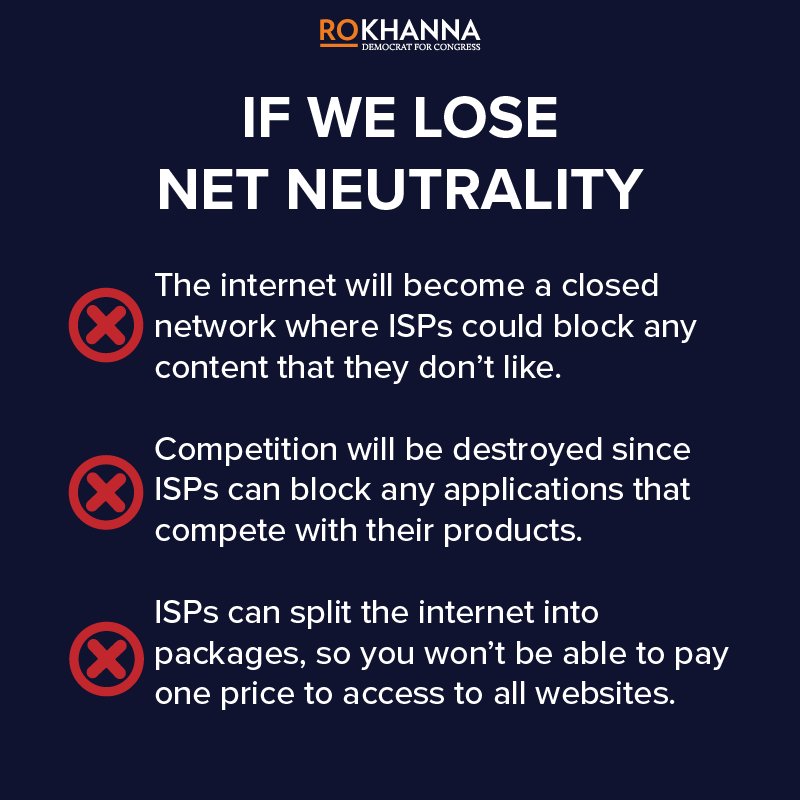
Net Neutrality is dead, FCC voted to kill it.

Bandwidth from their server's to the ISPs, yes. But from the ISP's servers to the user they do not I believe.
Why would Netflix pay when the users are already paying for it?! How do you not realize this? What do you think paying for internet service even is buying?

The ISPs want to get paid to do the same job twice. It’s bullshit.
 
Because apparently there are a few dumbasses in this thread who still don't quite understand what ISPs are trying to do by rolling back net neutrality.

DPK-kSlUIAAe2S4.jpg:large
"Can, can, can". How come they didn't do this when they could?

I think people are a little over-skeptical of corporations. I can't find an instance of ISPs implementing policies like this before net neutrality and they had no reason to.
 
Why would Netflix pay when the users are already paying for it?! How do you not realize this?

The ISPs want to get paid to do the same job twice. It’s bullshit.
Because this recent wave of 4K/2K streaming has only recently come into play, and it overloads their servers. This isn't something that's always been around.

Bandwidth is a limited resource, there is only so much of it. The only way to do things is to either spread the resource out (i.e., throttle those sites that use too much), or to exclude people from using any bandwidth at all.
 
Ok, so net neutrality will just make every ISP lower their proclaimed usage by 90%? What exactly does that solve?

The problem is a site like Netflix is using 35% of all the internet's bandwidth, but only paying for the same amount that a blog does. How is that fair? What if Netflix used 35% of global energy, should they pay the same amount as a regular household?

Net neutrality wouldn't cause anything to change because the net is already neutral.

Netflix isn't using 35% of the Internet's bandwidth... people are using 35% of the their Internet bandwidth (which they paid for) on Netflix traffic. How would it be fair to tell people what they can and can't use their bandwidth for?

Also bandwidth is not like electricity, otherwise it would be priced by the GB like cell phone data. Its true, that it can be limited to a certain degree by infrastructure.... but for the most part ISPs have continually beefed up their infrastructure to accommodate the increasing demands of internet usage.

In fact you bring up a good point, if we do away with net neutrality ISPs could have less incentive to continually update their infrastructure, and possibly set back innovation, since they can just throttle or block websites like Commcast wanted to do with Netflix.
 
Because this recent wave of 4K/2K streaming has only recently come into play, and it overloads their servers. This isn't something that's always been around.

Bandwidth is a limited resource, there is only so much of it. The only way to do things is to either spread the resource out (i.e., throttle those sites that use too much), or to exclude people from using any bandwidth at all.

Or expand bandwidth capabilities, which monopolistic ISPs have continually prevented. Bandwidth isnt some nonrenewable natural resource.
 
"Can, can, can". How come they didn't do this when they could?

I think people are a little over-skeptical of corporations. I can't find an instance of ISPs implementing policies like this before net neutrality and they had no reason to.

They have on multiple occasions. You can look it up.
 
How do it work in the rain is it like satellite TV where the signal degrades?

Ka Band works fine in the rain -- it may have issues in the snow but it's not a major issue at all. The Ku band is the one that has issues with rain. But, when you factor in down time a lot of copper based infrastructure have due to constant maintenance requirements, the difference is pretty negligible.

Another option (I'm assuming you're in a more rural area) is fixed wireless delivery. You said you only have one provider but usually the limited areas only regard a dsl or cable connection. If you pm me your areas postal code I can do a service check for you and see what options you may have.
 
"Can, can, can". How come they didn't do this when they could?

I think people are a little over-skeptical of corporations. I can't find an instance of ISPs implementing policies like this before net neutrality and they had no reason to.

Putting your trust in corporations is the definition of folly. A Business's number one goal is to make more money this year than they did last year at all cost no matter what the circumstances. Keep in mind ISPs are also CSP's(cable service providers). In a day in age where people are cutting the cord now more than ever, this represents an opportunity for them to make more money on a service that people are not going to be cutting at all because everybody needs/uses the Internet. Also many people in different parts of the country won't have a choice in who their ISP is as some companies basically have a monopoly over certain regions.

They are spending multiple millions of dollars to combat net neutrality for a very specific reason and we already know what that reason is. So I don't know what your political leanings are but let's say whatever your favorite political sites are started getting the bottled beyond all belief because that specific corporation donates to opposing politicians. I don't think you would like that very much would you? Sites like RT America, the Young Turks, or even something like Breitbart and Info Wars could be targeted by the corporate fat cats.

Never trust people who have no financial obligation to care about you.
 
Because this recent wave of 4K/2K streaming has only recently come into play, and it overloads their servers. This isn't something that's always been around.

Bandwidth is a limited resource, there is only so much of it. The only way to do things is to either spread the resource out (i.e., throttle those sites that use too much), or to exclude people from using any bandwidth at all.

I've always seen it a bit differently but not too much. Bandwidth is a limited resource, but I don't think it's Netflix responsibility to pay for that because they don't control how much a consumer uses. If I want to leave Stranger Things streaming all day in 4K, Netflix shouldn't foot that bill. I think responsibility and accountability need to go hand in hand, and it doesn't make sense to me to make the content provider accountable for something the content consumer is responsible for.
 
Net neutrality wouldn't cause anything to change because the net is already neutral.

Netflix isn't using 35% of the Internet's bandwidth... people are using 35% of the their Internet bandwidth (which they paid for) on Netflix traffic. How would it be fair to tell people what they can and can't use their bandwidth for?

Also bandwidth is not like electricity, otherwise it would be priced by the GB like cell phone data. Its true, that it can be limited to a certain degree by infrastructure.... but for the most part ISPs have continually beefed up their infrastructure to accommodate the increasing demands of internet usage.

In fact you bring up a good point, if we do away with net neutrality ISPs could have less incentive to continually update their infrastructure, and possibly set back innovation, since they can just throttle or block websites like Commcast wanted to do with Netflix.
Why would ISPs care to throttle anything if bandwidth usage wasn't an issue? ISPs don't just needlessly hate Netflix and Youtube. They hate that there is not enough bandwidth at certain times of the day, which causes users to experience disruptions in their service. If Netflix and Youtube were to disappear, there would be enough bandwidth. The type of content is the reason these issues are arising, i.e. 4K and 2K streaming.

And ISPs were continuously updating their infrastructure long before net neutrality arose.

I think a lot of people are ignorant of what it takes to run the internet, and thus don't even have a drop of sympathy for ISPs. ISPs aren't these assholes who want to fuck you over from watching youtube videos because they hate you.

There's a reason there is such a huge barrier of entry into the market, running an ISP is not easy, especially with the amount of scaling they have been forced to do in very recent years.

 
They have on multiple occasions. You can look it up.
Very few cases I can find of a free market ISP blocking a site.

The main ones I can think of is when... wait for it.... a government got involved in the industry. China, North Korea, etc.
 
ISPs aren't these assholes who want to fuck you over from watching youtube videos because they hate you.

To be fair, a lot of ISP's are also cable companies. And cable companies are notorious for seeming like assholes who want to fuck you over because they hate you.
 
Or expand bandwidth capabilities, which monopolistic ISPs have continually prevented. Bandwidth isnt some nonrenewable natural resource.
I don't understand why an ISP would want to prevent bandwidth expansion capabilities. And if they did, that a monopolistic practice that the government should look at. Luckily we have anti-monopoly laws in place.

But all net neutrality does is help monopolies by introducing a further barrier of entry.
 
Why would ISPs care to throttle anything if bandwidth usage wasn't an issue? ISPs don't just needlessly hate Netflix and Youtube. They hate that there is not enough bandwidth at certain times of the day, which causes users to experience disruptions in their service. If Netflix and Youtube were to disappear, there would be enough bandwidth. The type of content is the reason these issues are arising, i.e. 4K and 2K streaming.

And ISPs were continuously updating their infrastructure long before net neutrality arose.

I think a lot of people are ignorant of what it takes to run the internet, and thus don't even have a drop of sympathy for ISPs. ISPs aren't these assholes who want to fuck you over from watching youtube videos because they hate you.

There's a reason there is such a huge barrier of entry into the market, running an ISP is not easy, especially with the amount of scaling they have been forced to do in very recent years.

You keep going back to the bandwidth. As I said its not like electricity, otherwise they would price it by the GB like electricity prices it by the kilowatt (which btw would be fine as far as net neutrality is concerned).

I don't feel like going in circles with you, so just re-read the post you quoted and address the points if you still want to discuss.
 
You keep going back to the bandwidth. As I said its not like electricity, otherwise they would price it by the GB like electricity prices it by the kilowatt (which btw would be fine as far as net neutrality is concerned).

I don't feel like going in circles with you, so just re-read the post you quoted and address the points if you still want to discuss.
Only so much data can be transmitted through a cable at one time. How can you even deny this? Their pricing structure doesn't have to correlate with usage, much like an all you can eat restaurant doesn't price their food by how much you eat. They look at the average cost of a user and set their price much higher.
 
Bandwidth from their server's to the ISPs, yes. But from the ISP's servers to the user they do not I believe.
I am paying for X bandwidth. Why does the ISP get to dictate how I use it? I am paying for 100mpbs. They can fuck right off if they are going to let me have 100mpbs to my email and 10 mpbs to Netflix.
 
Only so much data can be transmitted through a cable at one time. How can you even deny this? Their pricing structure doesn't have to correlate with usage, much like an all you can eat restaurant doesn't price their food by how much you eat. They look at the average cost of a user and set their price much higher.
You can look me straight in the face and say they will lower prices for the average user if net neutrality goes away? They are doing the exact opposite right now!.
 
You can look me straight in the face and say they will lower prices for the average user if net neutrality goes away? They are doing the exact opposite right now!.
I didn't say that. I said they don't set their prices for plans based on exact bandwidth usage, but rather expected bandwidth usage.

Even though in many cases they do set their prices based on bandwidth usage (like 200MB/s vs 100MB/s vs 50MB/s, etc.)
 
Back
Top