Economy ~ Made In America ~ [US Shale Juggernaut Stomping OPEC + MFG's Biggest Annual Job Gain In 20 Years]

NoDak

Banned
Banned
Joined
Jul 26, 2018
Messages
8,873
Reaction score
5
Before we get to the central thread topic and study, a quick review would probably serve a decent purpose here.

There are some pretty huge misconceptions about the Industrial sector, US manufacturing, the state and future of it. Industry 4.0 is upon us: driven by a massive volume of available data, developments in analytics and machine learning, new forms of human-machine interaction and the ability to transmit digital instructions to the physical world. The whole sector is undergoing a reinvention and many of the new jobs will require skilled labor.

The importance of a strong manufacturing base is probably understated considering that it indirectly supports millions of other jobs (17.1 million to be exact, according to an EPI release in 2015) and has the highest multiplier of any economic sector: each dollar’s worth of manufactured goods generates around $1.89 in output from other sectors of the economy (per Deloitte).

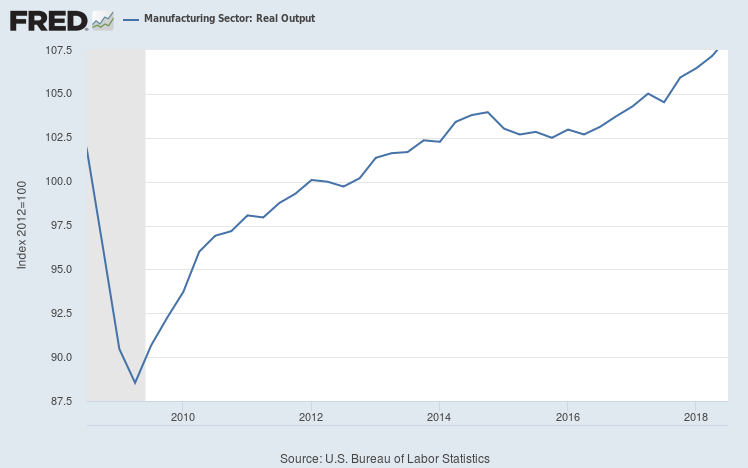
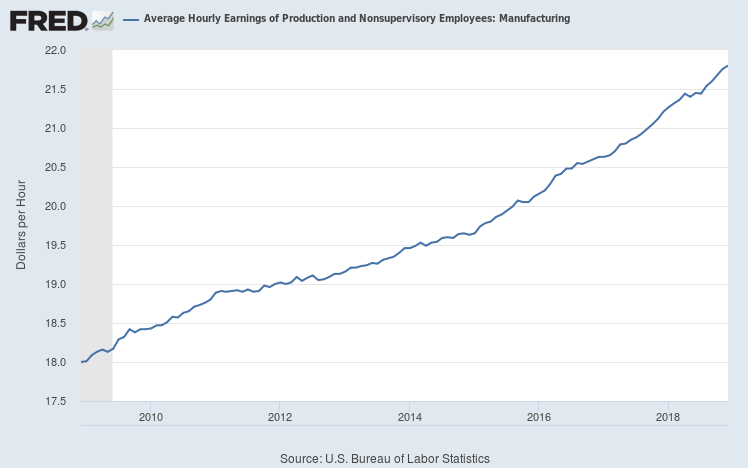
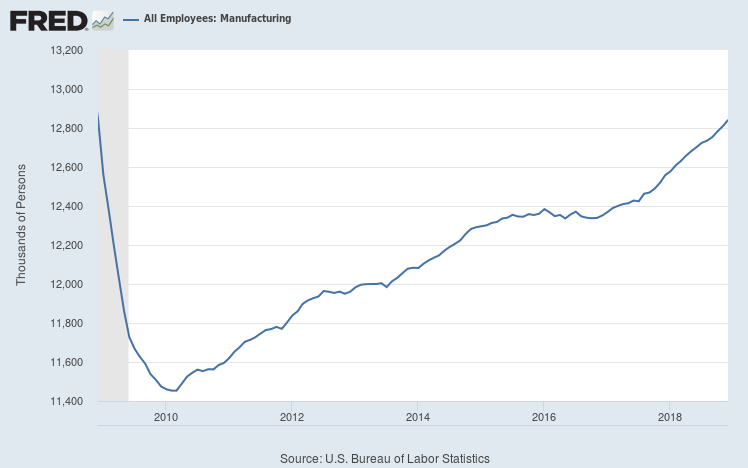
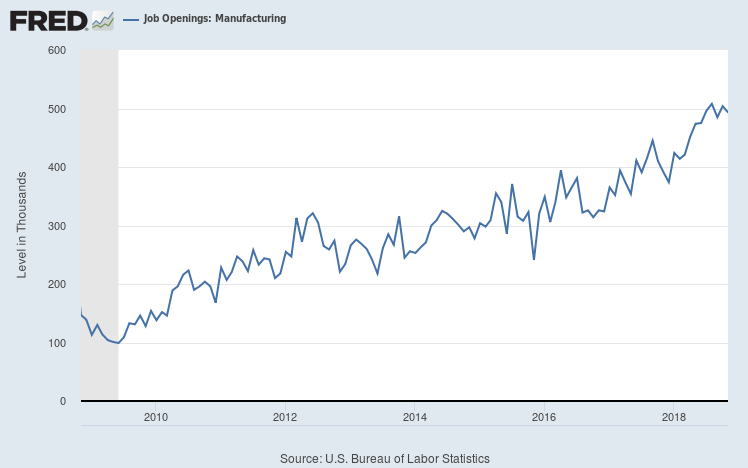
It's also actually very far from "hallowing out", I'll replace and update the FRED data as time moves along.

mfg-768x513.png


Index.png


Output.png


Wages.png


Employees.png


Openings.png


The US Is Beating China On The Factory Floor. This Is Why.

image.png


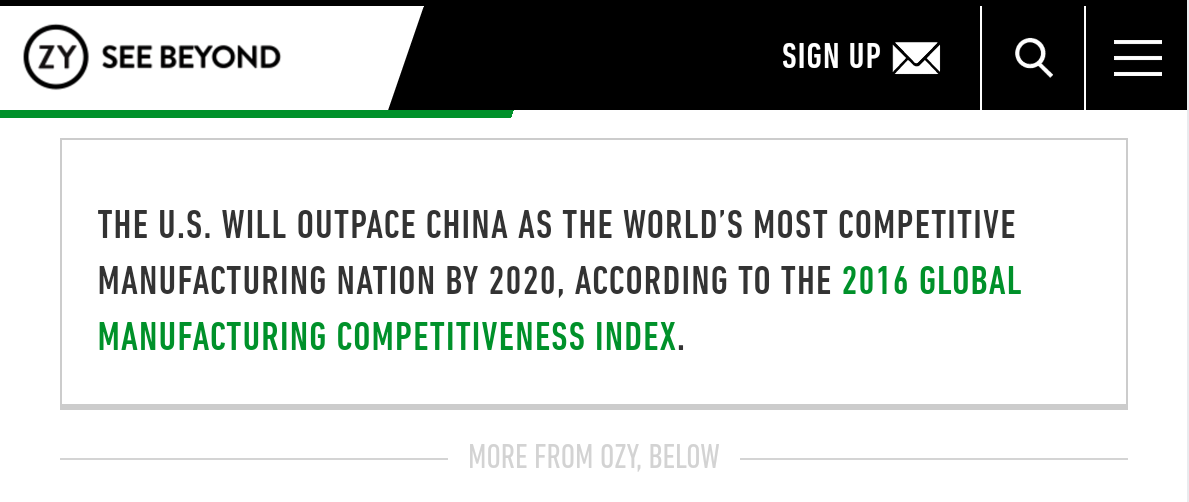
How The US Plans To Replace China As The World's Largest Manufacturer

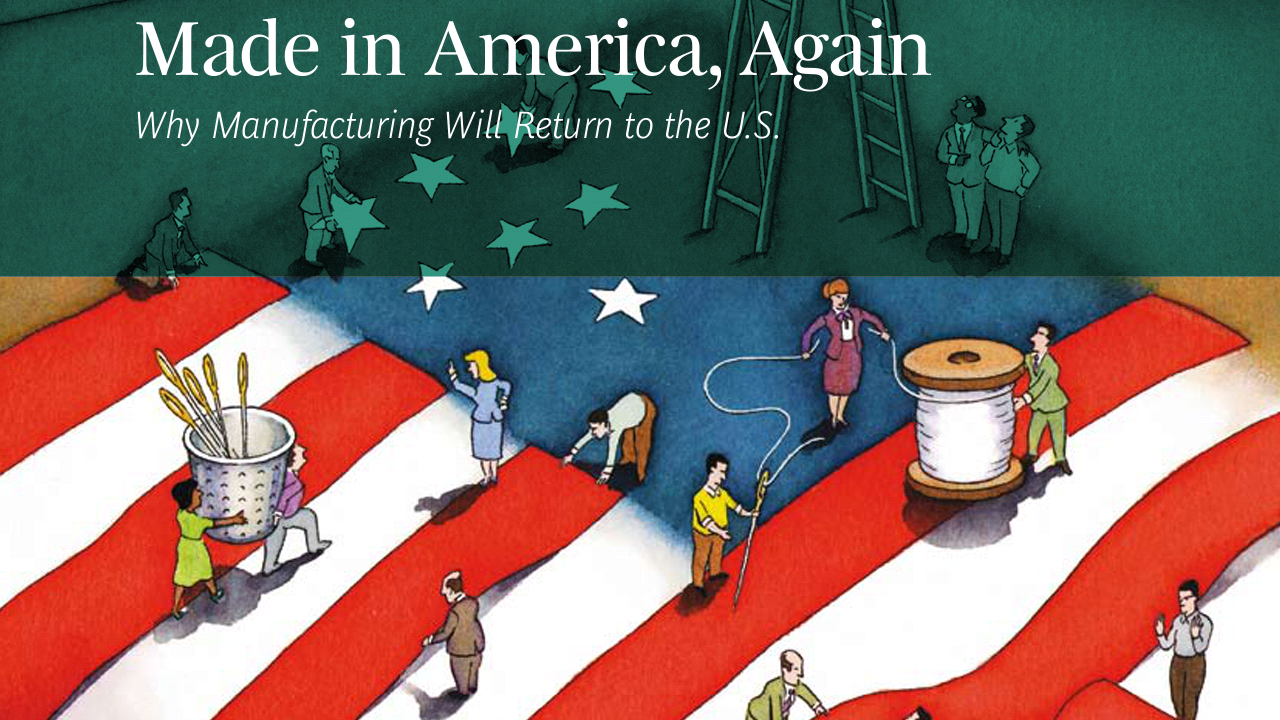
Made_USA.png


Reshoring Initiative Data Report: Manufacturing Reshoring Plus FDI Job Announcements Up 2,800% Since 2010

dr3.png


Now here's the actual problem.

Deloitte: Future Of Manufacturing Skills Gap (Study)

For more than two centuries, the manufacturing industry has adopted new technologies and provided new jobs for workers. Today, the industry is experiencing exciting and exponential change, as technologies such as artificial intelligence (AI), robotics, and Internet of Things (IoT) are rapidly changing the workplace. While some predicted that these new technologies would eliminate jobs, we have found the reverse—more jobs are actually being created.

In fact, job openings have been growing at double-digit rates since mid-2017, and are nearing the historical peak recorded in 2001. In this dynamic manufacturing environment, Deloitte and The Manufacturing Institute launched their fourth skills gap study to reevaluate their prior projections and move the conversation forward on today’s hiring environment and the future of manufacturing work. The results appear to highlight a widening gap between the jobs that need to be filled and the skilled talent pool capable of filling them.

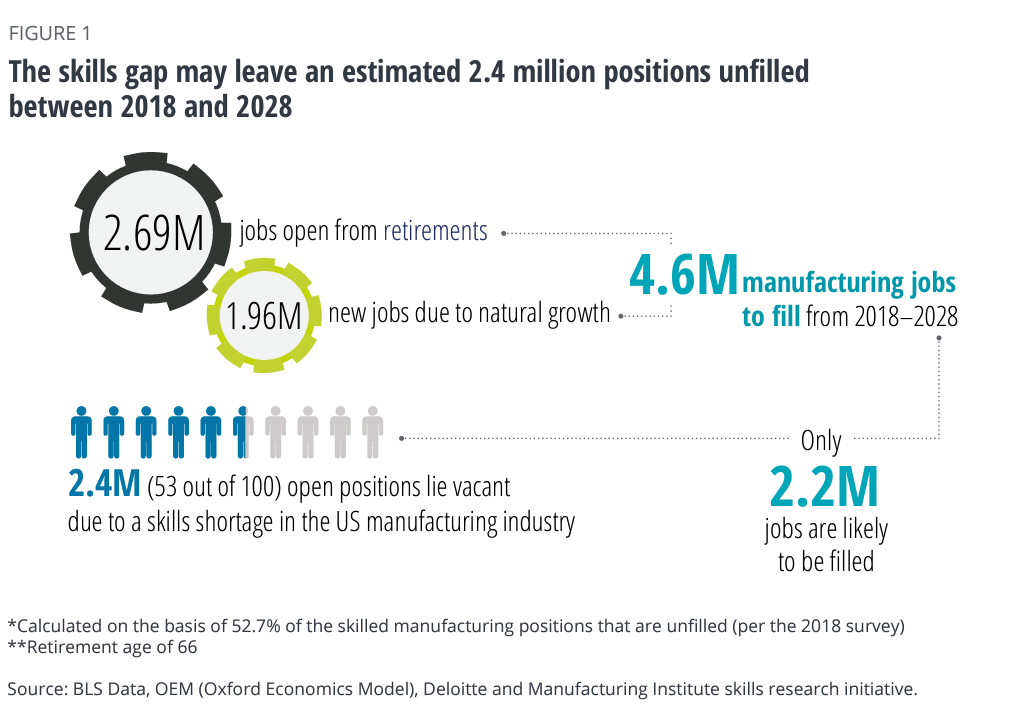
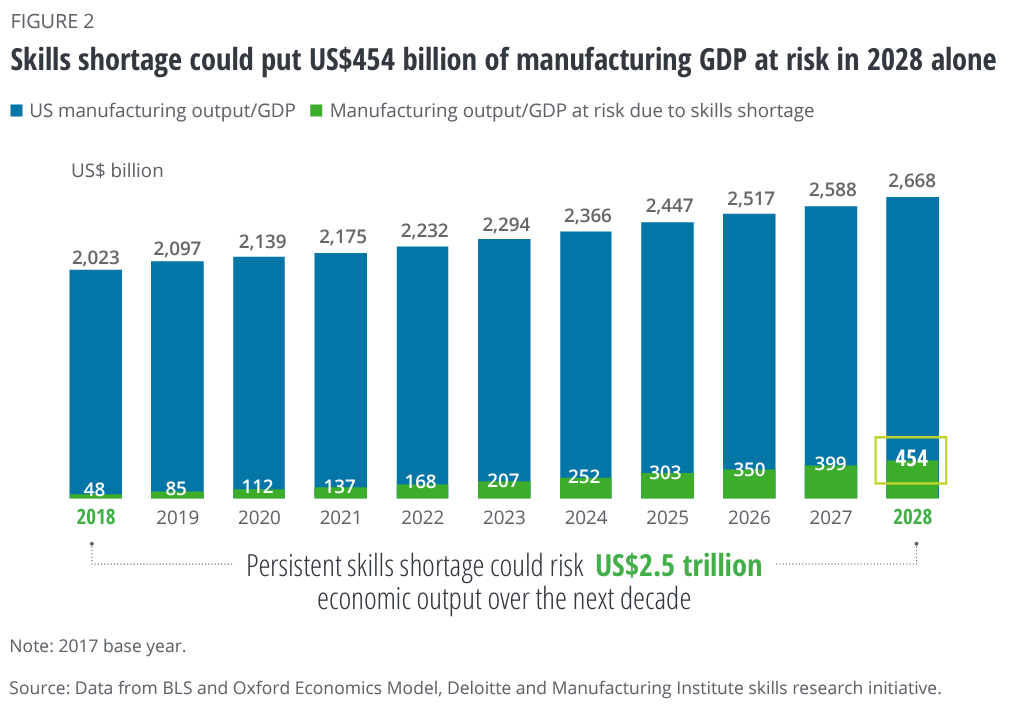
The study reveals that the skills gap may leave an estimated 2.4 million positions unfilled between 2018 and 2028, with a potential economic impact of $2.5 trillion. Further, the study shows that the positions relating to digital talent, skilled production, and operational managers may be three times as difficult to fill in the next three years.


Fig1.png


Fig2.png
 
Last edited:
From a (shitty) article on Quartz covering the study:

Millennial or Generation Z employees “would rather take less pay if they feel like they are working for a company that has a social purpose,” Pajula said. She points out that “people don’t think of manufacturing as sexy, creative, or attractive, and in technology, companies are more attractive.” The prospect of higher wages elsewhere is a factor, yet Pajula said “image is the bigger problem.”

Oh. Would they, Pajula?

That's funny, I could've sworn indispensable national and strategic assets spawned by American innovation such as the aerospace and semiconductor industries - in addition to being primary sources of high wage employment and global exports - manufactured the most creative, R&D intensive, technologically advanced products in the world? They're also overwhelmingly based stateside, 'Made In America'. That's part of why our output is so high and of course, I'm right. Are these kids retarded? My generation, SMH. No more gender queer studies and lesbian dance theory for you.

I guess people do kind of loathe the likes of Boeing, Lockheed and Northrop Grumman these days although their employees seem to be happy; the latter was listed at #1 on a survey of the best companies to work for in the United States on Indeed. The flight systems group of their Innovation division - formerly Orbital ATK - is based here in Phoenix-Metro right next to Intel's absurd Ocotillo campus and fabrication manufacturing plant, with another (the third) $7 billion facility currently under construction. Microchip, ON and NXP all have manufacturing capacity here, Boeing builds the Apache AH-64's here, etc.

The talent of the labor pool, educational infrastructure, business environment, quality of life, cost of living and supply of land is all very impressive in Kyrsten Sinema's AZ district and she also co-sponsored the bisexual bipartisan 2017 Made In America Act, but whatever. ASU has been named the most innovative university in the country four years running and the Ira Fulton Schools of Engineering have over 20,000 students, but we can't house everything now.

How is this not sexy?


Before we get to the central thread topic and study, a quick review would probably serve a decent purpose here.

There are some pretty huge misconceptions about US manufacturing, the state and future of it. Industry 4.0 is upon us: driven by a massive volume of available data, developments in analytics and machine learning, new forms of human-machine interaction and the ability to transmit digital instructions to the physical world. The whole sector is undergoing a reinvention and many of the new jobs will require skilled labor.

The importance of a strong manufacturing base is probably understated considering that it indirectly supports millions of other jobs (17.1 million to be exact, according to an EPI release in 2015) and has the highest multiplier of any economic sector: each dollar’s worth of manufactured goods generates around $1.40 in output from other sectors of the economy (per Forbes).

It's also actually very far from "hallowing out"...

mfg-768x513.png


The US Is Beating China On The Factory Floor. This Is Why.

image.png


How The US Plans To Replace China As The World's Largest Manufacturer

Made_USA.png


Reshoring Initiative Data Report: Manufacturing Reshoring Plus FDI Job Announcements Up 2,800% Since 2010

dr3.png


Now here's the actual problem.

Deloitte: Future Of Manufacturing Skills Gap (Study)

For more than two centuries, the manufacturing industry has adopted new technologies and provided new jobs for workers. Today, the industry is experiencing exciting and exponential change, as technologies such as artificial intelligence (AI), robotics, and Internet of Things (IoT) are rapidly changing the workplace. While some predicted that these new technologies would eliminate jobs, we have found the reverse—more jobs are actually being created.

In fact, job openings have been growing at double-digit rates since mid-2017, and are nearing the historical peak recorded in 2001. In this dynamic manufacturing environment, Deloitte and The Manufacturing Institute launched their fourth skills gap study to reevaluate their prior projections and move the conversation forward on today’s hiring environment and the future of manufacturing work. The results appear to highlight a widening gap between the jobs that need to be filled and the skilled talent pool capable of filling them.

The study reveals that the skills gap may leave an estimated 2.4 million positions unfilled between 2018 and 2028, with a potential economic impact of $2.5 trillion. Further, the study shows that the positions relating to digital talent, skilled production, and operational managers may be three times as difficult to fill in the next three years.


Fig1.png


Fig2.png
A 454 billion job deficit will drive these wages through the roof. Should have workers scrambling for training and education. Student debt and education costs are going to jump as well.
Do you think the wage will support the educational debt? I wonder when it becomes unsustainable. My ex wife and I are killing ourselves to keep our 2 out of debt as they get a bachelors and enter the job market. AND they aren't in manufacturing...

<Ellaria01>
 
That multiplier is lower than I’ve seen in other reports. Also worth mentioning that it varies significantly by industry. What’s beyond question though is that manufacturing is an economic engine that has been undervalued by this country for far too long. It’s economic benefit goes far beyond the jobs on the factory floors themselves and manufacturing losses in recent decades are felt far beyond as well. This is part of the picture why countries like China will export their production at less than cost and still reap an economic benefit. All the percolation of these gained industries is worth more than the subsidies that went into them.
 
Sort of skimmed the bloated OP... Here is a takeaway:

The entire reason most people speak of the necessity for "good paying" factory jobs in America would be erased if said good paying factory jobs required extensive, hi-tech skill acquisitions.
 
A 454 billion job deficit will drive these wages through the roof. Should have workers scrambling for training and education. Student debt and education costs are going to jump as well.
Do you think the wage will support the educational debt? I wonder when it becomes unsustainable. My ex wife and I are killing ourselves to keep our 2 out of debt as they get a bachelors and enter the job market. AND they aren't in manufacturing...

<Ellaria01>

I guess time will tell. I have a cushy equipment and materials manager job at a caulking and waterproofing contractor while I finish my university work and business is out of control, new factories and warehouses always popping up left and right.

Hmm, yeah. On second thought...

Sort of skimmed the bloated OP.

That's extreme brevity and super-lean, man.

<bball1>
 
Last edited:
The big problem facing US manufacturers is the competition overseas that gets away with treating laborers like we did back in the 1920s. We did the right thing for the workers, obviously, but it has hindered our ability to produce the same shit we buy from China or Indonesia.
 
Really solid OP man. You're a smart guy, and it's much appreciated with some real data.

In extension, I think parts of the "doomsday prohpecies" are vastly overexaggerated. There's no doubt some positives happening right now in the US economy under Trump. With that said, and yes I have to do a *with that said*, there's so many moving parts that goes against the OP's hopeful consequences that I find it hard to be optimistic. Sure, some parts will and have improved, others who are more important will not.

Then again, I just got home from a funeral 10 beers deep so I might be wrong.

PS: @NoDak is the man <3
 
Really solid OP man. You're a smart guy, and it's much appreciated with some real data.

In extension, I think parts of the "doomsday prohpecies" are vastly overexaggerated. There's no doubt some positives happening right now in the US economy under Trump. With that said, and yes I have to do a *with that said*, there's so many moving parts that goes against the OP's hopeful consequences that I find it hard to be optimistic. Sure, some parts will and have improved, others who are more important will not.

Then again, I just got home from a funeral 10 beers deep so I might be wrong.

PS: @NoDak is the man <3

Oh, this isn't some kind of down low pro-Trump thread bro. It's being driven by technological innovation and is (somewhat unfortunately) also a byproduct of the shale oil boom. For instance, the global manufacturing competitive index report was released before Trump was even elected. I also abhor the way our aerospace manufacturers milk their government contracts but the shit that they engineer and produce is high T-level induced cool as hell... and downright fucking nasty. This is dirty business, and we're flawed human beings.

PS: Muah <3
 
Oh, this isn't some kind of down low pro-Trump thread bro. It's being driven by technological innovation and is (somewhat unfortunately) also a byproduct of the shale oil boom. For instance, the global manufacturing competitive index report was released before Trump was even elected. I also abhor the way our aerospace manufacturers milk their government contracts but the shit that they engineer and produce is high T-level induced cool as hell... and downright fucking nasty. This is dirty business, and we're flawed human beings.

PS: Muah <3
For sure. Agree completely. In the name of the great leader:

https://www.independent.co.uk/news/...-smart-human-rights-north-korea-a8397906.html

You're a smart guy.

Again, ultimately I still think it's not the most important metric. Good for a few, for sure, good for some, yes, good for all, definitely no.

REFORM
 
For sure. Agree completely. In the name of the great leader:

https://www.independent.co.uk/news/...-smart-human-rights-north-korea-a8397906.html

You're a smart guy.

Again, ultimately I still think it's not the most important metric. Good for a few, for sure, good for some, yes, good for all, definitely no.

REFORM

It's definitely good for me because I'm in STEM and probs not a PhD candidate (not so smart eh), industry is ultimately the route. A large bulk of this manufacturing boom is going to require skilled labor, it's not your grandpa's greasy factory work. A fair amount of that actually is coming back in the short term due to lower TCO as noted in the hyperlinked articles but nothing like it was post-WW2 up through to the 1970s and 80s when direct employment peaked.

This is a good move though.

It is expected that Trump's administration will follow Obama's Industry 4.0 policy (2011): the formation of the Advanced Manufacturing Partnership (AMP), a national effort bringing together industry and the Federal Government to invest in Industry 4.0 technologies.

The US Federal Government and the private sector are investing in Industry 4.0 to increase the American industrial base, which has been taken over by China and low-labor-cost countries in Mexico, Brazil and Asia-Pacific. During Trump administration's first year, American factories added jobs at the fastest pace since 2014. In the next decades, it is expected that American businesses will establish global networks that incorporate their machinery, warehousing systems, and production facilities in the shape of cyber-physical systems.

In the manufacturing environment, these cyber-physical systems comprise of smart machines, storage systems, and production facilities capable of autonomously exchanging information, triggering actions, and controlling each other independently.
 
It's definitely good for me because I'm in STEM and probs not a PhD candidate (not so smart eh), industry is ultimately the route. A large bulk of this manufacturing boom is going to require skilled labor, it's not your grandpa's greasy factory work. A fair amount of that actually is coming back in the short term due to lower TCO as noted in the hyperlinked articles but nothing like it was post-WW2 up through to the 1970s and 80s when direct employment peaked.

This is a good move though.

It is expected that Trump's administration will follow Obama's Industry 4.0 policy (2011): the formation of the Advanced Manufacturing Partnership (AMP), a national effort bringing together industry and the Federal Government to invest in Industry 4.0 technologies.

The US Federal Government and the private sector are investing in Industry 4.0 to increase the American industrial base, which has been taken over by China and low-labor-cost countries in Mexico, Brazil and Asia-Pacific. During Trump administration's first year, American factories added jobs at the fastest pace since 2014. In the next decades, it is expected that American businesses will establish global networks that incorporate their machinery, warehousing systems, and production facilities in the shape of cyber-physical systems.

In the manufacturing environment, these cyber-physical systems comprise of smart machines, storage systems, and production facilities capable of autonomously exchanging information, triggering actions, and controlling each other independently.
Yeah I know what you mean. That's why I think there's a lot of positive stuff going on in specific fields, and that's GOOD. However, the overaching point is that wealth is being distributed the wrong way, buying power is going down for the middle class and climate change (I know i've harped on this minutiae sorry) will change the landscape for the worse. Same with health insurance and so forth which again I must concede I'm harping on. It's not something that happens in a vacuum.

Just wait 10 years my friend.

Btw

.....

<3
 
I try to buy Made in the USA as much as possible

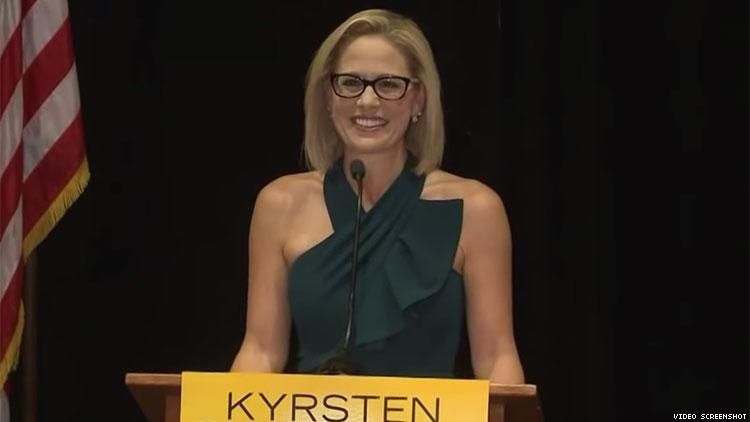
Did you catch my reply in the McConspiracy thread when you compared Kyrsten to that noob Ocasio-Cortez? She's a 3x elected House rep already and moving up to the Senate. The district Sinema represented here constitutes the university & high-tech business corridor; she won her elections from 2012-2016 with 48.7%, 54.6% and 60.9% of the vote and just flipped a 30-year held red Senate seat.

https://fitzpatrick.house.gov/media...fitzpatrick-sinema-introduce-made-america-act

Congressman Brian Fitzpatrick (R-PA) and Congresswoman Kyrsten Sinema (D-AZ) introduced legislation this week that would support American manufacturing and incentivize businesses to increase domestic production. The Made in America Act of 2017 [H.R. 3850] creates a voluntary, standardized labeling program that would allow consumers to easily identify the extent to which products are American-made.

“American manufacturing means American jobs. People in my community understand that when they buy American they’re not only buying quality products, they’re helping American businesses – and American workers – in their neighborhoods and across the country,” said Fitzpatrick. “The Made in America Act would connect American consumers to American manufacturers like never before by creating a definitive, standardized definition of American-made goods. I’m grateful for the support of Congresswoman Sinema in working to advance this bipartisan priority.”

“Helping American consumers purchase American-made products is a win-win,” said Sinema. “It’s simple: buying American-made products supports American jobs and gives America consumers what they want. I’ll continue working with my colleagues on both sides of the aisle to ensure Arizona businesses, manufacturers, and entrepreneurs have the support they need to grow and thrive.”


kyrsten-sinema-gives-her-victory-speech750x422.jpg


Yeah I know what you mean. That's why I think there's a lot of positive stuff going on in specific fields, and that's GOOD. However, the overaching point is that wealth is being distributed the wrong way, buying power is going down for the middle class and climate change (I know i've harped on this minutiae sorry) will change the landscape for the worse. Same with health insurance and so forth which again I must concede I'm harping on. It's not something that happens in a vacuum.

Just wait 10 years my friend.

Btw

.....

<3

You fucking cocktease lol.
 
Did you catch my reply in the McConspiracy thread when you compared Kyrsten to that noob Ocasio-Cortez? She's a 3x elected House rep already and moving up to the Senate. The district Sinema represented here constitutes the university & high-tech business corridor; she won her elections from 2012-2016 with 48.7%, 54.6% and 60.9% of the vote and just flipped a 30-year held red Senate seat.

https://fitzpatrick.house.gov/media...fitzpatrick-sinema-introduce-made-america-act

Congressman Brian Fitzpatrick (R-PA) and Congresswoman Kyrsten Sinema (D-AZ) introduced legislation this week that would support American manufacturing and incentivize businesses to increase domestic production. The Made in America Act of 2017 [H.R. 3850] creates a voluntary, standardized labeling program that would allow consumers to easily identify the extent to which products are American-made.

“American manufacturing means American jobs. People in my community understand that when they buy American they’re not only buying quality products, they’re helping American businesses – and American workers – in their neighborhoods and across the country,” said Fitzpatrick. “The Made in America Act would connect American consumers to American manufacturers like never before by creating a definitive, standardized definition of American-made goods. I’m grateful for the support of Congresswoman Sinema in working to advance this bipartisan priority.”

“Helping American consumers purchase American-made products is a win-win,” said Sinema. “It’s simple: buying American-made products supports American jobs and gives America consumers what they want. I’ll continue working with my colleagues on both sides of the aisle to ensure Arizona businesses, manufacturers, and entrepreneurs have the support they need to grow and thrive.”


kyrsten-sinema-gives-her-victory-speech750x422.jpg


You fucking cock tease lol.
Haha I thought for a moment you were talking about ME comparing Sinema to Cortez. I would never. Cortez is a newb for sure and while I support SOME of her points, she's pretty daft it seems.

Ohh, but in regards to being a tease. For sure.

Is it friday yet?
 
Back
Top