- Joined
- Dec 7, 2014
- Messages
- 1,317
- Reaction score
- 1,410
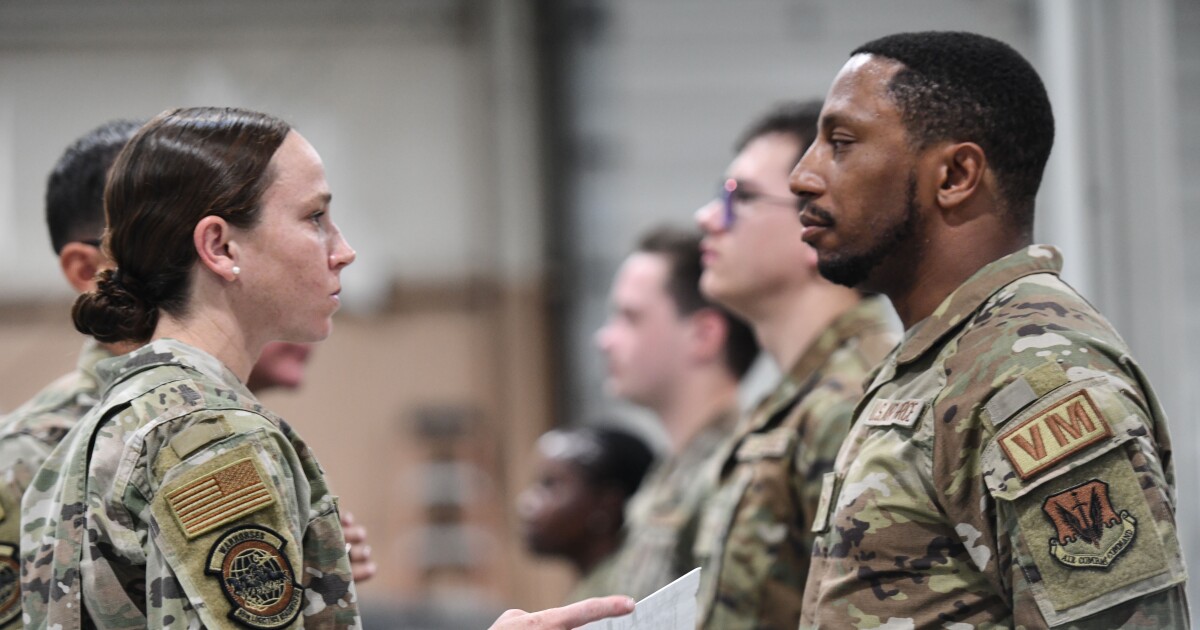
As the military tightens its shaving policies, some Black troops worry their careers are in danger
Troops will now face tougher rules to get exceptions to the daily shaving requirement. That could especially affect Black men with a skin condition that makes shaving painful and potentially disfiguring.
 americanhomefront.wunc.org
Troops will now face tougher rules to get exceptions to the daily shaving requirement. That could especially affect Black men with a skin condition that makes shaving painful and potentially disfiguring.
When Derrick Braxton joined the Air Force at age 21, he'd never shaved in his life. He had a short beard that he got trimmed at the barber. But on the first day of basic training, he willingly broke out a razor.
"The next day, my face was just on fire," he said. "The best way I can put it is, it literally looked like a Crunch bar. One of those Nestlé Crunch bars."
Braxton, speaking in a personal capacity and not on behalf of the Air Force, said he was sent to a military shaving clinic. He was told to try an electric razor, new shaving techniques, and a host of topical treatments.
"They work for a little bit," he said. "After you get shaving bumps, they kind of help them go away. But they don’t necessarily fix the situation."
He was later diagnosed with pseudofolliculitis barbae, or PFB, a chronic condition where hairs grow back into the skin and cause painful irritation after shaving. PFB is more common in Black men.
"This particular disease affects individuals with tightly coiled hair," said Dr. Chris Adigun, a North Carolina board-certified dermatologist and owner of the Dermatology and Laser Center of Chapel Hill. "So it looks like little bumps or pustules, because the body is processing the presence of that hair in the skin as a foreign body."
She said the best intervention is to avoid close shaving. Laser hair removal can help too, but the devices that work for patients with darker skin are expensive and uncommon.
"The lack of access is monstrous," Adigun said. "It takes many, many treatments, sometimes seven or more treatments. And then they will not be able to grow a beard again later in life."
Relief and Stigma
More than a decade ago, the Air Force gave Braxton a shaving waiver, a doctor-approved exception to the daily shaving requirement that can last from 90 days to five years. He has always kept his beard well within regulation at under a quarter inch. But even with that, as a young airman, he said he was asked to show his waiver as many as seven times a day.
He remembers an officer in one of his squadrons in 2014 fixating on his appearance.
"She came over and looked at my face. She even touched my face to feel my beard and all that stuff. I backed up like, 'Whoa.'"
"Then, for the next three months -- literally every single day -- she would come up to me and another airman I worked with and ask, 'Hey, do you all have your shaving waivers?' It's not like the dates changed on them or anything like that."
Now Braxton isn't sure he'll be able to stay in the Air Force with a shaving waiver.
In March, Defense Secretary Pete Hegseth launched a review of grooming standards, which Pentagon officials say is meant to restore discipline and uniformity in the ranks.
"We must remain vigilant in maintaining the standards that enable the men and women of our military to protect the American people and our homeland as the world's most lethal and effective fighting force," Hegseth wrote in a memo.
"Our adversaries are not growing weaker, and our tasks are not growing less challenging. This review will illuminate how the Department has maintained the level of standards required over the recent past and the trajectory of any change in those standards," he added.
The Air Force said it’s tightening the shaving waiver process, increasing medical oversight, and reserving long-term waivers only for the most severe PFB cases. The Army and Marine Corps also have made it harder to get shaving waivers and now can kick out troops who can't shave.
The Pentagon declined a request for an interview on the topic.
Kyle Bibby, a former Marine Corps infantry unit commander who oversaw troops with shaving waivers, said short beards don't affect service members' ability to fight.
"I can say that there's absolutely zero correlation between someone getting a no-shave chit [waiver] and a military's ability to function and perform its duty," he said.
Bibby, now the co-CEO of the Black Veterans Project, sees the changes as part of a broader political message. Studies suggest more than 45 percent of Black men in the military have PFB.
"I think it’s more about the politics of the Trump Administration and their feelings about what the military should look like -- not in terms of beards, but racially and ethnically -- than it is about combat readiness," he said.
"I don't find it a coincidence that this decision was being made as the Defense Department was taking down references to Jackie Robinson and Black Medal of Honor recipients. I don’t think it's a coincidence that they’re openly and categorically antagonistic to anything related to diversity, equity, and inclusion, or that this administration is canceling grants that even mention race, or Black, or anything like that. All of this paints a very clear picture."
A Medical Condition In Question
Joshua Nixon has had a shaving waiver since he joined the Air Force in 2011. Speaking in a personal capacity, he described living with PFB.
"When you have bumps on your face, and then those bumps turn to permanent scarring that doesn’t go away -- that just looks like little black moles everywhere -- that hurts your confidence, especially a young person," he said. "If I had to just keep shaving, it would have only gotten worse. It wouldn’t have gotten better. That’s not how PFB works."
As a medical technician, he entered waivers into airmen's records. Unlike broken bones or pregnancy, which came with routine accommodations, he found that shaving waivers tended to invite extra questions.
Nixon was once told he couldn’t become an Air Force recruiter because of his waiver. Studies have found that shaving profiles are tied to career setbacks, including promotion delays and being disqualified from certain duties and awards. Over time, Nixon said his experiences around shaving waivers left him burned out.
"I think we have to look at, hey, if we are being this strict on this medical condition that mostly affects this race, what are our intentions?" he asked. "Are there hidden motives? I’m not saying that there are. But I would be lying to you if I said my mind didn’t go there."
The Army is preparing to roll out a new policy that could lead to soldiers diagnosed with a chronic skin condition that causes painful razor bumps and scarring to be kicked out of the service -- an issue that disproportionately affects Black men.
The new guidance, expected to take effect in the coming weeks, would bar permanent shaving waivers and require medical personnel to craft formal treatment plans for affected troops, according to multiple service officials and internal documents reviewed by Military.com.
Soldiers in need of prolonged waivers may be directed to get laser treatments. Those who need shaving exemptions for more than 12 months over a two-year period could be kicked out of the Army. Units across the force will also be mandated to rebrief personnel on grooming standards within 90 days of the policy's rollout.
Most shaving waivers are for soldiers diagnosed with pseudofolliculitis barbae, or PFB, a condition in which hairs curl back into the skin after shaving and cause irritation. The Pentagon may cover the laser treatment, but that can cost thousands of dollars per soldier, depending on the number of sessions required. It's unclear how many soldiers would require the procedure.
The American Osteopathic College of Dermatology estimates that up to 60% of Black men are affected by the condition. Laser treatments can cause scarring and changes in skin pigmentation.
"Of course, this is racially motivated," one senior noncommissioned officer familiar with the plans told Military.com on the condition of anonymity to avoid retaliation. "There's no tactical reason; you can look professional with facial hair."
In March, the Marine Corps rolled out a similar program allowing troops to be separated if the genetic skin condition persists, also raising concerns of racial discrimination.
The Army has been in a prolonged recruiting slump since the high-water mark of the wars in Iraq and Afghanistan, something it started to turn around last year.
While Black Americans make up about 14% of the U.S. population, they have accounted for roughly one-quarter of the Army's new recruits in recent years, with that number steadily rising.
However, the services have made deliberate efforts to reduce recruiting efforts linked to minority groups amid Defense Secretary Pete Hegseth's purge of diversity initiatives during the Trump administration.
In 2018, more than 44,000 new recruits identified as white, according to Army data. By 2023, that number had fallen to just over 25,000 -- a staggering 43% drop in five years. The steepest annual decline came most recently, with a 6% dip from 2022 to 2023 alone. No other demographic group has seen such a precipitous fall.
Much of the recent recruiting slump was attributable to men being less qualified, or willing, to don the uniform while women have been joining the ranks at a steady rate.
Medical complications tied to mandatory shaving emerged as a flashpoint during the military's bumpy road toward racial integration. In the early 1970s, then-Chief of Naval Operations Adm. Elmo Zumwalt launched an aggressive campaign to root out racism and sexism across the ranks.
As part of that broader push, Zumwalt issued a now-famous directive permitting sailors to grow beards and mustaches, a move that clashed with the Navy's traditionally rigid grooming codes but aimed to ease chronic skin issues that disproportionately affected Black service members.
The primary argument against allowing beards in the ranks has long centered on concerns that they could compromise the seal of a gas mask. But a 2021 study from Military Medicine, a peer-reviewed medical journal, found there's no conclusive evidence that a well-groomed, modest beard interferes with mask function.
The publication also noted that only a small fraction of service members operate in environments where chemical attacks are a realistic threat.
In Alaska, units are granted wide latitude when it comes to grooming standards, with commanders often waiving shaving requirements during the frigid winter months. Troops are frequently instructed to skip their morning shave or forgo it entirely while operating in the field -- not out of convenience but as a safety precaution. The extreme cold can make shaving a medical hazard, with exposed skin at risk of frostbite and other cold-weather injuries.
The Army move to clamp down on shaving waivers follows Hegseth, who has protested shaving waivers, ordering a sweeping review of grooming standards across the services. He has claimed that standards have fallen in recent years and damaged the military.
"We kicked out good soldiers for having naked women tattooed on their arms," Hegseth said in a March statement criticizing what he characterized as bad policy decisions by past administrations. "And today we are relaxing the standards on shaving, dreadlocks, man buns, and straight-up obesity. Piece by piece, the standard had to go -- because of equity."