• We are currently experiencing technical difficulties. We sincerely apologize for the inconvenience.

Social How do we sleep while our beds are burning? The climate changing thread

I wonder why so many countries in the EU are adamant about the climate crisis, but at the same time move away from nuclear energy?

I saw that the import of LNG gas from Russia to China he EU increased a lot in 2024.
They are moving towards solar and wind , it's cheaper and doesn't take ten to twenty years to come online

And they are still building nuclear plants
 
Humans being the only know “intelligent” life in at least our little corner of the galaxy taking care of the planet and in turn the survival of humanity should be the entire world’s number one priority.

Nah, it's "climate alarmism"

Global warming can't be real because Greta Thunberg is annoying and Al Gore flies in private planes.
 

‘Pray for rain’: wildfires in Canada are now burning where they never used to​

Canada’s response to the extreme weather threat is being upended as the traditional epicentre of the blazes shifts as the climate warms

Leyland Cecco in Toronto

Road closures, evacuations, travel chaos and stern warnings from officials have become fixtures of Canada’s wildfire season. But as the country goes through its second-worst burn on record, the blazes come with a twist: few are coming from the western provinces, the traditional centre of destruction.

Instead, the worst of the fires have been concentrated in the prairie provinces and the Atlantic region, with bone-dry conditions upending how Canada responds to a threat that is only likely to grow as the climate warms.

Experts say the shift serves as a stark reminder that the risk of disaster is present across the thickly forested nation.

In recent weeks, tens of thousands of people have been evacuated from their homes due to the wildfires. Saskatchewan and Manitoba have been the worst hit, covering more than 60% of the area burned in Canada. But the fires have also seized strained resources in Atlantic Canada, where officials in Newfoundland and Labrador are struggling to battle out-of-control blazes.

In response to the crisis, the Newfoundland premier, John Hogan, said on Wednesday morning he would temporarily ban off-road vehicles in forested areas because the province “simply cannot afford any further risks, given the number of out-of-control wildfires we have”.


The ban follows a similar move by Nova Scotia, where a 15-hectare (37-acre) out-of-control fire is burning outside the provincial capital, Halifax. In addition to barring vehicles in wooded areas, Nova Scotia officials so shut down hiking, camping and fishing in forests, a decision reflecting the troubling fact that nearly all fires in the province are started by humans.

“Conditions are really dry, there’s no rain in sight, the risk is extremely high in Nova Scotia,” the province’s premier, Tim Houston, told reporters. “I’m happy to make sure that we’re doing everything we can to protect people, to protect property and try to just get through this fire season and really just pray for rain.”

Fires have even erupted in Ontario’s Kawartha Lakes region, a collection of rural communities less than 100 miles (160km) north of Toronto that are a popular summer destination for residents of Canada’s largest city.

For a country of sprawling landmass, fires have long been a common feature of the hot spring, summer and autumn. But for the last century, a mix of geography, climate and industry meant that the biggest and hottest fires – and the vast majority of destruction – have been concentrated in Canada’s western provinces.

That changed in 2023 when Canada had its worst fire season on record and the thick haze of smoke blanketed the US.

“We had fire everywhere. We had evacuations everywhere. We had smoke at a scale that was remarkable,” said Paul Kovacs, the executive director of the Institute for Catastrophic Loss Reduction at Western University. “And so for the first time, we had a different thought about wildfires as a country. With all of the smoke, it became a global conversation. This year is repeating all of that. This is a national issue. This can show up anywhere.”

Kovacs, whose organisation focuses largely on preventing structural loss, said more buildings had been destroyed this year compared with 2023, and he warned that a majority of the residents of the most fire-prone parts of the country, such as British Columbia and Alberta, had not yet taken steps to protect or “harden” their homes from fire risk.

He hopes that a broader national recognition of fire risk spurs people in other parts of the country to reassess how vulnerable their home or business might be to a fast-moving blaze.

“That’s the behavioural change we’re hoping to see next, because there will be many years of fires to come,” he said. “The size of the burned area will not go back to where things were 25 years ago. This is just our new reality and we need to be prepared. We need a change in mindset and a recognition that this can, and probably will, happen in so many parts of our country.”

Already, nearly 7.5m hectares (18.5m acres) have burned across Canada in 2025, far above the 10-year average.

Despite the national threat, there is no one-size-fits-all approach to reducing risk, said Jen Baron, a postdoctoral researcher at the University of British Columbia’s Centre for Wildfire Coexistence.

“British Columbia and Alberta have long been the poster children for this wildfire problem for a long time, but other regions are beginning to experience some of those same challenges,” she said. “This speaks to the pervasiveness of climate change: even if a location was relatively low fire risk in the past, with the extended droughts that we’re seeing, that’s no longer the case now and into the future.

“Even though some parts of the country are having a wet year on average, things across the board are still warmer and drier than they were in the past.”

That uncertainty has prompted a multimillion-dollar funding effort from the federal government to study risk and adaptation, because “there are very few parts of Canada that would be totally protected from wildfire”, Baron said.

With an international focus on wildfires, experts like Baron hope the recent years of immense blazes and choking smoke can spur a response that acknowledges the legacy of forestry industry practices, urban encroachment into the wilderness and the Indigenous stewardship of forests.

“We’re just starting to catch up to the scale of the problem,” she said. “Wildfire is a natural ecological process, but it’s become increasingly challenging to manage with changing climatic conditions.”


The concerns in Canada echo those emerging across the Atlantic as southern Europe grapples with one of its worst wildfire seasons in two decades.

In Spain, officials were scrambling on Sunday to contain 20 major wildfires. The prime minister, Pedro Sánchez, said during a visit to the north-western region of Galicia: “There are still some challenging days ahead and, unfortunately, the weather is not on our side.”

After fires killed three people and burnt more than 115,000 hectares, Sánchez said his government would seek to put forward a “national pact” to deal with the climate emergency.

“We need to reflect deeply on how we can rethink our capabilities, not only in terms of responses but also in terms of preventing everything related to the climate emergency, whether it be fires, storms, or any other climate-related natural disaster,” he said.

In Portugal, the area burned by wildfires this year is 17 times higher than in 2024, at about 139,000 hectares, according to preliminary calculations by the Institute for the Conservation of Nature and Forests. Across Europe, countries such as Greece, Bulgaria, Montenegro and Albania have requested help from the EU’s firefighting force as exhausted officials battle forest fires, fuelled by record-breaking temperatures, dry conditions and strong winds.

In Canada, Baron said the mild nature of this year’s western fire season provided a glimpse into the country’s future.

“Instead of one big fire year every 15 or 20 years, every year will be big in some part of the country,” she said. “We really don’t know exactly how climate change is going to continue. It doesn’t drive things in linear ways. And we can’t predict where there’s going to be a drought next year. But it will be somewhere.”

https://www.theguardian.com/world/2025/aug/17/new-canada-wildfires-locations

 

‘Pray for rain’: wildfires in Canada are now burning where they never used to​

Canada’s response to the extreme weather threat is being upended as the traditional epicentre of the blazes shifts as the climate warms

Leyland Cecco in Toronto

Road closures, evacuations, travel chaos and stern warnings from officials have become fixtures of Canada’s wildfire season. But as the country goes through its second-worst burn on record, the blazes come with a twist: few are coming from the western provinces, the traditional centre of destruction.

Instead, the worst of the fires have been concentrated in the prairie provinces and the Atlantic region, with bone-dry conditions upending how Canada responds to a threat that is only likely to grow as the climate warms.

Experts say the shift serves as a stark reminder that the risk of disaster is present across the thickly forested nation.

In recent weeks, tens of thousands of people have been evacuated from their homes due to the wildfires. Saskatchewan and Manitoba have been the worst hit, covering more than 60% of the area burned in Canada. But the fires have also seized strained resources in Atlantic Canada, where officials in Newfoundland and Labrador are struggling to battle out-of-control blazes.

In response to the crisis, the Newfoundland premier, John Hogan, said on Wednesday morning he would temporarily ban off-road vehicles in forested areas because the province “simply cannot afford any further risks, given the number of out-of-control wildfires we have”.


The ban follows a similar move by Nova Scotia, where a 15-hectare (37-acre) out-of-control fire is burning outside the provincial capital, Halifax. In addition to barring vehicles in wooded areas, Nova Scotia officials so shut down hiking, camping and fishing in forests, a decision reflecting the troubling fact that nearly all fires in the province are started by humans.

“Conditions are really dry, there’s no rain in sight, the risk is extremely high in Nova Scotia,” the province’s premier, Tim Houston, told reporters. “I’m happy to make sure that we’re doing everything we can to protect people, to protect property and try to just get through this fire season and really just pray for rain.”

Fires have even erupted in Ontario’s Kawartha Lakes region, a collection of rural communities less than 100 miles (160km) north of Toronto that are a popular summer destination for residents of Canada’s largest city.

For a country of sprawling landmass, fires have long been a common feature of the hot spring, summer and autumn. But for the last century, a mix of geography, climate and industry meant that the biggest and hottest fires – and the vast majority of destruction – have been concentrated in Canada’s western provinces.

That changed in 2023 when Canada had its worst fire season on record and the thick haze of smoke blanketed the US.

“We had fire everywhere. We had evacuations everywhere. We had smoke at a scale that was remarkable,” said Paul Kovacs, the executive director of the Institute for Catastrophic Loss Reduction at Western University. “And so for the first time, we had a different thought about wildfires as a country. With all of the smoke, it became a global conversation. This year is repeating all of that. This is a national issue. This can show up anywhere.”

Kovacs, whose organisation focuses largely on preventing structural loss, said more buildings had been destroyed this year compared with 2023, and he warned that a majority of the residents of the most fire-prone parts of the country, such as British Columbia and Alberta, had not yet taken steps to protect or “harden” their homes from fire risk.

He hopes that a broader national recognition of fire risk spurs people in other parts of the country to reassess how vulnerable their home or business might be to a fast-moving blaze.

“That’s the behavioural change we’re hoping to see next, because there will be many years of fires to come,” he said. “The size of the burned area will not go back to where things were 25 years ago. This is just our new reality and we need to be prepared. We need a change in mindset and a recognition that this can, and probably will, happen in so many parts of our country.”

Already, nearly 7.5m hectares (18.5m acres) have burned across Canada in 2025, far above the 10-year average.

Despite the national threat, there is no one-size-fits-all approach to reducing risk, said Jen Baron, a postdoctoral researcher at the University of British Columbia’s Centre for Wildfire Coexistence.

“British Columbia and Alberta have long been the poster children for this wildfire problem for a long time, but other regions are beginning to experience some of those same challenges,” she said. “This speaks to the pervasiveness of climate change: even if a location was relatively low fire risk in the past, with the extended droughts that we’re seeing, that’s no longer the case now and into the future.

“Even though some parts of the country are having a wet year on average, things across the board are still warmer and drier than they were in the past.”

That uncertainty has prompted a multimillion-dollar funding effort from the federal government to study risk and adaptation, because “there are very few parts of Canada that would be totally protected from wildfire”, Baron said.

With an international focus on wildfires, experts like Baron hope the recent years of immense blazes and choking smoke can spur a response that acknowledges the legacy of forestry industry practices, urban encroachment into the wilderness and the Indigenous stewardship of forests.

“We’re just starting to catch up to the scale of the problem,” she said. “Wildfire is a natural ecological process, but it’s become increasingly challenging to manage with changing climatic conditions.”


The concerns in Canada echo those emerging across the Atlantic as southern Europe grapples with one of its worst wildfire seasons in two decades.

In Spain, officials were scrambling on Sunday to contain 20 major wildfires. The prime minister, Pedro Sánchez, said during a visit to the north-western region of Galicia: “There are still some challenging days ahead and, unfortunately, the weather is not on our side.”

After fires killed three people and burnt more than 115,000 hectares, Sánchez said his government would seek to put forward a “national pact” to deal with the climate emergency.

“We need to reflect deeply on how we can rethink our capabilities, not only in terms of responses but also in terms of preventing everything related to the climate emergency, whether it be fires, storms, or any other climate-related natural disaster,” he said.

In Portugal, the area burned by wildfires this year is 17 times higher than in 2024, at about 139,000 hectares, according to preliminary calculations by the Institute for the Conservation of Nature and Forests. Across Europe, countries such as Greece, Bulgaria, Montenegro and Albania have requested help from the EU’s firefighting force as exhausted officials battle forest fires, fuelled by record-breaking temperatures, dry conditions and strong winds.

In Canada, Baron said the mild nature of this year’s western fire season provided a glimpse into the country’s future.

“Instead of one big fire year every 15 or 20 years, every year will be big in some part of the country,” she said. “We really don’t know exactly how climate change is going to continue. It doesn’t drive things in linear ways. And we can’t predict where there’s going to be a drought next year. But it will be somewhere.”

https://www.theguardian.com/world/2025/aug/17/new-canada-wildfires-locations
Furthermore we used to be able to share our fire fighting crews , when bad fires flared up in one area one province could help out another, hell one country could help another, we used to send fire crews and equipment all over and vice versa , that just doesn't happen anymore, there are fucking fires everywhere.

Fire season used to mean pretty much the summer , that is no longer the case

Fires are also more intense and spread much faster , that's due to multi year droughts and over all dryer conditions

Also some fires are overwintering, smouldering underground and flaring up again come spring

And it's only getting hotter
 
Why is climate changed not fixed yet ? I was told by the Liberals we can tax the weather until it cools down.
 
Furthermore we used to be able to share our fire fighting crews , when bad fires flared up in one area one province could help out another, hell one country could help another, we used to send fire crews and equipment all over and vice versa , that just doesn't happen anymore, there are fucking fires everywhere.

Fire season used to mean pretty much the summer , that is no longer the case

Fires are also more intense and spread much faster , that's due to multi year droughts and over all dryer conditions

Also some fires are overwintering, smouldering underground and flaring up again come spring

And it's only getting hotter
- The dry seasons, make far harder to combat fires.
 
- Because we cant undo two centuries of destruction in a year or two?
My point is that taxing literally everything with a carbon tax creating massive price increases fueling a cost of living crisis in a country where according to all data is carbon negative.


The government in Canada knows they are the reason why there is a new wildfire phenominon when they are poisoning the forests in order to promote the growing of certain types of trees for the sake of lumber supply

Could it be that the prevalence of wildfire in Canada and the dry conditions on the ground is due to the government spraying Glyphosate on the ground killing parts of the ecosystem to promote growth of the types of trees to be harvested for lumber ?

Would it not be an idea to hold off on these practices during and leading up to fire season ?


Is historically arid Beijing ready for a wetter future?​

By Laurie Chen

  • Beijing hit by 'once-a-century' floods three times since 2012
  • Experts say China's rain belt expanding northwards due to climate change
  • Beijing still lags in prioritising climate adaptation in projects
BEIJING, Aug 21 (Reuters) - During last month's deadly floods in Beijing, rural hotel owner Cui Jian and his guests spent the night stranded on a rooftop in torrential rain before rescuers battled through metre-high mud and silt to get to them the next day.

Beijing's mountainous northern Huairou district and neighbouring Miyun district received a year's worth of rain in a single week, triggering flash floods that devastated entire villages and killed 44 people in the deadliest flood since 2012.

The authorities' most serious weather warning came too late for most villagers in Huairou, who were already asleep by the time it was issued.

"In the past, they closed scenic areas and campsites, evacuated tourists and relocated villagers. If you warn people in time, good, but if not, it's a natural disaster," said Cui, whose 10 properties in the same Huairou district village, which he had spent 35 million yuan ($4.87 million) renovating, were submerged.

The floods exposed weaknesses in the rural emergency response infrastructure for Beijing, whose urban core is surrounded by several rural districts.

But they also revealed how historically-dry Beijing, home to 22 million people, remains insufficiently prepared for what experts say will be an increasingly wet future. The Chinese capital has experienced three deluges since 2012 that forecasters said could only happen once every 100 years, and climate experts warn there is a growing risk of disasters on a previously unthinkable scale.

Chinese experts are increasingly calling for city planners to prioritise "ecological resilience" given the disastrous effects of climate change.
"The current understanding of the climate crisis and its future challenges is insufficient, which naturally leads to insufficient deployment and planning," said Zhou Jinfeng, Secretary-General of the China Biodiversity Conservation and Green Development Foundation.

China's ministries of housing and environment, and the Beijing city government, did not respond to faxed requests for comment.

While two Beijing districts devastated by floods in 2023 have issued long-term reconstruction plans prioritising "climate-adaptive city construction" and proposing measures to improve rural flood control systems and upgrade infrastructure, the vast majority of recently-commissioned infrastructure projects in the capital do not prioritise climate adaptation in their plans.

A Chinese government database showed only three Beijing infrastructure projects in the past five years whose procurement tenders mentioned "ecological resilience", while several hundred tenders mentioning "climate change" were mostly related to research projects at state scientific institutes in Beijing.

Ecological resilience refers to measures such as restoring natural river embankments, reducing the use of concrete and other hard materials and excessive artificial landscaping, as well as increasing biodiversity, according to Zhou.

In a shift away from decades of breakneck urbanisation that propelled China's economic growth, a top-level urban planning meeting in July emphasised building "liveable, sustainable and resilient" cities.

Mid-July is typically when northern China's rainy season starts, but this year it had its earliest start since records began in 1961, while several Beijing rivers experienced their largest-ever recorded floods.

Citywide rainfall in June and July surged 75% from a year earlier, official data showed.

This is due to the "significant northward expansion of China's rain belt since 2011" linked to climate change, the director of China's National Climate Center told state-owned China Newsweek, marking a shift towards "multiple, long-term, sustained cycles of rainfall" in the traditionally arid north.

https://www.reuters.com/sustainabil...-arid-beijing-ready-wetter-future-2025-08-21/
 

Heatwave that fuelled deadly wildfires was Spain’s ‘most intense on record’​

Country’s weather agency says 10-day period from 8-17 August was hottest since at least 1950, as fires still rage

A 16-day heatwave Spain suffered this month was “the most intense on record”, the country’s state meteorological agency (AEMET) has said.

Provisional readings for the 3-18 August heatwave exceeded the last record, set in July 2022, and showed an average temperature 4.6C higher than for previous such phenomena, the agency said on X.


The August heatwave exacerbated tinderbox conditions in Spain that fuelled wildfires that continue to ravage parts of the north and west of the country.

More than 1,100 deaths in Spain have been linked to the heatwave, according to an estimate released on Tuesday by the Carlos III Health Institute.

Since it began its records in 1975, AEMET has registered 77 heatwaves in Spain, with six going 4C or more above the average – five of those since 2019.

Scientists say the climate crisis is driving longer, more intense and more frequent heatwaves worldwide.

AEMET said a 10-day period within the last heatwave, covering 8-17 August, was the hottest 10 consecutive days recorded in Spain since at least 1950.

The agency said it was “a scientific fact that current summers are hotter than in previous decades”.

It added: “Each summer is not always going to be hotter than the previous one, but there is a clear trend towards much more extreme summers. What is key is adapting to, and mitigating, climate change.”

https://www.theguardian.com/world/2025/aug/24/heatwave-wildfires-spain-most-intense-on-record
 

As the Atlantic Ocean warms, climate change is fueling Hurricane Melissa’s ferocity​


BY SIBI ARASU

The warming of the world’s oceans caused by climate change helped double Hurricane Melissa’s wind speed in less than 24 hours over the weekend, climate scientists said Monday.

Melissa is currently a Category 5 storm, the highest category, with sustained wind speeds of over 157 mph (252 kph). Melissa is forecast to make landfall in Jamaica on Tuesday before crossing Cuba and the Bahamas through Wednesday.

Scientists said this is the fourth storm in the Atlantic this year to undergo rapid intensification of its wind speed and power.

“That part of the Atlantic is extremely warm right now — around 30 degrees Celsius (86 degrees Fahrenheit), which is 2 to 3 degrees Celsius above normal,” said Akshay Deoras, a meteorologist at the University of Reading, in the United Kingdom. “And it’s not just the surface. The deeper layers of the ocean are also unusually warm, providing a vast reservoir of energy for the storm.”

Deoras, who has tracked the impact of climate change on weather phenomena for decades, said scientists are seeing storms intensify quickly.

“Climate change is fundamentally changing our weather. It does not mean that every single tropical cyclone is going to go through rapid or super-rapid intensification. However, in our warmer world, it will continue to increase the likelihood of storms going through rapid and super-rapid intensification,” said Bernadette Woods Placky, chief meteorologist at Climate Central, an independent group of scientists and communicators.

Storms more likely to intensify​

A 2023 study had found that Atlantic hurricanes are now more than twice as likely as before to intensify rapidly from minor storms to powerful and catastrophic events. The study looked at 830 Atlantic tropical cyclones since 1971. It found that in the last 20 years, 8.1% of storms powered from a Category 1 minor storm to a major hurricane in just 24 hours. That happened only 3.2% of the time from 1971 to 1990, according to a study in the journal Scientific Reports.

The U.S. National Hurricane Center has warned of “ catastrophic flash flooding and numerous landslides ” from Melissa in Jamaica, where some areas could receive up to 40 inches (1 meter) of rain. The storm has already killed at least four people in Haiti and the Dominican Republic.

Climate scientists have long warned that warming oceans — driven by greenhouse gas emissions — are making such explosive storm development more common. “We’re living in a warmer world, and that means hurricanes are more likely to intensify quickly, especially near coastlines,” Deoras said.

Storms intensifying faster near land poses greater risks to lives and infrastructure, said Deoras. “If a hurricane forms deep in the ocean and just dissipates over the ocean, it’s fine. It’s not going to affect anyone. But if it forms close to the coast, and if it just crosses the coast, as we are going to see in the case of Jamaica and other regions, it’s a big problem,” he said.

Deoras added that while hurricanes are natural phenomena, climate change is amplifying their impact. “We can’t stop hurricanes, but we can reduce the risk by cutting emissions and improving coastal defenses,” he said. Investment is needed in early warning systems, sea walls and other infrastructure to make communities, especially in island countries, more resilient to climate impacts, he said.

The world has warmed too much to prevent phenomena like rapid intensification, he said. Various global weather agencies found that last year was the hottest year on record.

Islands at risk​

The impact of climate change is putting lives at risk on islands and in coastal areas, Placky said. “With 90% of our extra heat going into our oceans, we’re seeing these oceans warm and they’re rising. And that plays out with sea level rise. So even outside of any storm, the water levels are getting higher. They’re creeping away at our coastlines and they’re going farther inland,” she said.

A storm like Melissa only compounds these impacts, according to Placky. “These storms are really ripping away at the coastal infrastructure of these islands,” she said.

The NOAA predicted a busier-than-usual Atlantic hurricane season this year, with 13 to 18 named storms, five to nine hurricanes and two to five major hurricanes. After a slow start, that’s been largely accurate, with 13 storms and four major hurricanes and roughly another month left in the season.

The impact of such storms increases the urgency for global action to reduce the amount of planet-heating gases released into the atmosphere according to policymakers in small island countries.

At least six people have already died as a result of Melissa in the northern Caribbean and the storm has damaged nearly 200 homes in the Dominican Republic. When the hurricane makes landfall in Jamaica, it’ll likely be the strongest storm to hit the island since record-keeping began in 1851.

“All of our small island developing states know all too well the fear and dread those in the hurricane’s path are feeling. This trauma should not be anyone’s norm,” said Anne Rasmussen, lead negotiator for the Alliance of Small Island States at the United Nations climate talks, the next session of which is scheduled to be held in Brazil next month.

Rasmussen said extreme weather events like Hurricane Melissa only make it more urgent for countries to begin acting more decisively on climate change. “We need urgent action that gets us back on track with a 1.5 degrees Celsius (2.7 degrees Fahrenheit) warming limit increase, so we can avoid even worse impacts to come,” she said.


https://apnews.com/article/warming-...sa-intensity-c7d40036574e77e3e108e20b213b10f9
 

Thousands evacuated in Spain as deadly heatwave fans Mediterranean wildfires​

Boy, four, dies of heatstroke in Rome as scientists say high temperatures and fires are reminder of climate emergency

Sam Jones in Madrid and Helena Smith in Athens

The deadly heatwave fanning wildfires across the Mediterranean region has claimed at least three lives and forced thousands of people from their homes.

Firefighters continued to battle blazes on Tuesday and authorities braced for further damage as temperatures in some areas surged well past 40C. In Spain, a Romanian man in his 50s died after suffering 98% burns while trying to rescue horses from a burning stable near Madrid on Monday night.

A four-year-old boy who was found unconscious in his family’s car in Sardinia died in Rome on Monday after suffering irreversible brain damage caused by heatstroke. And in Montenegro, one soldier died and another was seriously injured when their water tanker overturned while fighting wildfires in the hills north of the capital, Podgorica, on Tuesday.

Scientist have warned that the heat currently affecting large parts of Europe is creating perfect conditions for wildfires and serving as another reminder of the climate emergency.
“Thanks to climate change, we now live in a significantly warmer world,” Akshay Deoras, a research scientist at the University of Reading’s meteorology department told Agence France-Presse, adding that “many still underestimate the danger”.

The fire in Tres Cantos, near Madrid – which had been fuelled by winds of 70km/h (45mph) and which has devoured 1,000 hectares of land – was still not under control on Tuesday evening, when further strong gusts were expected. The regional government said it had recovered 150 dead sheep and 18 dead horses from the area.

More than 3,700 people were evacuated from 16 municipalities amid dozens of reported blazes in the north-western region of Castilla y León, including one that damaged the Unesco world heritage-listed Roman-era mining site at Les Médulas.

Authorities in neighbouring Galicia said the largest wildfire of the year had burned through 3,000 hectares of land in Ourense province. In the southern town of Tarifa, firefighters on the ground and in planes battled a fire that broke out on Monday, with 2,000 people evacuated.

The blazes have led the interior ministry to declare a “pre-emergency phase” to help coordinate emergency resources.
The prime minister, Pedro Sánchez, offered his condolences to the family of the man who died after the Tres Cantos fire, and thanked the emergency services for their “tireless efforts”.

He urged people to recognise the seriousness of the situation. “We’re at extreme risk of forest fires,” he said in a message on X on Tuesday. “Let’s be very careful.”

In neighbouring Portugal, firefighters were battling three large wildfires in the centre and north of the country.

Authorities in Greece requested EU help as fires, fuelled by gale force winds, ripped across vast swathes of the western Peloponnese and emergency services ordered the evacuation of thousands of residents.

Firefighters were also trying to contain blazes on the popular Ionian tourist islands of Zakynthos and Kefalonia. With gusts hampering firefighting efforts, emergency services ordered all hotels in the region of Agala and Keri on Zakynthos to temporarily close, forcing suitcase-wielding holidaymakers to flee and relocate to other areas.
41324a5fbc0202e81cd1bae34068602b.jpg

By late Tuesday, dozens of firefighters, supported by 15 fire trucks and eight water-bombing planes and helicopters, were still trying to douse the fast-moving flames.

“Everything that civil protection can offer is here but there are very strong winds and the fires are out of control,” said the island’s mayor, Giorgos Stasinopoulos. “We need a lot more air support, it’s vital.”

The fire service said it was also dealing with blazes farther north in Epirus, around Preveza and in the central region of Aetolia-Acarnania.

Despite temperatures nudging 43C in some parts of the Peloponnese region of southern Greece on Tuesday – and the prolonged drought, which has produced highly flammable conditions on tinder-dry soil – officials described the outbreak of so many fires as “suspiciously high”.

Faced with an estimated 63 blazes erupting and firefighters confronting flames on 106 fronts, fire officers dispatched specialist teams to several of the stricken regions to investigate possible arson.

In Albania, hundreds of firefighters and troops had subdued most of the nearly 40 fires that flared up in the past 24 hours, the defence ministry said, but more than a dozen were still active.
maxresdefault.jpg

Since the start of July, nearly 34,000 hectares have been scorched nationwide, according to the European Forest Fire Information System. Police say many of the blazes were deliberate, with more than 20 people arrested.

In Croatia, about 150 firefighters spent Monday night defending homes near the port city of Split.

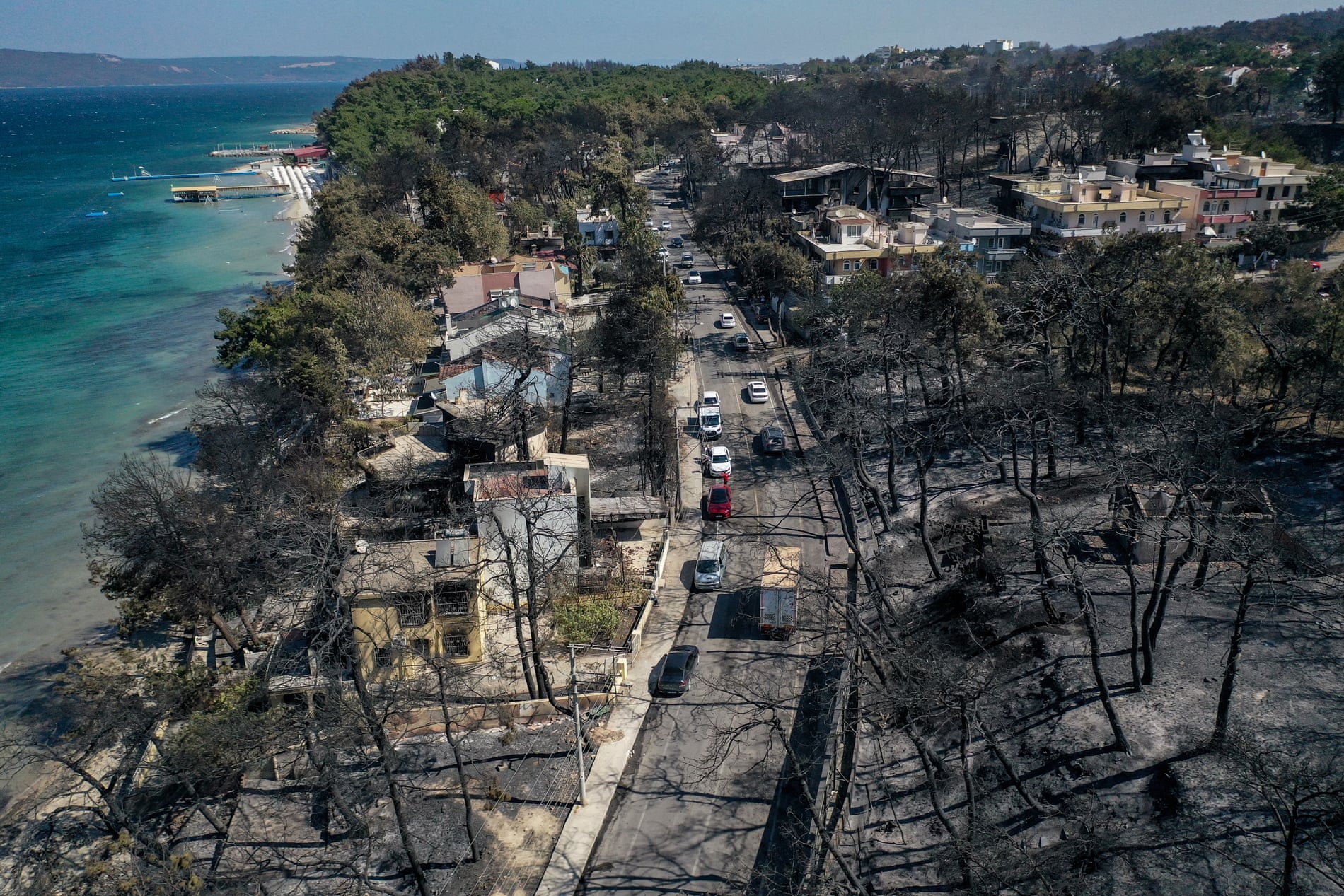
In the north-western Turkish province of Çanakkale, more than 2,000 people were evacuated and 77 people treated in hospital for smoke inhalation after fires broke out near the tourist village of Güzelyalı, authorities said.

Images on Turkish media showed homes and cars ablaze, while more than 760 firefighters, 10 planes, nine helicopters and more than 200 vehicles were deployed to battle the flames. Turkey this year experienced its hottest July since records began 55 years ago.

In southern France, where temperature records were broken in at least four weather stations, the government called for vigilance.

The south-western city of Bordeaux hit a record 41.6C on Monday, while all-time records were broken at meteorological stations in Bergerac, Cognac and Saint Girons, according to the national weather service, Météo France.
5472.jpg

https://www.theguardian.com/world/2...-spain-amid-deadly-wildfires-and-new-heatwave
How exactly was a 4 year old boy "found" in his family's car and then deemed as being dead because of climate change?
 
i think they modding weather with weather mod tech and blaming it on CO2
 
How exactly was a 4 year old boy "found" in his family's car and then deemed as being dead because of climate change?
It's such politized BS. The strongest hurricanes ever known in that region was in the revolutionary war, they took out a lot of French ships. In the 40's and 50's NY use to get hurricanes and now they don't....There are times in the world where CO2 was higher and temps were lower. Right now the earth has more green on it , then it has had in many years. CO2 levels are very minimal effects in the world.
From a podcast recenty , key bullet points

"Science is not a consensus. Science is a methodology." – Richard Lindzen
→ Consensus is irrelevant; it’s about falsifiable predictions and data, not votes.
"Calling something ‘settled science’ is anti-science." – William Happer
→ True science thrives on doubt and challenge, not dogma.
"The appeal to authority is the death of science." – Lindzen
→ Citing "97% of scientists" is a logical fallacy, not evidence.
"Science has been replaced by a cult-like narrative." – Rogan summarizing
→ Dissenters are excommunicated, not debated.


"We’re in a CO₂ famine — levels were 4x higher in Earth’s past and life thrived." – Happer
→ Current 420 ppm is low historically; plants starve below 150 ppm

"1.5°C rise since 1850 is normal recovery from the Little Ice Age." – Lindzen
→ No acceleration in warming despite CO₂ rise.

"It’s been rising ~2–3 mm/year for 150 years — no change." – Happer
→ Satellites show no increase in rate; island nations aren’t sinking.

**Extreme weather is not increasing
→ Hurricanes, droughts, floods — all within historical norms.
→ "The data doesn’t show it. The headlines do."

Why Alarmism Is Over-the-TopFollow the money: $1 trillion+ annually in climate funding
→ "You get funding if you predict doom. You don’t if you say it’s fine." – Happer
→ Universities, NGOs, green tech — all dependent on crisis.
"Net Zero" is economic suicide, not science
→ "You can’t run a modern society on wind and solar." – Lindzen
→ Blackouts in CA/TX/UK prove it.
**Greta, Gore, UN — propaganda, not science
→ "Al Gore made $300M selling fear." – Rogan
→ Kids terrified of dying at 12 — psychological abuse.
**"Climate change" used to justify control
→ Carbon taxes, 15-minute cities, meat bans — power grabs, not solutions.
"We’ve seen this before: eugenics, DDT ban, Y2K"
→ "Science hijacked for politics — then quietly abandoned." – Happer

Happer: "If CO₂ were really a thermostat, why didn’t it cook us when it was 7000 ppm in the Cambrian?"
Lindzen: "I’ve been called a ‘denier’ for 30 years. I just ask for data."
 
I for my part just not get the "ThErE iS nO cLiMaTe ChAnGe BeCaUsE tHiS sUmMeR wAs So CoLd AnD iN 1983 tHeRe WaS a WaRm WiNtEr!!" I mean, if you’re older than 30, you can already see the difference for yourself.

For us in Europe—which now includes the entire continent from north to south—we just don’t have winters as cold as they used to be 30 years ago. There’s absolutely no room for denial here. It doesn’t get as cold as it used to, and in the valleys of Austria, Germany, Slovenia, Croatia, etc., we barely get two weeks of continuous snow. It used to snow from December until March; nowadays, we’re lucky to get 15 days of snow in a row. Honestly, I can’t even remember the last time that happened.

Even in Russia, winters have become warmer. Recently, there was a winter where all the snow melted in December—something that had never happened in my seven years there. Back then, snow would fall at the end of November and wouldn’t disappear until April.

And don’t even get me started on summers… In Vienna, we now have about 70 tropical nights per year, whereas in the 1980s the average was just 3–5. This trend isn’t limited to Vienna—it’s happening all across Austria.

There are literally millions of examples like this, all observable by people themselves, yet some still deny global warming. I honestly don’t understand how someone can be so blind to the obvious.
 
Back
Top