
-
Xenforo Cloud is upgrading us to version 2.3.8 on Monday February 16th, 2026 at 12:00 AM PST. Expect a temporary downtime during this process. More info here
You are using an out of date browser. It may not display this or other websites correctly.
You should upgrade or use an alternative browser.
You should upgrade or use an alternative browser.
Tech Gaming Hardware discussion (& Hardware Sales) thread
- Thread starter Madmick
- Start date

And it took about a year to get to profitability, in part because they did a redesign that swapped a the larger copper heat sink for an aluminum heatsink. Which heatsink is cheaper?The article covered this, LOL. It's because of the rising cost of production over time. They profited when the cost for a PS5 Digital was still $399, and now the MSRP despite these strategies to reduce cost is $499. Damn, it's almost like reading could have saved you this embarrassment.
It's almost as if you're too dull to understand what attach rate is.So it won't protect its software MOAT.
Concession accepted.
I wonder why you keep refusing to answer questions like this.If SteamOS doesn't compete with Windows, then how come Lenovo offers both a Windows and Steam versions of its handhelds?

- Joined
- Jun 13, 2005
- Messages
- 66,900
- Reaction score
- 39,004
Concession accepted.And it took about a year to get to profitability, in part because they did a redesign that swapped a the larger copper heat sink for an aluminum heatsink. Which heatsink is cheaper?
Could have saved yourself by reading.
Because you think asking stupid questions will distract people from you floundering and failing to prove a point.It's almost as if you're too dull to understand what attach rate is.
I wonder why you keep refusing to answer questions like this.
You were asked to substantiate how this machine will "protect its software moat." You failed.
Are people with a steam machine or steam deck more likely to spend money on Steam than those without?Concession accepted.
Could have saved yourself by reading.
Because you think asking stupid questions will distract people from you floundering and failing to prove a point.
You were asked to substantiate how this machine will "protect its software moat." You failed.
And lol you tried arguing that weight was the primary cost saving for the PS5. It wasn't. You didn't even know how much a TEU cost since you thought that saving was more than a die shrink of all things.

- Joined
- Nov 18, 2022
- Messages
- 361
- Reaction score
- 707
Anyone else into fight sticks?
I used to be back in the SF4/5 days but don't really have the time or inclination to get gud at new iterations these days. I still have my Rose B15SDM stick though. I'll never part with that. I will occasionally play USF4 and UMvC3 with a Hori HRAP4 with some sanwa buttons and a seimitsu stick but pretty bog standard apart from that. I managed to get out before the hitbox became a thing.
Last edited:


- Joined
- Jul 4, 2009
- Messages
- 70,097
- Reaction score
- 43,158
Even the Power Glove?
- Joined
- Jun 13, 2005
- Messages
- 66,900
- Reaction score
- 39,004
Valve Confirms Steam Machine Will Not Be Subsidized Hardware Like Consoles, and Some Are Questioning That Strategy While Bracing Themselves for a 'Current PC Market' Price
Now, in a new interview with Skill Up, Valve's Lawrence Yang and Pierre-Loup Griffais discussed the price of Steam Machine without actually confirming what it is. The conversation began with software engineer Pierre-Loup Griffais confirming that Steam Machine is more powerful than 70% of gaming PCs that Valve registers on its hardware survey, in terms of general GPU level, saying: “We have looked at that number as part of speccing the machine, so it’s possible it’s evolved a little bit over time, but I think ballpark, it’s about there.”
He then said that fans should expect the Steam Machine price to be around the same as if you were to build a PC from parts to get “basically the same level of performance.”
“I think that if you build a PC from parts and get to basically the same level of performance, that's the general price window that we aim to be at,” he said. “Ideally we'd be pretty competitive with that and have a pretty good deal, but we're working on refining that as we speak. Right now is just a hard time to have a really good idea of what the price is going to be because there's a lot of different things… a lot of external things.”

Killed before it even reached the cradle.

- Joined
- Jun 24, 2006
- Messages
- 46,609
- Reaction score
- 36,025
Steam Machine 2 episode 1, Steam Controller 2 episode 1 and Index 2 episode 1:
They’re going to need to come up with a good wireless keyboard/mouse solution to market with these things for couch gaming. I had one of those older steam controllers and it just wasn’t good imo.

- Joined
- Apr 18, 2007
- Messages
- 13,335
- Reaction score
- 6,659
They’re going to need to come up with a good wireless keyboard/mouse solution to market with these things for couch gaming. I had one of those older steam controllers and it just wasn’t good imo.
Forget if someone mentioned it here or in a reddit thread. For i had the same connection stability problem when couch gaming. In the controller packaging a hidden USB extender was in it that remedied the problem.
Does this mean concession accepted on your blathering when I told you Steam won't benefit from the economies of scale that console makers do and price would depend on how much they want to subsidize it?
You kept telling me it was going to be $499 or even less lol
P.S. That quote was from the day the Steam Machine was announced, it's old news.
I can't imagine they will let it cost as much as the PS5's new MSRP at $549. I suppose $499 is a safe bet, but it's conceivable Valve puts it for lower given...well, they can..
Furthermore, why would it require "taking a bath"? Sony has actually made money on hardware sales. That has been one of their new goals in contradiction to historical precedent; they seek to turn a profit on the consoles themselves. If they made a profit on the PS5 at $399/$499, and still apparently do at $499/$549, then why is it so inconceivable Steam could make a profit with a lesser machine than the PS5 while undercutting the PC market when they still have hundreds of dollars of room to spare beyond that $499 price point? The following was written before Sony's price hike:
I've already explained to you what I disagreed with. Now you're changing your argument to "they won't compete with consoles" to "they won't compete with future consoles", and scampering to hide behind "they don't have the same economy of scale!" nonsense when it's shown to you Sony has profited off roughly equivalent hardware with hundreds of dollars of room to spare against PCs powerful enough that it would render the Steam Machine unattractive for someone looking to get into PC gaming.
Derp. We get it. It's not going to be as powerful as the PS5 or XSX, much less the PS5 Pro, or their future consoles. It won't sell as many units. That doesn't mean it isn't a competitor. It's a goddamn gaming box that connects to your TV expected to arrive in the $500-$600ish price range. It also doesn't mean Steam will have to "take a bath" to make it attractive to prospective PC neophytes.
- Joined
- Jun 13, 2005
- Messages
- 66,900
- Reaction score
- 39,004
Does this mean concession accepted on your blathering when I told you Steam won't benefit from the economies of scale that console makers do and price would depend on how much they want to subsidize it?
You kept telling me it was going to be $499 or even less lol
P.S. That quote was from the day the Steam Machine was announced, it's old news.

Um, no. You asserted Steam would have to "take a bath" to set it at a $500 or lower price point, and this development in the story offers zero insight into where Steam could price it while remaining profitable. Rather, all it confirms is that Steam has decided they won't subsidize it, no matter at what price point that would entail, because rather they are targeting a price point analogous to the self-building market for a similarly powered PC. His comment suggests they aren't even targeting the typically more cheaply priced prebuilts or mini PCs (on the same laptop-type hardware).
And right now, as the article mentioned, $700+ is more likely.
Indeed, right now, ~$725 with no OS (and no controller) would be a rough target.IGN said:In that context, Valve’s Steam Machine will likely cost above $750. We’ve suggested Steam Machine will cost $700-$800.
Congratulations, you were wrong, too, Backfire Bob.What I did say was substantially lower than $499 isn't likely, unless Valve intends on taking a bath on hardware. $599-$699 would be my guess, since that gives Valve more room for partners down the road, plus the uncertainty of NAND and DRAM supply right now. I
So we both agree that $500 requires subsidizing the Steam Machine, and here you are still claiming that I'm wrong when i literally said Valve would have to subsidize it if it was priced $500 or less. Brilliant.
Um, no. You asserted Steam would have to "take a bath" to set it at a $500 or lower price point, and this development in the story offers zero insight into where Steam could price it while remaining profitable. Rather, all it confirms is that Steam has decided they won't subsidize it, no matter at what price point that would entail, because rather they are targeting a price point analogous to the self-building market for a similarly powered PC. His comment suggests they aren't even targeting the typically more cheaply priced prebuilts or mini PCs (on the same laptop-type hardware).
And right now, as the article mentioned, $700+ is more likely.
You can just admit you were way off the mark in estimating the costs of modern PCs, just like when you were way off the mark estimating the Xbox ROG Ally X's price.
Furthermore, why would it require "taking a bath"? Sony has actually made money on hardware sales. That has been one of their new goals in contradiction to historical precedent; they seek to turn a profit on the consoles themselves. If they made a profit on the PS5 at $399/$499, and still apparently do at $499/$549, then why is it so inconceivable Steam could make a profit with a lesser machine than the PS5 while undercutting the PC market when they still have hundreds of dollars of room to spare beyond that $499 price point?
How am I wrong when we don't have a launch price yet? I still think $599 to $699 is the likely price range given they're selling DTC and that range gives them easily the ~10 profit margin that is standard for gaming desktops sold in retail. I wouldn't be surprised if it's a bit higher too since Valve has so many start up costs to here, and I have no issue being wrong if it ends up launching at $700+.Congratulations, you were wrong, too, Backfire Bob.
Also, what happened to you bold claim where you insisted Valve was positioned to compete on price with console?
As I've shown, the Steam Machine is clearly positioned to compete directly with the consoles. Not only in processing power, but more importantly, in terms of price.
- Joined
- Jun 13, 2005
- Messages
- 66,900
- Reaction score
- 39,004
Again, the cost of the machine to Valve isn't established, here. They haven't provided any insight. All of these inferences are no different than your predictions-- since you're correct that the price hasn't been declared-- based on the the exchange with Linus. He didn't even confirm in the interview this meant $500. As Linus said, this is inferred (i.e. "the energy of the room wasn't great).So we both agree that $500 requires subsidizing the Steam Machine, and here you are still claiming that I'm wrong when i literally said Valve would have to subsidize it if it was priced $500 or less. Brilliant.
You can just admit you were way off the mark in estimating the costs of modern PCs, just like when you were way off the mark estimating the Xbox ROG Ally X's price.
The PS5 Pro is $750. Consoles range from $350-$750, presently. Your own predicted price range still puts it in the competition sphere with consoles. The "console pricing model" comment was Linus's, not Valve's. Herpaderp.How am I wrong when we don't have a launch price yet? I still think $599 to $699 is the likely price range given they're selling DTC and that range gives them easily the ~10 profit margin that is standard for gaming desktops sold in retail. I wouldn't be surprised if it's a bit higher too since Valve has so many start up costs to here, and I have no issue being wrong if it ends up launching at $700+.
Also, what happened to you bold claim where you insisted Valve was positioned to compete on price with console?
I will say this. I'm flabbergasted they think they can price it relative to desktop PCs because of quad-bluetooth, noise, and small form factor. LOL. Give me a break. I did not expect a mindset this out of touch from Valve, clearly.
Maybe we'll see at CES. It's just funny to see you backpedaling after insisting that you were so correct that it'd be $499 or even sub-$499 and not understanding what economies of scale means.Again, the cost of the machine to Valve isn't established, here. They haven't provided any insight. All of these inferences are no different than your predictions-- since you're correct that the price hasn't been declared-- based on the the exchange with Linus. He didn't even confirm in the interview this meant $500. As Linus said, this is inferred (i.e. "the energy of the room wasn't great).
It's pretty clearly not going to compete with the PS5 Pro given the difference in the latter's positioning and superior performance (both on paper and due to games being optimized for it). I also from the start said it would compete with consoles to some extent, that's obvious.The PS5 Pro is $750. Consoles range from $350-$750, presently. Your own predicted price range still puts it in the competition sphere with consoles. The "console pricing model" comment was Linus's, not Valve's. Herpaderp.
I will say this. I'm flabbergasted they think they can price it relative to desktop PCs because of quad-bluetooth, noise, and small form factor. LOL. Give me a break. I did not expect a mindset this out of touch from Valve, clearly.
SFF is actually very hard to build economically, you're acting like they're going to be taking insane margins on this. The ceiling is pretty clearly $799 since this is a US focused product and that's where the fist mass market competitor is priced at during the holidays. Pricing at $699 would mean low double digit margins, which is pretty standard in the industry.
Valve itself from day 1 has said it will not be priced like a console, I don't know why you kept and continue to keep ignoring this obvious red flag that it won't be selling for sub-$499 like you claimed.
- Joined
- Jun 13, 2005
- Messages
- 66,900
- Reaction score
- 39,004
The argument I insisted is that $499 is an entirely feasible price point for Valve without "taking a bath". Otherwise, that was merely my favored prediction. The notion they would let it cost as much or more than the PS5 was (and is) unfathomable to me. Even more so to price it targeting comparably powerful self-built PCs. Because it's a pricing strategy doomed to relegate the device to the same failure as the first iteration a decade ago.Maybe we'll see at CES. It's just funny to see you backpedaling after insisting that you were so correct that it'd be $499 or even sub-$499 and not understanding what economies of scale means.
Ignorant comment. As was already shown with the Tweaktown article, the very strategy Sony embraced to reduce their costs was to move to a smaller form factor.SFF is actually very hard to build economically, you're acting like they're going to be taking insane margins on this.
If you have to subsidize to hit $499 or less, that means you're taking a bath...aka losing money.The argument I insisted is that $499 is an entirely feasible price point for Valve without "taking a bath". Otherwise, that was merely my favored prediction. The notion they would let it cost as much or more than the PS5 was (and is) unfathomable to me. Even more so to price it targeting comparably powerful self-built PCs. Because it's a pricing strategy doomed to relegate the device to the same failure as the first iteration a decade ago.
Like I kept telling you and you kept ignoring: Economies of scale are very real, whether we're talking component pricing or NRE and other start up costs. Consoles get to spread out the latter over almost 100 million units, Valve only gets to spread it out over several million.
How are you so eager to take L's after being grossly wrong in your last two hardware price predictions. You'd think it'd instill some humility and a willingness to listen.Ignorant comment. As was already shown with the Tweaktown article, the very strategy Sony embraced to reduce their costs was to move to a smaller form factor.
For the umpteenth time: the primary cost savings that led to PS5 becoming profitable was dropping a copper heatsink for a smaller aluminum one and normal production optimizations. Reduced size helps a little, but shipping is one of the smaller line items for a console.
Nor does your argument make sense: SFF is inherently more expensive than full sized. That's why SFF PCs are always more expensive, especially for gaming. If you have to scale up production to almost 100 million units to make SFF break even and profit, that's bright as day evidence that it's really hard to do SFF economically.

- Joined
- Jan 2, 2007
- Messages
- 14,781
- Reaction score
- 13,904
The main group taking a loss in this is Steam...If you have to subsidize to hit $499 or less, that means you're taking a bath...aka losing money.
Like I kept telling you and you kept ignoring: Economies of scale are very real, whether we're talking component pricing or NRE and other start up costs. Consoles get to spread out the latter over almost 100 million units, Valve only gets to spread it out over several million.
How are you so eager to take L's after being grossly wrong in your last two hardware price predictions. You'd think it'd instill some humility and a willingness to listen.
For the umpteenth time: the primary cost savings that led to PS5 becoming profitable was dropping a copper heatsink for a smaller aluminum one and normal production optimizations. Reduced size helps a little, but shipping is one of the smaller line items for a console.
Nor does your argument make sense: SFF is inherently more expensive than full sized. That's why SFF PCs are always more expensive, especially for gaming. If you have to scale up production to almost 100 million units to make SFF break even and profit, that's bright as day evidence that it's really hard to do SFF economically.
If they came in with a cheap console and took an initial financial hit they would have come out way on top.
They already have the PC market cornered gaming wise. If people could access Steam sales on a console, they would pretty much take the gaming market within the decade. You throw some Steam sales at people each time they log on and they would have made it back in no time.
This went from a day 1 release to a wait and see purchase within the space of a week. Gamers are sick of paying subscription fees to use Xbox and PS services to just play COD/Battlefield each year.
Last edited:
Seems a little premature to write off a product that hasn't even had a launch price confirmed lolThe main person taking a loss in this is Steam...
What cost do you think they should sell at for the current specs?If they came in with a cheap console and took an initial financial hit they would have come out way on top.
They currently can't go toe to toe with console makers. It's why they went for off the shelf parts AMD had stockpiled, rather than full custom silicon.They already have the PC market cornered gaming wise. If people could access Steam sales on a console, they would pretty much take the gaming market within the decade. You throw some Steam sales at people each time they log on and they would have made it back in no time.
This went from a day 1 release to a wait and see purchase within the space of a week. Gamers are sick of paying subscription fees to use Xbox and PS services to just play COD/Battlefield each year.
Maybe they will be able to one day, but that takes time and multiple generations of products. I also don't think you understand the demographics of who buys a Steam Deck or Steam Machine and how that factors into pricing.
- Joined
- Jun 13, 2005
- Messages
- 66,900
- Reaction score
- 39,004
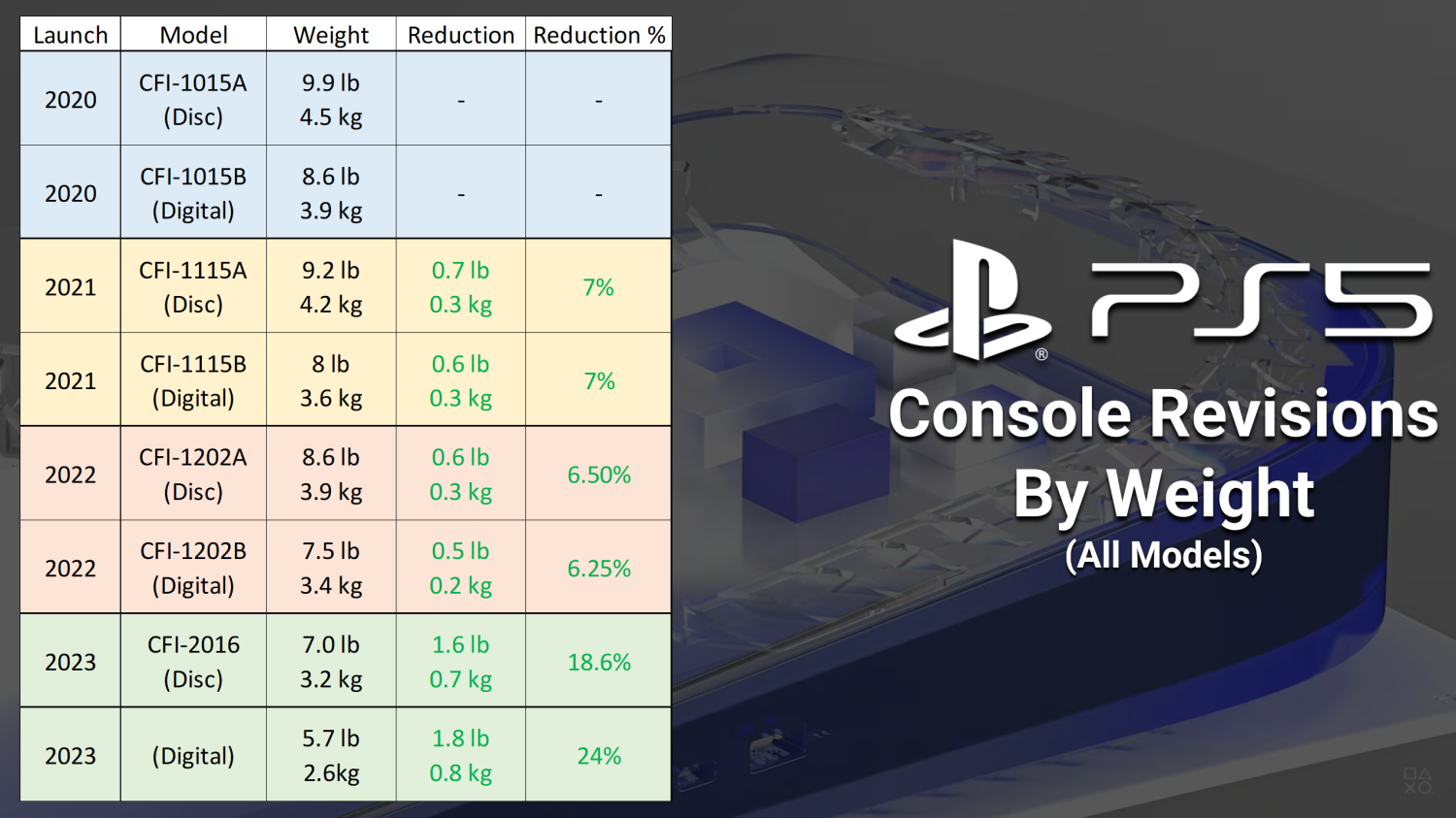
Yes, it does! This is why given the same processing power target a reduction in dimensions and weight reduces costs.How are you so eager to take L's after being grossly wrong in your last two hardware price predictions. You'd think it'd instill some humility and a willingness to listen.
For the umpteenth time: the primary cost savings that led to PS5 becoming profitable was dropping a copper heatsink for a smaller aluminum one and normal production optimizations. Reduced size helps a little, but shipping is one of the smaller line items for a console.
Analysis: Why the Sony PlayStation 5 Pro console costs $700
Why is Sony charging $700 for its new PS5 5 Pro console? In a phrase: profit maximization. Here's a closer look at the trends leading up to the Pro's cost.
 www.tweaktown.com
Tweaktown said:2. Profit Maximization to Offset Losses - Sony makes a long-term strategy to sell PS5 at the highest profits possible
Sony has responded to these higher costs in a number of strategic ways...
The second major strategic innovation was the introduction of the PS5 Slim's new revised form factor, which emphasizes size and weight reductions.
Sony has significantly reduced the weight of its new PS5 Slim models in an effort to reduce costs across manufacturing lines--lighter consoles were achieved through reductions in specific extraneous cooling solutions.
Lighter consoles also mean less weight to ship overseas, which lowers the cost of freight shipping. When Sony ships hundreds of thousands of pounds of consumer electronics to multiple regions worldwide, every ounce matters.
What? No they're not. That isn't at all universally true. That's only true at the higher end, not at these sub-$600 price points with the integrated SoCs.Nor does your argument make sense: SFF is inherently more expensive than full sized. That's why SFF PCs are always more expensive, especially for gaming. If you have to scale up production to almost 100 million units to make SFF break even and profit, that's bright as day evidence that it's really hard to do SFF economically.
As I've shown in this thread, the Ryzen 7 6800H Mini PCs (Beelink, Firebat, Aoostar, etc) have been selling at $275-$375 for the past year, at least. Even for an older chipset that sort of sustained pricing doesn't suggest inventory clearance, especially considering the newer R7-8745HS iteration's offering is $384. This is a Hawk Point chipset launched sometime after December 2023:
($384) Firebat Ryzen 7 8745HS Mini PC
Show me a full-sized PC with Windows with comparable gaming power to that for less money. Equal CPU power, GPU power, RAM amount & speed, SSD storage & class, ports, & WiFi capability. Can be a prebuilt or a PCPP assembly.
Latest posts
-

-

-

-

-
 Economy Women and minorities make up 10% of Airline pilots, but cause 50% of all crashes
- Latest: Big Nasty Edison