Intel’s Rocket Lake CPU shouldn’t have been made
Intel has it’s Trinity moment
Mar 16, 2021 by
Charlie Demerjian
Tweet

Rocket Lake perfectly sums up the rapidly worsening malaise that Intel is mired in, there is no up side. SemiAccurate is on record saying that Intel should not have launched this turkey and the details we can now share move the needle further in the wrong direction.
Lets start our look at Rocket Lake with the good stuff. The complete list of up-sides SemiAccurate sees for this new Intel backport of a 10nm design is that it is officially out. The end. We really wanted to find something good about this CPU even if our initial technical assessment said it was unlikely. After the rather solid pre-briefing, the basic questions SemiAccurate asked were either dodged or ignored, and things went downhill from there, it was another string of own-goals for no potential up side.
We honestly tried to find a silver lining and were still trying even after
the Anandtech numbers came out. (Note:
And an update) The briefing went really well, it was unusually direct, questions were answered clearly where possible, and the marketing fluff was minimal. Disclosure was, as is the norm with Intel of late, best in class, and it all looked good for the writeup.
Sure the numbers Ian posted were both correct and devastatingly bad, AMD’s Ryzen 5K CPUs effectively win on just about every user-focused benchmark vs Rocket Lake, but that is for the i7-11700K, the top i9-11900K can run up to 200MHz or ~4% faster. If you look at the summaries in Ian’s Rocket testing update, it is pretty clear that the last 4% would still mean a loss in two of the three categories, basically it would narrow the overall delta but Intel wouldn’t win.
The rosy but narrow wins vs Comet Lake/10th Gen Core presented by Intel were pretty much backed up by Anandtech’s numbers but the wins against AMD’s Ryzen CPUs most definitely were not. Make of that what you will. Also consider the places with the largest wins vs either older Intel or AMD CPUs were in the content creation segment which utilized software heavily tuned for AVX-512 and/or Intel ISAs, something not often found in the real world.
Then there are the power numbers. Intel claims the i7-11700K that Anandtech tested is a 125W TDP CPU but they measured 294W in one test, a number which you could be forgiven for not considering close to the advertised spec. Blaming the motherboard makers for not following guidance on power settings is a convenient excuse even if it is not very plausibly deniable. Rocket Lake is a ghastly pig of a power hog that pulls
more than twice the peak wattage of the 105W TDP AMD Ryzen 5800X tested by Anandtech. The i9-11900K is unlikely to pull less power than the i7-11700K but
the Ryzen 5900X should pull little if any more than the tested 5800X. AMD wins almost everything at half the power.
Then there are the internal graphics which SemiAccurate has not seen any reliable numbers for. Intel routinely claims wins for their GPUs in presentations but those numbers are rarely if ever backed up by independent testing. Again we will leave it up to the reader to figure out where this discrepancy comes from, SemiAccurate has no *COUGH* clue, sorry. (Note: AMD claims they win as well but due to their endemic disclosure problems we won’t use their numbers) That said Intel claims that their Xe graphics, something SemiAccurate is fond of because of excellent driver support, are 50% faster than the setup found in the older 10th Gen Comet Lake parts, something SemiAccurate believes. This would be a win but the 10nm 45W Tiger Lake CPU is a claimed 2x faster. If you thought the backport would only bite on the CPU side, you were wrong.
By now you are probably getting the idea that Rocket Lake is indeed a slow, hot pig of a CPU. To be fair it isn’t all that slow, it does beat the 10th Gen Intel parts by decent margins at time, but loses to comparable AMD Ryzen 5K parts by nearly as much. To make matters worse, the die is absolutely huge, 270+mm^2 or so according to reliable sources vs
206.1 or so for the previous Comet Lake CPU. (Note 2: Intel refuses to disclose die sizes for not good reason)
Did we forget to mention that the Comet die in question had two more cores? Silver lining time, the integrated GPU is significantly faster. Now we feel obligated to point out that no sane buyer will run the highest end Intel gaming CPUs without a discrete GPU so that last sentence is as close to a moot point as you can get. Intel only gave out numbers for integrated graphics when comparing to other Intel products, when comparing against AMD’s offerings they used an Nvidia 3080 like any real customer would. Again, your turn to figure out why this is the case. And then ask yourself why they ran an i9-11900K/Ryzen 5900X with a 3080 at 1080p resolutions.
So why is this CPU so bad? We hate to say we told you so but SemiAccurate did tell you so, in fact
we did so here. What it comes down to is Intel took a 10nm design that was not intended to be process portable and backported it to their 14nm process. Those massive energy use reductions and claimed 2.7x die shrinks work both ways, think 2.7x die area gain and sucking wattage like it was going out of style. Backporting Ice Lake’s CPU and GPU cores to 14nm is just stupid, there is no defense for it at all and the results speak for themselves. Intel should not have done this and the fact that those who greenlighted this turkey are still employed at the company is a bit shocking. Remember that malaise we started the story off with? Case and point.
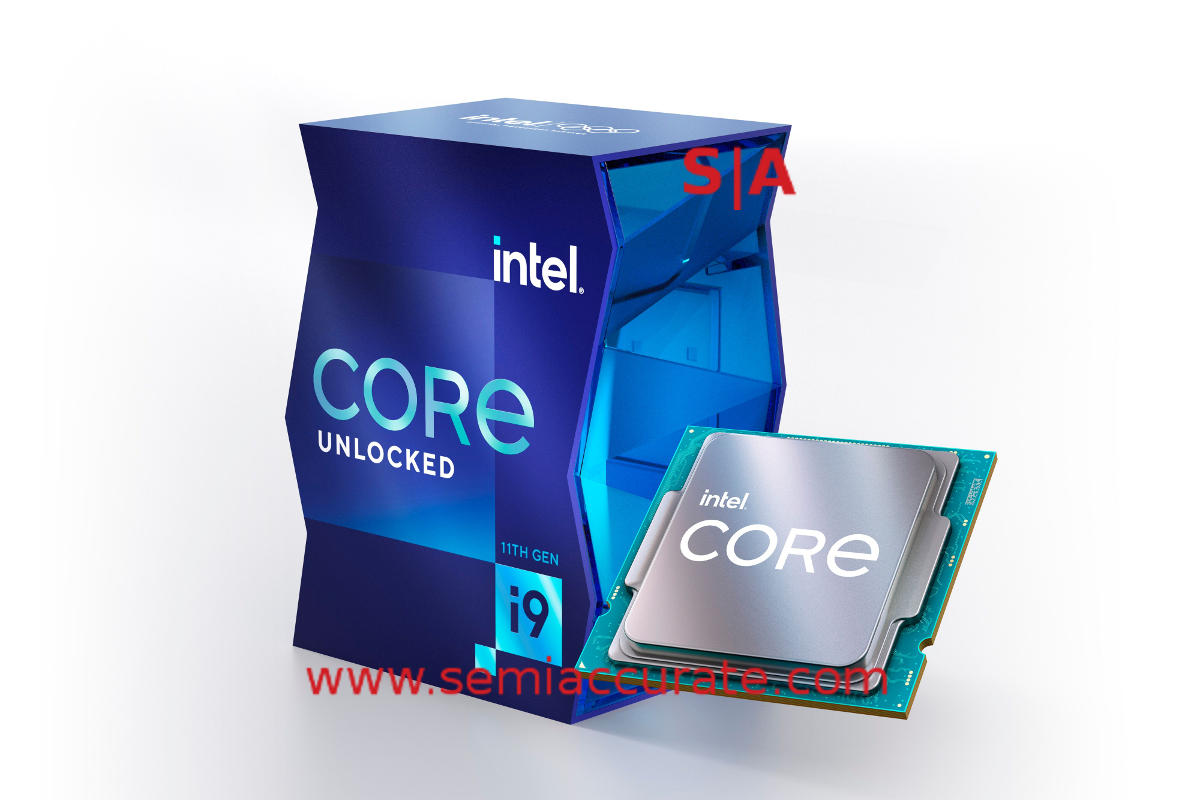
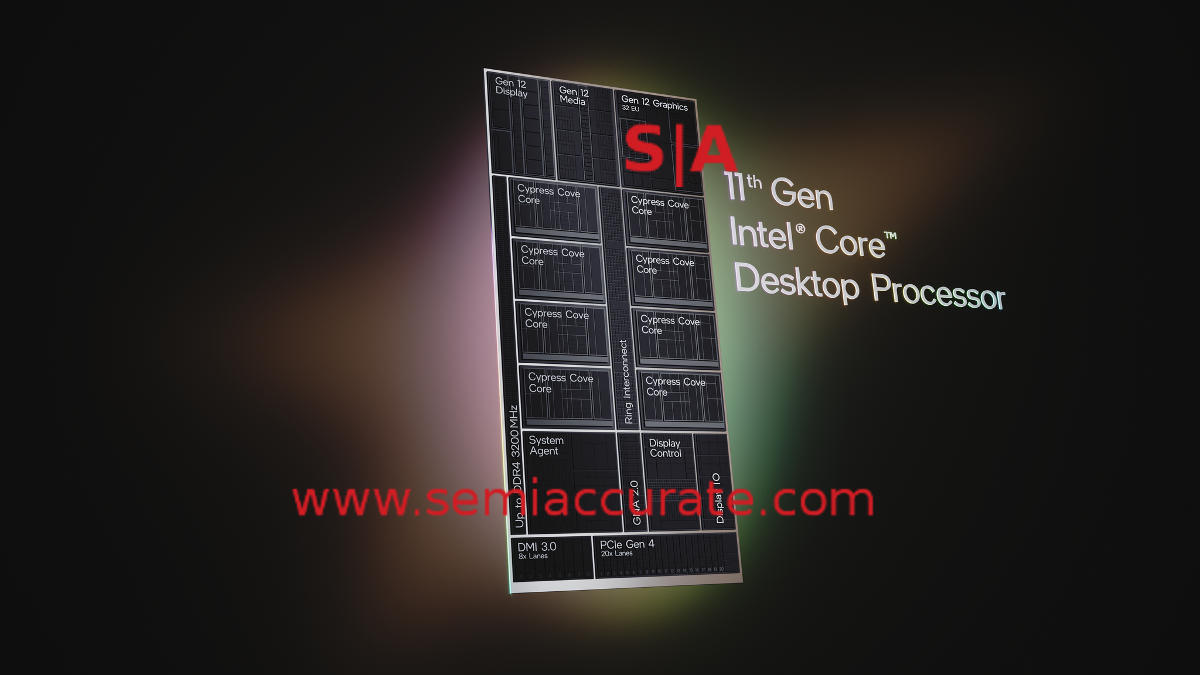
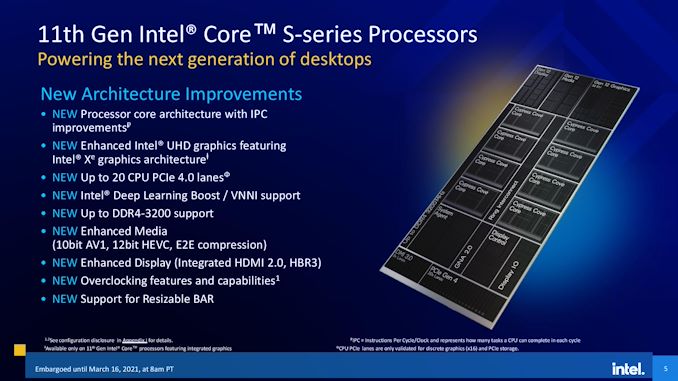
Going back to the excellent briefing, our hopes were lifted and stayed that way even in spite of the Anandtech numbers until SemiAccurate got the answer to the questions we submitted to Intel. Actually we should say the lack of answers to the questions we submitted. We asked about die sizes, for die shots, and transistor counts, and all the usual technical bits. Dodged. Worse yet they didn’t even send any pictures of the CPU itself with the lid on or even the box it came in, only cheesy renderings not worth republishing. Intel further insulted our intelligence by providing ‘die shots’ of fake functional blocks in the same noxious way Qualcomm does. Oh what the heck, if we suffered through this idiocy, so should you, ‘enjoy’.
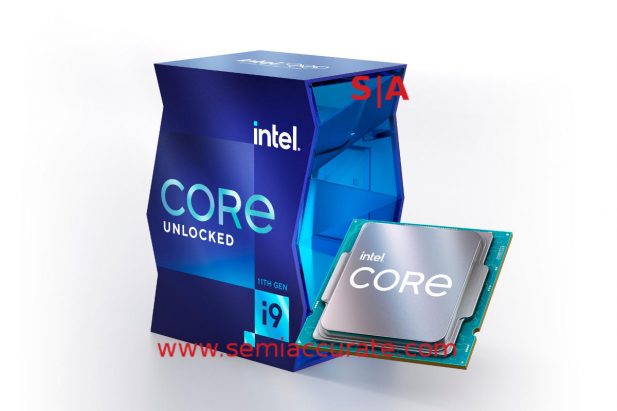 Almost as real as the testing scenarios
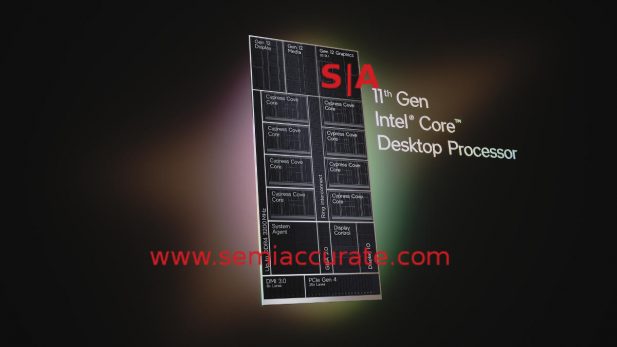 We hate this stuff, don’t you?
But it gets worse. Those questions that were ‘answered’ were either mostly dodged or the response addressed something not really related. The most egregious of these was when SemiAccurate asked about die size. Rocket Lake was originally intended to be a
10-core device as seen in the Dell leaks which SemiAccurate has verified as real. It came out as an 8C product and when asked by several journalists at the product briefing about why, Intel replied that the 8C die was the largest they could make.
This is a wonderful sounding sound bite but it is factually wrong, unquestionably so. Why? Because Intel makes tens of millions of 14nm dies that are about 2x as large as Rocket Lake every year. They are called Xeons, specifically the
HCC Xeon die which was 601.92mm^2 for Skylake-SP, larger for Cascade Lake. Intel unquestionably can make 14nm dies that are a multiple larger than Rocket, 10C would not be an issue at all if they wanted to manufacture it.
Usually factual discrepancies like this are a result of minor misunderstandings which is why SemiAccurate likes to clarify things in writing. We asked, “
You touched on the 8C being the biggest you could make on 14nm, why is that when you can make 500mm^2 Cascades?“. Clear enough right? The answer was, “
We said that 8 core 11th Gen Intel® Core™ processors (RKL-S) with integrated graphics is the largest die we can make on 14nm. Cascade doesn’t have graphics.” So someone is either not being truthful or there is some magical property of the Xe GPU that when backported to 14nm limits the reticle size at Intel, and only Intel, fabs. If you forced us to pick an option, we would probably go with someone lying but we can’t figure out why they would pull the footgun out for this one, it is self-harm for no possible potential gain. Oh yeah, that malaise thingy again, sorry, we forgot.
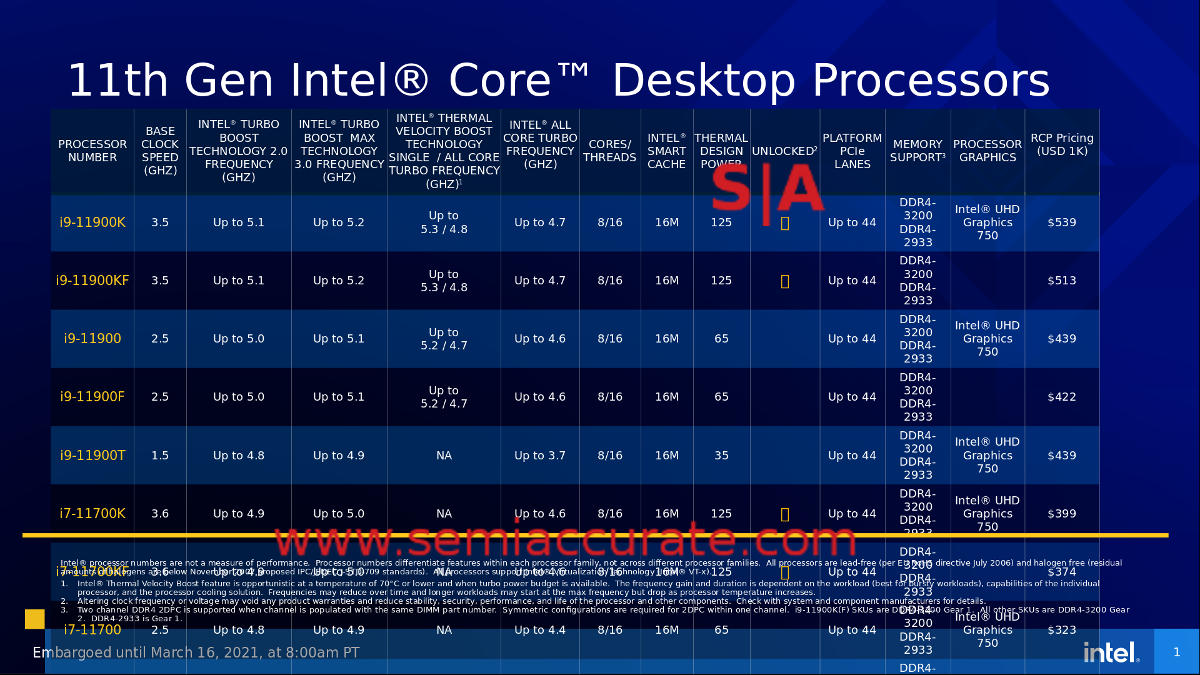
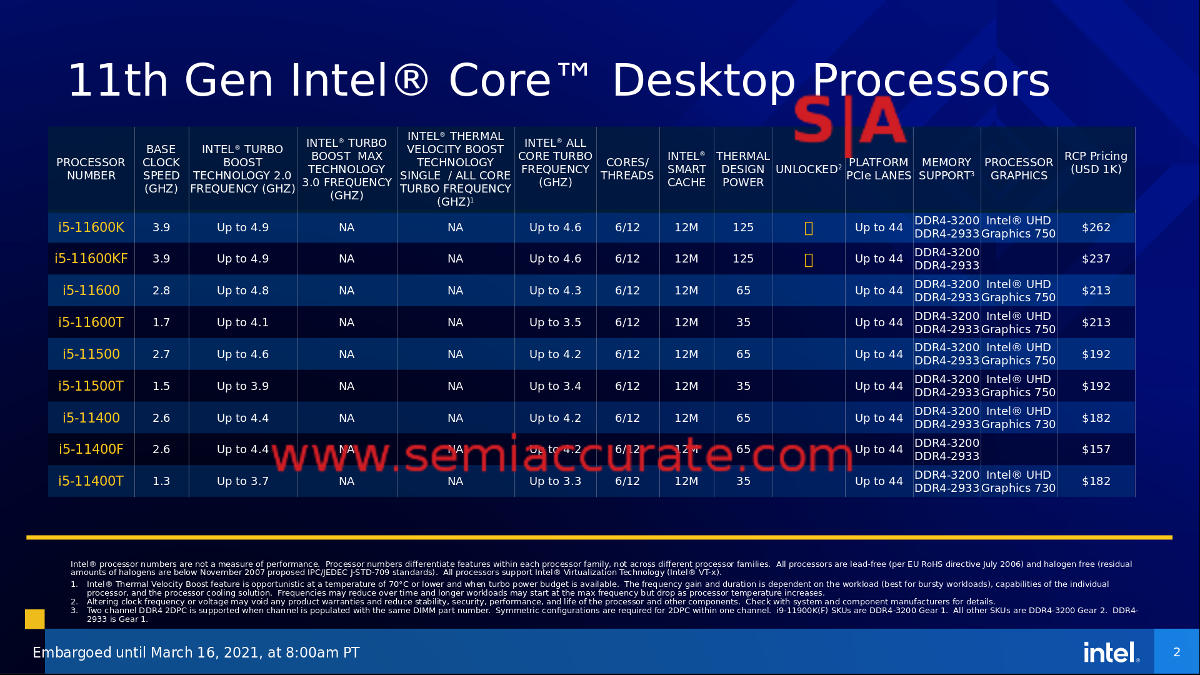
That brings us to what exactly Intel is launching today, and there are three pages of CPUs all stemming from a single 14nm die. We asked what process variant Intel was on and once again they voluntarily shredded their credibility by claiming it was 14nm and only 14nm. Why do they keep doing this? We aren’t joking when we say there is no up side, it will only hurt the company reputation. If you wonder why we don’t write good things about Intel more often, it is interactions like this that preclude the option. We will skip the renamed/tarted up 10th gen parts slide for brevity, and yes the formatting is munged, it was give to us that way, sorry.
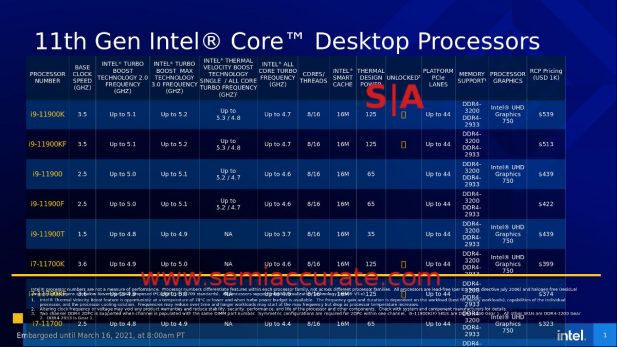
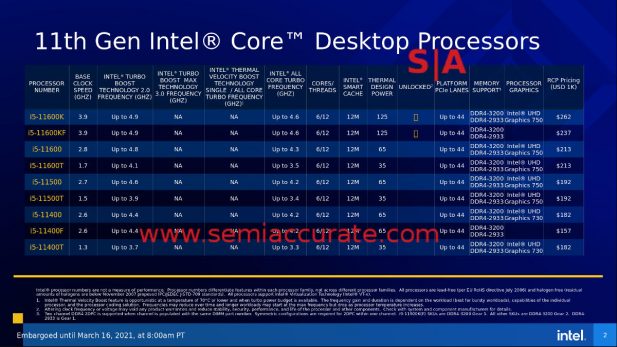 The SKUs that matter
Now here is where it all ties together. Intel is asking $539 for the top end 8C i9-11900K which, according to Anandtech’s testing of closely related SKUs, likely loses to AMD’s 12-C $549 Ryzen 5900X at just about everything. Sure Intel’s wins were a result of testing with a high end CPU and an Nvidia 3080 GPU at 1080p resolutions, something which evaporates when tested at real world settings, but… but… sorry, got nothing here, Rocket loses basically everywhere at everything if you don’t cook the scenarios. $10 less than the Ryzen 5900X is risible, there is no sane reason SemiAccurate can think of that would justify this pricing even if you ignore the eye-watering energy use figures.
Going down the stack the comparisons get a little better as the Anandtech testing showed, the Ryzen 5800X beats the Rocket Lake i7-11700K by decent margins but AMD’s offering costs $50 more. This would be ok, it is slower for less, but the obscene energy use once again makes it a non-starter, running costs alone price Rocket out of the game. Rinse and repeat as you go down the stack, nothing stands out as a bright spot. Unless real world pricing is a massive discount over MSRP, just avoid Rocket Lake and hold out until you find a Ryzen 5000 CPU.
So in the end, what can we conclude? Rocket Lake could have been a solid mid-range product if positioned and priced that way. It will probably have better availability than the AMD Ryzen 5000 CPUs for the next few months, something attributable to both supply and demand. What was a potential win, or at least a potential non-loss, was flipped around by Intel’s dishonest messaging and dodging of basic questions. Why did anyone think putting out third rate product renderings of things that have been openly on sale for weeks was a sane much less smart idea? Unfortunately those who made these idiotic decisions will deflect responsibility and blame the front line folk who were just following orders once again. Malaise thy name is Rocket Lake.
On the technical side we have a product that loses by a bit in raw performance at almost everything. When you take performance per Watt or running costs into account, it is a complete blowout, AMD’s Ryzen 5000 line pummels Rocket Lake silly. Throw in some very corner case benchmarks that show how desperate Intel is for a headline win, even at the expense of the last shreds of their credibility, and you have quite the opposite of a winner.
The worst is of course set for last, the manufacturing. Intel has no 10nm capacity to speak of, they are at a fraction of what they need for a leading edge node. It is beyond the scope of this article to go into detail on why, suffice it to say that it is because 10nm is not and will never be economically viable at Intel. Because of this someone made the decision to backport a 10nm design to 14nm even though it was going to be a hot, slow, huge turkey. To their credit, the CPU side of things didn’t end up all that slow but the marginal gains over the +2 core Comet Lake is simply not worth the excess power burned.
The die size, not disclosed by Intel because of what it will do to their margins, is almost 50% larger than it’s predecessor. That 2.7x shrink from 14nm to 10nm and the honestly impressive energy use gains working in reverse mean the end result will be… Rocket Lake. SemiAccurate desperately tried to find a few scraps of goodness on this one but between the idiocy of the product itself and the painfully inept dodging of the basic questions asked, we can’t find any. This is why Intel is sinking, the rot runs deep and wide.
But there is hope.
S|A