Tech Gaming Hardware discussion (& Hardware Sales) thread

Is it worthwhile to buy a New 3DS XL now for watching 3D videos and playing 3DS and DS cartridges on a bigger screen?

I kinda want to wait for a backwards compatible 3DS successor, but quite a few times when I waited for something better, it was a bad idea.
 
Is it worthwhile to buy a New 3DS XL now for watching 3D videos and playing 3DS and DS cartridges on a bigger screen?

I kinda want to wait for a backwards compatible 3DS successor, but quite a few times when I waited for something better, it was a bad idea.

I highly doubt there will be a 3DS successor. Nintendo seems all in on the Switch and the 2DS even came out, which suggests that the 3D aspect wasn't as big a selling point as it being a Nintendo handheld was.
 
I highly doubt there will be a 3DS successor. Nintendo seems all in on the Switch and the 2DS even came out, which suggests that the 3D aspect wasn't as big a selling point as it being a Nintendo handheld was.
I saw an article yesterday saying Sony is reconsidering their own portable gameplan after the success of Switch.

If there's no 3DS successor, how about a Newer 3DS XL with more CPU power and RAM or something like that? Don't they have a history of releasing multiple minor revisions of their portables? GB, GBC, GBA. DS, DS Lite, DSi.

I don't want to miss out on being able to buy something for 3D video in case there's something "good" I want to watch in 3D that becomes available to me later.
 
I saw an article yesterday saying Sony is reconsidering their own portable gameplan after the success of Switch.

Theres been articles like that for a couple of years even before the switch. Sony got a patent a while back looking at a possible new handheld but nothings really come of it since.
 
A couple of TSMC articles:

AMD disclosed its Q1 2018 earnings figures Wednesday, with remarkably strong sales that bucked seasonal trends and emphasized that Ryzen is driving AMD’s newfound profitability. During the conference call, Lisa Su announced that 7nm GPU production was on track, and that AMD still expects to ship a 7nm Vega in the machine learning market later this year. That part, as we’ve reported before, is expected to be a “pipecleaner” — a design used to ensure that a company’s new node is ready for prime time before mass market parts are run through it.

According to CEO Lisa Su, however, that chip isn’t being built at GlobalFoundries — or, at least, it isn’t being built exclusively at GlobalFoundries. Here’s what she said:
"So our foundry strategy is to use both TSMC and GlobalFoundries on the first 7-nanometer product. We are using TSMC for that product and we have a very strong relationship with them. And so, we do see a good momentum on it from what we see, and I’m not concerned about capacity."
https://www.extremetech.com/computi...ews-amd-moves-7nm-gpu-production-back-to-tsmc


According to Digitimes’ sources, Intel has sought the assistance of Taiwan Semiconductor Manufacturing Company (TSMC) to fulfil 14nm chip production after the firm has fallen short of demand by up to 50 percent. While Intel plans to prioritise server-use processors and chipsets, TSMC will be tasked with handling “entry-level H310 and several other 300 series desktop processors.”
https://www.kitguru.net/components/...chips-by-outsourcing-some-production-to-tsmc/
 
BTW, were any of you bastards fast enough to get one of these?
AMD’s 12 Core 1920X Gets Insane Price Cut Down to $249 – Inventory Runs Out Within Hours

Threadripper-1920X-249.png


Don't fret. Still good news:
AMD’s First Gen Ryzen Threadripper CPUs Get Insane Price Cuts – 12 Core 1920X For Just $400 US, 8 Core 1900X For $300 US


5d5e1518-6b3a-4bab-8e36-5846b5aaf543.png


Spectacular time to be in the photo editing CPU market.
This sale still pisses me off that I missed it LOL.

I guess there’s no hope that the 1950 will go on a short run fire sale anytime soon?

Or maybe the left over 1900’s for 99.00 lol.
 
Intel Core i9-9900K 8 Core Flagship CPU’s 3DMark Timespy Benchmark Leaks Out – Stock Clocked 9900K Faster Than an Overclocked Ryzen 2700X
Intel Core i9-9900K, Intel’s First 8 Core Mainstream CPU With 4.7 GHz All 8 Core Boost Frequency, Faster Than Intel’s 8086K Anniversary Edition In All Possible Ways
The Intel Core i9-9900K is the flagship SKU of the 9th Generation Core family. This will be the first mainstream desktop Core i9 part and also the first Intel chip to boast 8 cores and 16 threads. In terms of cache, the chip will feature 16 MB of L3 and will come with an Intel UHD 620 graphics chip.

The clock speeds are something to check out here, we are going to get a 3.6 GHz base clock out of the box and a 5.0 GHz boost clock in single and dual core operations. 4 core boost is rated at 4.8 GHz while 6/8 core boost is rated at 4.7 GHz. This is the highest frequency we have seen on an 8 core part across all cores. All of this is done under a 95W package so we can expect some hefty cooling solutions to go along with this chip.

The performance results show that at stock clocks, the Core i9-9900K 10,916 points and 36.68 FPS in the CPU tests on 3DMark Timespy. The chip was also tested by a different user with clock speeds of 4.8 GHz across all cores and that scored 11,459 points and 38.50 FPS in the CPU tests. Now when we compare these results to an overclocked AMD Ryzen 2700X at 4.45 GHz that seems to be the near limit of the AMD flagship 8 core processor, the chip scores 10,285 points and 34.56 FPS in the same CPU benchmark.


The Core i9-9900K is tested in 3DMark Timespy at both, a stock and overclocked frequencies. (3DMark Timespy Link)

Looking at the above-mentioned results, we can see that even at stock speeds, the Intel Core i9-9900K is ahead of it’s overclocked competitor. Another thing to note is that the overclocked CPU doesn’t score a whole lot more than the stock clocked Core i9-9900K. The reason being that the Intel Core i9-9900K already boosts to 4.7 GHz across all 8 cores so we are only looking at a 100 MHz bump with the overclock. Keeping that in mind, the score is good enough but we expect it to reach much higher with retail samples that would be able to hit clocks north of 5 GHz.


In addition to the 3DMark Timespy results, we also have a new listing for the Core i9-9900K in the Geekbench 4 benchmark at 5.10 GHz clock speed across all 8 cores on an ASUS ROG Maximus X HERO motherboard.
c17c12b1-550d-4bc6-9672-48ac0d974d78.png

Intel strikes back.
 
Last edited:
Cool, but its rumored to be 520.00 vs the 279.00 the R7 2700x is @ Micro center..

https://www.pcgamesn.com/intel-i9-9900k-cpu-leaked-pricing

you can ALMOST buy TWO R7 2700x's for that price..
Comparing sale prices to launch MSRPs is stacking the deck.
  • i9-9900K MSRP = $519
  • R7-2700X MSRP = $329
There is no question the 9900K is in a different price tier, but gamers historically have demonstrated a willingness to pay a real premium to get the best gaming processor which is why the i7-K processors have outsold the i5-K processors on Newegg and Amazon when the extra $100 or so offered a tiny improvement in gaming performance. Didn't matter. The i7's were #1, and the i5's weren't. Simple as that. Being #1 sells.

This is a big jump over i7 pricing of the past:
  • i7-8700K = $359
  • i7-7700K = $349
  • i7-6700K = $329
  • i7-4790K = $339
  • i7-4770K = $339
  • i7-3770K = $313
  • i7-2700K = $332
At an MSRP of $519 is occupies the same pricing space as the i7-E processors made for the more expensive LGA 2xxx socket motherboards that have more memory lanes & other features, and have been more of an entry class to serious editing builds that disinterested gamers. The reason is a common trait with those CPUs was that they rolled out with a slightly lower native frequency than the gaming i7 processors. Furthermore, the leaks show that the i7-9700K running on an X370 motherboard, and these i9's will apparently run on the same socket class of LGA 1151 motherboards because they are X390 compatible.

That is a huge development. This appears to be a shift in the targeted market. Gamers are now targeted.

Last generation the i9 class did not target gamers at all. The entry processor was $989. Unlike the i7-E processors mentioned above, which attracted hybrid gamer/editors or gamer/streamers who liked the higher core count and overall potential, but also liked how much closer to the gaming i7 processors they were in single core frequency, too, the Skylake i9 processors were purely after editors with their starkly lower frequency.

For example, in addition to the $989 MSRP the baseline i9-7900X only turboed across all eight cores to 4.0 GHz. Meanwhile, this i9-9900K turbos across all eight cores to 4.7 GHz. That is superior to the i7-8700K which only turbos to 4.3 GHz across all six cores, or the i7-7700K before it that only turboed to 4.4GHz across all four cores. In fact, the new i7-9700K below it, as you can see, only turbos to 4.6 GHz across all cores.

That's what wets gamer dicks. Nobody cares about spending $1000 on an editing processor or $2k+ on a server processor that is far more powerful, overall, but still inferior to the i7 king (currently the i7-8700K) in terms of gaming performance.

This i9-9900K will indisputably be the #1 gaming processor when it is released.

 
Last edited:
Comparing sale prices to launch MSRPs is stacking the deck.
  • i9-9900K MSRP = $519
  • R7-2700X MSRP = $329
There is no question the 9900K is in a different price tier, but gamers historically have demonstrated a willingness to pay a real premium to get the best gaming processor which is why the i7-K processors have outsold the i5-K processors on Newegg and Amazon when the extra $100 or so offered a tiny improvement in gaming performance. Didn't matter. The i7's were #1, and the i5's weren't. Simple as that. Being #1 sells.

This is a big jump over i7 pricing of the past:
  • i7-8700K = $359
  • i7-7700K = $349
  • i7-6700K = $329
  • i7-4790K = $339
  • i7-4770K = $339
  • i7-3770K = $313
  • i7-2700K = $332
At an MSRP of $519 is occupies the same pricing space as the i7-E processors made for the more expensive LGA 2xxx socket motherboards that have more memory lanes & other features, and have been more of an entry class to serious editing builds that disinterested gamers. The reason is a common trait with those CPUs was that they rolled out with a slightly lower native frequency than the gaming i7 processors. Furthermore, the leaks show that the i7-9700K running on an X370 motherboard, and these i9's will apparently run on the same socket class of LGA 1151 motherboards because they are X390 compatible.

That is a huge development. This appears to be a shift in the targeted market. Gamers are now targeted.

Last generation the i9 class did not target gamers at all. The entry class was $989. Unlike the i7-E processors mentioned above, which attracted hybrid gamer/editors or gamer/streamers who liked the higher core count and overall potential, but also liked how much closer to the gaming i7 processors they were in single core frequency, too, the Skylake i9 processors were purely after editors with their starkly lower frequency.

For example, in addition to the $989 MSRP the baseline i9-7900X only turboed across all eight cores to 4.0 GHz. Meanwhile, this i9-9900K turbos across all eight cores to 4.7 GHz. That is superior to the i7-8700K which only turbos to 4.3 GHz across all six cores, or the i7-7700K before it that only turboed to 4.4GHz across all four cores. In fact, the new i7-9700K below it, as you can see, only turbos to 4.6 GHz across all cores.

That's what wets gamer dicks. Nobody cares about spending $1000 on an editing processor or $2k+ on a server processor that is far more powerful, overall, but still inferior to the i7 king (currently the i7-8700K) in terms of gaming performance.

This i9-9900K will indisputably be the #1 gaming processor when it is released.
Oh I completely understand that, but comparing it to a processor that costs 1/2 as much seems out of sync.

Amd’s processors still seem to be the kings for workstation and multi tasking loads because of their lower clock speeds, and thier threadrippers are killers with that stuff.

I am about to get another Mobo and cpu soon, in my haste buying used components I didn’t do enough research.

I don’t have enough pci-e ports on the mini Mobo I have, this case will only fit an mini or micro atx.

My 970 takes up all of them. I would like a Mobo with enough pci-e for a good graphics card and an Elgato capture card, and one that already has WiFi in the Mobo, or room for a good WiFi card also.
 
Comparing sale prices to launch MSRPs is stacking the deck.
  • i9-9900K MSRP = $519
  • R7-2700X MSRP = $329
There is no question the 9900K is in a different price tier, but gamers historically have demonstrated a willingness to pay a real premium to get the best gaming processor which is why the i7-K processors have outsold the i5-K processors on Newegg and Amazon when the extra $100 or so offered a tiny improvement in gaming performance. Didn't matter. The i7's were #1, and the i5's weren't. Simple as that. Being #1 sells.

This is a big jump over i7 pricing of the past:
  • i7-8700K = $359
  • i7-7700K = $349
  • i7-6700K = $329
  • i7-4790K = $339
  • i7-4770K = $339
  • i7-3770K = $313
  • i7-2700K = $332
At an MSRP of $519 is occupies the same pricing space as the i7-E processors made for the more expensive LGA 2xxx socket motherboards that have more memory lanes & other features, and have been more of an entry class to serious editing builds that disinterested gamers. The reason is a common trait with those CPUs was that they rolled out with a slightly lower native frequency than the gaming i7 processors. Furthermore, the leaks show that the i7-9700K running on an X370 motherboard, and these i9's will apparently run on the same socket class of LGA 1151 motherboards because they are X390 compatible.

That is a huge development. This appears to be a shift in the targeted market. Gamers are now targeted.

Last generation the i9 class did not target gamers at all. The entry class was $989. Unlike the i7-E processors mentioned above, which attracted hybrid gamer/editors or gamer/streamers who liked the higher core count and overall potential, but also liked how much closer to the gaming i7 processors they were in single core frequency, too, the Skylake i9 processors were purely after editors with their starkly lower frequency.

For example, in addition to the $989 MSRP the baseline i9-7900X only turboed across all eight cores to 4.0 GHz. Meanwhile, this i9-9900K turbos across all eight cores to 4.7 GHz. That is superior to the i7-8700K which only turbos to 4.3 GHz across all six cores, or the i7-7700K before it that only turboed to 4.4GHz across all four cores. In fact, the new i7-9700K below it, as you can see, only turbos to 4.6 GHz across all cores.

That's what wets gamer dicks. Nobody cares about spending $1000 on an editing processor or $2k+ on a server processor that is far more powerful, overall, but still inferior to the i7 king (currently the i7-8700K) in terms of gaming performance.

This i9-9900K will indisputably be the #1 gaming processor when it is released.

Intel really screwed up with the naming scheme of the i7-8086k. They should have reserved the 8086 name for the 9900k.
It'll be interesting to see if AMD responds to the 9900k with a 2800x.
 
Oh I completely understand that, but comparing it to a processor that costs 1/2 as much seems out of sync.

Amd’s processors still seem to be the kings for workstation and multi tasking loads because of their lower clock speeds, and thier threadrippers are killers with that stuff.

I am about to get another Mobo and cpu soon, in my haste buying used components I didn’t do enough research.

I don’t have enough pci-e ports on the mini Mobo I have, this case will only fit an mini or micro atx.

My 970 takes up all of them. I would like a Mobo with enough pci-e for a good graphics card and an Elgato capture card, and one that already has WiFi in the Mobo, or room for a good WiFi card also.
It's not about parity of cost. It's about parity of pursuit. The R7-2700X is AMD's top gaming processor, right now. The i9-9900K will be Intel's top gaming processor upon release. That is why they are compared.

But yes, Intel is effectively price-jacking their two top gaming processor. That's the downside. The upside is they have cannibalized the hybrid gaming/editing i7-E processor space.
  • The i9-9900K is the new i7 (corresponds to this gen's i7-8700K)
  • The i7-9700K is the new i5 (corresponds to this gen's i5-8600K

AMD is not "still" king of workstation/multi-tasking loads because they haven't been dominant there in a decade, and lower frequencies aren't an advantage there (just a necessity of higher cores). The TR-2990WX just gained this title. You misunderstand this dynamic. AMD has always appealed to those hybrid gamer/editors because their higher-core processors, although not quite as good as Intel gaming processors in games, were much stronger for editing/workstation tasks, but at 1/4-1/2 the price than the corresponding Intel hybrid class depending on how many generations you go back.

Now Intel is matching AMD gaming processors in the total number of cores. This means AMD no longer wins editing as secondary tasking to gaming. The i9-9900K will shit on the R7-2700X in everything. That's why Jefferz is wondering if AMD will respond with an 2800X. For this response to be meaningful it will have be a 12-core or 16-core processor. There is just no way on this timetable they are going to be able to push up the clocks another 300-500 MHz, in which case they would still lose, and have to settle for 2nd place in everything at a significantly lower price. Without more cores for the 2800X it wouldn't be like right now. Presently they still have +2 cores as a consolation for overall power (8-core R7 vs. 6-core i7).

Additionally, Intel's dynamic overclocking-- aka Turbo modes-- will have now rendered manual overclocking entirely obsolete with this generation. At a 4.7 all-core Turbo with a spinup to 5.0GHz on a single core there's no meaningful space to gain by manual overclocking, anymore, which increases noise, heat, metal-stress, risk of failure, and voids your warranty.
Intel really screwed up with the naming scheme of the i7-8086k. They should have reserved the 8086 name for the 9900k.
It'll be interesting to see if AMD responds to the 9900k with a 2800x.
Indeed. Now the i7 processor is no longer hyperthreaded which since the introduction of hyperthreading has been its defining difference from the i5 processors. There's no continuity anymore.

They should just take the opportunity to rebrand the entire naming scheme more logically.
 
Last edited:
It's not about parity of cost. It's about parity of pursuit. The R7-2700X is AMD's top gaming processor, right now. The i9-9900K will be Intel's top gaming processor upon release. That is why they are compared.

But yes, Intel is effectively price-jacking their two top gaming processor. That's the downside. The upside is they have cannibalized the hybrid gaming/editing i7-E processor space.
  • The i7-9900K is the new i7 (corresponds to this gen's i7-8700K)
  • The i7-9700K is the new i5 (corresponds to this gen's i5-8600K

AMD is not "still" king of workstation/multi-tasking loads because they haven't been dominant there in a decade, and lower frequencies aren't an advantage there (just a necessity of higher cores). The TR-2990WX just gained this title. You misunderstand this dynamic. AMD has always appealed to those hybrid gamer/editors because their higher-core processors, although not quite as good as Intel gaming processors in games, were much stronger for editing/workstation tasks, but at 1/4-1/2 the price than the corresponding Intel hybrid class depending on how many generations you go back.

Now Intel is matching AMD gaming processors in the total number of cores. This means AMD no longer wins editing as secondary tasking to gaming. The i9-9900K will shit on the R7-2700X in everything. That's why Jefferz is wondering if AMD will respond with an 2800X. For this response to be meaningful it will have be a 12-core or 16-core processor. There is just no way on this timetable they are going to be able to push up the clocks another 300-500 MHz, in which case they would still lose, and have to settle for 2nd place in everything at a significantly lower price. It wouldn't be like right now. They still have +2 cores as a consolation for overall power.

Additionally, Intel's dynamic overclocking-- aka Turbo modes-- will have now rendered manual overclocking entirely obsolete with this generation. At a 4.7 all-core Turbo with a spinup to 5.0GHz on a single core there's no meaningful space to gain by manual overclocking, anymore, which increases noise, heat, metal-stress, risk of failure, and voids your warranty.

Indeed. Now the i7 processor is no longer hyperthreaded which since the introduction of hyperthreading has been its defining difference from the i5 processors. There's no continuity anymore.

They should just take the opportunity to rebrand the entire naming scheme more logically.
I agree with most of that and I get it, just as a budget minded consumer it’s always felt silly to compare parts that cost twice as much to one another.

If you have no budget the i9 and 2080 gtx are great. But if you only have 279.00 for a processor in your budget the 2700x is king unless all you care about is straight gaming.

I’m confused about the i5 hyperthreading comment though.

My i5 is 4 core 8 thread. Did the newer generations of i5’s just now start hyper threading to keep up with amd?

My i5 is 8th gen.
 
I’m confused about the i5 hyperthreading comment though.
My i5 is 4 core 8 thread. Did the newer generations of i5’s just now start hyper threading to keep up with amd?
My i5 is 8th gen.
He was talking about i7 not i5.

Desktop 8th gen i5 where 6 cores with no HT (8400,8500,8600).

Normal i7s (same socket and not i7 extreme edition) have always been the same amount of cores as the i5 but have HT.

HT and maybe slightly higher clocks where literally the only difference between i7 and i5 from 2009 up until now.

@Madmick is basically pointing out how its funny that HT has been the main selling point of i7 for almost a decade (HT is also a decent selling point for Ryzen as well) and now there mysteriously removing it to add a new more expensive i9 model
 
Last edited:
He was talking about i7 not i5.

Desktop 8th gen i5 where 6 cores with no HT (8400,8500,8600).

Normal i7s (same socket and not i7 extreme edition) have always been the same amount of cores as the i5 but have HT.

HT and maybe slightly higher clocks where literally the only difference between i7 and i5 from 2009 up until now.

@Madmick is basically pointing out how its funny that HT has been the main selling point of i7 for almost a decade (HT is also a decent selling point for Ryzen as well) and now there mysteriously removing it to add a new more expensive i9 model

I gotcha, I haven’t been in the loop on Intel desktop cpu’s In a while.
My 8th gen I-5 is a laptop drive, 4 cores, 8 threads.
8250u iirc

Edit: here
http://cpu.userbenchmark.com/SpeedTest/338266/IntelR-CoreTM-i5-8250U-CPU---160GHz


Also I think I know where the confusion lies, since mine was 4c/8td, and I knew desktop I-7 was 6c/12td, and the r7 was 8c/16td, I assumed the I-5 desktop was 4c/8td like laptop I-5’s
 
It's not about parity of cost. It's about parity of pursuit. The R7-2700X is AMD's top gaming processor, right now. The i9-9900K will be Intel's top gaming processor upon release. That is why they are compared.

But yes, Intel is effectively price-jacking their two top gaming processor. That's the downside. The upside is they have cannibalized the hybrid gaming/editing i7-E processor space.
  • The i7-9900K is the new i7 (corresponds to this gen's i7-8700K)
  • The i7-9700K is the new i5 (corresponds to this gen's i5-8600K

AMD is not "still" king of workstation/multi-tasking loads because they haven't been dominant there in a decade, and lower frequencies aren't an advantage there (just a necessity of higher cores). The TR-2990WX just gained this title. You misunderstand this dynamic. AMD has always appealed to those hybrid gamer/editors because their higher-core processors, although not quite as good as Intel gaming processors in games, were much stronger for editing/workstation tasks, but at 1/4-1/2 the price than the corresponding Intel hybrid class depending on how many generations you go back.

Now Intel is matching AMD gaming processors in the total number of cores. This means AMD no longer wins editing as secondary tasking to gaming. The i9-9900K will shit on the R7-2700X in everything. That's why Jefferz is wondering if AMD will respond with an 2800X. For this response to be meaningful it will have be a 12-core or 16-core processor. There is just no way on this timetable they are going to be able to push up the clocks another 300-500 MHz, in which case they would still lose, and have to settle for 2nd place in everything at a significantly lower price. It wouldn't be like right now. They still have +2 cores as a consolation for overall power.

Additionally, Intel's dynamic overclocking-- aka Turbo modes-- will have now rendered manual overclocking entirely obsolete with this generation. At a 4.7 all-core Turbo with a spinup to 5.0GHz on a single core there's no meaningful space to gain by manual overclocking, anymore, which increases noise, heat, metal-stress, risk of failure, and voids your warranty.

Indeed. Now the i7 processor is no longer hyperthreaded which since the introduction of hyperthreading has been its defining difference from the i5 processors. There's no continuity anymore.

They should just take the opportunity to rebrand the entire naming scheme more logically.
Also after some research it seems overclockers are regularly getting 4.5-4.6 on 2700x’s. Need to do some more research on that though.
 
I assumed the I-5 desktop was 4c/8td like laptop I-5’s
For the first 7 generations almost every single laptop i5 was dual core (even the cheaper models of the i7s were dual core as well).

The current line of laptops finally switched to quad but they where kinda forced to with the desktop i5s moving to six core
 
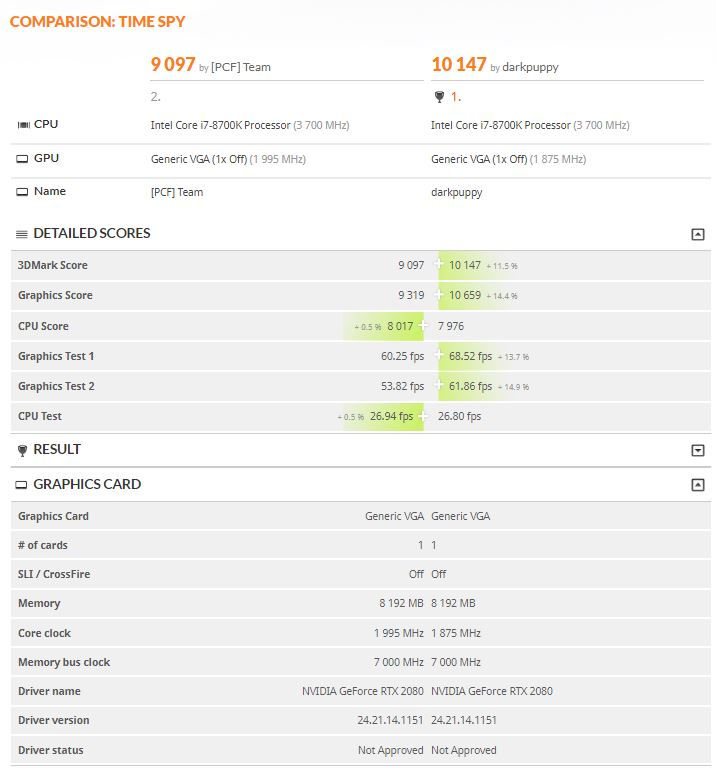
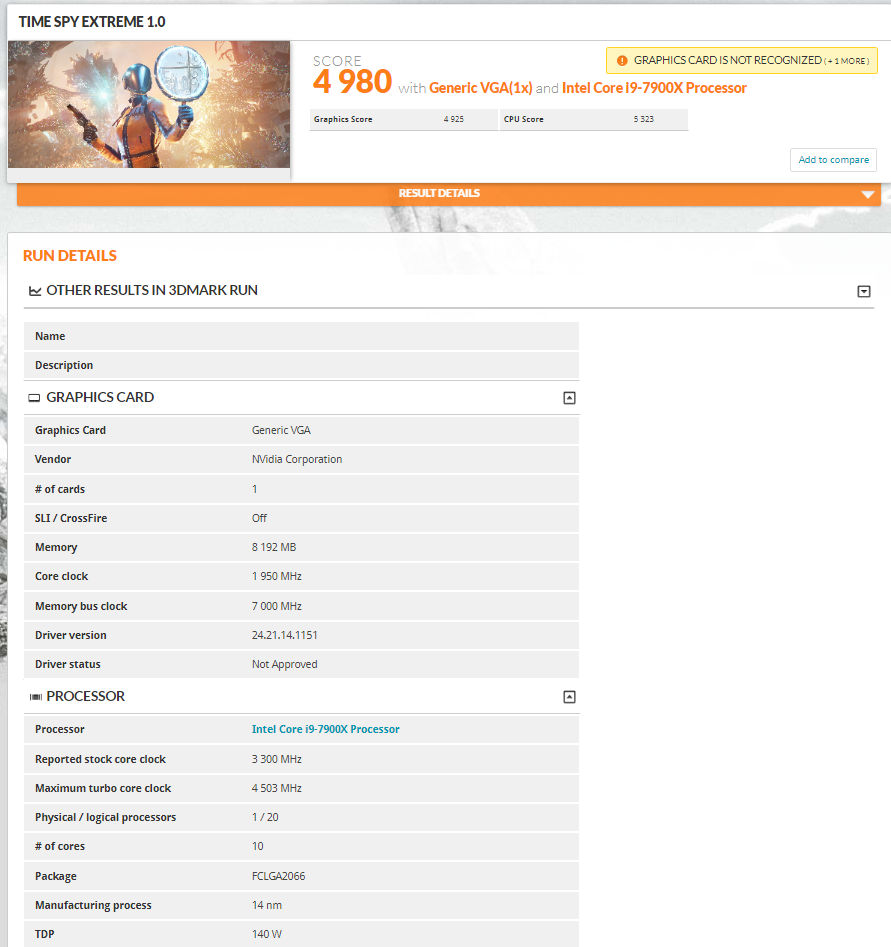
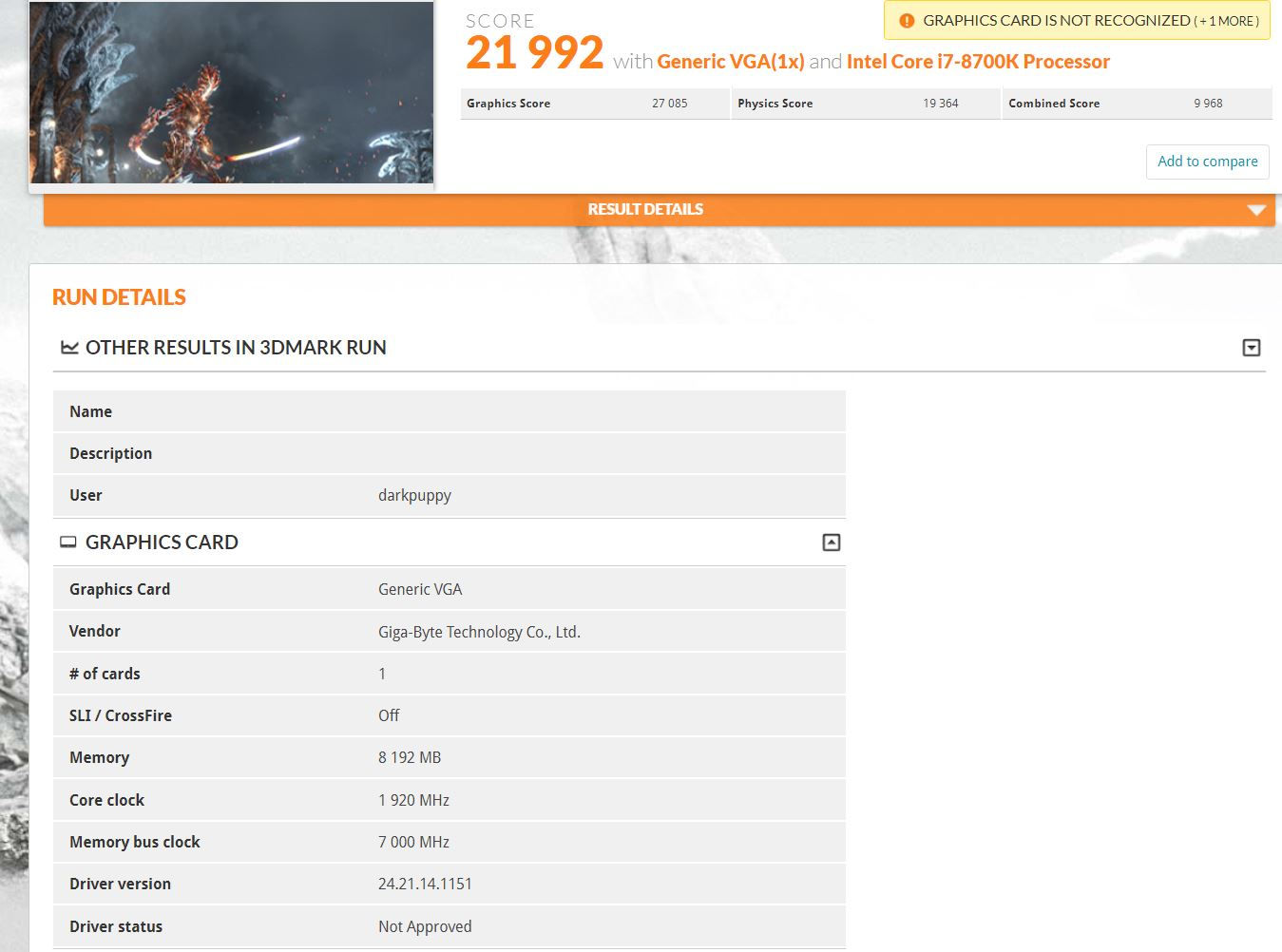
The new GeForce RTX 2080 (Ti) series can finally be tested by reviewers, as the GeForce 411.51 driver has been released under NDA.
The new GeForce RTX 2080 is about to compete with the GeForce GTX 1080 Ti in Time Spy and Fire Strike performance benchmarks. We are looking at performance similar to stock GTX 1080 Ti. The results vary because the reference models are now overclocked (Founders Edition).

GeForce RTX 2080 in Time Spy
GeForce-RTX-2080-Time-Spy-.jpg
GeForce RTX 2080 in Time Spy Extreme
GeForce-RTX-2080-Time-Spy-Extreme.jpg
GeForce RTX 2080 in Fire Strike
GeForce-RTX-2080-Fire-Strike.jpg
Source: VideoCardZ
 
The new GeForce RTX 2080 (Ti) series can finally be tested by reviewers, as the GeForce 411.51 driver has been released under NDA.
The new GeForce RTX 2080 is about to compete with the GeForce GTX 1080 Ti in Time Spy and Fire Strike performance benchmarks. We are looking at performance similar to stock GTX 1080 Ti. The results vary because the reference models are now overclocked (Founders Edition).
Source: VideoCardZ
Bizarre. For some reason I can't see your images in your post, but when I go to quote you, I see them in my quote box. Apparently the official benchmark figures got leaked to your source, Videocardz:
https://videocardz.com/77983/nvidia-geforce-rtx-2080-ti-and-rtx-2080-official-performance-unveiled
NVIDIA also pushed back the release a week to the 27th.

*Edit* Ah, that makes sense. This is a website that blocks hotlinking. Okey doke. That's easy to circumvent.
e61ee19a-3888-42d4-9d3d-570d15745554.png


Settings

DirectX 12 Games

  • Battlefield 1 – Ultra Preset
  • Hitman – Highest Settings
  • Shadow of the Tomb Raider – Very High Preset, TAA
  • Star Wars: Battlefront II – Ultra Preset

DirectX 11 Games

  • Call of Duty: WWII – Render Resolution: Native, Pre-T2X Resolution: Native, Post Process AA: Filmic SMAA T2x, Texture Resolution: Extra, Normal Map Resolution: Extra, Specular Map Resolution: Extra, Sky Resolution: Normal, Shader Preload: On, Anisotropic Filtering: High, Shadows: On, Shadow Map Resolution: Extra, Shadow Depth: High, Screen Space Shadows: Always On, Screen Space Reflections: High, Cache Sun Shadow Maps: On, Depth of Field: High, Motion Blur: High Quality, Screen Space Ambient Occlusion: Hemo AO, Medium Distance Ambient Occlusion: On, Surface Scattering: On
  • F1 2018 – Ultra Preset, TAA, AF: 16x
  • Mass Effect: Andromeda – Ultra Preset
  • Middle-earth: Shadow of War – Ultra Preset
  • PlayerUknown’s Battlegrounds – Ultra Preset
  • Rainbow Six Siege – Ultra Preset
  • The Witcher 3 – Ultra Preset

Vulkan Games

  • Wolfenstein 2: The New Colossus – Mein leben Preset

DirectX 12 Synthetic Benchmarks

  • 3DMark – Timespy Extreme
  • VRMark – Cyan Room
 
Bizarre. For some reason I can't see your images in your post, but when I go to quote you, I see them in my quote box. Apparently the official benchmark figures got leaked to your source, Videocardz:
https://videocardz.com/77983/nvidia-geforce-rtx-2080-ti-and-rtx-2080-official-performance-unveiled
NVIDIA also pushed back the release a week to the 27th.

*Edit* Ah, that makes sense. This is a website that blocks hotlinking. Okey doke. That's easy to circumvent.

Weird because they were fine earlier, also. What do you think about the RTX cards?
 
Back
Top