This Week in Muay Thai

This Week In Muay Thai: Khunsuklek's Dominance Continues​


Khunsuklek Boomdeksian firmly established himself as the top fighter in Muay Thai with his April win over Kumandoi (#3 P4P) for the Rajadamnern 118lbs title. This time he was taking on #8 pound-for-pound fighter and Rajadamnern 122lbs champion, Petchsiam Jor.Pattreya. Khunsuklek entered this fight on an insane 39 fight unbeaten streak, while Petchsiam had won his last 12.

The fight felt like a throwback to a bygone era, as both fighters displayed a high level of skill and activity. Kicking exchanges went deep with constant counters and re-counters, the ending of one exchange and the beginning of another bled together in the sort of fireworks only two elite strikers can produce. The incredible balance on display allowed seemless offense and defense off both legs while both fighters manouvered around in the pocket to find angles.

Petchsiam started strong, leveraging his length and slick rear kick to success on the counter:


Though he’s a while rounded fighter and an ambidextrous kicker, Petchsiam’s bread and butter is the counter rear kick. He excels at blocking or pulling back from his opponent’s kicks and instantly snapping up the rear leg, always keeping himself in position to land it. Throughout the fight you’ll notice him taking short L-steps and split steps to quickly take angles and change distances without putting his weight in a position that leaves him unable to land the kick.

Khunsuklek was initiating most exchanges, but Petchsiam defense and counter kicking allowed him to score off Khunsuklek’s entries, and his depth and balance allowed him to keep up with Khunsuklek as the exchange grew deeper.

While Petchsiam took the first round, Khunsuklek started adjusting before the round was even over. We often talk about the importance of closing off the open side against a slick distance kicker, by bringing the rear leg forward in a check, filling the space with your own kicks, or marching forward to jam up the kicking lane. What was interesting with Khunsuklek’s performance is that he worked through a progression of tactics to close off the lane of Petchsiam’s rear kick.

He started throwing marching combinations, stepping forward into southpaw after his first kick was defended and countered:


The marching combos let Khunsuklek give something back to Petchsiam in exchanges, forcing Petchsiam’s kicks to fall on the less impactful closed side, but they weren’t exactly ideal as they still involved trading kicks.

In the second round, Khunsuklek added footsweeps onto the end of his marching combinations to punish Petchsiam’s counter kicks:


He’d show Petchsiam the same opening he’d been exploiting previously, then step forward and take out his base while he was on one leg. At times he’d show a short little feint or throwaway kick to get Petchsiam biting on counters, then just step through into southpaw and gently bring him to the mat with the footsweep.

The next step for Khunsuklek in taking away Petchsiam’s primary weapon was bringing out a forward floating check. He would enter with his right kick, but instead of touching the kicking leg down and giving Petchsiam the opening for his counter, he would immediately thrust it in front of him in a block, forcing Petchsiam to kick into the shin.


At one point, Khunsuklek entered with his right kick and Petchsiam pulled back, making it miss. Almost anyone else would have rotated too far and lost their balance, giving up a free, high-scoring kick to the back. But Khunsuklek simply kept his weight over his plant leg, externally rotated his kicking leg right as it past by Petchsiam’s body to halt its momentum, and drew it right into a floating check, catching Petchsiam’s counter kick on his shin and allowing him to step into his own leg kick.

Karuhat Sor.Supawan is the most notable purveyor of this sort of forward check, and it’s not hard to see a little bit of Karuhat in Khunsuklek.

Petchsiam wasn’t helpless either though. He started targetting Khunsuklek’s plant leg when he brought his rear leg forward, threatened with punch combinations, and relied more on his lead leg to counter, kicking around the forward check. But Khunsuklek forcing Petchsiam to rely on the closed side kick more was a win in itself - strong southpaw open side kicks cut off distance in a way few other attacks do, physically blocking their recipient from stepping in and returning. When Petchsiam landed kicks to the closed side, he was forced into closer range engagements as Khunsuklek could step through it and rattle off a punch combo or return his own kick.

The final step in Khunsuklek swinging the momentum firmly to his side was implementing a consistent forward march to take away Petchsiam’s time and space.


Khunsuklek would enter behind the raised rear leg, touching it down abruptly to snap into quick kicks off his rear side or march into lead leg kicks, throwing out teeps occasionally to keep Petchsiam off balance. Petchsiam’s kicks continued falling safely onto the blocking right leg, and once Khunsuklek backed him up to the ropes he would attack with jumping knees and kicks.

Midway through the second round, Khunsuklek started an exchange that would forshadow the finish:


Khunsuklek steps in with a teep, which is deflected and countered by Petchsiam’s rear kick. Khunsuklek anticipates the rear kick however and switches his feet to put his right leg in front, taking the kick on his closed side. This makes the kick easier to catch and puts his left leg in the rear, setting up a powerful open side kick to Petchsiam’s arm.

Only seconds into the third round, Khunsuklek built on that sequence to land a fight finishing head kick:


Khunsuklek checks a rear kick from Petchsiam, then lifts his right leg up, showing both a check and a kick, bouncing it into a quick kick that gets through. The feint let Khunsuklek seize the initiative and now Petchsiam is slow to react with his counter kick that Khunsuklek easily checks. Petchsiam then kicks with his lead leg, anticipating a check of Khunsuklek’s right side, but Khunsuklek takes it on his arm and scoops underneath it, passing the leg across his body to land a clean counter. Petchsiam finally sees the opening for his counter rear kick, but he’s still operating on Khunsuklek’s initaitve and the move was fully anticipated. Khunsuklek draws his left leg back into a southpaw stance, making Petchsiam’s kick fall on the closed side and into an easy catch. From there, Khunsuklek takes a slight angle to the inside and counters, but this time his kick goes upstairs, dropping Petchsiam for the finish.

Every step of the exchange is remarkable from Khunsuklek in terms of positioning, initative, anticipation, and balance. But what made it even more successful is that it built off their prior exchanges, where Khunsuklek conditioned Petchsiam to expect the body kick counter, before switching up to the head.

Khunsuklek is now on a 40 fight unbeaten streak with wins over our pound-for-pound #3 and #8. He has proven himself both the present and future of Muay Thai. At only 18 years old, he has all the makings of a generational talent and I can’t wait to see what’s next for him.

Continued Here...


This Week in Muay Thai: Khunsuklek's Revenge​


A couple months ago, Khunsuklek Boomdeksian was the top fighter in Muay Thai, on a 40-fight unbeaten streak with recent wins over elite names like Kumandoi, Petchsiam, Pangtor, and Paeyim. Ryuki Matsuda is a Japanese kickboxer who only turned pro in 2021, amassing an 11-0 record before taking a couple Muay Thai fights in RWS.

Matsuda’s first RWS fight was a draw against the middling Issei Wor. Wanchai. In his very next fight, he was set to challenge for Khunsuklek’s Rajadamnern 118lbs title, in what looked like a showcase fight for the Thai with nearly 100 Muay Thai fights under his belt. Instead, Matsuda pulled off the biggest upset in recent combat sports memory, knocking Khunsuklek out in the second round and toppling the pound-for-pound king in only his second fight under Muay Thai rules.

The strike that lead to Matsuda’s upset was his left hook to the body. Thais often struggle with powerful body punchers in kickboxing due to their upright stance and willingness to fight off the ropes, where body shots lose their usual disadvantage of range, as the recipient has no room to back up and make them miss. The main equalizers under Muay Thai rules, aside from a scoring system which prioritizes kicks and knees, are the threat of clinch and elbows. To land a body hook, one needs to get close enough for his opponent to reach out and grab him, which makes it tricker to land consistently against a Thai looking to grab your neck. They also require reaching low and sacrificing frames or control of the arms while standing close, making elbows a natural counter to powerful body punchers.

Khunsuklek’s main weapon is his deft lead leg kick, and he often follows up his body kicks by ducking in with a high guard. Kumandoi was able to catch Khunsuklek to the body a few times as he covered up, but Matsuda found an even better time to land.


Matsuda timed Khunsuklek’s lead leg kick, hopping to the side and landing the body hook while he stood on one leg. Khunsuklek stepped back and froze up for a moment, and that was all Matsuda needed to jump on him and finish him off to the head.

Timing body shots with an opponent’s kick isn’t a great point scoring tactic in Muay Thai as you’re trading a much lower scoring strike for a higher scoring one. But it’s effective enough as a damage-dealing and dissuasion tactic that it’s seen widespread use in Muay Thai, often employed by powerful Muay Mats who don’t always have their stance set to properly check kicks. Taking a hard body punch with both feet rooted to the ground is bad enough, but eating one with a leg in the air can be devastating, as the ab muscles don’t properly brace for the blow and there’s no rear foot on the ground to absorb some of the impact.

Khunsuklek’s main adjustment in the rematch was immediately obvious, as he relied almost solely on his rear leg this time, kicking into Matsuda’s closed side. The closed side body kick hid the squishy parts of his body from Matsuda’s lead hand and allowed him to attack from further away. The distance of a kick is determined by the plant leg, and since the farther rear leg stays planted when throwing the lead leg, you need to get closer to land it. By attacking with his rear leg, Khunsuklek could stay out of body punching range and juggle him off with the kick.


The closed side kick is more cumbersome and lower scoring than open side kicks for a number of reasons. One of the main problems is that kicking into the back and side of the ribs forces the kick to ride up, making it easier to catch. This ended up working to Khunsuklek’s advantage though, as Matsuda scarcely had any effective follow up after he’d caught the leg. Instead, it allowed Khunsuklek to control the distance with his shin, kicking the body and then pushing off with the shin or laying it across Matsuda’s body to force him away as he tried to step in. He landed the kick so consistently and so clean that by the second round it looked like someone spilled red paint all over Matsuda’s ribs.

Matsuda barely attempted a defensive response to the body kicks, instead relying entirely on punishing or dissuading them. This is the same gameplan with which he approached their first fight, but the problem is that it left him no way to win unless he managed to finish Khunsuklek again, or hurt him so badly he stopped kicking entirely. It’s hard to say that was the wrong approach for Matsuda however, as a fighter with so little Muay Thai experience was never going to outpoint someone like Khunsuklek in kicking exchanges.


Matsuda’s first response was to try catching the leg and sweeping, but after his first attempt he failed to get Khunsuklek to the mat with his sweep. He started catching the leg and throwing back a rear body hook instead, managing to land several solid body punches in the second round. Later in the fight he also managed to crowd a few of the body kicks and step into his right hand, though he struggled to find the distance to do it consistently, and at times exposed himself to head kicks by lunging in with the right hand.

Khunsuklek quickly adjusted in turn and started punishing Matsuda’s attempts to dissuade the body kick:


Matsuda’s right hook to the body required him to plant both feet and square his hips, leaving him still for a brief moment where Khunsuklek could easily grab his head. Khunsuklek consistently found clinch entries off the body punches, tearing Matsuda apart on the inside with elbows for nearly every clean body hook he landed.

The gap in positioning and sensitivity in the clinch was predictably enormous. Matsuda left his head high in the air, took grips that left enough space for Khunsuklek to pummel and strike all he wanted, and couldn’t keep up with Khunsuklek’s transitions, often committing to a holding a grip that had already been neutralized.


While Khunsuklek thrashed Matsuda in the clinch all fight, I wasn’t terribly impressed with his work on the inside. He was fighting an opponent with next to no clinch experience, and the comparison flattered him. While he entered with solid head position at times, he would throw a few strikes and quickly lose head position without replacing it with a frame, or open an elbow too much and let Matsuda inside. He was often able to recover and dip his head back down or force Matsuda’s face away to regain space, but a more experienced opponent wouldn’t give him the chance to easily re-establish position once lost.

Khunsuklek has proven effective as a neutralizing clincher, able to stymie strong clinchers by handfighting their entries at mid range and finding some gorgeous elbows in transition, but he was obviously uncomfortable and fighting against type as a pursuing clincher. A lot of his entries into the clinch looked desperate and poorly timed, and someone more experienced than Matsuda would have been given a lot of opportunities to stall out the clinch.

Continued Here...


This Week in Muay Thai: Khunsuklek's Revenge​


A couple months ago, Khunsuklek Boomdeksian was the top fighter in Muay Thai, on a 40-fight unbeaten streak with recent wins over elite names like Kumandoi, Petchsiam, Pangtor, and Paeyim. Ryuki Matsuda is a Japanese kickboxer who only turned pro in 2021, amassing an 11-0 record before taking a couple Muay Thai fights in RWS.

Matsuda’s first RWS fight was a draw against the middling Issei Wor. Wanchai. In his very next fight, he was set to challenge for Khunsuklek’s Rajadamnern 118lbs title, in what looked like a showcase fight for the Thai with nearly 100 Muay Thai fights under his belt. Instead, Matsuda pulled off the biggest upset in recent combat sports memory, knocking Khunsuklek out in the second round and toppling the pound-for-pound king in only his second fight under Muay Thai rules.

The strike that lead to Matsuda’s upset was his left hook to the body. Thais often struggle with powerful body punchers in kickboxing due to their upright stance and willingness to fight off the ropes, where body shots lose their usual disadvantage of range, as the recipient has no room to back up and make them miss. The main equalizers under Muay Thai rules, aside from a scoring system which prioritizes kicks and knees, are the threat of clinch and elbows. To land a body hook, one needs to get close enough for his opponent to reach out and grab him, which makes it tricker to land consistently against a Thai looking to grab your neck. They also require reaching low and sacrificing frames or control of the arms while standing close, making elbows a natural counter to powerful body punchers.

Khunsuklek’s main weapon is his deft lead leg kick, and he often follows up his body kicks by ducking in with a high guard. Kumandoi was able to catch Khunsuklek to the body a few times as he covered up, but Matsuda found an even better time to land.


Matsuda timed Khunsuklek’s lead leg kick, hopping to the side and landing the body hook while he stood on one leg. Khunsuklek stepped back and froze up for a moment, and that was all Matsuda needed to jump on him and finish him off to the head.

Timing body shots with an opponent’s kick isn’t a great point scoring tactic in Muay Thai as you’re trading a much lower scoring strike for a higher scoring one. But it’s effective enough as a damage-dealing and dissuasion tactic that it’s seen widespread use in Muay Thai, often employed by powerful Muay Mats who don’t always have their stance set to properly check kicks. Taking a hard body punch with both feet rooted to the ground is bad enough, but eating one with a leg in the air can be devastating, as the ab muscles don’t properly brace for the blow and there’s no rear foot on the ground to absorb some of the impact.

Khunsuklek’s main adjustment in the rematch was immediately obvious, as he relied almost solely on his rear leg this time, kicking into Matsuda’s closed side. The closed side body kick hid the squishy parts of his body from Matsuda’s lead hand and allowed him to attack from further away. The distance of a kick is determined by the plant leg, and since the farther rear leg stays planted when throwing the lead leg, you need to get closer to land it. By attacking with his rear leg, Khunsuklek could stay out of body punching range and juggle him off with the kick.


The closed side kick is more cumbersome and lower scoring than open side kicks for a number of reasons. One of the main problems is that kicking into the back and side of the ribs forces the kick to ride up, making it easier to catch. This ended up working to Khunsuklek’s advantage though, as Matsuda scarcely had any effective follow up after he’d caught the leg. Instead, it allowed Khunsuklek to control the distance with his shin, kicking the body and then pushing off with the shin or laying it across Matsuda’s body to force him away as he tried to step in. He landed the kick so consistently and so clean that by the second round it looked like someone spilled red paint all over Matsuda’s ribs.

Matsuda barely attempted a defensive response to the body kicks, instead relying entirely on punishing or dissuading them. This is the same gameplan with which he approached their first fight, but the problem is that it left him no way to win unless he managed to finish Khunsuklek again, or hurt him so badly he stopped kicking entirely. It’s hard to say that was the wrong approach for Matsuda however, as a fighter with so little Muay Thai experience was never going to outpoint someone like Khunsuklek in kicking exchanges.


Matsuda’s first response was to try catching the leg and sweeping, but after his first attempt he failed to get Khunsuklek to the mat with his sweep. He started catching the leg and throwing back a rear body hook instead, managing to land several solid body punches in the second round. Later in the fight he also managed to crowd a few of the body kicks and step into his right hand, though he struggled to find the distance to do it consistently, and at times exposed himself to head kicks by lunging in with the right hand.

Khunsuklek quickly adjusted in turn and started punishing Matsuda’s attempts to dissuade the body kick:


Matsuda’s right hook to the body required him to plant both feet and square his hips, leaving him still for a brief moment where Khunsuklek could easily grab his head. Khunsuklek consistently found clinch entries off the body punches, tearing Matsuda apart on the inside with elbows for nearly every clean body hook he landed.

The gap in positioning and sensitivity in the clinch was predictably enormous. Matsuda left his head high in the air, took grips that left enough space for Khunsuklek to pummel and strike all he wanted, and couldn’t keep up with Khunsuklek’s transitions, often committing to a holding a grip that had already been neutralized.


While Khunsuklek thrashed Matsuda in the clinch all fight, I wasn’t terribly impressed with his work on the inside. He was fighting an opponent with next to no clinch experience, and the comparison flattered him. While he entered with solid head position at times, he would throw a few strikes and quickly lose head position without replacing it with a frame, or open an elbow too much and let Matsuda inside. He was often able to recover and dip his head back down or force Matsuda’s face away to regain space, but a more experienced opponent wouldn’t give him the chance to easily re-establish position once lost.

Khunsuklek has proven effective as a neutralizing clincher, able to stymie strong clinchers by handfighting their entries at mid range and finding some gorgeous elbows in transition, but he was obviously uncomfortable and fighting against type as a pursuing clincher. A lot of his entries into the clinch looked desperate and poorly timed, and someone more experienced than Matsuda would have been given a lot of opportunities to stall out the clinch.

Continued Here...


Good post. I see a lot of people call the first fight a fluke. But It was ovbious that Khunsueklek came in here with a better gameplan. Looked like he took advntage of his muay thai tools./
 

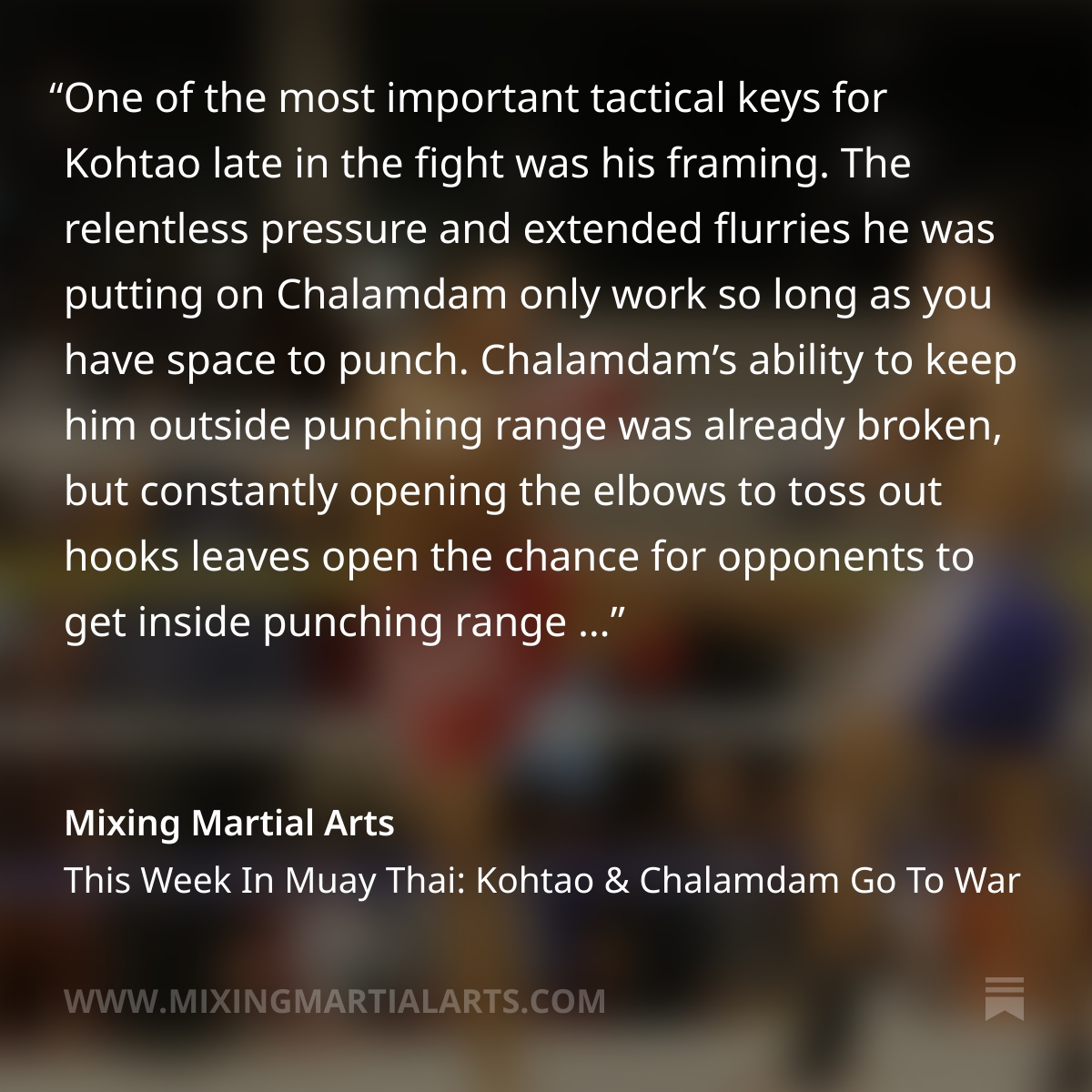
This Week In Muay Thai: Kohtao & Chalamdam Go To War​

Kohtao Petchsomnuek recently established himself as one of the top fighters at 118lbs with a knockout over Detphet in May. Chalamdam Nayokathasala was one of the highest profile and up comers in Muay Thai last year, but he’s struggled once he started consistently fighting elite competition, snapping a 13 fight win streak in late 2023 and going 1-4 in his last five.

Chalamdam is a crafty kicker, with an active teep and slick marching combinations off both legs. Kohtao is a heavy-handed Muay Mat, so Chalamdam’s teep came in handy enforcing his preferred range and keeping Kohtao on the outside, where he couldn’t apply his power.


During the first half of the fight, Chalamdam looked dominant, bouncing Kohtao back with his teep whenever he approached and maintaining the perfect distance to land his rear kick at will.

When Chalamdam has space to work, he’s a treat to watch. He used the threat of the teep brilliantly, constantly mixing up hard teeps to back Kohtao off with feints and footwork. Particularly effective was his pairing of the teep with his jab:


Teeps and jabs go together so well because they serve very similar functions, but at different ranges. They flow into and out of one another easily, as the raised leg planting back down also serves to power the jab, and the weight rocking to the rear foot with a flick of the lead hand facilitates the teep. As the opponent pushes past teeping range, they walk themselves right onto the point of the jab, and backing away from the jab allows you to teep with impunity. Chalamdam is also great about jabbing off his feinted teeps, briefly lifting the leg to halt his opponent’s advance and stomp it back down as he thrusts out the jab.

He also used the dual threat of his teep and jab to pivot off and break the line of Kohtao’s attack:


Once the bouncing lead leg or flicking lead hand had done it’s job and frozen Kohtao in place for a moment, or draw him into picking up his own leg to check, Chalamdam would pivot outside of his lead foot. The outside angle gave him space to circle back into the center of the ropes or get in a quick combination as Kohtao turned to face him.

Since Chalamdam’s piercing teep kept Kohtao from walking him down and creating pocket exchanges, he was left rushing in from kicking range. With the large distance between them, Chalamdam rarely had a problem making the first punch miss, and his counter elbows caught Kohtao as he fell forward.


The concept here is the same as the inside angle straight counter we see all the time from southpaws. Chalamdam pulls his head back and avoids the long left, then pivots inside Kohtao’s stance to face him as he stumbles forward off balance.

While Chalamdam cruised through the opening rounds of the fight, the momentum swung on a dime late in the third round. Kohtao started crowding Chalamdam more urgently, intent on dragging him into a brawl. At one point he succesfully backed Chalamdam into the corner and ate a clean body kick to step into his own 1-2. Chalamdam avoided both punches, but the pressure and threat of both the punches and Kohtao occupying space right in front of him clearly got to him, as he turned his back and ran across the perimeter of the ring to regain distance.


Continued Here...


This Week In Muay Thai: Phetsila vs Fahpratan / Duangsompong vs Thanuphet​

Duangsompong vs Thanuphet​


Thanuphet Wor.Sangprapai and Duangsompong Jitmuangnon are top fighters at 135lbs. Thanuphet was 2-1 for the year coming into this fight, beating Superlek Jitmuangnon and losing only to a top pound-for-pound fighter in Samingdet. Duangsompong was 5-0 with an impressive win over Phetwanchai and two wins under ONE rules.

This was a lovely performance from Thanuphet, as he demonstrated excellent distance control and defense, neutralizing Duangsompong in open space while setting up his routes to the clinch.

Thanuphet started out the fight by establishing a pot-shotting jab and a hard teep, repeatedly knocking Duangsompong back with his teep in the first round.


One thing that stood out about Thanuphet was his comfort occupying space directly in front of Duangsompong. He didn’t have to launch raids into the clinch or constantly cover lots of distance, because wasn’t giving up distance himself. He was constantly setting up just inside Duangsompong’s comfortable kicking range, making him feel the threat of closeness and drawing attacks with subtle feints rather than stepping himself onto the attacks. His counter kicking was aided by this pressure early, as he would draw a kick to catch and strike back, making subtle defensive reactions that left him in position when Duangsompong tried to feint back.

When Duangsompong tried to find space by punching, it opened up routes to the clinch for Thanuphet. Thanuphet started looking for the clinch in the third round and Duangsompong struggled to deal with his smothering inside game. The teeps and jab he established early began to find use as clinch entries, the teep closing distance for Thanuphet to grab the head, and the jab deflecting right hands off the shoulder as he settled into position.

As Thanuphet entered the clinch, Duangsompong would look to control the head and Thanuphet would frame the face away around his arm. He would switch sides on the frame as Duangsompong tried to pummel for head control, creating space with his frame and using it to bring both hands inside on the biceps.


Later on, Duangsompong started retracting his arm around the head back to a loose collar or bicep tie to avoid having his posture broken by the frame, but that gave Thanuphet room to find elbows. Duangsompong was able to do some work from his collar tie as well though, as having his elbow locked in the shoulder made it harder for Thanuphet to frame his face away and he would isntead trying to swim inside from underneath, giving Duangsompong an opening to land a few transitional elbows, even opening a cut near Thanuphet’s eye.

The double bicep control paid off big for Thanuphet in the fourth round, as he tightened up his clinch entries to fight both hands inside as he was coming in. With Duangsompong’s hands locked outside he couldn’t effectively elbow, and footsweeps from Thanuphet kept him hesitant to open up with knees. Later in the round, Thanuphet used his inside control to rock Duangsompong with a big elbow.

After hurting Duangsompong late in the fourth, Thanuphet took the back foot and used his jab and teep to play keep away, winding down the clock and demonstrating his dominance.


For an advancing clincher, Thanuphet showed off a pretty solid jab once he started moving backwards. The jab was used to lance Duangsompong on entry, but he would also throw it away to draw out counters, creating an opening to move off the ropes, or triple up on it to distract and blind Duangsompong while pivoting away.

Thanuphet has proven himself one of the top fighters in his weight class, but he’s also lost decisively to the two best around his weight in Kompatak and Samingdet. I think a fight with Thongnoi Wor.Sangprapai would make a lot of sense for him in the near future.

Continued Here...

149630167.jpg
 
Back
Top