Television The Star Trek Thread V6.0

Something happened in the DS9 wormhole to split her into 2 versions and she's back.
I'm sure they've done sillier plots but your Bashir and Ezri suggestion makes more sense.

Nicole De boar is in Private Eyes but I can't really recall seeing Terry Farrell in much since she left DS9, I've never seen Becker and that finished a long time ago too. Alexander Siddig on the other hand has been in so many things.
Shes hasn't been in much. She had a kid in the 2000s and moved to the midwest. She just moved back to LA in the past year or two, and married Adam Nimoy, Leonard Nimoy's son. They actually met at a Star Trek convention. Here's a pretty good article that variety did last year, for DS9 25th anniversary. Photos of all the cast and interviews.
https://variety.com/2018/tv/features/star-trek-ds9-25th-anniversary-interview-1202648047/
 
This episode was significantly better than last week's one. But I really hated the violence in the beginning. It served no purpose, no need to show the gore in detail except making it unwatchable for 12 year olds.

I really miss technobabble. It does serve a purpose: to show how people are collaborating methodically to solve a problem.

I also am very confused about some stuff that the showrunners have said about not only Discovery, but also this series, being about 'hope'. I don't want to hope for messiah-type individuals to save the galaxy, I want to see human progress. It's okay to have ups and downs, therefore I have no problem with the starting point for Picard. But the overall trajectory must be positive, driven by a positive spirit instead of individual heroes.
 
This episode was significantly better than last week's one. But I really hated the violence in the beginning. It served no purpose, no need to show the gore in detail except making it unwatchable for 12 year olds.

I really miss technobabble. It does serve a purpose: to show how people are collaborating methodically to solve a problem.

I also am very confused about some stuff that the showrunners have said about not only Discovery, but also this series, being about 'hope'. I don't want to hope for messiah-type individuals to save the galaxy, I want to see human progress. It's okay to have ups and downs, therefore I have no problem with the starting point for Picard. But the overall trajectory must be positive, driven by a positive spirit instead of individual heroes.
It will ultimately be about confronting a Federation that has lost its way and trying to right the ship. Ichebs torture was pretty brutal, but I think they are really trying to emphasize has lawless and brutal the former neutral zone has become, in large part, due to the Federations isolationist turn.
 
It will ultimately be about confronting a Federation that has lost its way and trying to right the ship. Ichebs torture was pretty brutal, but I think they are really trying to emphasize has lawless and brutal the former neutral zone has become, in large part, due to the Federations isolationist turn.


Yeah the point just could have been made without being so graphic.
 
This show is so stunningly stupid and bad it's hilarious, but I doubt they ment it to funny bad.

It's not Trek it's not Picard either its barely mediocre scify bordering on trash half the time. Makes Discovery look top quality.

The romulan wine makers seemed most interesting characters so of course they are back in France fucking about while band of Picard the bold with space Legolas and wishes he was Pedro Pascal with token colored character and annoying short hair blonde yard act like band of retards.

7 would still get the D. About the only good thing Ohh and the evil romulan madman sister. Shed really get it .
It's so sad that she traveled and suffered so much to get back to an Earth and Federation full of hateful assholes, and that JLP would retire as a legendary Captain to a world that turns sour immediately.
 
How is the show still scoring above 7 for each of the those episodes? It went off a fucking cliff after the first episode imo.

I really liked the last episode, probably my second favorite after the premiere. You can definitely tell when Jonathan Frakes directs an episode.
 
How is the show still scoring above 7 for each of the those episodes? It went off a fucking cliff after the first episode imo.
The curve, my friend. Everything is relative, and must be assessed on a curve.

Scores of 7.0-7.5 on IMDb for TV show episodes are actually pretty miserable. Only pilot episodes are analogous to movies. The reason is that if people don't like a show they just don't watch it. Perhaps because of this TV episode ratings don't slide as far as movies do over time, but they still slide, so expect those numbers to fall a bit.

You also can't compare this to vintage shows which are rated years after they stopped airing because IMDb didn't come along. You might as well add a half point to every episode for shows like that (ex. The Next Generation). That's true for movies, too, but it's especially true for TV because TV has always made a point of grounding itself in more obscure issues of the day that grip the common consciousness. TV shows love to make quips and other sly references that get lost in time. The volume of production also means that it's more willing to adorn itself in the stereotypical styles and tastes preferred at the time of release.

Just look through the canceled shows this past year, and it's best to compare shows from the same subgenre for the most enlightening study (Sci-Fi Drama):
https://tvseriesfinale.com/tv-show/ending-or-cancelled-tv-shows-for-the-2018-19-season/

The CW's The 100 is an example. This show made it to seven seasons, so it can't be that terrible, though we are talking about the CW, here, but even the most recent season (#6) before cancellation doesn't have an episode rated below 8.4. In fact, in all of its seasons, only 17 of 86 total episodes have ever been rated below an 8. Only a dozen have been at 7.6 or below, and unlike Picard's disastrous episodes, they've had time to age & slide:
https://www.imdb.com/list/ls073927025/?sort=user_rating,desc&st_dt=&mode=detail&page=1

Right now all these post-pilot episodes are doing about as well as the canceled shows Channel Zero, The Gifted, and Origin, the last of which didn't even make it past a single season, and none of these shows have anything close to the production value Picard enjoys. It also doesn't benefit from the Star Trek nerd-blinder effect. Remember Del Toro's vampire production The Strain? Yeah, it was awful. It sports a 7.3.

This Business Insider article is about the worst current show on each network as judged by a synthesis of RottenTomatoes critic and user scores. Almost every show there scores over a 7, and some even above 8 (ex. New Amsterdam):
https://www.businessinsider.com/wor...fox-cbs-netflix-2018-3#amazon-the-romanoffs-2

Maybe the punctuation mark I should put on this is that Fuller House is retiring with a 6.8.

The truth is that if a TV drama isn't rated above an ~8.4 on IMDb these days it generally isn't worth watching. Of course there are some exceptions, especially with regard to personal taste, but speaking generally, that's true, and frankly, Picard won't prove to be an exception.

 
The curve, my friend. Everything is relative, and must be assessed on a curve.

Scores of 7.0-7.5 on IMDb for TV show episodes are actually pretty miserable. Only pilot episodes are analogous to movies. The reason is that if people don't like a show they just don't watch it. Perhaps because of this TV episode ratings don't slide as far as movies do over time, but they still slide, so expect those numbers to fall a bit.

You also can't compare this to vintage shows which are rated years after they stopped airing because IMDb didn't come along. You might as well add a half point to every episode for shows like that (ex. The Next Generation). That's true for movies, too, but it's especially true for TV because TV has always made a point of grounding itself in more obscure issues of the day that grip the common consciousness. TV shows love to make quips and other sly references that get lost in time. The volume of production also means that it's more willing to adorn itself in the stereotypical styles and tastes preferred at the time of release.

Just look through the canceled shows this past year, and it's best to compare shows from the same subgenre for the most enlightening study (Sci-Fi Drama):
https://tvseriesfinale.com/tv-show/ending-or-cancelled-tv-shows-for-the-2018-19-season/

The CW's The 100 is an example. This show made it to seven seasons, so it can't be that terrible, though we are talking about the CW, here, but even the most recent season (#6) before cancellation doesn't have an episode rated below 8.4. In fact, in all of its seasons, only 17 of 86 total episodes have ever been rated below an 8. Only a dozen have been at 7.6 or below, and unlike Picard's disastrous episodes, they've have had time to age & slide. :
https://www.imdb.com/list/ls073927025/?sort=user_rating,desc&st_dt=&mode=detail&page=1

Right now all these post-pilot episodes are doing about as well as the canceled shows Channel Zero, The Gifted, and Origin, the last of which didn't even make it past a single season, and none of these shows have anything close to the production value Picard enjoys. It also doesn't benefit from the Star Trek nerd-blinder effect. Remember Del Toro's vampire production The Strain? Yeah, it was awful. It sports a 7.3.

This Business Insider article is about the worst current show on TV as judged by a synthetis of RottenTomatoes critic and user scores. Almost every show there scores over a 7, and some even above 8 (ex. New Amsterdam):
https://www.businessinsider.com/wor...fox-cbs-netflix-2018-3#amazon-the-romanoffs-2

Maybe the punctuation mark I should put on this is that Fuller House is retiring with a 6.8.

The truth is that if a TV drama isn't rated above an ~8.4 on IMDb these days it generally isn't worth watching. Of course there are some exceptions, especially with regard to personal taste, but speaking generally, that's true, and frankly, Picard won't prove to be an exception.

I see. I guess I’m too used to Sherdog movie polls where if the median or average was above a 7 it would be fair to call it good but flawed.

With the exception of a couple of outliers I would think if we did a Mayberry poll asking people what they thought of Picard it would get absolutely mauled like the alien captain on the TNG episode “Darmok”.
 
Star Trek has been a utopia since 1966. In the basic concept of the series, Gene Roddenberry wanted to show us how mankind has grown beyond its petty wars and disputes and is now setting off for new shores together. In his imagination, Earth had become a paradise. That is why Americans, Russians, Asians, Africans and Europeans travelled into space together on the Enterprise and stood firmly side by side. In this scenario, problems always came only from the outside, but normally not from the inside. Exceptions (like misguided admirals) confirmed the rule. The majority of humanity, however, lived the idea of a united Earth and a common Starfleet.

This concept was even strengthened in the later series.

Many people have been inspired by the values of Star Trek for more than fifty years, many have found their calling through Star Trek and quote the different series (especially the original series and TNG) as a reason for their choice of profession or attitude towards life until today. The general direction: We humans can grow beyond ourselves at some point, the future is worth living, it is only possible together. In this view, everyone is responsible for making the best of themselves and their lives and for following these ideals. With Roddenberry, all of this runs under the term Advanced Human, or more precisely, the human being 2.0, who we must and should become at some point.

But how does it all look like in Star Trek: Picard? Even in Trek, you have probably gotten used to a more drastic language by now. The brutality shown in this episode isn't something you don't get to see elsewhere on TV and even in Star Trek there were splatter moments (think of the exploding head from Conspiracy from Star Trek: The Next Generation). Today's creators of Star Trek simply deal with these topics according to the spirit of the time. This certainly doesn't have to please the inclined Old Trekkie, but it is neither surprising nor reprehensible.

More questionable are the decisions regarding content. If you take a closer look at the La Sirena crew, an unpleasant pattern becomes apparent. The fact that Jean-Luc Picard was actually the model Advanced Human á la Gene Roddenberry is not in question. Nevertheless, he now has 14 years behind him, in which he firstly gave up (without pursuing other options after his retirement) and secondly, bathing in self-pity, forgot and abandoned a colleague like Raffi or even the Romulan Elnor. So this Picard is no longer the impeccable man we knew. If the series should be about him finally finding his way back to himself, that would surely be a potent story to make. Already in Star Trek: First Contact the Captain had gone astray for a short time out of revenge and had to be argued by Lily Sloane back on the right track. Let us also think back to Star Trek: Deep Space Nine. Due to the war, there were many moments when crew members entered grey areas or crossed lines. Nevertheless, these also found their way back into the trail again and again. And in Star Trek: Discovery it was Michael Burnham who had to prove after her mutiny that she had learned from her mistake. But in these comparisons there is also a relevant difference to Star Trek: Picard.

Let's have a look at the crew around Picard. Raffi felt sorry for herself for 14 years, drinking and using drugs, because she lost her job and obviously also her family. It seems that Rios quit his job because of a mission that went wrong and now he is a Lonesome Cowboy and gets paid for all kinds of (legal and illegal) missions. His holograms give him a subtle narcissistic touch. Although Dr. Jurati is a respected cyberneticist, she apparently becomes a murderer (!) of her ex-boyfriend Maddox through the influence of Commodore Oh. Finally, Seven of Nine is unswervingly driven by her desire for revenge and kills Bjayzl (and several others) in cold blood. Elnor is a trained killing machine and beheads a Romulan ex-senator in front of Picard's eyes.

So the crew of La Sirena gathers self-pity, narcissism, vigilanteism, murder, self-sacrifice, abandonment of friends and many lies and secrets. In fact, there's no one left in this group who could serve as a role model. Now you have to know that the world view of showrunner Michael Chabon is different from that of Gene Roddenberry. Chabon does not believe in Advanced Human. In his opinion we will always keep our mistakes. This may be realistic, but it doesn't correspond at all to the foundation on which Star Trek was built. And even if we accept that in a modern form of Star Trek, the characters are more flawed than in the past, it doesn't have to affect all main characters. It is always a question of balance.

Let's think again of DS9 and Sisko's attempts to get the Romulans into war by a trick. The Captain crossed several red lines at this point. But his behaviour also made it abundantly clear how he struggled with his decisions. Besides, we still had enough moral authorities (Bashir, Dax, Worf, O'Brien, Odo) on board next to him to remind us of the right way. This is how the balancing act between the Roddenberry utopia and a realistic portrayal of human failure in individual cases works.

In the Classic series and Star Trek: The Next Generation, the crews consisted of advanced humans who wanted to research and help in space. In Star Trek: Deep Space Nine we met Advanced Humans who tried to maintain the ideals under considerable pressure and in the most difficult times. In Star Trek: Voyager, a crew of Advanced Humans in a distant sector of space had to preserve these very ideals under extreme conditions. Star Trek: Enterprise then presented us as a prequel a crew on their way to becoming Advanced Humans. The pattern becomes clear, doesn't it?

In Star Trek: Picard now somehow all is broken. What does that tell us about the ideals on which Star Trek is based? Have they finally become irrelevant in the eyes of the creators? It would seem so. Unless the authors first wanted to take us so far into the depths to make some exciting statement later on. We'll have to wait and see, but we should also keep an eye on this drastic departure from Trek values.

But one question remains: What does all this tell us about the much criticized Star Trek: Discovery? Actually, one has to apologize a little to the series. With Burnham, Stamets, Tilly, Culber, Saru (as well as Pike, Spock and Number One) we are dealing with wonderfully positive characters in the best Trek sense, who want to research and learn and who hold the ideals of Starfleet and the Federation in high regard. One may certainly discuss about the quality of the scripts, but Star Trek: Discovery is definitely Star Trek so far. About Star Trek: Picard, on the other hand, one can unfortunately only say this to a very limited extent at the moment.
 
Star Trek has been a utopia since 1966. In the basic concept of the series, Gene Roddenberry wanted to show us how mankind has grown beyond its petty wars and disputes and is now setting off for new shores together. In his imagination, Earth had become a paradise. That is why Americans, Russians, Asians, Africans and Europeans travelled into space together on the Enterprise and stood firmly side by side. In this scenario, problems always came only from the outside, but normally not from the inside. Exceptions (like misguided admirals) confirmed the rule. The majority of humanity, however, lived the idea of a united Earth and a common Starfleet.

This concept was even strengthened in the later series.

Many people have been inspired by the values of Star Trek for more than fifty years, many have found their calling through Star Trek and quote the different series (especially the original series and TNG) as a reason for their choice of profession or attitude towards life until today. The general direction: We humans can grow beyond ourselves at some point, the future is worth living, it is only possible together. In this view, everyone is responsible for making the best of themselves and their lives and for following these ideals. With Roddenberry, all of this runs under the term Advanced Human, or more precisely, the human being 2.0, who we must and should become at some point.

But how does it all look like in Star Trek: Picard? Even in Trek, you have probably gotten used to a more drastic language by now. The brutality shown in this episode isn't something you don't get to see elsewhere on TV and even in Star Trek there were splatter moments (think of the exploding head from Conspiracy from Star Trek: The Next Generation). Today's creators of Star Trek simply deal with these topics according to the spirit of the time. This certainly doesn't have to please the inclined Old Trekkie, but it is neither surprising nor reprehensible.

More questionable are the decisions regarding content. If you take a closer look at the La Sirena crew, an unpleasant pattern becomes apparent. The fact that Jean-Luc Picard was actually the model Advanced Human á la Gene Roddenberry is not in question. Nevertheless, he now has 14 years behind him, in which he firstly gave up (without pursuing other options after his retirement) and secondly, bathing in self-pity, forgot and abandoned a colleague like Raffi or even the Romulan Elnor. So this Picard is no longer the impeccable man we knew. If the series should be about him finally finding his way back to himself, that would surely be a potent story to make. Already in Star Trek: First Contact the Captain had gone astray for a short time out of revenge and had to be argued by Lily Sloane back on the right track. Let us also think back to Star Trek: Deep Space Nine. Due to the war, there were many moments when crew members entered grey areas or crossed lines. Nevertheless, these also found their way back into the trail again and again. And in Star Trek: Discovery it was Michael Burnham who had to prove after her mutiny that she had learned from her mistake. But in these comparisons there is also a relevant difference to Star Trek: Picard.

Let's have a look at the crew around Picard. Raffi felt sorry for herself for 14 years, drinking and using drugs, because she lost her job and obviously also her family. It seems that Rios quit his job because of a mission that went wrong and now he is a Lonesome Cowboy and gets paid for all kinds of (legal and illegal) missions. His holograms give him a subtle narcissistic touch. Although Dr. Jurati is a respected cyberneticist, she apparently becomes a murderer (!) of her ex-boyfriend Maddox through the influence of Commodore Oh. Finally, Seven of Nine is unswervingly driven by her desire for revenge and kills Bjayzl (and several others) in cold blood. Elnor is a trained killing machine and beheads a Romulan ex-senator in front of Picard's eyes.

So the crew of La Sirena gathers self-pity, narcissism, vigilanteism, murder, self-sacrifice, abandonment of friends and many lies and secrets. In fact, there's no one left in this group who could serve as a role model. Now you have to know that the world view of showrunner Michael Chabon is different from that of Gene Roddenberry. Chabon does not believe in Advanced Human. In his opinion we will always keep our mistakes. This may be realistic, but it doesn't correspond at all to the foundation on which Star Trek was built. And even if we accept that in a modern form of Star Trek, the characters are more flawed than in the past, it doesn't have to affect all main characters. It is always a question of balance.

Let's think again of DS9 and Sisko's attempts to get the Romulans into war by a trick. The Captain crossed several red lines at this point. But his behaviour also made it abundantly clear how he struggled with his decisions. Besides, we still had enough moral authorities (Bashir, Dax, Worf, O'Brien, Odo) on board next to him to remind us of the right way. This is how the balancing act between the Roddenberry utopia and a realistic portrayal of human failure in individual cases works.

In the Classic series and Star Trek: The Next Generation, the crews consisted of advanced humans who wanted to research and help in space. In Star Trek: Deep Space Nine we met Advanced Humans who tried to maintain the ideals under considerable pressure and in the most difficult times. In Star Trek: Voyager, a crew of Advanced Humans in a distant sector of space had to preserve these very ideals under extreme conditions. Star Trek: Enterprise then presented us as a prequel a crew on their way to becoming Advanced Humans. The pattern becomes clear, doesn't it?

In Star Trek: Picard now somehow all is broken. What does that tell us about the ideals on which Star Trek is based? Have they finally become irrelevant in the eyes of the creators? It would seem so. Unless the authors first wanted to take us so far into the depths to make some exciting statement later on. We'll have to wait and see, but we should also keep an eye on this drastic departure from Trek values.

But one question remains: What does all this tell us about the much criticized Star Trek: Discovery? Actually, one has to apologize a little to the series. With Burnham, Stamets, Tilly, Culber, Saru (as well as Pike, Spock and Number One) we are dealing with wonderfully positive characters in the best Trek sense, who want to research and learn and who hold the ideals of Starfleet and the Federation in high regard. One may certainly discuss about the quality of the scripts, but Star Trek: Discovery is definitely Star Trek so far. About Star Trek: Picard, on the other hand, one can unfortunately only say this to a very limited extent at the moment.

One of the things I hated the most about Discovery was their utter butchery of the Klingons. How they look, how they sound, how they act. They fucked it all up.

Picard has taken it even further though by fucking up Starfleet, the Federation and 24th century humanity.

This show is fucking trash.
 
One of the things I hated the most about Discovery was their utter butchery of the Klingons. How they look, how they sound, how they act. They fucked it all up.

Picard has taken it even further though by fucking up Starfleet, the Federation and 24th century humanity.

This show is fucking trash.
I just don't think of it as ST.

That bright future for humanity?
Out the fucking window.

<Prem973>

I would be upset but they've been making garbage ST for so many years, I'm numb to it.
 
"He's one of thousands of species that we've encountered. We live in a peaceful Federation with most of them; the people you see are here by choice... poverty was eliminated on earth a long time ago, and a lot of other things disappeared with it: hopelessness, despair, cruelty..."

<{MingNope}>

Fuck you, TNG.
 
One of the things I hated the most about Discovery was their utter butchery of the Klingons. How they look, how they sound, how they act. They fucked it all up.

Picard has taken it even further though by fucking up Starfleet, the Federation and 24th century humanity.

This show is fucking trash.
I'm not a fan of Discovery, obviously, but at least it doesn't fail in producing some role models. That's why I like Saru & Culber so much. The show at least has characters who desperately try to adhere to idealism when confronted with practical scenarios that make this impossible, or at least impossible without sustaining serious sacrifice. Ultimately, this review gets that wrong. Discovery deserves the hate. That show is almost as cynical as Picard, when the chief protagonist is so consistently lionized (or unscathed) for defying the chain of command, which reflects shared values, and ultimately the rule of law. She's a pseudo-vigilante who symbolizes writers that value narcissism & furtiveness above teamwork & transparency. Nothing could be further from Star Trek values. It also has this perverse need to celebrate weak people like Tilly.

Both are fucking garbage, and a disgrace to Roddenberry's legacy.
"He's one of thousands of species that we've encountered. We live in a peaceful Federation with most of them; the people you see are here by choice... poverty was eliminated on earth a long time ago, and a lot of other things disappeared with it: hopelessness, despair, cruelty..."

<{MingNope}>

Fuck you, TNG.
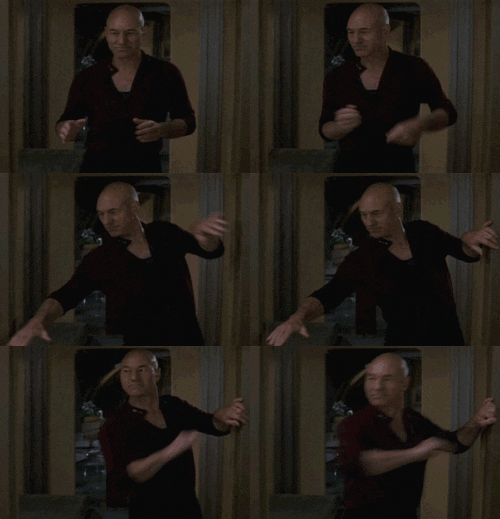
giphy.gif
 
Nothing makes me think Star Trek like a realistic and gory fight scene that goes on forever.

Every other series accomplished the same storytelling with much less, and it didn't need more, because that's window dressing and not the focus.

Well, until now. Now it's no different than life. I have no desire to see the depressing, violent, hate filled normal world reflected in Star Trek. It's what gives me a hopeful break from all that.

My understanding is that Sir Patrick Stewart not only agreed to portray Picard in this schlock (presumably after reading the script), he wants it to be like real life and push his personal politics.

<codychoke>
 
Nothing makes me think Star Trek like a realistic and gory fight scene that goes on forever.

Every other series accomplished the same storytelling with much less, and it didn't need more, because that's window dressing and not the focus.

Well, until now. Now it's no different than life. I have no desire to see the depressing, violent, hate filled normal world reflected in Star Trek. It's what gives me a hopeful break from all that.

My understanding is that Sir Patrick Stewart not only agreed to portray Picard in this schlock (presumably after reading the script), he wants it to be like real life and push his personal politics.

<codychoke>

Yeah, apparently he had a real axe to grind over Brexit so the modern Federation’s attitude towards Romulans is supposed to be a reflection of current day Britain’s attitude towards immigrants.
 
Also, I realized that Stewart having more creative control was going to be a bad thing when I learned he had a lot of creative control over Star Trek Insurrection, which was awful

giphy.gif
 
Yeah, apparently he had a real axe to grind over Brexit so the modern Federation’s attitude towards Romulans is supposed to be a reflection of current day Britain’s attitude towards immigrants.
To quote Hackfraud Evans, "Fuck that. Stop shitting on Star Trek!"

Stewart has done the franchise even dirtier because he's consciously trashing the old Federation... the one that existed too recently for these bizarre changes to occur within Picard's lifetime.

Fourteen Federation planets said "Fuck it, let them die"?

It's funny to me when people insist that canon be respected.

Canon be damned. If this is what Star Trek is now, it choked sucking its own dick.
 
Back
Top