

- Joined
- Sep 23, 2014
- Messages
- 739
- Reaction score
- 0
The Life and Times of Jimmy Hoffa
https://www.counterpunch.org/2019/11/29/the-life-and-times-of-jimmy-hoffa/
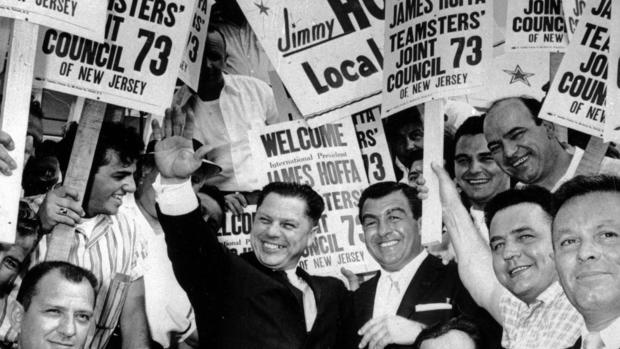
I thought I’d start a thread to discuss the Irishman movie and the legacy of the Teamsters in the United States, as well as the history of the union movement, which was the backbone of getting impoverished workers and Irish, Italian, etc. immigrants into the American middle class. The movie also examines the Bay of Pigs scandal and the seedier sides of Kennedy’s presidency, with how embroiled the mafia was with the American government. A great film and possibly a final hurrah to crime films by Scorsese, it’s available on Netflix for easy viewing.
https://www.counterpunch.org/2019/11/29/the-life-and-times-of-jimmy-hoffa/
As described in Charles Brandt’s bestseller I Heard You Paint Houses, on which Scorsese’s movie is based, Hoffa’s subsequent campaign to regain the presidency of the Teamsters was sufficiently threatening to the Mafia that they had him killed.
The Irishman focuses on this seedier side of Hoffa’s life, thus perpetuating the image of a wholly amoral and self-serving criminal with which the McClellan hearings made Hoffa’s name synonymous. Most articles published in popular media, such as Steve Early’s recent piece “The Ghost of Jimmy Hoffa Won’t Go Away,” express a similarly one-sided view. The truth is that Hoffa’s Mob connections were hardly the defining feature of his life. Rather, he deserves to be known, in large part, as the preternaturally effective and hard-working—20-hour days six days a week—leader of what was then the largest union in American history, responsible for raising millions of truck drivers, warehousemen, laundry workers, retail clerks, and others into the middle class.
With the possible exception of John L. Lewis, no twentieth-century union leader was as beloved by the members as Hoffa. He made it a point to be approachable and endlessly responsive: in speeches, for example, he regularly gave out his office phone number and insisted that members call him at any hour of the day or night if they had problems. The contracts he secured were remarkably generous—and yet, ironically, even employers profoundly admired him, considering him a master negotiator, a “genius,” more knowledgeable about the trucking industry than anyone, all in all “a great statesman” who was scrupulously honest and realistic in bargaining.
Indeed, the fundamental reason for the perennial fascination with Jimmy Hoffa may be not so much his ties to the Mafia as his sheer power and success. No other industry was more critical to the nation’s economy than trucking, and Hoffa did more than anyone to rationalize and stabilize conditions in this chaotic, competitive industry (a service for which employers were grateful). Bobby Kennedy may have exaggerated when he said Hoffa was the second most powerful man in the country, but he certainly did have a degree of power unimaginable for a union official in the twenty-first century. And that’s what’s so interesting about him: Hoffa symbolizes a political economy long gone, an era when a union leader could strike fear and loathing in the hearts of senators and presidents, when the old industrial working class, millions strong and capable of bringing the economy to its knees if it so desired, was still the foundation of the social order.
I thought I’d start a thread to discuss the Irishman movie and the legacy of the Teamsters in the United States, as well as the history of the union movement, which was the backbone of getting impoverished workers and Irish, Italian, etc. immigrants into the American middle class. The movie also examines the Bay of Pigs scandal and the seedier sides of Kennedy’s presidency, with how embroiled the mafia was with the American government. A great film and possibly a final hurrah to crime films by Scorsese, it’s available on Netflix for easy viewing.


