
- Joined
- Aug 15, 2019
- Messages
- 6,042
- Reaction score
- 12,060
Unfortunately more money doesn’t fix lazy.
This is true, but I was hoping with an increase in salary they could hire better workers instead of the bottom of the shit barrel.

Unfortunately more money doesn’t fix lazy.

Gotta disagree with you there. I'm currently in college and speaking with a minority opinion on a political issue is a quick way to get ostracized .Huh? I'm saying it's idiotic and pointless because nobody thinks that (that, if a minimum wage exists, then automatically every position in the economy tangibly generates profits in excess of that wage) and the perspective doesn't present any new information or considerations. If labor costs exceed revenue, the business fails.
I definitely don't think that college-aged people are less tolerant of ideas than persons who are middle aged or older. Quite the opposite, in fact.

I'm more referring to college age people, who aren't very tolerant of other ideas as of late
the minimum wage was birthed from racism, couldn't have them blacks undercutting whites to get jobs...had to make that min wage a wage that white people would take... no wonder leftists love it


Cliffs. Min wage forces small businesses to pay more than they can afford.

I never stated that. They have very sound arguments for racists and other losers full or resentment.Yea leftists can't make sound arguments you say
I never stated that. They have very sound arguments for racists and other losers full or resentment.

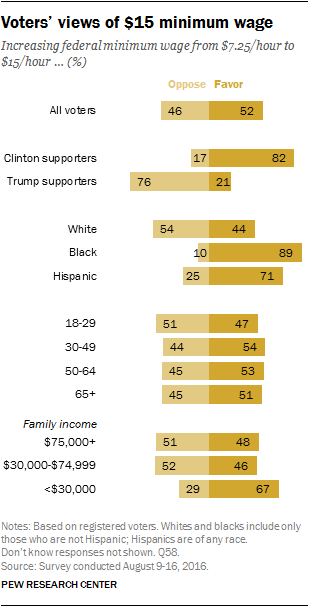
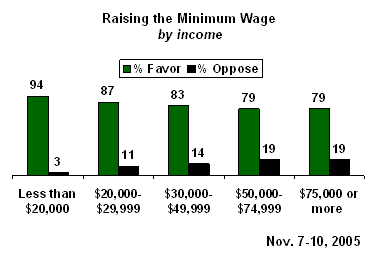
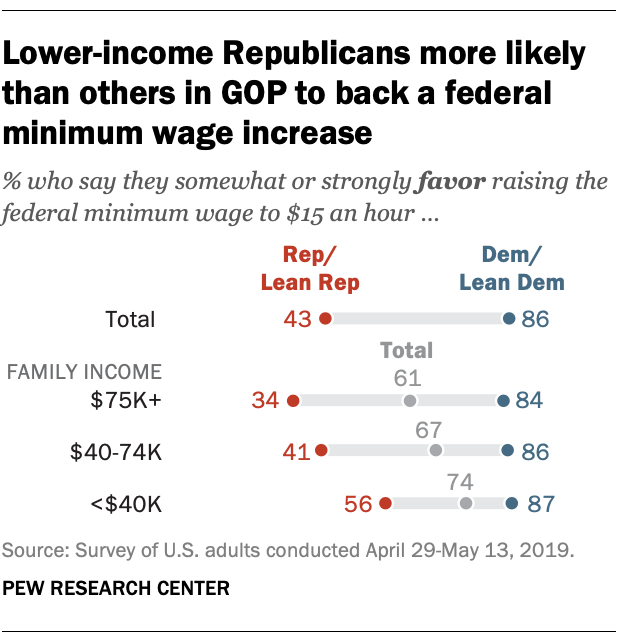
Working class employees are often among the most vocal opponents of large increases in the min wage.

An interesting question way to look at the minimum wage argument.
If minimum wage = $X/hr, does that mean you think every single job out there, no matter how small, brings in at least $X/hr to the company?


In the context of a market economy it simply means a legitimately vulnerable small business will have to increase the price of its good or service. Everyone in that industry will have to compete based on the same wage floor so there is nothing "unfair" about inserting a MW into the competition.
The real hypocrisy comes when we see that no one on the right complains when Mom & Pop can't compete with the town's new Walmart's prices and so quickly gets driven out of business.
But suddenly the capacity of small, locally owned companies to compete in the marketplace becomes sacred when discussions of minimum wage arise. It's a fake, politically motivated concern on the part of the GOP. Their opposition to MW is ultimately just about capitalist "government hands off" dogma.
You are just foul for no reason all the time.
And the other guy made it sound like leftists are the only ones to go full retard ....I was just pointing out that isn't true

Gotta disagree with you there. I'm currently in college and speaking with a minority opinion on a political issue is a quick way to get ostracized .

Don't you qualify for food stamps or welfare based on the size of the family?The flip side someone working 40 hours a week at Wal Mart gets government assistance. So my tax dollars are supplementing Wal Marts CEO salary who earned 22.1 million in 2019.
Not saying he should not get paid that, but pay your people enough so I don't have too with my tax dollars.
https://www.cnbc.com/2020/11/19/wal...of-medicaid-and-food-stamp-beneficiaries.html
One big aspect that gets overlooked with large companies such as Wal-Mart is their ability to use their power to force companies to almost sell exclusively to them then pull their contracts. I have seen where they have made large orders with companies, then those companies gear up to sell to Wal-Mart, dropping other contracts. Wal-Mart will then use their power over the company to force them to sell their goods at a lower price. If the company is unwill or able to sell to them at almost no profit they will pull the contracts. This has forced several American companies to go into bankruptcy or close.
The moral of the story is if you are an American company it may not be in your best interest to do business with a company such as Wal-Mart. This is also probably the best argument for putting tariffs on cheap good coming from countries such as China. The effects of cheap goods imported from other countries has really had a negative effect on smaller towns where manufacturing has been shut down. Some of these small towns have lost the largest employer and good paying jobs because of these tactics.

If by "interesting," you mean "idiotic" or "pointless," then yes. Very interesting..
The question I asked is intended to lead into an interesting discussion. It wasn't just a "hey, what's your answer to this" and leave at that. You're usually overly emotional so I understand that I had to break that down for you.Huh? I'm saying it's idiotic and pointless because nobody thinks that (that, if a minimum wage exists, then automatically every position in the economy tangibly generates profits in excess of that wage) and the perspective doesn't present any new information or considerations. If labor costs exceed revenue, the business fails.
The question I asked is intended to lead into an interesting discussion. It wasn't just a "hey, what's your answer to this" and leave at that. You're usually overly emotional so I understand that I had to break that down for you.
Anyway, the point is if a minimum wage exists and some jobs out there aren't producing enough value to at least cover $X/hr, then that law is forcing a company to lose money with that position.
Capitalism is all about people making agreements with each other so both mutually benefit. As an employer, I need a job done that provides X value to my company and you, the employee, want money. Now, you as the potential employee shouldn't be forced to accept the job & wage offer I come up with (that would be slavery) if you feel it doesn't benefit you, so why should I, as the employer, be forced to pay a position that ends up losing me money?
You really think people running businesses don't have someone crunching the numbers to answer the question "well, what is this position worth to us?" It probably isn't exact but they have a ballpark number. You would have to when you're negotiating wage/salary otherwise how would you know when to say "nah, that's too much"?I don't think the valuation really works like that. Think of a cashier. You don't have a business if there isn't someone working the register. You can do it yourself if you have the time or you can pay someone to do it, and you pay whatever it takes to fill the position. You don't make a determination that someone working the register is worth $X/HR. Of course if your general costs are above what the business is bringing in, you might close your doors. Or if your time isn't worth what you'd be paying, you might do the job yourself.
I think the main argument for having a MW is that the conditions of the market for low-end labor is nowhere near ideal, and it's not ideal in a way that systematically leads to workers being underpaid relative to what they'd make in a better-functioning market.
You really think people running businesses don't have someone crunching the numbers to answer the question "well, what is this position worth to us?" It probably isn't exact but they have a ballpark number. You would have to when you're negotiating wage/salary otherwise how would you know when to say "nah, that's too much"?
Now, I agree it has to be a balancing act because you do need certain positions for your company to run. That's where negotiation comes in. If you say "this is the minimum you can pay", then you're taking away some of the employer's ability to negotiate.


