That's the point, ascertaining the intents of historical figures is the job of a historian, not a legal scholar. That's why so many originialist decisions have flat out bad history. When's the last time an originalist on the Supreme Court read a peer reviewed journal or consulted credible historians?I’m not a constitutional scholar. I can’t dissect rulings and say “wow that’s definitely an originalist ruling!”

You are using an out of date browser. It may not display this or other websites correctly.
You should upgrade or use an alternative browser.
You should upgrade or use an alternative browser.
Law SCOTUS: Apex Court of Last Resort
- Thread starter Deorum
- Start date

- Joined
- Jun 1, 2007
- Messages
- 37,171
- Reaction score
- 61,343
So then no one is an originalist and everyone is just giving their interpretation. It’s just the interpretations some like and some don’t.That's the point, ascertaining the intents of historical figures is the job of a historian, not a legal scholar. That's why so many originialist decisions have flat out bad history. When's the last time an originality on the Supreme Court read a peer reviewed journal or consulted credible historians?

- Joined
- Oct 30, 2004
- Messages
- 95,963
- Reaction score
- 35,164
The 2A is another one where "originalists" completely dispense with even pretending to follow the original intent, as it was clearly intended to ensure that citizens could assist in the defense of the country, given that they didn't anticipate a professional military. Whatever one's views are about the ideal gun laws, no one can argue that the founders had the current system in mind.What's your general position on the 2A? Take your time on any reply, I just don't recall ever seeing you post much on it. I'm more or less a 2A absolutist, shall not be infringed means shall not be infringed.

- Joined
- Jul 20, 2011
- Messages
- 61,595
- Reaction score
- 47,867
Idk if I agree on the gridlock point(more on that later) but I understand your point because it does feel like its in some ways a manifestation of the conservative nature of the American Republic which we both agree is one of our strengths. And the point about state legislatures being closer to the people and thus better equipped for legislating for them does ring true to me, its the "laboratories of democracy" at work. From marijuana to abortion to gun rights, chances are whatever your policy priorities there's a state out there for you. And when you look at the local and state level you might be surprised at which party is delivering your preferred policies.I think I was misunderstood on this, I have no issue with the amendment process. I'm of the mind that if you're going to fundamentally alter the national framework of a country, then the standard for doing so damn well should be as high as it is. @Islam Imamate's description of America as a conservative republic in another thread was on point. I also learned to love the gridlock a long time ago because I'm not particularly crazy about a bunch of top-down federal laws being passed. The states have their own legislatures for that, and the bills signed into law are more directly representative of the constituent populations and their respective industries, subcultures, and priorities. The only thing I really want out of Congress is to fund essential national departments, agencies, institutions, and programs.
It seems the forum sees me now as more partisan because of my strong anti-Trump stance but I've said it before and I'll say it again, at the state and local level things can be very different. Those who have argued with me in the housing threads know I am a pro-construction urbanist and when it comes to the state level some red states are among the best at encouraging the building of new housing while Dem states like Cali are blocking housing to preserve Harvey Milk's camera store. Florida Dems in particular are awful, crooks and clowns the lot of them. I was even a fan of RDS for a minute because he had a good track record on the environment for the GOP which matters a lot to me at the state level given we are stewards of the Everglades.
Back to the point about gridlock, while I see your point what bothers me about it is the fact that its the result of partisanship. If we had gridlock because our representatives were mostly conservative in the sense of avoiding radical change and were deliberately embracing a state driven "laboratories of democracy" approach that would be one thing but no, its because of "factionalism" as the Founders might've called it. Its worrying when one party kills a bill written by one of their own because passing it would be inconvenient for their presidential nominee.
You are right that our decentralized governance is a strength but really it goes even further than that, we have an even finer, less coercive layer of governance on top of that from civil society institutions. So even before something comes before a state legislature, it may have been deliberated upon and decided on this way or that by certain non-governmental bodies in ways that influence the government's ultimate decision. Its not just that we have rule of law but we have a society and government that adheres to the spirit of the law, to norms which could be just as if not more binding than de jure regulations. Hence Mike Pence rejecting the idea that he had plenary authority over aspects of the election.
Last edited:
- Joined
- Jun 1, 2007
- Messages
- 37,171
- Reaction score
- 61,343
Well said.Idk if I agree on the gridlock point(more on that later) but I understand your point because it does feel like its in some ways a manifestation of the conservative nature of the American Republic which we both agree is one of our strengths. And the point about state legislatures being closer to the people and thus better equipped for legislating for them does ring true to me, its the "laboratories of democracy" at work. From marijuana to abortion to gun rights, chances are whatever your policy priorities there's a state out there for you. And when you look at the local and state level you might be surprised at which party is delivering your preferred policies.
It seems the forum sees me now as more partisan because of my strong anti-Trump stance but I've said it before and I'll say it again, at the state and local level things can be very different. Those who have argued with me in the housing threads know I am a pro-construction urbanist and when it comes to the state level some red states are among the best at encouraging the building of new housing while Dem states like Cali are blocking housing to preserve Harvey Milk's camera store. Florida Dems in particular are awful, crooks and clowns the lot of them. I was even a fan of RDS for a minute because he had a good track record on the environment for the GOP which matters a lot to me at the state level given we are stewards of the Everglades.
Back to the point about gridlock, while I see your point what bothers me about it is the fact that its the result of partisanship. If we had gridlock because our representatives were mostly conservative in the sense of avoiding radical change and were deliberately embracing a state driven "laboratories of democracy" approach that would be one thing but no, its because of "factionalism" as the Founder might've called it. Its worrying when one party kills a bill written by one of their own because passing it would be inconvenient for their presidential nominee.
You are right that our decentralized governance is a strength but really it goes even further than that, we have an even finer, less coercive layer of governance on top of that from civil society institutions. So even before something comes before a state legislature, it may have been deliberated upon and decided on this way or that by certain non-governmental bodies in ways that influence the government's ultimate decision. Its not just that we have rule of law but we have a society and government that adheres to the spirit of the law, to norms which could be just as if not more binding than de jure regulations. Hence Mike Pence rejecting the idea that he had plenary authority over aspects of the election.

- Joined
- Dec 1, 2020
- Messages
- 9,601
- Reaction score
- 40,896
I’m not a constitutional scholar.

@panamaican worthy of the utmost respect as a poster. I've been curtailing my time here a bit because of a house move and restarting a 3rd daily class at my gym, but he's worth the time and effort to respond with as much passion and detail as is in this thread. @Rob Battisti has come very far as well. I dont grit my teeth a bit anymore when I see he's tagged me lol
I actually have come to respect you here a lot. Way more than the other posters.

It's clear that Samuel has been a boon to your outlook on life, and the ways you wish to engage other people whether IRL or on this silly clown world corner of the interwebs. I'd like to think I played some kind of small role in encouraging that as well based on the discussions of the last few months.
Idk if I agree on the gridlock point(more on that later) but I understand your point because it does feel like its in some ways a manifestation of the conservative nature of the American Republic which we both agree is one of our strengths. And the point about state legislatures being closer to the people and thus better equipped for legislating for them does ring true to me, its the "laboratories of democracy" at work. From marijuana to abortion to gun rights, chances are whatever your policy priorities there's a state out there for you. And when you look at the local and state level you might be surprised at which party is delivering your preferred policies.
It seems the forum sees me now as more partisan because of my strong anti-Trump stance but I've said it before and I'll say it again, at the state and local level things can be very different. Those who have argued with me in the housing threads know I am a pro-construction urbanist and when it comes to the state level some red states are among the best at encouraging the building of new housing while Dem states like Cali are blocking housing to preserve Harvey Milk's camera store. Florida Dems in particular are awful, crooks and clowns the lot of them. I was even a fan of RDS for a minute because he had a good track record on the environment for the GOP which matters a lot to me at the state level given we are stewards of the Everglades.
Back to the point about gridlock, while I see your point what bothers me about it is the fact that its the result of partisanship. If we had gridlock because our representatives were mostly conservative in the sense of avoiding radical change and were deliberately embracing a state driven "laboratories of democracy" approach that would be one thing but no, its because of "factionalism" as the Founder might've called it. Its worrying when one party kills a bill written by one of their own because passing it would be inconvenient for their presidential nominee.
You are right that our decentralized governance is a strength but really it goes even further than that, we have an even finer, less coercive layer of governance on top of that from civil society institutions. So even before something comes before a state legislature, it may have been deliberated upon and decided on this way or that by certain non-governmental bodies in ways that influence the government's ultimate decision. Its not just that we have rule of law but we have a society and government that adheres to the spirit of the law, to norms which could be just as if not more binding than de jure regulations. Hence Mike Pence rejecting the idea that he had plenary authority over aspects of the election.
Well said.
Insane Quality, lol.
I grew up down South. Gun racks on pickups, utility drawers (or junk drawer, or packing drawer) with bullets and/or shells, and sometimes an actual handgun in them. My Father had a bad habit of running afoul with the law, so he kept a loaded shotgun in the corner of his bedroom behind the door. I do think our gun culture is overly absurd, and I say that as a Boxing Coach, where I hear from kids on a regular basis. Kids dont even want to fight anymore, they want to shoot. That's their go-to. But I also believe that pacifistic practices in schools have contributed to this. I wrote an article for Sherdog.com about it when Mark Muñoz lost his job as a PE Coach for letting two kids spar, supervised.
That being said, Historically, even former conservative SCOTUS Justices, in retrospect, didnt fully agree with essentially disregarding the "organized militia" portion of the 2nd Amendment.
Now, I'm not 100% sure I agree with their assessments fully, however, I recall reading that in the earlier days of the US, the 2nd Amendment was never regarded as a right to arm yourself as you please, but rather as a way for Militias to level their own armories in the event of not having access to Military armories, and that average home gun laws were relegated to the States or even the municipalities.
The fact of the matter is, that despite current gun fanaticism, gun control is also as American as apple pie:
The 2A is another one where "originalists" completely dispense with even pretending to follow the original intent, as it was clearly intended to ensure that citizens could assist in the defense of the country, given that they didn't anticipate a professional military. Whatever one's views are about the ideal gun laws, no one can argue that the founders had the current system in mind.
I usually leave the pro-2A arguments in threads on here to Sherbros like @Gutter Chris, @My Spot, and @spamking. I "recuse" myself on the grounds that I have gradually become radical on this specific issue -- just completely unreasonable and totally unwilling to compromise. It's a waste of time for all involved. Anyhow, a militia by definition is composed of ordinary individual citizens. So, the idea that the framers intended for the government to restrict individual gun ownership but not gun ownership by militias makes no sense.
It actually makes Madison's writings in The Federal Papers completely devoid of reason. Is the Father of the Constitution and author of the Bill of Rigits devoid of reason? Another founding father Samuel Adams remarked that the "Constitution be never construed to authorize Congress to prevent the people of the United States, who are peaceable citizens, from keeping their own arms.” And as noted earlier, Madison's original draft of the 2A is a lot more direct. By all means, pursue your policy preferences but the only truly Constitutional form of gun control would be done through an Amendment to the Constitution.

EDIT: Redundant.
Last edited:

- Joined
- Feb 22, 2005
- Messages
- 55,100
- Reaction score
- 36,758
It's clear that Samuel has been a boon to your outlook on life, and the ways you wish to engage other people whether IRL or on this silly clown world corner of the interwebs. I'd like to think I played some kind of small role in encouraging that as well based on the discussions of the last few months.
Insane Quality, lol.
I usually leave the pro-2A arguments in threads on here to Sherbros like @Gutter Chris, @My Spot, and @spamking. I "recuse" myself on the grounds that I have gradually become radical on this specific issue -- just completely unreasonable and totally unwilling to compromise. It's a waste of time for all involved. Anyhow, a militia by definition is composed of ordinary individual citizens. So, the idea that the framers intended for the government to restrict individual gun ownership but not gun ownership by militias makes no sense.
It actually makes Madison's writings in The Federal Papers completely devoid of reason. Is the Father of the Constitution and author of the Bill of Rigits devoid of reason? Another founding father Samuel Adams remarked that the "Constitution be never construed to authorize Congress to prevent the people of the United States, who are peaceable citizens, from keeping their own arms.” And as noted earlier, Madison's original draft of the 2A is a lot more direct. By all means, pursue your preferred policy preferences but the only truly Constitutional form of gun control would be done through an Amendment to the Constitution.
No I don't think the argument in the videos of the retired Justices above is that the constituton restricts gun ownership, it would be that the Constitution specifically doesn't protect individual private gun ownership in the home. Those are two different arguments, and early American cities and townships had varying rules, which is why in that clip from Tombstone shows Virgil Earp (who was a former Soldier and many suspect he and James to be the true executors of feats that ended up attributed to Wyatt), differentiating that the town of Tombstone wouldn't ban guns, just the carrying of them in town. Many towns DID fully ban gun ownership, except for armories. It's funny that an American icon like Wyatt Earp, and his Brothers, would be tied to guns in the same manner of all Hollywood Cowboys, when the truth is that almost all early Lawmen were huge gun-grabbers.
From there the the next logical question would be, does the Constitution spell out what is considered an organized Militia? It does.


What's that one saying about begging those that hold you in bondage for your freedom? Considering how definitively Rebellions were crushed, and how some of the Framers enacted definitively anti-democratic mechanisms to assure that, at the very least, economic heirarchies remained intact...I just dont see a logical argument in that the framers were looking out for the Joe Everyman here. At the very least not Hamilton. Jefferson did seem more understanding of Rebellion and had a more "let them fight" disposition, but he was also an Embassador at the time when it mattered and seemed to generally not give a f*co. I dont find the idea that the Framers meant that the every day person could and should arm themselves against what was considered "tyranny"...in any context EXCEPT the Imperial rule of another Country, the assertion of divine right or some such (except they had that Manifest Destiny nonsense beginning). When faced with Rebellion about taxation without Representation...and rebellions aimed to disrupt tax cases where wealthy holders of War bonds were being awarded public money, the Government was quite heavy-handed against the commoners. In the case of Shay's Rebellion, the Militia were called upon to fight. Militia used in the exact opposite context of what WE think of as to why the 2nd Amendment exists...protecting the interests of the Massachusetts Elites. Same as the Battle of Blair Mountain with the US Army fighting against the Miners, in the interest of the Company...fighting alongside Pinkerton goons to crush worker rebellion.
A quote from Washington in a letter where he advocates, very eloquently, for heavy-handed Governance (which back then, meant crushing dissent):
"You talk, my good sir, of employing influence to appease the present tumults in Massachusetts. I know not where that influence is to be found, or, if attainable, that it would be a proper remedy for the disorders. Influence is not government. Let us have a government by which our lives, liberties, and properties will be secured, or let us know the worst at once."
Last edited:
- Joined
- Dec 1, 2020
- Messages
- 9,601
- Reaction score
- 40,896
No I don't think the argument in the videos of the retired Justices above is that the constituton restricts gun ownership, it would be that the Constitution specifically doesn't protect individual private gun ownership in the home. Those are two different arguments, and early American cities and townships had varying rules, which is why in that clip from Tombstone shows Virgil Earp (who was a former Soldier and many suspect he and James to be the true executors of feats that ended up attributed to Wyatt), differentiating that the town of Tombstone wouldn't ban guns, just the carrying of them in town. Many towns DID fully ban gun ownership, except for armories. It's funny that an American icon like Wyatt Earp, and his Brothers, would be tied to guns in the same manner of all Hollywood Cowboys, when the truth is that almost all early Lawmen were huge gun-grabbers.
From there the the next logical question would be, does the Constitution spell out what is considered an organized Militia? It does.
What's that one saying about begging those that hold you in bondage for your freedom? Considering how definitively Rebellions were crushed, and how some of the Framers enacted definitively anti-democratic mechanisms to assure that, at the very least, economic heirarchies remained intact...I just dont see a logical argument in that the framers were looking out for the Joe Everyman here. At the very least not Hamilton. Jefferson did seem more understanding of Rebellion and had a more "let them fight" disposition, but he was also an Embassador at the time when it mattered and seemed to generally not give a f*co. I dont find the idea that the Framers meant that the every day person could and should arm themselves against what was considered "tyranny"...in any context EXCEPT the Imperial rule of another Country, the assertion of divine right or some such (except they had that Manifest Destiny nonsense beginning). When faced with Rebellion about taxation without Representation...and rebellions aimed to disrupt tax cases where wealthy holders of War bonds were being awarded public money, the Government was quite heavy-handed against the commoners. In the case of Shay's Rebellion, the Militia were called upon to fight. Militia used in the exact opposite context of what WE think of as to why the 2nd Amendment exists...protecting the interests of the Massachusetts Elites. Same as the Battle of Blair Mountain with the US Army fighting against the Miners, in the interest of the Company...fighting alongside Pinkerton goons to crush worker rebellion.
A quote from Washington in a letter where he advocates, very eloquently, for heavy-handed Governance (which back then, meant crushing dissent):
"You talk, my good sir, of employing influence to appease the present tumults in Massachusetts. I know not where that influence is to be found, or, if attainable, that it would be a proper remedy for the disorders. Influence is not government. Let us have a government by which our lives, liberties, and properties will be secured, or let us know the worst at once."
I have to respect the effort put in here. That's why the District of Columbia vs. Heller decision was such a big deal (i.e. landmark) and the reason I made sure to bold highlight it in the OP. For the sheer purpose of objectiveness, I also noted it was the first time that the SCOTUS ruled on the 2A explicitly protecting individual gun ownership within the home. It's something that NYSRPA v. Bruen expanded on for the right to carry in public, with a clause and reasoning of self-defense attached to both. I'm over the moon with both decisions, tbh. The primary purpose for my advocacy is self-defense. I have no delusions about overthrowing a tyrannical government, lol. If the US Gov wants me dead, I am fucking DEAD. Period. I do believe that a collectively armed citizenry does at least provide a form of tangible pause to the aspirations of an authoritarian government, though.
- Joined
- Oct 30, 2004
- Messages
- 95,963
- Reaction score
- 35,164
The point is that the intention was just to enable a defense of states and the nation. That's also how it was interpreted for almost all of our history. It was only in 2008 that it became interpreted as protecting individual gun ownership (first time the SCOTUS struck down a state law restricting ownership). Again, whatever people think about gun laws, it's just not how it was originally interpreted or generally interpreted until just a few years ago.I usually leave the pro-2A arguments in threads on here to Sherbros like @Gutter Chris, @My Spot, and @spamking. I "recuse" myself on the grounds that I have gradually become radical on this specific issue -- just completely unreasonable and totally unwilling to compromise. It's a waste of time for all involved. Anyhow, a militia by definition is composed of ordinary individual citizens. So, the idea that the framers intended for the government to restrict individual gun ownership but not gun ownership by militias makes no sense
I'm saying if you were an originalist, you would seriously engage with history as a discipline and rely on historical experts (aka trained historians). Instead, originalists on the court rely on, at best, pop history and legal works masquerading as history. Just junk history all around.So then no one is an originalist and everyone is just giving their interpretation. It’s just the interpretations some like and some don’t.
Do you think it's not odd that Supreme Court decisions that are allegedly based on the history of colonial and early America almost never cite respected historians and experts in that part of history?

- Joined
- Aug 20, 2009
- Messages
- 50,620
- Reaction score
- 35,398
It just occurred to me: by giving presidents immunity for "official acts" couldn't the POTUS... ahem... "dismiss" the members of the Supreme Court he doesn't like?They'd need the House and Senate for it to have teeth, though. If that happens I'm with you. If not, use that power granted by scotus to investigate Thomas and Alito like it's their job.

Pew pew pew.

- Joined
- Feb 26, 2008
- Messages
- 15,517
- Reaction score
- 16,675
Haha, I’m not sure even Dershowitz would be able to spin that as an official act.It just occurred to me: by giving presidents immunity for "official acts" couldn't the POTUS... ahem... "dismiss" the members of the Supreme Court he doesn't like?
Pew pew pew.
OTOH, as we are learning that the DOJ has been sicked on Thomas, it could be that his own ruling for presidential power over that dept leads to his undoing, and that at least would be some pretty sweet irony.
- Joined
- Jun 1, 2007
- Messages
- 37,171
- Reaction score
- 61,343
- Joined
- Feb 26, 2008
- Messages
- 15,517
- Reaction score
- 16,675
I support term limits and a binding code of conduct, so sure. The details could vary, but I am good with this approach in spirit.Even if it’s all three in unison, at what point does it end?
My solution for ‘fixing’ the court would be:
All current jurors would be grandfathered with their current tenure.
Newly promoted justices would serve for 18 years maximum.
No justice shall be the recipient of any ‘gift’ of any kind and will receive yearly audits to ensure adherence.
This seems like the best way to go about it IMO but I’m open to suggestions.
I would also limit senators and congressmen to the 18 year limit.
Biden said the same thing, essentially, and got a pretty chilling warning from Gorsuch. Alito said that “No provision in the Constitution gives Congress the authority to regulate the Supreme Court—period.”
These guys are telling us in no uncertain terms that they believe they are the true power in this country. Now, if the DOJ does its thing and Thomas gets impeached, I’ll cool my jets for a while. Otherwise, I still support adding 4 seats and sending them a message that, yeah, Congress can check them if they have the political will, and there’s nothing they can do about it.
- Joined
- Aug 20, 2009
- Messages
- 50,620
- Reaction score
- 35,398
Instead of adding justices, why couldn't they remove 4?I support term limits and a binding code of conduct, so sure. The details could vary, but I am good with this approach in spirit.
Biden said the same thing, essentially, and got a pretty chilling warning from Gorsuch. Alito said that “No provision in the Constitution gives Congress the authority to regulate the Supreme Court—period.”
These guys are telling us in no uncertain terms that they believe they are the true power in this country. Now, if the DOJ does its thing and Thomas gets impeached, I’ll cool my jets for a while. Otherwise, I still support adding 4 seats and sending them a message that, yeah, Congress can check them if they have the political will, and there’s nothing they can do about it.
- Joined
- Jun 1, 2007
- Messages
- 37,171
- Reaction score
- 61,343
Shame we didn’t have a Jackson in the Oval to tell them where they can stick such language.“No provision in the Constitution gives Congress the authority to regulate the Supreme Court—period.”
If an amendment is needed to regulate the court, so be it.
- Joined
- Aug 20, 2009
- Messages
- 50,620
- Reaction score
- 35,398
Indeed, they need a massive bitch slap to show them who is boss, the legislature.I support term limits and a binding code of conduct, so sure. The details could vary, but I am good with this approach in spirit.
Biden said the same thing, essentially, and got a pretty chilling warning from Gorsuch. Alito said that “No provision in the Constitution gives Congress the authority to regulate the Supreme Court—period.”
These guys are telling us in no uncertain terms that they believe they are the true power in this country. Now, if the DOJ does its thing and Thomas gets impeached, I’ll cool my jets for a while. Otherwise, I still support adding 4 seats and sending them a message that, yeah, Congress can check them if they have the political will, and there’s nothing they can do about it.
- Joined
- Aug 20, 2009
- Messages
- 50,620
- Reaction score
- 35,398
Good luck getting Republicans to agree to that. Here's hoping for a Democrat landslide in November.Shame we didn’t have a Jackson in the Oval to tell them where they can stick such language.
If an amendment is needed to regulate the court, so be it.
- Joined
- Dec 1, 2020
- Messages
- 9,601
- Reaction score
- 40,896
@Deorum great point about the language that Madison had versus what got put in regarding the 2A. Would be so much less discussion if they went that route.
I love him so much.
 He showed up to Philadelphia like two weeks early to prepare for the Constitutional Convention and was the only delegate who attended every single meeting. Jefferson and Adams weren't even in the country when that shit was going down. The US Constitution is his work, dude. The Bill of Rights, too.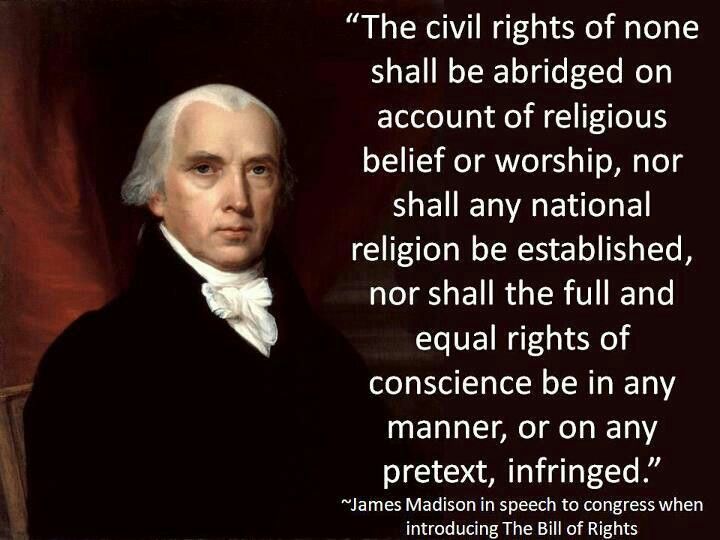
Not only is that quote genuine, but he kept going...
“The people shall not be deprived or abridged of their right to speak, to write, or to publish their sentiments; and the freedom of the press, as one of the great bulwarks of liberty, shall be inviolable. The people shall not be restrained from peaceably assembling and consulting for their common good; nor from applying to the legislature by petitions, or remonstrances for redress of their grievances.”
The GOAT Turbo Manlet, @Islam Imamate.
- Joined
- Feb 26, 2008
- Messages
- 15,517
- Reaction score
- 16,675
I don’t think that’s possible without impeaching justices, but, honestly, I’m not sure. If Congress voted to remove seats, who gets removed? And when? Like, when they retire the seat doesn’t get filled? I have no idea.Instead of adding justices, why couldn't they remove 4?
Similar threads

- Replies
- 411
- Views
- 4K

- Replies
- 125
- Views
- 3K


