• Xenforo Cloud is upgrading us to version 2.3.8 on Monday February 16th, 2026 at 12:00 AM PST. Expect a temporary downtime during this process. More info here

Elections Official Joe Biden Sundowning Megathread


Exactly what is the government supposed to do about higher rates of hiv in the black community or any community for that matter? Is personal responsibility a oppressive construct developed the conspiratorial patriarchy?
 
Not a direct quote from Biden, but it's a hilarious article about how the people who spent years pushing him as the best option to beat Trump have slowly realized how badly they fucked up.


How is this imbecile still leading the polls?
 
Lmao. Biden has lost it, 100% senile. It would almost be worth it for him to win the nomination so millions of people can watch his gaffes live during the debates with Trump. As it stands it's him or Pocanhontas, holy shit you guys are screwed.
 
When they tested rats in what would be considered an affluent environment even the worst of the worst outperformed the best rats in an environment that was akin to being low class. Even when they tested good genetics within the same parameters the rule still holds true. I wouldn't chalk it up to white privilege but rather to the luck of the draw.
<TrumpWrong1>
How Unequal School Funding Punishes Poor Kids
"School funding levels, according to the analysis of the Education Law Center and the Rutgers Graduate School of Education , vary most dramatically along school-district lines, generally dictated by local property taxes, which renders the education of some wealthy children funded at double the rate of a poor kid’s. There are also stark disparities across state lines, with statehouses primarily managing education policy. Fifteen years after “No Child Left Behind” promised to “close the achievement gaps” in race and socioeconomic background, children in more than one-third of the states are not just stagnating, they’re sliding backward with what the ELC calls “regressive” funding. In 17 states, including relatively affluent Connecticut and Maine, the school systems “provide less funding to their higher poverty school districts, even though students in these districts require more resources to achieve.” In many states, including Michigan and Arizona, poor kids are priced out of educational equity: “only the lowest-poverty districts have sufficient funding to reach national average student achievement outcomes.”"

And segregation by economic class is even more punishing:
The Racial Achievement Gap, Segregated Schools, and Segregated Neighborhoods – A Constitutional Insult
In schools with high proportions of disadvantaged children,

  • Remediation becomes the norm, and teachers have little time to challenge those exceptional students who can overcome personal, family, and community hardships that typically interfere with learning.
  • In schools with high rates of student mobility, teachers spend more time repeating lessons for newcomers, and have fewer opportunities to adapt instruction to students’ individual strengths and weaknesses.
  • When classrooms fill with students who come to school less ready to learn, teachers must focus more on discipline and less on learning.
  • Children in impoverished neighborhoods are surrounded by more crime and violence and suffer from greater stress that interferes with learning (Buka, Stichick, Birdthistle, & Earls, 2001; Burdick-Will et al., 2010; Farah et al., 2006).
  • Children with less exposure to mainstream society are less familiar with the standard English that’s necessary for their future success (Sampson, Sharkey, & Raudenbush, 2008).
  • When few parents have strong educations themselves, schools cannot benefit from parental pressure for higher quality curriculum, children have few college-educated role models to emulate and have few classroom peers whose own families set higher academic standards.
Sharkey finds that young African Americans (from 13 to 28 years old) are now ten times as likely to live in poor neighborhoods, defined in this way, as young whites—66 percent of African Americans, compared to 6 percent of whites (Sharkey, 2013, p. 27, Fig. 2.1). What’s more, for black families, mobility out of such neighborhoods is much more limited than for whites. Sharkey shows that 67 percent of African American families hailing from the poorest quarter of neighborhoods a generation ago continue to live in such neighborhoods today. But only 40 percent of white families who lived in the poorest quarter of neighborhoods a generation ago still do so (Sharkey, 2013, p. 38, Fig. 2.6).

Considering all black families, 48 percent have lived in poor neighborhoods over at least two generations, compared to 7 percent of white families (Sharkey, 2013, p. 39). If a child grows up in a poor neighborhood, moving up and out to a middle-class area is typical for whites but an aberration for blacks. Black neighborhood poverty is thus more multigenerational while white neighborhood poverty is more episodic; black children in low-income neighborhoods are more likely than others to have parents who also grew up in such neighborhoods.

The implications for children’s chances of success are dramatic: For academic performance, Sharkey uses a scale like the familiar IQ measure, where 100 is the mean and roughly 70 percent of children score about average, between 85 and 115. Using a survey that traces individuals and their offspring since 1968, Sharkey shows that children who come from middle-class (non-poor) neighborhoods and whose mothers also grew up in middle-class neighborhoods score an average of 104 on problem-solving tests. Children from poor neighborhoods whose mothers also grew up in poor neighborhoods score lower, an average of 96.

Sharkey’s truly startling finding, however, is this: Children in poor neighborhoods whose mothers grew up in middle-class neighborhoods score an average of 102, slightly above the mean and only slightly below the average scores of children whose families lived in middle-class neighborhoods for two generations. But children who live in middle-class neighborhoods—yet whose mothers grew up in poor neighborhoods—score an average of only 98 (Sharkey 2013, p. 130, Fig. 5.5.).

Sharkey concludes that “the parent’s environment during [her own] childhood may be more important than the child’s own environment.” He calculates that “living in poor neighborhoods over two consecutive generations reduces children’s cognitive skills by roughly eight or nine points … roughly equivalent to missing two to four years of schooling” (Sharkey 2013, pp. 129-131).

 
<TrumpWrong1>
How Unequal School Funding Punishes Poor Kids
"School funding levels, according to the analysis of the Education Law Center and the Rutgers Graduate School of Education , vary most dramatically along school-district lines, generally dictated by local property taxes, which renders the education of some wealthy children funded at double the rate of a poor kid’s. There are also stark disparities across state lines, with statehouses primarily managing education policy. Fifteen years after “No Child Left Behind” promised to “close the achievement gaps” in race and socioeconomic background, children in more than one-third of the states are not just stagnating, they’re sliding backward with what the ELC calls “regressive” funding. In 17 states, including relatively affluent Connecticut and Maine, the school systems “provide less funding to their higher poverty school districts, even though students in these districts require more resources to achieve.” In many states, including Michigan and Arizona, poor kids are priced out of educational equity: “only the lowest-poverty districts have sufficient funding to reach national average student achievement outcomes.”"

And segregation by economic class is even more punishing:
The Racial Achievement Gap, Segregated Schools, and Segregated Neighborhoods – A Constitutional Insult
In schools with high proportions of disadvantaged children,

  • Remediation becomes the norm, and teachers have little time to challenge those exceptional students who can overcome personal, family, and community hardships that typically interfere with learning.
  • In schools with high rates of student mobility, teachers spend more time repeating lessons for newcomers, and have fewer opportunities to adapt instruction to students’ individual strengths and weaknesses.
  • When classrooms fill with students who come to school less ready to learn, teachers must focus more on discipline and less on learning.
  • Children in impoverished neighborhoods are surrounded by more crime and violence and suffer from greater stress that interferes with learning (Buka, Stichick, Birdthistle, & Earls, 2001; Burdick-Will et al., 2010; Farah et al., 2006).
  • Children with less exposure to mainstream society are less familiar with the standard English that’s necessary for their future success (Sampson, Sharkey, & Raudenbush, 2008).
  • When few parents have strong educations themselves, schools cannot benefit from parental pressure for higher quality curriculum, children have few college-educated role models to emulate and have few classroom peers whose own families set higher academic standards.
Sharkey finds that young African Americans (from 13 to 28 years old) are now ten times as likely to live in poor neighborhoods, defined in this way, as young whites—66 percent of African Americans, compared to 6 percent of whites (Sharkey, 2013, p. 27, Fig. 2.1). What’s more, for black families, mobility out of such neighborhoods is much more limited than for whites. Sharkey shows that 67 percent of African American families hailing from the poorest quarter of neighborhoods a generation ago continue to live in such neighborhoods today. But only 40 percent of white families who lived in the poorest quarter of neighborhoods a generation ago still do so (Sharkey, 2013, p. 38, Fig. 2.6).

Considering all black families, 48 percent have lived in poor neighborhoods over at least two generations, compared to 7 percent of white families (Sharkey, 2013, p. 39). If a child grows up in a poor neighborhood, moving up and out to a middle-class area is typical for whites but an aberration for blacks. Black neighborhood poverty is thus more multigenerational while white neighborhood poverty is more episodic; black children in low-income neighborhoods are more likely than others to have parents who also grew up in such neighborhoods.

The implications for children’s chances of success are dramatic: For academic performance, Sharkey uses a scale like the familiar IQ measure, where 100 is the mean and roughly 70 percent of children score about average, between 85 and 115. Using a survey that traces individuals and their offspring since 1968, Sharkey shows that children who come from middle-class (non-poor) neighborhoods and whose mothers also grew up in middle-class neighborhoods score an average of 104 on problem-solving tests. Children from poor neighborhoods whose mothers also grew up in poor neighborhoods score lower, an average of 96.

Sharkey’s truly startling finding, however, is this: Children in poor neighborhoods whose mothers grew up in middle-class neighborhoods score an average of 102, slightly above the mean and only slightly below the average scores of children whose families lived in middle-class neighborhoods for two generations. But children who live in middle-class neighborhoods—yet whose mothers grew up in poor neighborhoods—score an average of only 98 (Sharkey 2013, p. 130, Fig. 5.5.).

Sharkey concludes that “the parent’s environment during [her own] childhood may be more important than the child’s own environment.” He calculates that “living in poor neighborhoods over two consecutive generations reduces children’s cognitive skills by roughly eight or nine points … roughly equivalent to missing two to four years of schooling” (Sharkey 2013, pp. 129-131).
I see we're well past that now. Effin' necrod threads. Biden wouldn't be my choice were I American, but I'd pick him after a debilitating stroke over Trump.
 
The first video posted in this thread isn’t offensive at all and is a big reason why Donald Fucking Trump has a good chance at re-election.

I’m not voting for Biden but come on.
 
tldr, thats just one big ass copy and paste , did I say kids? I said rats
You said the study was on rats, and then you extended it to humans when you said, "I wouldn't chalk it up to white privilege but rather to the luck of the draw."
 
Joe Biden is a complete looser.


giphy.gif
 
Biden calls Jair Bolsanaro, President of Brazil, "Boldesero" three separate times. Not as bad as when he created the word "expodentially" and said it five times in different settings.


Best Bolsonaro mispronunciation since Dave Rubin's.

 
45995

I'm a little bit creepy, old man by your side
I'm not one of those who can easily hide
I don't hand out candy, but boy if I did
I'd drive a van on the street you live

If I was a stalker, but, but then again, no
Or the man who looks in your windows on nights when you don't know
They say it's not much, but it's just what I do
My gift is my touch, and this one's for you

And now watches everybody my little wrong
It may be perverted, but now that it's done
I hope you don't mind
I hope you don't mind that I got on your nerves
How creepy my life is, cos I'm just a perv

I sat near by you and touched just a gloss
Well, a few of observers, well, they don't get too cross
But the crowd's been quite kind while I commit wrongs
But it's people like you that keep me turned on

So excuse me for touching, but these things I do
You see, I'm a frotteur, if they're teens or it's you
Anyway, the thing is, what I really mean
But yours are the sweetest thighs I've ever squeezed

And now watches everybody my little wrong
It may be perverted, but now that it's done
I hope you don't mind
I hope you don't mind that I got on your nerves
How creepy my life is, cos I'm just a perv

I hope you don't mind
I hope you don't mind that I got on your nerves
How creepy my life is, cos I'm just a perv
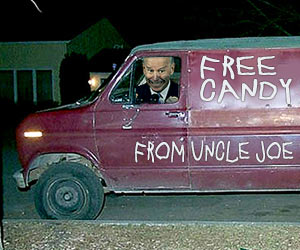
Free_Candy_Van_Biden_300.jpg
 
Back
Top