- Joined
- Nov 23, 2009
- Messages
- 1,338
- Reaction score
- 36
Why are you guys worried? You got nothing to hide right? #MAGA


Do you need the US government to go into grocery stores and tell them they must sell apples? No, because if a grocery store stopped selling apples people would just go to another.I don't understand why anyone would support dismantling net neutrality, aside from the telecom industry. It would be a huge loss for everyone.

Do you need the US government to go into grocery stores and tell them they must sell apples? No, because if a grocery store stopped selling apples people would just go to another.
If there is no good reason for a ISP to block a site, then why would they?
Note, under net neutrality an ISP might be unable to ban a site that is known to contain a bunch of viruses, because that simply wouldn't be neutral.
Also, net neutrality is 2 years old. The internet seemed to work fine before it was ever implemented.
I don't see why government intervention is necessary in this.
Because net neutrality hurts ISPs, of course. Just because something has money behind it doesn't mean it's because of corruption. The whole clean energy movement has tons of money behind it, does that mean it's because of corruption?Before I call you stupid, can I ask why you think the ISPs want to repeal net neutrality?
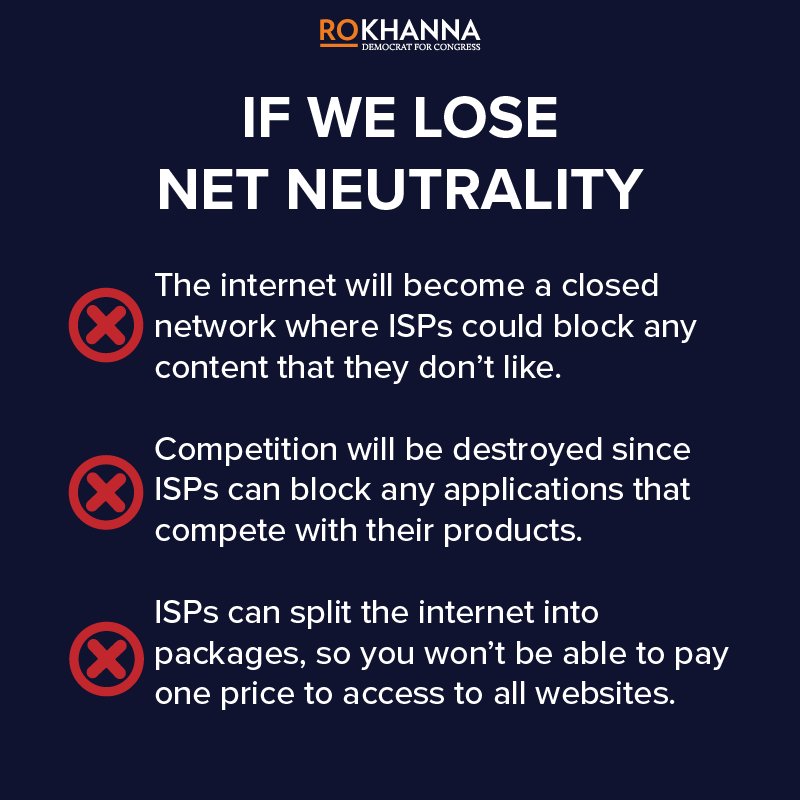
If you cant reach that conclusion then you are blind, so let me spell it out for you: Cable and ISPs are pissed about Netflix/Youtube/other streaming services/etc. This is nothing new nor is it even secret. For nearly a decade now, people have been leaving cable subscriptions in favor of streaming alternatives ("cut the cable" was a term being thrown around at least 5-6 years ago). In response the providers have been trying to create their own streaming competitors, but they all suck. Getting rid of Net Neutrality will let ISPs and cable companies slow down or block Netflix/YT/etc.. in favor of pushing their own service package.
You are being naïve if you think the government shouldn't step in here. It is not like another ISP can walk in and provide internet easily. Your local cable company owns the lines going through your entire neighborhood. I've lived in some areas where there was 1 cable option and 1 DSL option. Fiber is being rolled out, although very slowly. If you are lucky you have 3 ISP choices. Average is 2, and for many, we get a shitty option of 1 ISP.
Data caps is another way to implement control and push people back to cable subscriptions. My ISP just rolled out a data cap, and with a family of 5 we surpassed the cap the very first month.

Do you need the US government to go into grocery stores and tell them they must sell apples? No, because if a grocery store stopped selling apples people would just go to another.
.
If there is no good reason for a ISP to block a site, then why would they?
Note, under net neutrality an ISP might be unable to ban a site that is known to contain a bunch of viruses, because that simply wouldn't be neutral.
Also, net neutrality is 2 years old. The internet seemed to work fine before it was ever implemented.
I don't see why government intervention is necessary in this
Because it hurts them. Just because something hurts a company doesn't mean it's good for the users. In fact some times it means something bad for them.If the benevolent ISPs aren't planning on doing anything that violates net neutrality then why would they spend millions of dollars in lobbying to get rid of it?
Well we haven't really seen this apart from the Netflix and Youtube. Tell me why is it fair for Netflix to take 35% of the internet's traffic and pay the same as my blog that gets 1 view a year? Why is it different from a company using 35% of the electricity in the world and paying for the same as a single person? What differentiates internet bandwidth from electricity in this case?Because there is a good reason... money. An ISP could block sites that compete with their own offerings, or make exclusive deals with certain sites and agree to throttle or block traffic for competitors sites.
The only issues I've heard of are throttling of Youtube and Netflix, which are for very valid reasons. They are using an insane and unsustainable amount of bandwidth. Bandwidth is a limited resource, what is an alternative to throttling them? Giving some users bandwidth and other's none? Or pricing out users based on bandwidth usage?The internet has always been neutral since it started, net neutrality didn't start two years ago. What happened 2 years ago was ISPs tried to make the internet non-neutral, causing the government intervene. That's why Govt intervention is necessary at this point.
The reason the ISPs didn't try messing around with the neutrality of the internet from the get go is mainly because they didn't have the robust technology to monitor every bit of internet data like they do now.
Because it hurts them. Just because something hurts a company doesn't mean it's good for the users. In fact some times it means something bad for them.
Well we haven't really seen this apart from the Netflix and Youtube. Tell me why is it fair for Netflix to take 35% of the internet's traffic and pay the same as my blog that gets 1 view a year? Why is it different from a company using 35% of the electricity in the world and paying for the same as a single person? What differentiates internet bandwidth from electricity in this case?
The only issues I've heard of are throttling of Youtube and Netflix, which are for very valid reasons. They are using an insane and unsustainable amount of bandwidth. Bandwidth is a limited resource, what is an alternative to throttling them? Giving some users bandwidth and other's none? Or pricing out users based on bandwidth usage?
The only realistic thing I see net neutrality doing is ISPs will now have an asterisk beside their plans saying maximum peak usage, which some already do, as well as hurting small ISPs from entering the market and big ISPs from dealing with unreasonable demand.
Every ISP that I've looked at now says 'up to' or 'max' or has some additional text saying that during peak hours bandwidth might be lowered.These are not good reasons to do away with Net Neutrality. When you sign up for an internet service, you are paying your ISP money in exchange for bandwidth. The speed and price are agreed upon in a contract..... explain why they should care about what you are using that bandwidth for?

http://www.npr.org/sections/thetwo-...-begin-rollback-of-net-neutrality-regulations
Whelp, we lost. The only good thing Obama ever did has now been overturned. Time to bow down to Comcast. I wonder what this wil
NOTE FROM COMCAST: This forum post exceeds the maximum length of a forum post allowed to be viewed on your INTERNET BASIC package. Customers who upgrade to INTERNET PREMIUM are allowed to view forum posts up to 3000 characters! You can also pay a one time fee of $0.99 to view the rest of this post now.
Every ISP that I've looked at now says 'up to' or 'max' or has some additional text saying that during peak hours bandwidth might be lowered.
And I'm sure the contracts reflect the same statements.
Ok, so net neutrality will just make every ISP lower their proclaimed usage by 90%? What exactly does that solve?Most non-business contracts are like that, so that they can't be sued for breach of contract if the speeds are slightly below what they advertise (which is fine). But it doesn't say that they can throttle your bandwidth for certain sites, or block them entirely because they feel like it (which is what Net Neutrality prevents).
You pay them an agreed upon price, you get bandwidth at an agreed upon speed (roughly) and you use that bandwidth however you like. That's the way it has always been and I see no good for this to change, other than for ISPs to screw over the consumer.

Ok, so net neutrality will just make every ISP lower their proclaimed usage by 90%? What exactly does that solve?
The problem is a site like Netflix is using 35% of all the internet's bandwidth, but only paying for the same amount that a blog does. How is that fair? What if Netflix used 35% of global energy, should they pay the same amount as a regular household?

less corrupt than Trump.
Bandwidth from their server's to the ISPs, yes. But from the ISP's servers to the user they do not I believe.Where do you get this idea that Netflix is paying so little for bandwidth? You cant possibly believe they pay the same amount a blog does. A quick google search estimate 200-300mil a year.