History "Gun Dual Ediquett"?

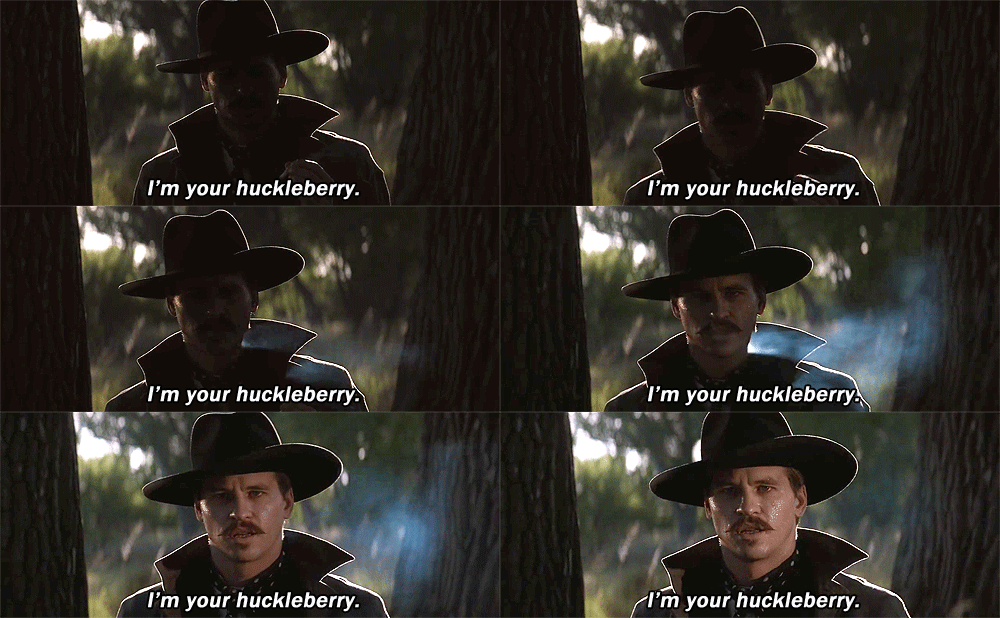
If you’re going to cheat in a duel you don’t shoot the guy in the back , you just send in a ringer and tell everyone you beat him fair and square
IMG_3653.gif
 
That's funny. We used this exact protocol on occasion growing up to ensure a fair fight.

That was some sort of mark of respect.

No one jumps in and it is a clean fight.

If you get whooped you get whooped,

the friends keep it from going too far

and then you shake hands (I guess sort of optional) and everyone goes their separate ways.

If all above is honored everyone leaves with respect including the person who lost the fight. And shit is squashed.


Decent system imo and probably been around for Hundreds of years or longer
True. Seems like an instinctual commonality with most guys at least, or it used to be anyway
 
Duels? Just hit the fucker in the head with a hammer when they piss you off.
 
True. It was for aristocrats, blue bloods, cultured gentiles like myself.
I prefer the old fashioned: burn his village to the ground, sack his castle, put his smallfolk to the sword and enslave his surviving family for barbarians such as myself.
 
True. Seems like an instinctual commonality with most guys at least, or it used to be anyway

I think because it really boils a conflict down to the lowest common denominator.

Witnesses are good to an extent, especially if you just want to ensure a fair fight.

Works in any language, country or time period.
 
If you’re going to cheat in a duel you don’t shoot the guy in the back , you just send in a ringer and tell everyone you beat him fair and square
View attachment 1128645

Make sure to deputize him first.

If you see a badge on a dead body then everyone knows that guy was a baddy and got what he deserved.
 
That ladies titties are longer than a Monday.
W6L6gwJ.gif


Would have a gun duel over them
 
That's funny. We used this exact protocol on occasion growing up to ensure a fair fight.

That was some sort of mark of respect.

No one jumps in and it is a clean fight.

If you get whooped you get whooped,

the friends keep it from going too far

and then you shake hands (I guess sort of optional) and everyone goes their separate ways.

If all above is honored everyone leaves with respect including the person who lost the fight. And shit is squashed.


Decent system imo and probably been around for Hundreds of years or longer
Best fight I ever saw in school had an enforcer for each side but wasn't needed. It was a proper fight, both guys knew how to box and once the other guy's nose broke he dropped to one knee and fight was over.

Smaller guy was actually lighting up the bigger one as he was faster but the big dude managed to land a strong jab and a few more punches and the other guy ended up looking like Arlovski when he had the broken nose. The enforcer for the guy who lost was actually a 20 year old brother of one of his friends, if he stepped in he would've destroyed the other guy. We were all expecting him to step in but everything was respectful thankfully.

1767659030796.png
 
Best fight I ever saw in school had an enforcer for each side but wasn't needed. It was a proper fight, both guys knew how to box and once the other guy's nose broke he dropped to one knee and fight was over.

Smaller guy was actually lighting up the bigger one as he was faster but the big dude managed to land a strong jab and a few more punches and the other guy ended up looking like Arlovski when he had the broken nose. The enforcer for the guy who lost was actually a 20 year old brother of one of his friends, if he stepped in he would've destroyed the other guy. We were all expecting him to step in but everything was respectful thankfully.

View attachment 1128668

As it should be

Fighting is stupid,
street fighting is retarded...

but


The way you conduct yourself in a fight says a LOT about the kind of person you are.

When the stakes are HIGH, can you maintain your dignity and honor the terms you agreed to or the generally accepted playground rules of a "fair fight" ?
 
That's funny. We used this exact protocol on occasion growing up to ensure a fair fight.

That was some sort of mark of respect.

No one jumps in and it is a clean fight.

If you get whooped you get whooped,

the friends keep it from going too far

and then you shake hands (I guess sort of optional) and everyone goes their separate ways.

If all above is honored everyone leaves with respect including the person who lost the fight. And shit is squashed.


Decent system imo and probably been around for Hundreds of years or longer
This. It wasn't about getting drunk and fighting in a bar or getting jumped and having to defend yourself....that's different.

But yes, if there was a problem and 2 people had beef and couldn't deal with it. They would meet outside and fight it out. There were usually enough other people around to keep it from going to far or to make sure it stopped if 1 person gave up or got TKOd.
Then usually whatever issues they had was done with. It was respect for stepping up and fighting for what you thought was right, or fighting a bully if you had enough of his teasing. It's not like they ended up being friends after a fight but whatever issues they had they usually let go.
 
The traditional situation that led to a duel often happened after a perceived offense, whether real or imagined, when one party would demand satisfaction from the offender.[68] The demand was commonly symbolized by an inescapably insulting gesture, such as throwing a glove to the ground before the offender.[69]

Usually, challenges were delivered in writing by one or more close friends who acted as "seconds". The challenge, written in formal language, laid out the real or imagined grievances and a demand for satisfaction. The challenged party then had the choice of accepting or refusing the challenge. Grounds for refusing the challenge could include that it was frivolous, or that the challenger was not generally recognized as a "gentleman" since dueling was limited to persons of equal social status. However, care had to be taken before declining a challenge, as it could result in accusations of cowardice or be perceived as an insult to the challenger's seconds if it was implied that they were acting on behalf of someone of low social standing. Participation in a duel could be honorably refused on account of a major difference in age between the parties and, to a lesser extent, in cases of social inferiority on the part of the challenger. Such inferiority had to be immediately obvious, however. As author Bertram Wyatt-Brown states, "with social distinctions often difficult to measure", most men could not escape on such grounds without the appearance of cowardice.[70]

Once a challenge was accepted, if not done already, both parties (known as "principals") would appoint trusted representatives to act as their seconds with no further direct communication between the principals being allowed until the dispute was settled. The seconds had a number of responsibilities, of which the first was to do all in their power to avert bloodshed provided their principal's honor was not compromised. This could involve back and forth correspondence about a mutually agreeable lesser course of action, such as a formal apology for the alleged offense.

In the event that the seconds failed to persuade their principals to avoid a fight, they then attempted to agree on terms for the duel that would limit the chance of a fatal outcome, consistent with the generally accepted guidelines for affairs of honor. The exact rules or etiquette for dueling varied by time and locale but were usually referred to as the code duello. In most cases, the challenged party had the choice of weapons, with swords being favored in many parts of continental Europe and pistols in the United States and Great Britain.

It was the job of the seconds to make all of the arrangements in advance, including how long the duel would last and what conditions would end the duel. Often sword duels were only fought until blood was drawn, thus severely limiting the likelihood of death or grave injury since a scratch could be considered as satisfying honor. In pistol duels, the number of shots to be permitted and the range were set out. Care was taken by the seconds to ensure the ground chosen gave no unfair advantage to either party. A doctor or surgeon was usually arranged to be on hand. Other things often arranged by the seconds could go into minute details that might seem odd in the modern world, such as the dress code (duels were often formal affairs), the number and names of any other witnesses to be present and whether or not refreshments would be served.[71]
 
A thought came to mind, and I can't find anything that shows "penalties". What happened if someone just said 'fuck it", and turned early to shoot the other guy in the back? (Honor/cowardice aside)

There's a book called Dueling in America a reprint of the book: The Field of Honor Major Ben C. Truman 1884 Hardcover History of Duelling.

The majority of gun duels, be it pistol, rifle, or shotgun started with the goons facing each other, guns lowered. Rise and fire at 3 count of the ref.

I can't remember any actual turn and fire duels in the like they show in movies. Maybe the turn n fire was made up, or quicklt dropped due to cheats?
 
Back
Top