• Xenforo Cloud is upgrading us to version 2.3.8 on Monday February 16th, 2026 at 12:00 AM PST. Expect a temporary downtime during this process. More info here

International Germany's Multicultural Experiment: 45% of Migrants Failed German Integration Courses

Europe's experiment with "Multiculturalism" rather than adopting North America's "Melting Pot" is...


  • Total voters
    285
German police reveal some footage from Cologne new years night.


That is past pathetic, just shameful.

If they tried to pull that shit in any nation east of germany they would have been beaten the fuck out of by the people. Cant imagine that shit happening where men still have balls.
 
That is past pathetic, just shameful.

If they tried to pull that shit in any nation east of germany they would have been beaten the fuck out of by the people. Cant imagine that shit happening where men still have balls.

That would be suicide.
 
Germany to invest 150 Million euros in 'voluntary return' incentives for asylum seekers
By Ben Knight
Dec 9, 2016

18672411_303.jpg

The German government has come up with a new way to remove as many asylum seekers from the country as possible. The Development Ministry is to invest some 150 million euros ($161 million) in a new program to encourage asylum seekers to return home.

"We're going to make 50 million euros available every year for the return program," Development Minister Gerd Müller told the "Augsburger Allgemeine" newspaper. The program, entitled "Perspektive Heimat" (literally: "prospect home"), is to be aimed at immigrants who are considered to have no chance of receiving asylum under Germany's immigration laws, which have been tightened by Angela Merkel's government in a series of legal packages over the past year.

The ministry's plan, outlined in a document revealed to the paper, argues that many people from Iraq, Afghanistan and the Balkan regions have shown a willingness to return voluntarily. The money is supposed to give them the security to show that "Germany will remain their reliable partner after their return and make a new start easier," Müller said.

"We can offer education, training, jobs, and existential support," he added. "The refugees won't be returning as losers."

Reluctant returnees

The minister also promised that the program would be cheaper than long asylum procedures in Germany. "We have to approach these people in our own interests, instead of being stuck for years in our procedural bureaucracy," he said.

Günter Burkhardt, director of refugee rights organization Pro Asyl, called the ministry's plans a "placebo" that was mainly aimed at the "voters in Müller's home state of Bavaria."

"If we're talking about Afghanistan, where there is armed conflict in 31 out of 34 provinces - if people return there they will find themselves in a destroyed country where several hundred thousand people are also currently being forced to return from Pakistan and Iran," he told DW.

"So the first question is safety, the second question is how are they supposed to reach the safe areas? And when they get there, the third question is how are they supposed to make a living? Also, an area that is safe today is not safe tomorrow," he added.

The ministry itself was reluctant to add any more details on Friday, since the program is only due to be formally presented next week, but a spokesman underlined that it would not only be a development ministry program - but would be organized along with other institutions. "It's all things that are still in discussion," a spokesman told DW.

The German government has already set up centers in other nations - in Albania, Serbia, and Kosovo - which offer information about legal migration opportunities and job training and education. "These information centers do already exist, but that is going to be expanded, especially in countries in Africa, for example," the development ministry spokesman said.

Previous efforts

"There are a whole set of people who have no possibility of gaining asylum status here," the spokesman added. "For these people there is an offer of support. And what our ministry does is to make people offers in their own countries. There are job training schemes in Egypt or in other African countries."

"It leaves a bitter taste - they're trying to throw sand in the eyes of people using money," Burkhardt said, before pointing out the increased dangers that returnees often face. "Now Müller is saying, 'it's about education, training, and jobs,' the threat situation is being completely ignored."

Burkhardt also accused the government of "blackmailing" developing countries by using development aid to force them to take people back. The few hundred euros that voluntary returnees might get, meanwhile, will "hardly be enough for most of them to start a new life back home."

Voluntary returns are the easiest way for Germany to get rid of asylum seekers, since deportations and redistribution programs around Europe's Schengen area - as stipulated in the Dublin regulations - rely on more complex international agreements.

According to figures from the Federal Office for Migration and Refugees (BAMF) and published in "Die Welt" newspaper, Germany made 40,000 Schengen applications between January and September this year, but only 2,860 people could be moved.

http://www.dw.com/en/germany-to-offer-voluntary-return-incentives-for-asylum-seekers/a-36711850
 
Last edited:
Won't work. They need to try harder.

It's good they are acknowledging the problem though
 
Won't work. They need to try harder.

It's good they are acknowledging the problem though

Well, it's either offering cash incentive or lengthly and forceful deportation for those who don't meet the criterias for asylum.

They're certainly realizing the insanity of letting anyone and everyone in first, process and disqualify later.

A bit late now though.
 
So if a migrant can't get asylum and welfare, the German government will give him go-away money and benefits. That's not going to make them want to stop coming, they win regardless of what happens.
 
Another example of Merkel displaying lack of foresight and exposing why she should be thrown out of office. Trying to patch things after third-worlders are inside.

German police reveal some footage from Cologne new years night.


As I thought they let all the shithead immigrants off the hook.
 
So if a migrant can't get asylum and welfare, the German government will give him go-away money and benefits. That's not going to make them want to stop coming, they win regardless of what happens.

one hell of a scam, to think germans can be so stupid or just plain full of shit.
 
Another example of Merkel displaying lack of foresight and exposing why she should be thrown out of office. Trying to patch things after third-worlders are inside.


As I thought they let all the shithead immigrants off the hook.
It pisses me off. The German politicians should be ashamed of themselves.
 
German politicians demand new deportation centers, more police powers and re-vetting of migrants
By Anthony Faiola
January 10, 2016

630288744-3745.jpg

Security and rescue workers in Berlin tend to the damaged area one day after a truck plowed through a Christmas market on Dec. 19.


BERLIN — Germany became an asylum seeker’s utopia, a beacon of hope for the war-weary and desperate. But following a string of terrorist attacks including last month’s strike on a Christmas market here, this nation is weighing tough changes to an asylum system that critics say has exposed millions of Germans to risk.

At a time when the incoming administration of President-elect Donald Trump has pledged a migrant crackdown in the United States, the moves in Western Europe’s most populous nation signal a harder line also forming on this side of the Atlantic.

Chancellor Angela Merkel, sniped at by Trump for welcoming the mostly Muslim migrants, remains opposed to some of the strictest proposals, including renewed pressure to set a firm cap on new asylum seekers, who are still arriving at a rate of several hundred per day. But in an election year in which Merkel’s refugee stance has become her Achilles’ heel, she and her top allies are accelerating a push for reform.

“You cannot apodictically separate security and asylum policy,” said Stephan Mayer, a senior German lawmaker from the center-right Christian Social Union. Referring to Christmas market attacker Anis Amri, a 24-year-old Tunisian asylum seeker, Mayer added: “Amri came to Germany disguised as a refugee. The more people come here, the more likely it is that there is going to be a villain among them.”

Proposals being discussed by Merkel’s cabinet could give German authorities more power to detain or slap ankle bracelets on rejected asylum seekers who are deemed security threats. New “repatriation centers” could also corral rejected asylum seekers in clearinghouses near airports to better ensure their ejection from Germany.

Developing nations that refuse to take their nationals back could also face cuts in foreign aid. Among the most radical proposals: a massive effort to reexamine the backgrounds of the roughly 1.2 million asylum seekers who arrived in Germany since 2015 — a large number of whom, critics say, were never thoroughly vetted.

The proposals are in response to three terrorist attacks last year in Germany involving militants who posed as asylum seekers, as well as the arrest of more than a dozen asylum seekers linked to suspected plots. But refugee advocates are deeply alarmed, arguing that proposals such as nationwide deportation centers could violate the human rights of innocent refugees.

“The question is, who do they want to send there?” said Stephan Dünnwald, spokesman for the Bavarian Refugee Council. “We currently have 160,000 people in Germany whose asylum requests have been rejected. . . . Do they want to build camps for 160,000 people? They should consider whether putting 160,000 people in camps doesn’t mean taking big steps towards a Nazi state again.”

Most of the proposals still require political deals before being set down into draft bills, as well as parliamentary approval. Still others, analysts warn, may be hard to impose even if consensus is reached.

Yet the clamor for change is growing, and Merkel has indicated a willingness to back a number of the measures.

“Those who do not have a right to stay must be returned to their home countries,” she said this week.

Her conservative allies in Bavaria have been pressing the chancellor especially to curb new arrivals. They ramped up calls on Tuesday, unveiling a proposal that includes a higher bar for family reunions that could make it significantly harder for families separated by war to reunite.

Yet the question in Germany now is not only how to manage migrants but how and whether to improve domestic security. Two days after the Dec. 19 Berlin Christmas market attack, the German government backed a bill aimed at expanding video surveillance in public spaces, including shopping centers, stadiums, parking lots and public transportation. The bill also would give federal police expanded power to use body cameras and automatic systems for reading license plates and to record emergency calls.

The plan had been in the pipeline for months, but the government pushed through an announcement of the measure shortly after the attack.

In an article for Frankfurter Allgemeine newspaper, Interior Minister Thomas de Maizière called for a stronger centralization of German security agencies and an expansion of powers for federal police. It is raising the prospect of a beefed-up state security apparatus in Germany, a notion long considered anathema in a nation with dark memories of the Cold War and the Nazi era.

“We owe it to the victims, those affected and the entire population to rethink our entire migration and security policy,” Bavaria’s governor, Horst Seehofer, recently said.

In 2015, Merkel famously declared that the right to asylum in Germany had “no limit”; critics say that prompted an even greater number of migrants to race to Germany or die trying.

Yet the Germans have since sought to stem the tide. In early 2016, Merkel brokered a deal with Turkey to block migrants attempting to enter Europe. German authorities are also working with neighboring nations to make it harder for irregular migrants to cross into Germany, where generous refugee benefits serve as a magnet for hundreds of thousands of would-be refugees.

Once migrants are here, laws and policies protecting their rights make it relatively hard for the Germans to expel those who are rejected. Several of the new measures being discussed are meant to plug what critics see as dangerous holes in the system.

The Berlin Christmas market attacker, for instance, was a rejected Tunisian asylum seeker with deportation orders who was long suspected by authorities of being a terrorism threat. Efforts to deport him, however, were stalled for months because Tunisia refused to take him back. Meanwhile, officials say, they never had enough evidence to detain him under current German law.

A legal change being discussed by Merkel’s cabinet, officials say, would grant authorities broader powers to detain rejected asylum seekers who are deemed potential terrorism threats for up to 18 months. There are 62 such people currently in Germany.

Arguing that too little is known about the wave of newcomers and that many of them received substandard checks, Gerd Müller, Merkel’s development minister, is also pushing to review all asylum seekers who have arrived in Germany since 2015.

Yet German authorities have a backlog of hundreds of thousands of applications waiting to be processed. In the short term, critics ague, it may be technically impossible to rapidly redo hundreds of thousands more.

More likely, they say, would be another look by authorities at the thousands of asylum applications that were remotely approved without in-person interviews, a process that could still take months, even years, to carry out.

“I think it’s all a reaction to the Berlin massacre,” said Dietrich Thränhardt, a migration expert at Münster University. “It’s an election year, and everybody wants to prove that he has some idea for solving the situation.”

https://www.washingtonpost.com/worl...502d6751bc8_story.html?utm_term=.e5d0ff65065f

 
Last edited:
The idea that the well being of some foreigners is more valuable than you own people is disgusting.

Honestly, they should see one German life as greater than 1,000,000 refugees.
 
"In 2015, Merkel famously declared that the right to asylum in Germany had “no limit”; critics say that prompted an even greater number of migrants to race to Germany or die trying. "

Idiotic, and downright irresponsible. Man, this woman pisses me off.
 
165 to 10??? Damn this poll is the most lop-sided I've ever seen.
 
"In 2015, Merkel famously declared that the right to asylum in Germany had “no limit”; critics say that prompted an even greater number of migrants to race to Germany or die trying. "

Idiotic, and downright irresponsible. Man, this woman pisses me off.

I still don't see any German politicians presenting a viable solution to a problem we brought up in the beginning of the thread: What are they gonna do with the hundred of thousand of failed asylum seekers when their country of origin simply refuses to take them back?
 
I still don't see any German politicians presenting a viable solution to a problem we brought up in the beginning of the thread: What are they gonna do with the hundred of thousand of failed asylum seekers when their country of origin simply refuse to take them back?

Easy, force them back to the country they first entered as a rapefuge. So Greece Italy whatever.
 
Easy, force them back to the country they first entered as a rapefuge. So Greece Italy whatever.

That's just dirty, man.

Greece and Italy didn't invite all these vulnerable women and children to come, Merkel did.

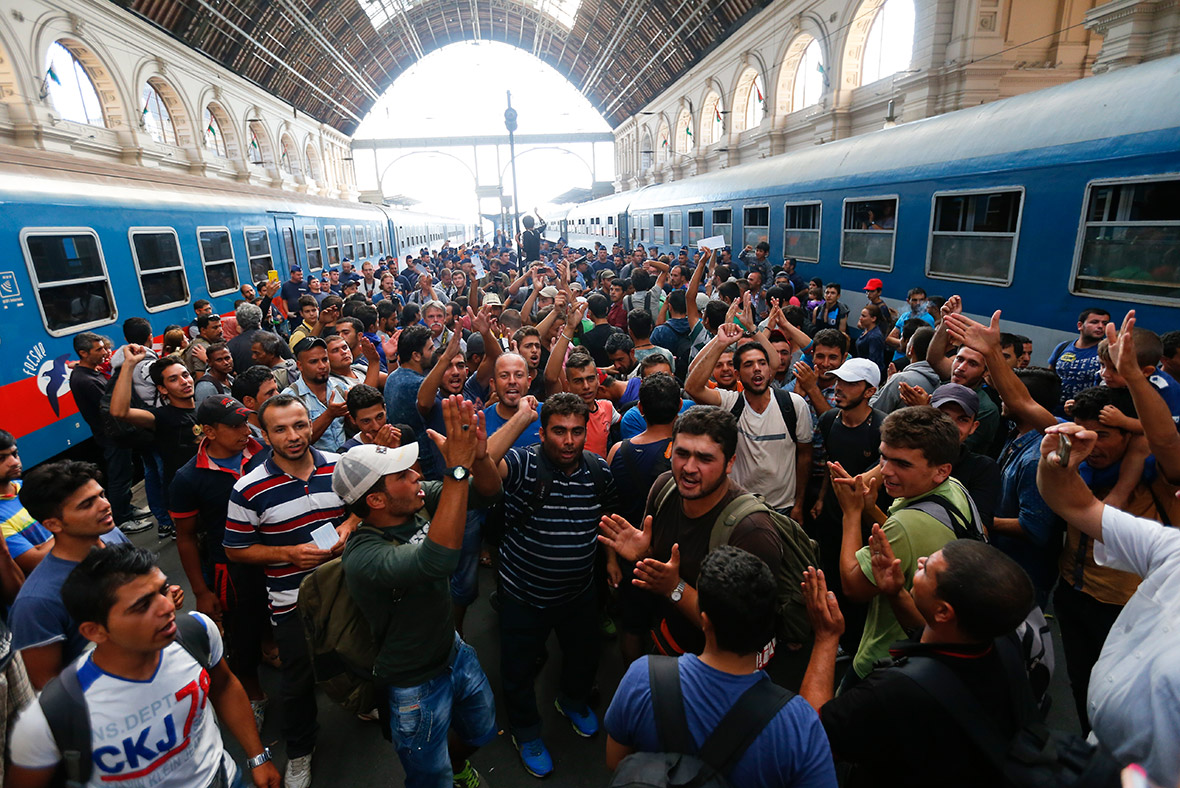
migrants-hungary-austria-germany.jpg
 
I still don't see any German politicians presenting a viable solution to a problem we brought up in the beginning of the thread: What are they gonna do with the hundred of thousand of failed asylum seekers when their country of origin simply refuses to take them back?
They're still trying to figure out how to stuff that damned genie back into the bottle. They should have an answer aaany day now.....

I have no suggestions. Perhaps the threath of withholding aid might work? Unfortunately some of these migrants are unidentifiable. As of now, the best they can do is warehouse these folks in open camps. That's right folks, they aren't allowed to restrict their movements by law. Frustrating situation, and one where the blame can be laid squarely at the Mad Cows feet.
 
Easy, force them back to the country they first entered as a rapefuge. So Greece Italy whatever.
Vikto Orbán is a grade A asshole, but he's not letting any of them back into Hungary. And I don't blame him.
 
They're still trying to figure out how to stuff that damned genie back into the bottle. They should have an answer aaany day now.....

I have no suggestions. Perhaps the threath of withholding aid might work? Unfortunately some of these migrants are unidentifiable. As of now, the best they can do is warehouse these folks in open camps. That's right folks, they aren't allowed to restrict their movements by law. Frustrating situation, and one where the blame can be laid squarely at the Mad Cows feet.

I think Merkel also discount this crucial detail when she opened that gate to Europe wide-open: the hundred thousands of frustrated and unidentifiable young Muslim males currently stuck in Europe with nowhere else to go are prime recruitment target by terror cells.

It would not surprise me if future terrorist attacks on German/European soils will be committed by failed asylum seekers that they're unable to deport who eventually got honeypotted by the tales of the 72 virgins.
 
Back
Top