Tech Gaming Hardware discussion (& Hardware Sales) thread

Can you or @Madmick or both :) kind of synthesize all this for a fool like me?

When it comes to XTX vs. 4080, is the only advantage of the 4080 being in Ray Tracing?

And is ray tracing just "reflections" or is there more to it. Sorry for being so ignorant, but I wonder if Ray Tracing is just an over-rated marketing gimmick, kind of like when Sega use to talk about "Blast Processing" as making it superior to SNES.

Personally, when I see side-by-side comparison videos on youtube of things that show FPS differences between systems, and some times resolution differences, I can't even seem to tell a difference or know what I"m supposed to be seeing lol.

I guess at the end of the day I defer to your expert opinions, if you want a graphics Card for 3440 x 1440 individual gaming that is pretty future proof for the next 5 or so years, what's the recommendation? 4080 or XTX or wait for 4070? Budget wise I'm willing to spend, but I don't like throwing money away, so value matters to an extent (hence, I think a 4090 is excessive to my needs and just seems absurdly priced to me).

Also, does having a G-synch monitor alter the equation at all?
Any of these cards will do well at that resolution and will definitely carry you for 5 years. If you’re not in a rush then you could always wait and see what the 4070 can do. Looking at Nvidias pricing with the other two though it’s probably going to be a dollar for dollar downgrade from the 4080. It will be perfectly capable at 3440.

In no frills benchmarks ( no ray tracing or DLSS) the 7900xtx is slightly faster than the 4080.. at 200 bucks cheaper. You’ll have to decide if the frills are worth it for yourself though. There was also rumors that Nvidia might drop the price on the 4080.
 
5.2% of Pc users game at 4K and 4K+. 12.7% of Pc users game at 1440p. Those graphs are pointless for the majority of Pc gamers.

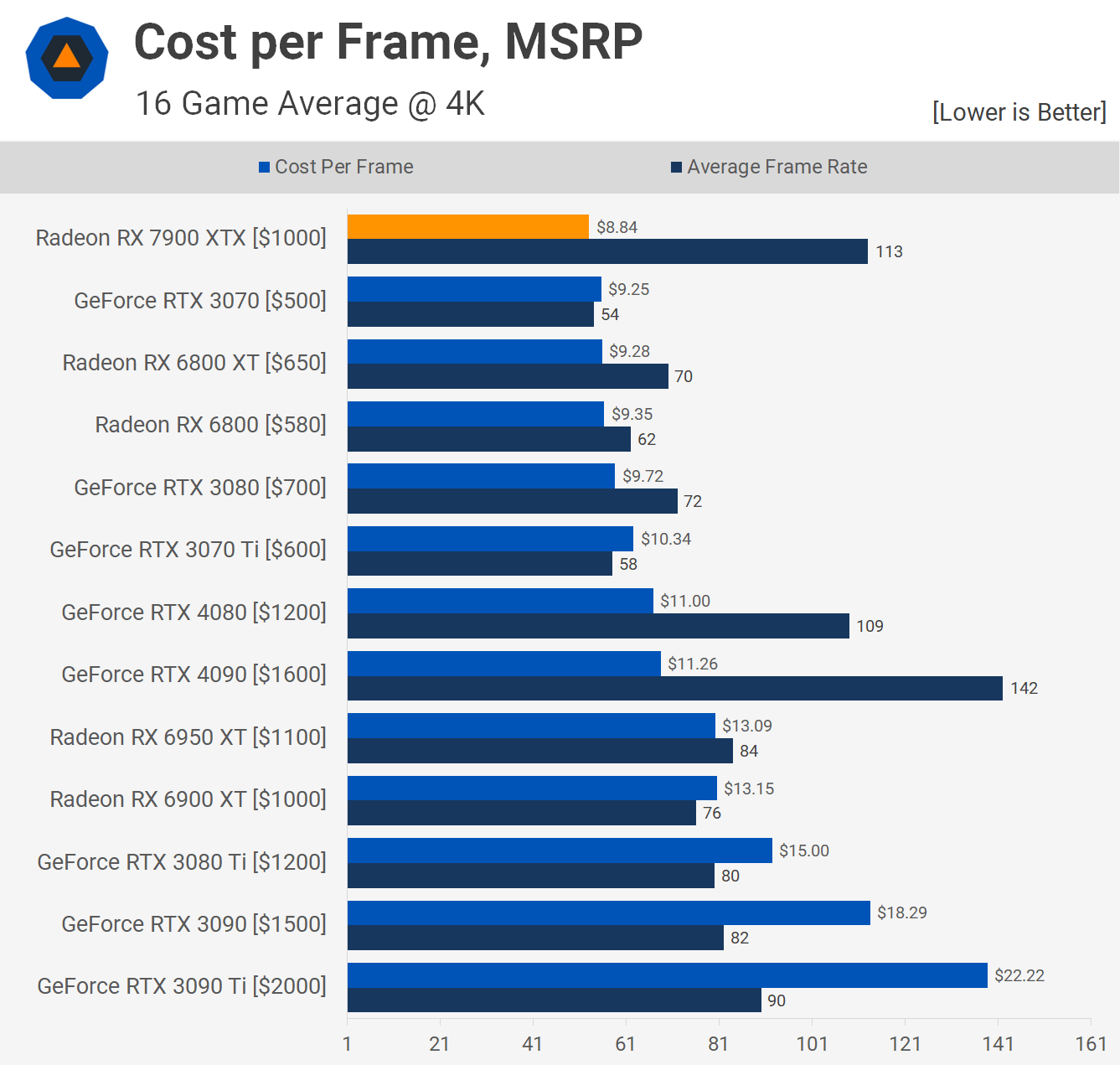
XTX operates on average 8% slower than the 4080. Its MSRP is exactly where it should be.
You're so full of shit, and I'm calling your bullshit. Produce one benchmarker who shows the 4080 beating the 7900 XTX by an 8% average across their suite of tested games at 1080p.

So tired of your disingenuous insistence that you're not an NVIDIA fanboy. You're a poster boy example.

Gamers Nexus.
You insufferable, lying, moronic fanboy.

Gamers Nexus only tested a single game at 1080p, and the 7900 XTX won. For the other nine games they tested, including their three ray-tracing benchmarks, they didn't even bother to bench 1080p since it's obviously an irrelevant resolution for these cards, and gamers purchasing at this price point.

Gamers Nexus 7900 XTX vs. RTX 4080
257.5 vs. 254.1 = Total War: Warhammer 3

"The 7900 XTX, after looking at all that, it kicks NVIDIA in the ass for rasterization. At worst it's about equivalent."
 
I've never had a bad experience buying on Craigslist locally, but...

1BT1UlA.jpg


<{fry}>

If you do the deal, do it at the police station parking lot. That way your chances of getting jacked are much lower. If they refuse, then cut ties.

Christmastime = Robbin' Season.
 
Can you or @Madmick or both :) kind of synthesize all this for a fool like me?

When it comes to XTX vs. 4080, is the only advantage of the 4080 being in Ray Tracing?

And is ray tracing just "reflections" or is there more to it. Sorry for being so ignorant, but I wonder if Ray Tracing is just an over-rated marketing gimmick, kind of like when Sega use to talk about "Blast Processing" as making it superior to SNES.

Personally, when I see side-by-side comparison videos on youtube of things that show FPS differences between systems, and some times resolution differences, I can't even seem to tell a difference or know what I"m supposed to be seeing lol.

I guess at the end of the day I defer to your expert opinions, if you want a graphics Card for 3440 x 1440 individual gaming that is pretty future proof for the next 5 or so years, what's the recommendation? 4080 or XTX or wait for 4070? Budget wise I'm willing to spend, but I don't like throwing money away, so value matters to an extent (hence, I think a 4090 is excessive to my needs and just seems absurdly priced to me).

Also, does having a G-synch monitor alter the equation at all?
You've got it in a nutshell. That's what Steve Burke is conveying when he says the 7900 XTX still kicks NVIDIA's ass on rasterization.

Ray-tracing isn't exactly a gimmick (nor was "blast processing", btw, that was just stupid lingo) but it definitely isn't as important as rasterization. What matters most is frames per second. That's more obvious to the eye.

More realistic lighting is, in my experience, more something that you sort of feel. You'll play the game, and you'll sit there wondering, "Why does this look so real? Why does it look so good?" It's not as obvious why, but the reason it just looks good is because the light is acting more like it does in the real world. There is more than just reflections to ray-tracing. It's about treating a virtual environment's light as it exists and behaves in the real world: its sources, their strength, its reflections, how it bounces, how it scatters, how it is bent. Global illumination, ray-traced caustics, ray-traced shadows, screen space reflections, and ambient occlusion are key terms you can Google if you want to learn more about that.

The other reason ray-tracing hasn't yet shined is because games are only starting to really use it intelligently. This is going to change in the next few years now that you see all these Unreal Engine 5 games coming up (just look at how many games carry that UE5 label in their trailers in the upcoming games thread). Ironically, that's why NVIDIA outperforms AMD. The discrete hardware cores are an advantage, yes, but as I understand it, it's their software sophistication that is the real reason they're thumping AMD in the ray-tracing charts in these reviews. After all, there are 26% more acceleration units for ray-tracing in the 7900 XTX than discrete ray-tracing cores in the 4080. Software is huge, and AMD is playing catch-up. We just observed this with the release of the Intel GPUs which are performing a whopping 3 classes below where their raw rasterization capability should put them.

But yes, ray-tracing, like DLSS and FSR, shouldn't be the primary consideration when buying a GPU. Ancillary concerns. Just like the rest of NVIDIA's features (RTX Voice, NVIDIA Reflex, NVENC).

Buying Considerations
  • Primary: rasterization (i.e. framerate capability) is #1, easy, along with price, however that factors into the amount of rasterization you're getting. Also VRAM. Usually higher-end cards can't keep up by the time this is relevant, it's more a concern with lower-end cards that age out more quickly, but the VRAM is substantial. You either have enough, or you have crashes.
  • Secondary: noise, power consumption / PSU implications, and physical installation implications.
  • Tertiary, additional software features (ray-tracing, DLSS/FSR, RTX Voice, NVIDIA Reflex, NVENC or other assessments of performance that matter to streamers for stability and upload quality, etc). In several years ray-tracing may move up.

The reference 7900 XTX is clearly superior to the reference 4080 when it comes to rasterization and price. It has 24GB of VRAM compared to 16GB in the 4080. It's noticeably louder because it's hotter. That is a significant loss, so AIBs may become more attractive. It draws ~20W-30W more power, but that isn't really an issue. It's much easier to install. That is a win depending on your case/motherboard/setup. Obviously NVIDIA wins tertiary as it long has.

If you want the card that will get you higher framerates on a 3440x1440 setup, the 7900 XTX is the way to go.
 
Last edited:
Maybe at 1080p but otherwise no. That’s at like 250+fps. At 1440 and 4k it will not bottleneck.
Okay I'm dumb. Why would it bottleneck at 1080p but not at 1440p?

Just to clarify both my monitors are now HD, so I don't see myself ever going back to 1080p
 
Okay I'm dumb. Why would it bottleneck at 1080p but not at 1440p?

Just to clarify both my monitors are now HD, so I don't see myself ever going back to 1080p
At 1080 the 4090 is able to generate enough frames that now the cpu is having trouble keeping up. Even then it’s pretty small difference I think between the top CPUs.

Each step in resolution up from the puts more load on the gpu. The gpu isn’t able to render frames fast enough to challenge modern CPUs at 4k and 1440. If you look at 4k charts with CPUs, all the modern CPUs are within a few frames of each other. So if you’re playing at 4k, a $200 cpu is going to get you basically the same results as an $800 one.
 
You keep saying that, and it keeps being wrong.

24% superior as an a la carte assessment of value. Not a "reflection". It isn't mirroring NVIDIA. There is no equality.
Cost1.png

relative-performance_2560-1440.png
relative-performance_3840-2160.png


1440p and 4k charts are pointless. You should be posting 720p charts. 720p minimizes any CPU binding, to keep gaming performance assessment more pure. You know this.
 
:rolleyes: Not how corrollary scaling limiters work in benchmarks.

 
I don't think someone still brooding over a simple hardware value dispute from last week should be accusing anyone of immature behavior.
 
You've got it in a nutshell. That's what Steve Burke is conveying when he says the 7900 XTX still kicks NVIDIA's ass on rasterization.

Ray-tracing isn't exactly a gimmick (nor was "blast processing", btw, that was just stupid lingo) but it definitely isn't as important as rasterization. What matters most is frames per second. That's more obvious to the eye.

More realistic lighting is, in my experience, more something that you sort of feel. You'll play the game, and you'll sit there wondering, "Why does this look so real? Why does it look so good?" It's not as obvious why, but the reason it just looks good is because the light is acting more like it does in the real world. There is more than just reflections to ray-tracing. It's about treating a virtual environment's light as it exists and behaves in the real world: its sources, their strength, its reflections, how it bounces, how it scatters, how it is bent. Global illumination, ray-traced caustics, ray-traced shadows, screen space reflections, and ambient occlusion are key terms you can Google if you want to learn more about that.

The other reason ray-tracing hasn't yet shined is because games are only starting to really use it intelligently. This is going to change in the next few years now that you see all these Unreal Engine 5 games coming up (just look at how many games carry that UE5 label in their trailers in the upcoming games thread). Ironically, that's why NVIDIA outperforms AMD. The discrete hardware cores are an advantage, yes, but as I understand it, it's their software sophistication that is the real reason they're thumping AMD in the ray-tracing charts in these reviews. After all, there are 26% more acceleration units for ray-tracing in the 7900 XTX than discrete ray-tracing cores in the 4080. Software is huge, and AMD is playing catch-up. We just observed this with the release of the Intel GPUs which are performing a whopping 3 classes below where their raw rasterization capability should put them.

But yes, ray-tracing, like DLSS and FSR, shouldn't be the primary consideration when buying a GPU. Ancillary concerns. Just like the rest of NVIDIA's features (RTX Voice, NVIDIA Reflex, NVENC).

Buying Considerations
  • Primary: rasterization (i.e. framerate capability) is #1, easy, along with price, however that factors into the amount of rasterization you're getting. Also VRAM. Usually higher-end cards can't keep up by the time this is relevant, it's more a concern with lower-end cards that age out more quickly, but the VRAM is substantial. You either have enough, or you have crashes.
  • Secondary: noise, power consumption / PSU implications, and physical installation implications.
  • Tertiary, additional software features (ray-tracing, DLSS/FSR, RTX Voice, NVIDIA Reflex, NVENC or other assessments of performance that matter to streamers for stability and upload quality, etc). In several years ray-tracing may move up.

The reference 7900 XTX is clearly superior to the reference 4080 when it comes to rasterization and price. It has 24GB of VRAM compared to 16GB in the 4080. It's noticeably louder because it's hotter. That is a significant loss, so AIBs may become more attractive. It draws ~20W-30W more power, but that isn't really an issue. It's much easier to install. That is a win depending on your case/motherboard/setup. Obviously NVIDIA wins tertiary as it long has.

If you want the card that will get you higher framerates on a 3440x1440 setup, the 7900 XTX is the way to go.


really helpful, thank you
 
This is a cool vid, a lot of cool history here.

 
So 7900XTX sold out everywhere already. I'm lucky I am busy with travel til mid-Feb so won't upgrade til then, but this does make me soften my hate for Nvidia as of late.

If you make a product and can only physically manufacture at such a pace, I don't see why scalpers who had nothing to do with the R&D and production of the product should benefit versus Nvidia. So Nvidia setting scalper like prices initially isn't as egregious as I thought.
 
So 7900XTX sold out everywhere already. I'm lucky I am busy with travel til mid-Feb so won't upgrade til then, but this does make me soften my hate for Nvidia as of late.

If you make a product and can only physically manufacture at such a pace, I don't see why scalpers who had nothing to do with the R&D and production of the product should benefit versus Nvidia. So Nvidia setting scalper like prices initially isn't as egregious as I thought.
Nah, this happens with every release. Not just this generation. NVIDIA was no different.

All the 4090's and 4080's were sold out immediately after launch, too. Why do you think the average pricing for the cards on the market is still above the MSRP for each, respectively, two months after they launched? Don't buy the clickbait crap that gets posted here about scalpers not being able move their inventories. If that was true, if supply exceeded demand, prices would have dropped below MSRP already. Instead, Amazon and B&H and Best Buy and the AIC manufacturers themselves (ex. ASUS) are selling them above the launch price.

Just look at PCPP. Cheapest 4090 available from its tracked merchants is $1799 for this ASUS from ASUS directly-- $200 above MSRP:
https://pcpartpicker.com/product/rB...4090-24-gb-video-card-tuf-rtx4090-o24g-gaming
Meanwhile, there's only a single variant of the 4080 matching the $1199 MSRP, a Zotac, and only from Newegg, because everyone is avoiding Newegg in 2022:
https://pcpartpicker.com/product/J2...orce-rtx-4080-16-gb-video-card-zt-d40810d-10p

Stock issues abound for every variant of those cards if you peruse PCPP. This is a full two months after launch. It's way better than it was during the cryptoboom/pandemic with the last generation, but we're not seeing a paper launch from AMD like we have in the past. They're just struggling to keep up with demand because that's the status quo.
 
Nah, this happens with every release. Not just this generation. NVIDIA was no different.

All the 4090's and 4080's were sold out immediately after launch, too. Why do you think the average pricing for the cards on the market is still above the MSRP for each, respectively, two months after they launched? Don't buy the clickbait crap that gets posted here about scalpers not being able move their inventories. If that was true, if supply exceeded demand, prices would have dropped below MSRP already. Instead, Amazon and B&H and Best Buy and the AIC manufacturers themselves (ex. ASUS) are selling them above the launch price.

Just look at PCPP. Cheapest 4090 available from its tracked merchants is $1799 for this ASUS from ASUS directly-- $200 above MSRP:
https://pcpartpicker.com/product/rB...4090-24-gb-video-card-tuf-rtx4090-o24g-gaming
Meanwhile, there's only a single variant of the 4080 matching the $1199 MSRP, a Zotac, and only from Newegg, because everyone is avoiding Newegg in 2022:
https://pcpartpicker.com/product/J2...orce-rtx-4080-16-gb-video-card-zt-d40810d-10p

Stock issues abound for every variant of those cards if you peruse PCPP. This is a full two months after launch. It's way better than it was during the cryptoboom/pandemic with the last generation, but we're not seeing a paper launch from AMD like we have in the past. They're just struggling to keep up with demand because that's the status quo.
I haven’t seen many 4080 founders additions, but I e seen plenty of the partner cards going for their msrps. They’re just now drying up, but a quick look at Amazon and two of the partner cards are up for their normal prices. I believe it that they e had more trouble moving those due to the relatively bad value
 
I think they'll be more available next year. Everyone wants these cards for Christmas
 
Back
Top