Wow, slightly faster than a 2 year old card for the same price. This is not a good generation of GPUs. I guess that isn't a surprise in of itself since the 1000's were a great series, but the price Nvidia is charging for this is kind of offensive.
Wow I had seen murmurs of this but didn't know it was so bad. This is surprising since Nvidia is usually pretty reliable. What the hell is going on in the generation? I think they've gotten too comfortable with their control over the market. Hopefully AMD can get their shit together and force Nvidia to do better then this.The more we learn the more of a disaster the RTX launch turned out to be.
Tech headlines abound in the past few days covering the excellent investigative journalism of-- once again-- Steve Burke over at Gamer's Nexus. They found there are actually two different versions of the RTX 2070 being sold, and this explains the performance discrepancies being observed across the benchmark landscape, and it's the result of undeclared binning. This is observed in performance & thermal discrepancies between the EVGA RTX 2070 Ultra and the EVGA RTX 2070 Black. The latter runs considerably hotter at stock, about 10%, and achieves 3%-5% lower in game framerates:
NVIDIA's Secret GPU: TU106-400A vs. TU106-400 Benchmark (2070 XC Ultra Review)
It was bad enough that NVIDIA was already so quiet with the rollout about the change to the Founder's Edition cards as pre-overclocked for the first time (when those always served as incarnation of the reference blueprint).
Meanwhile, the RTX 2080 Ti is already suffering an inordinately high number of failures reported anecdotally (as on Reddit and the official NVIDIA forums) that could be linked to the Turing architecture itself. This has been reported across a dozen outlets now dating back to a Digital Trends article on October 29th, but Tom's Hardware has dug in with the finest comb:
Tom's Hardware > RTX 2080 Ti Owners Complain of Defects, Nvidia Responds (Update)
What is NVIDIA's solution to this, and the widespread dissatisfaction with the new line's value? Well, to cancel production of the GTX 1080 Ti, of course!
Report: Nvidia GTX 1080 Ti No Longer In Production, Supply Running Low
Hard to feel good about this company as a PC gamer, right now.
I think it's that they're so focused on the future of AR/VR and the self-driving car stuff that the gaming market (which has driven virtually all of this development with its money the past several decades) was overlooked.Wow I had seen murmurs of this but didn't know it was so bad. This is surprising since Nvidia is usually pretty reliable. What the hell is going on in the generation? I think they've gotten too comfortable with their control over the market. Hopefully AMD can get their shit together and force Nvidia to do better then this.
Hell given the ridiculous pricing of the 2000 series and the fact they shutting down production on the old line up, AMD Might be the way to go right now.
Ars Technica said:AMD today charted out its plans for the next few years of product development, with an array of new CPUs and GPUs in the development pipeline.
On the GPU front are two new datacenter-oriented GPUs...
On the CPU side of things, AMD talked extensively about the forthcoming Zen 2 architecture. The goal of the original Zen architecture was to get AMD, at the very least, competitive with what Intel had to offer. AMD knew that Zen would not take the performance lead from Intel, but the pricing and features of its chips made them nonetheless attractive, especially in workloads that highlighted certain shortcomings of Intel's parts (fewer memory channels, less I/O bandwidth). Zen 2 promises to be not merely competitive with Intel, but superior to it.
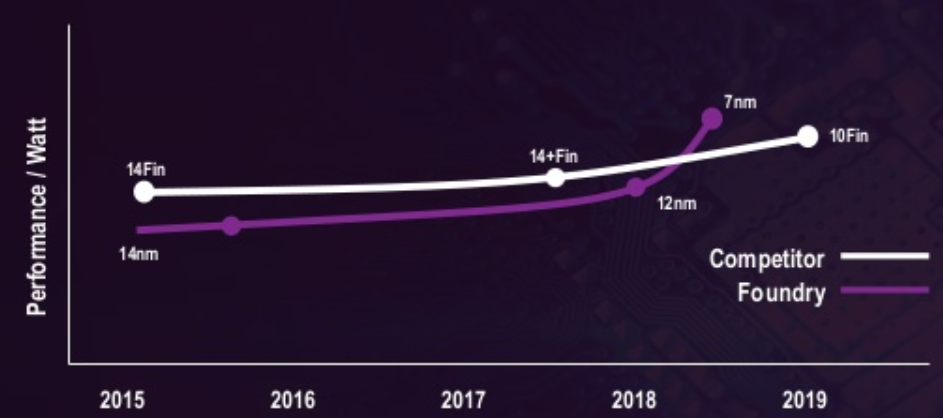
Enlarge / TSMC's 7nm process gives AMD the manufacturing advantage over Intel.
AMD
Key to this is TSMC's 7nm process, which offers twice the transistor density of the 14nm process the original Zen parts used. For the same performance level, power is reduced by about 50 percent, or, conversely, at the same power consumption, performance is increased by about 25 percent. TSMC's 14nm and 12nm processes both trail behind Intel's 14nm process in terms of performance per watt, but with 7nm, TSMC will take the lead.
Zen 2 will also address certain weak aspects of the original Zen. For example, the original Zen used 128-bit data paths to handle 256-bit AVX2 operations; each operation was split into two parts and processed sequentially. In workloads using AVX2, this gave Intel, with its native 256-bit implementation, a huge advantage. Zen 2 doubles the floating-point execution units and data paths to be 256-bit, doubling the bandwidth available and greatly improving the performance of this code. For integer workloads, branch prediction and prefetching have been made more accurate and some caches enlarged.
Zen 2 will also offer improved hardware protection against some variants of the Spectre attacks.
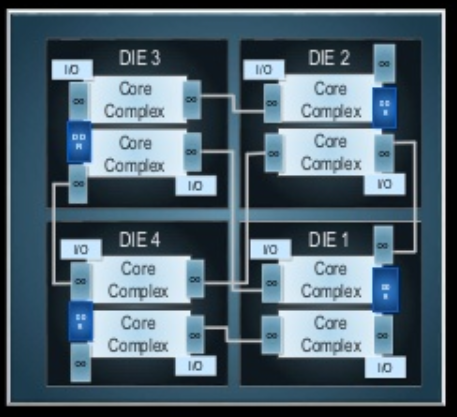
The original Zen used a multichip module design. Chips used one, two, or four dies (for Ryzen, first-generation Threadripper, and Epyc/second-generation Threadripper, respectively) all put together into a single package. Each die had two Core Complexes (blocks of four cores), two memory controllers, some Infinity Fabric links (for connections between dies), and some PCIe channels. This made it straightforward for AMD to scale from the single-die, 8-core/16-thread Ryzen up to the 32-core/64-thread Epyc.
![]()
The original Zen topology: each die has all the parts needed for a complete processor.
AMD
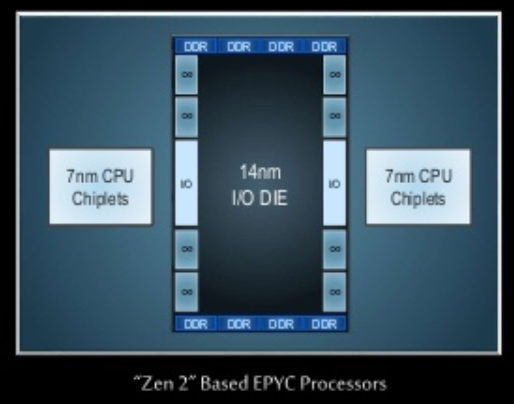
Zen 2 is taking a very different approach, albeit one that still uses a multichip design. Instead of having each die contain CPUs, memory controllers, and I/O, the new design splits up the different roles. There will be a single 14nm I/O die, with eight memory controllers, eight Infinity Fabric ports, and PCIe lanes, and then a number of 7nm "chiplets" containing only CPUs and Infinity Fabric. This new approach should remedy some of the more awkward aspects of the original Zen; for example, there is a significant latency overhead when a core on one Zen die has to use memory from another die. With the Zen 2 design, memory latency should become much more uniform.
![]()
The new Zen 2 design: common I/O functions are put on the 14nm I/O die, with the 7nm "chiplets" containing only CPUs.
AMD
AMD says that Zen 2 is sampling now, with processors due to hit the market in 2019. Zen 3, using an enhanced version of the 7nm process, is currently "on track" and likely to land in 2020, and Zen 4, on a more advanced process, is currently in the design stage.

The performance hit with Ray Tracing is much higher than I thought it would be. May as well just keep it off.
A 970 is still a very good 1080p 60fps high/ultra settings card. If you're running a 1080p 60fps monitor there's no reason to upgrade.It’s crap like this that makes it harder and harder to upgrade my old reliable 970.
980 ti’s are getting cheap used though. Probably need to offload the 970 while it’s still worth something.
1080p 144hz, But want to add a 1440p, 144hrz that matches my current monitors.A 970 is still a very good 1080p 60fps high/ultra settings card. If you're running a 1080p 60fps monitor there's no reason to upgrade.
I hear the new sega is going to have 16 bits!!!
HYPE!!!!
I recently purchased a 970 and I was surprised it still can hold 1080p 60fps considering it’s a 4 year old card.1080p 144hz, But want to add a 1440p, 144hrz that matches my current monitors.
I can normally run 80-90fps on planetside until it gets into hectic battles then it can Drop to high 50’s at times.
My main want for gpu upgrade will be for 1440p and alsonfor when doom eternal comes out.
But yes for now it’s hanging in there and why I’m not in a rush to upgrade it.
Yeah I love my microcenter it’s on the other side of town across downtown traffic about 25 miles away thankfully or I’d spend way to much money there.I recently purchased a 970 and I was surprised it still can hold 1080p 60fps considering it’s a 4 year old card.
Micro center has the 1700x for $139 if you live near one.
Why??I was gonna sell my 1080 Ti and "downgrade" to a 1070 but looks like I'll be holding on to it for now.
You can put the 1700x in your A320 mobo, you just won’t be able to over clock it.Yeah I love my microcenter it’s on the other side of town across downtown traffic about 25 miles away thankfully or I’d spend way to much money there.
There is a Best Buy a few miles from me and they never have crap and when they do it’s always more than micro center thankfully and I don’t buy and tell myself I’ll get it at microcenter later, what ever it is I’m looking at. And that saves me money by not buying anything lol.
I saw the 1700x prices dropping and have me rethinking the 2600 for the 1700x a while back but for some reason i was thinking the 2600 r5 did better then the 1700x.
I’ll have to go look at benchmarks again before I go purchase.
I only have an a320 mb, so I’ll be getting a new mb too.
And trying to decide if I want to keep it in this case or not. I like the small form factor and it looks good with my set up, but my mb config is limited.
It’s a micro atx
But i have a new in the box fractile mid tower case i bought that I was gonna build in but I’ve gotten to like this core v21 case for asthetics.
I plan on putting a aoi friend has a h60 I can get cheap.You can put the 1700x in your A320 mobo, you just won’t be able to over clock it.
The R5-2600 will have slightly higher clock speeds but you lose 2 cores/4 threads.
The 1700x doesn’t come with a cooler, so you’d need to buy one. The 2600 comes with a cooler as well but it doesn’t handle overclocking, stock speeds it’s fine.
A Cooler Master Hyper 212 is more than adequate for either chip.
Best Buy will price match micro center. Staples will price match as well.
Nvidia Corp.’s stock plummeted Friday for its worst one-day drop in more than a decade, as a disappointing earnings report cost the graphics-chip specialist more than $23 billion in market capitalization.
Nvidia NVDA, -18.76% shares closed down nearly 19% at $164.43 in heavy trading, and are now down 15% for the year. Shares closed at their lowest price since Sept. 8, 2017, when they finished at $163.69, and the company’s market capitalization finished the day just below $100 billion at $99.97 billion. The company’s market cap hit was worth more than its biggest rival in the graphics-processing unit business, Advanced Micro Devices Inc. AMD, -3.86% which closed Friday with a market cap of less than $21 billion.
This information has me revising my expectations for GPU prices following these excellent sales leading into Black Friday and Cyber Monday. The market landscape isn't anything like it was during the Holidays the past two years. The GTX 1080 Ti problem has dried up, but between the GTX 1060 glut and the renewed competition from the RX 590 I suspect we are going to see tremendously good prices through the end of the year.The oversupply specifically impacts Nvidia's GTX 1060 graphics cards, which could result in a delay in shipments of Nvidia's forthcoming Turing 2060 cards because Nvidia will surely wait for the existing stock to be liquidated before it floods the market with newer, faster video cards in the same price range.
AMD also released the RX 590 yesterday, which it designed specifically to compete with the GTX 1060. That could complicate matters for Nvidia as it tries to liquidate the excess inventory...
Nvidia's Jensen Huang summarized the excessive inventory of mid-range graphics cards, meaning the GTX 1060, as a byproduct of the blockchain/cryptomining crash. That's similar to AMD's recent earnings report that was impacted by poor demand after cryptocurrency-driven demand had dried up. Huang stated that the oversupply of mid-range graphics cards would take "one to two" quarters to clear up, which is similar to AMD CEO Lia Su's prediction of "several" quarters before the graphics card market returned to normal.