Tech Gaming Hardware discussion (& Hardware Sales) thread

The AI Max processors are in notebooks (elitebook as you noted) and the ROG gaming tablet (x13?). Cost and supply were big challenges, but also it was a chip with more design restraints than people realize.

It was a cool product but AMD kind of yeeted it out there and OEMs were like...ok what am I supposed to do with this processor.

I'd definitely recommend Computex, it's much easier to access and do stuff without being industry as compared to CES or MWC (the con food and floor design is much better too). It's also the Big Tech effect, companies prefer not having to share the spotlight and would rather do their own thing. CES only exists for wining and dining to close deals at whatever hotel floor companies buy out after the CTA shakes them down.

I will say though though CES 2025 is better than Computex 2024 as far as PC stuff.
I know a few of those Chinese OEMs put it in their min PCs which is kinda cool but they're way too expensive.

I don't normally watch the whole show, I just watch the recap vids from my tech subscriptions to see what they have. I remember it used to be more exciting.
 

This is an even bigger helping of the the same we got with Series 2. It seems like Intel is throwing the towel in on the desktop space. They have pushed all their chips in on energy efficiency, and robust iGPUs targeting gaming laptops, gaming handhelds, and office workers who want AI crap in their AIOs/laptops/MiniPCs.
05swDULMnXT9S982V4Glybx-3.fit_lim.size_768x.png
 
This is an even bigger helping of the the same we got with Series 2. It seems like Intel is throwing the towel in on the desktop space. They have pushed all their chips in on energy efficiency, and robust iGPUs targeting gaming laptops, gaming handhelds, and office workers who want AI crap in their AIOs/laptops/MiniPCs.
05swDULMnXT9S982V4Glybx-3.fit_lim.size_768x.png
What would you rather Intel do given their yield challenges and limited financial position?

Its not like they have production capacity they've chosen to not tap.
 
I know a few of those Chinese OEMs put it in their min PCs which is kinda cool but they're way too expensive.

I don't normally watch the whole show, I just watch the recap vids from my tech subscriptions to see what they have. I remember it used to be more exciting.
Yeah it's always difficult to get a read on the mini PC makers since they get supply here and there and don't sell much.

And I feel that, but PC is a very mature and commodified. It is what it is at this point.
 
Yeah it's always difficult to get a read on the mini PC makers since they get supply here and there and don't sell much.

And I feel that, but PC is a very mature and commodified. It is what it is at this point.
Well I'll be damned, ASUS put the Strix Halo on one of their laptops

 
Well I'll be damned, ASUS put the Strix Halo on one of their laptops


Yeah, checked it out today. Makes the decision to go panther lake for g14 and AMD for tuf even more interesting.

One of Asus' better recent lineups.
 
This was a bit of news I had not heard that Intel new SOC could support different manufacturers products. Tensortornet RISC-V TENSIX processor for AI training. Maybe even stuff for automation such Arduino UNO Q as a part of robotics and automation. It really does open the door for some interesting mix and match. I really don't know how far it could go but NVIDIA took a 5 billion dollar stake in the company.

 
So with the realization we will now be living in an effective desktop discrete-CPU monopoly under AMD, our attention turns to what to expect from Intel's Mini PC & handheld performance since they apparently believe this is the future of gaming.

Intel readies Core G3 Extreme and Core G3 “Panther Lake” chips for gaming handhelds, featuring 12 and 10 Xe3 GPU cores

Videocardz said:
Intel is preparing a Core G3 series aimed at gaming handhelds...Several companies are mentioned in the official presentation, including Acer, MSI, ONEXPLAYER, GPD, and Microsoft...

The Core G3 Series Specs
There are two chips, the Core G3 Extreme and Core G3, both said to use a 14-core CPU layout. The configuration is 2 P-cores, 8 E-cores, and 4 LP-cores. That points to Panther Lake rather than Wildcat Lake. The G3 Extreme has Arc B380 GPU (12 Xe3 cores) and G3 has Arc B360 (10 Xe3 cores).

In terms of clocks, the G3 Extreme goes up to 4.7 GHz (400 MHz slower than X9 388H) and Core G3 goes up to 4.6 GHz. In terms of GPU clocks, the B380 has 2.3 GHz clock and B360 has 2.2 GHz.
The B380 is apparently identical to the B390 that will be in laptops and Mini PCs, but with a lower GPU clock (2.3 GHz instead of 2.5 GHz). Can't calculate what the impact is to throughputs since they haven't shared detailed raster pipelines, but the next logical question, then, is what kind of performance to expect from the B390. You can see that below. The Core G3 Extreme will also have a lower CPU clock at that 4.7GHz than the 5.1GHz in the Ultra X9 388H tested below.

I did some quick and dirty testing of the Intel Arc B390 iGPU in Intel's new top-end Core Ultra chip and I'm pretty impressed

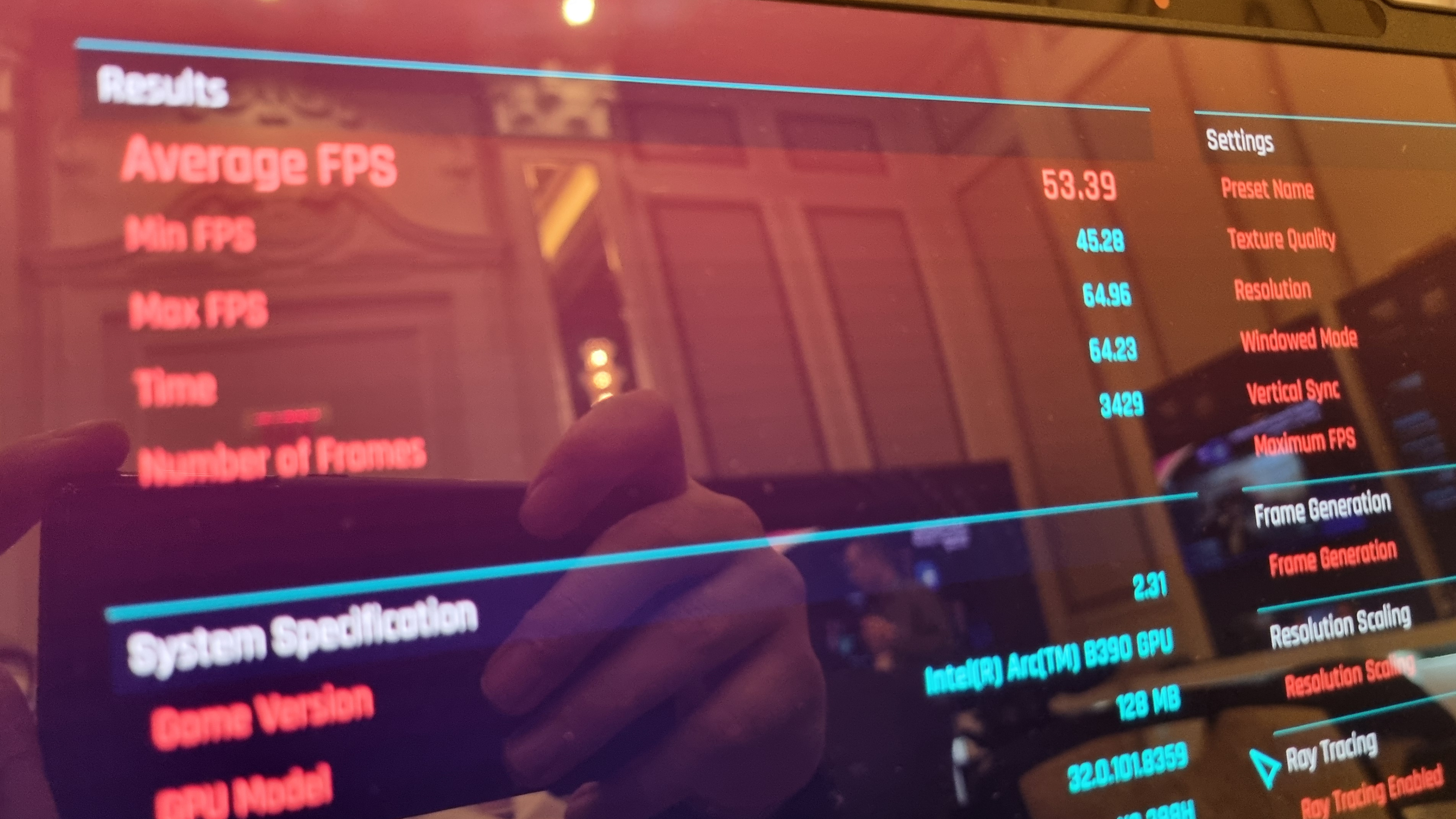
Still, I'm enough of an old hand to know exactly what game I was benching first—Cyberpunk 2077, of course. My test laptop was a non-descript Lenovo machine with an Intel Core Ultra X9 388H onboard, the top-end Panther Lake CPU from the new lineup...Intel says the Arc B390 is around 10% faster on average than an Nvidia RTX 4050...

High settings then, 1200p. No upscaling, no ray tracing. The result? A perfectly playable average of 53 fps.

Cyberpunk 2077 benches on an Intel Arc B390 iGPU

That's pretty impressive. For perspective, the Steam Deck can't even maintain an average of 25fps at 800p on Medium settings without any FSR.

The Intel Core G3 Extreme is obviously newer and will be much more expensive. It's more direct competition will be the current top chipset in handhelds, the AMD Ryzen AI 9 HX370, seen in the most expensive variants of the GPD Win 4 or OneXPlayer OneXFly F1 Pro, for example. Although probably the more prevalent nearest chipset is the AMD Ryzen AI Z2 Extreme seen in the ASUS ROG Xbox Ally X, or the non-AI version, seen in what is probably the best overall handheld in existence right now, the one that nobody can get because demand so outrageously paces supply, the Lenovo Legion Go 2. With the exception of the ROG Xbox Ally X handhelds that carry these are always well north of $1K (usually around $1300+).
 
Surprised no one posted about this abomination:

To be fair, Razer doing "lifestyle"/Razer things. Ava itself is old for them (CES 2025). Motoko is more interesting, even if it's odd.
So with the realization we will now be living in an effective desktop discrete-CPU monopoly under AMD, our attention turns to what to expect from Intel's Mini PC & handheld performance since they apparently believe this is the future of gaming.
So dramatic. Intel still has massive desktop CPU share and Nova Lake is a year out.

You're acting like chip design and production is magic and Intel should have devoted its extremely limited supply of 18A to gaming desktops for a design they don't have instead of laptops. Intel's 2025 lineup is based on decisions made years ago, it's not like Intel decided they don't care about gaming desktops.
 
So with the realization we will now be living in an effective desktop discrete-CPU monopoly under AMD, our attention turns to what to expect from Intel's Mini PC & handheld performance since they apparently believe this is the future of gaming.

Intel readies Core G3 Extreme and Core G3 “Panther Lake” chips for gaming handhelds, featuring 12 and 10 Xe3 GPU cores


The B380 is apparently identical to the B390 that will be in laptops and Mini PCs, but with a lower GPU clock (2.3 GHz instead of 2.5 GHz). Can't calculate what the impact is to throughputs since they haven't shared detailed raster pipelines, but the next logical question, then, is what kind of performance to expect from the B390. You can see that below. The Core G3 Extreme will also have a lower CPU clock at that 4.7GHz than the 5.1GHz in the Ultra X9 388H tested below.

I did some quick and dirty testing of the Intel Arc B390 iGPU in Intel's new top-end Core Ultra chip and I'm pretty impressed


That's pretty impressive. For perspective, the Steam Deck can't even maintain an average of 25fps at 800p on Medium settings without any FSR.

The Intel Core G3 Extreme is obviously newer and will be much more expensive. It's more direct competition will be the current top chipset in handhelds, the AMD Ryzen AI 9 HX370, seen in the most expensive variants of the GPD Win 4 or OneXPlayer OneXFly F1 Pro, for example. Although probably the more prevalent nearest chipset is the AMD Ryzen AI Z2 Extreme seen in the ASUS ROG Xbox Ally X, or the non-AI version, seen in what is probably the best overall handheld in existence right now, the one that nobody can get because demand so outrageously paces supply, the Lenovo Legion Go 2. With the exception of the ROG Xbox Ally X handhelds that carry these are always well north of $1K (usually around $1300+).
The main parameter for GPU or CPU is data conveyers productivity for bus.
Sometimes slower ( by GHz ) processors and GPUs might have more fast data magistrales bus and more conveyers with more pipelines for data flow.

Size and speed for L1, L2, L3 caches too matters a lot for processor productivity.
And for different usage is different stuff. Sometimes larger but slower caches are better, sometimes opposite and smaller but faster are better.
 
The main parameter for GPU or CPU is data conveyers productivity for bus.
Sometimes slower ( by GHz ) processors and GPUs might have more fast data magistrales bus and more conveyers with more pipelines for data flow.

Size and speed for L1, L2, L3 caches too matters a lot for processor productivity.
And for different usage is different stuff. Sometimes larger but slower caches are better, sometimes opposite and smaller but faster are better.
Why are you copy/pasting A.I. jargon?

I'm pretty sure everyone who frequents this forum is aware real world performance is more complicated than mere processor frequency. That's why I mentioned it's impossible to calculate throughputs for comparison until Intel publishes specs. Although even with those figures you don't know what the figures mean until the rubber hits the road. That's why reviewers test performance in apps and games.

The point I was driving there is it will be reasonable to expect the G3 Extreme will offer slightly inferior performance versus the Ultra X9 388H processor that the journalist benched. Otherwise, they're highly similar: 14 cores vs. 16 cores on the same Series 3 architecture on the CPU side, and apparently identical Xe3 architecture and core count/layout on the iGPU side. So, no, in this case, the frequency effectively does become the only meaningful difference. The only other significant factor will be the sustained power states.
 
Back
Top