
You are using an out of date browser. It may not display this or other websites correctly.
You should upgrade or use an alternative browser.
You should upgrade or use an alternative browser.
Deconstructing MMA Myths... [Part 23] - Cross-Trainin´ in MMA´s 'Dark Ages'...
- Thread starter gono btw
- Start date



- Joined
- Dec 7, 2006
- Messages
- 1,693
- Reaction score
- 0
You give alot examples of well rounded fighters from the beginning, and I do agree that not every fighter back then was one dimensional. The problem with that age, is the fact that their were alot of competitors that had no business stepping into a fight, that we dont really see in today's standards

- Joined
- Mar 2, 2018
- Messages
- 15,164
- Reaction score
- 1,742
Iz Normal.You give alot examples of well rounded fighters from the beginning, and I do agree that not every fighter back then was one dimensional. The problem with that age, is the fact that their were alot of competitors that had no business stepping into a fight, that we dont really see in today's standards
At the beginning, it´s more important for a rookie Org. to build a market/capture the audience, than to look for high level matches.
Fights like the Gordeau vs Tuli one are then more essential than [high level] chess matches.
https://forums.sherdog.com/threads/...art-18-the-genesis-of-ufc-1´s-roster.3855847/
- Joined
- Dec 7, 2006
- Messages
- 1,693
- Reaction score
- 0
I suppose with the teeth flying into the commentators laps, it definitely feed the "just bleed " crowd and adding more views down the road. But the Dutchman was dirty as hell, kicking out some teeth was childs play compared to other transgressions. For all the spectacle, the bouts of present day are for the most part light years ahead in technique and competitiveness of the earliest non vale tudo days. Aside from the few cross training athletes that were ahead of their time
- Joined
- Mar 2, 2018
- Messages
- 15,164
- Reaction score
- 1,742
hmmm...This thread is actually not a comparison between 2 eras, as explained ITT.I suppose with the teeth flying into the commentators laps, it definitely feed the "just bleed " crowd and adding more views down the road. But the Dutchman was dirty as hell, kicking out some teeth was childs play compared to other transgressions. For all the spectacle, the bouts of present day are for the most part light years ahead in technique and competitiveness of the earliest non vale tudo days. Aside from the few cross training athletes that were ahead of their time
- Joined
- Mar 2, 2018
- Messages
- 15,164
- Reaction score
- 1,742
> Russian NHB scene:
Bozigit Atajev [RTT]:
Sanshou / Sambo
https://forums.sherdog.com/threads/the-day-little-volk-forgot-to-grapple-in-rings-19.3878575/
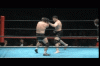

Bozigit Atajev [RTT]:
Sanshou / Sambo
https://forums.sherdog.com/threads/the-day-little-volk-forgot-to-grapple-in-rings-19.3878575/
Last edited:
- Joined
- Mar 2, 2018
- Messages
- 15,164
- Reaction score
- 1,742
> Brazilian Vale Tudo scene:
King of The Streets:

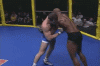
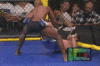
Marco Huas interview right before UFC 7 in Black Belt magazine (1995)
BB: When did you start in the Martial Arts?
MR: 13. At first I practiced Judo.
BB: Judo?
MR: Yes, because I was a coward. My father took me to a Judo academy. I soon got to love the fighting arts and have done various things.
BB: What other Martial Arts did you try?
MR: From 16, Tae Kwon Do and Capoeira. From 18, Muay Thai, Boxing, Wrestling, Jiu-Jitsu, and Luta Livre.
BB: Most Vale Tudo fighters know Jiu-Jitsu, but you know many other Martial Arts as well.
MR: Well, the Judo academy was managed by my father. It had classes of Capoeira, Tae Kwon Do, and so on. So I learned alot of Martial Arts. From my late teen years on, I have trained almost everyday in the Martial Arts.
BB: How successful have you been in your matches?
MR: I'm a little bit embarrased, because there have been so many that I can't remember them all.
In Muay Thai, I fought 16 bouts, won them all, and was Heavyweight champion in Brazil. In Capoeira I won the Heavyweight championship. In Boxing I won 8 out of 8 bouts, and was once Middleweight champion in Rio. I won the Wrestling championships in Brazil 5 or 6 times.
BB: Is it your dream to be a champion in evry kind of Martial Art?
MR: No, I just love various fighting arts. I do have another reason that I do so many kinds of Martial Arts. When I continue to win nobody wants to challenge me anymore! If I want to keep fighting I have to turn to a new Martial Art.
King of The Streets:
Marco Huas interview right before UFC 7 in Black Belt magazine (1995)
BB: When did you start in the Martial Arts?
MR: 13. At first I practiced Judo.
BB: Judo?
MR: Yes, because I was a coward. My father took me to a Judo academy. I soon got to love the fighting arts and have done various things.
BB: What other Martial Arts did you try?
MR: From 16, Tae Kwon Do and Capoeira. From 18, Muay Thai, Boxing, Wrestling, Jiu-Jitsu, and Luta Livre.
BB: Most Vale Tudo fighters know Jiu-Jitsu, but you know many other Martial Arts as well.
MR: Well, the Judo academy was managed by my father. It had classes of Capoeira, Tae Kwon Do, and so on. So I learned alot of Martial Arts. From my late teen years on, I have trained almost everyday in the Martial Arts.
BB: How successful have you been in your matches?
MR: I'm a little bit embarrased, because there have been so many that I can't remember them all.
In Muay Thai, I fought 16 bouts, won them all, and was Heavyweight champion in Brazil. In Capoeira I won the Heavyweight championship. In Boxing I won 8 out of 8 bouts, and was once Middleweight champion in Rio. I won the Wrestling championships in Brazil 5 or 6 times.
BB: Is it your dream to be a champion in evry kind of Martial Art?
MR: No, I just love various fighting arts. I do have another reason that I do so many kinds of Martial Arts. When I continue to win nobody wants to challenge me anymore! If I want to keep fighting I have to turn to a new Martial Art.
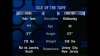
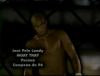
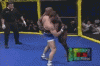
Marco Huas interview right before UFC 7 in Black Belt magazine (1995)
BB: When were you born?
MR: January 27, 1961. In Rio.
BB: When did you start in the Martial Arts?
MR: 13. At first I practiced Judo.
BB: Judo?
MR: Yes, because I was a coward. My father took me to a Judo academy. I soon got to love the fighting arts and have done various things.
BB: What other Martial Arts did you try?
MR: From 16, Tae Kwon Do and Capoeira. From 18, Muay Thai, Boxing, Wrestling, Jiu-Jitsu, and Luta Livre.
BB: Most Vale Tudo fighters know Jiu-Jitsu, but you know many other Martial Arts as well.
MR: Well, the Judo academy was managed by my father. It had classes of Capoeira, Tae Kwon Do, and so on. So I learned alot of Martial Arts. From my late teen years on, I have trained almost everyday in the Martial Arts.
BB: How successful have you been in your matches?
MR: I'm a little bit embarrased, because there have been so many that I can't remember them all. In Muay Thai, I fought 16 bouts, won them all, and was Heavyweight champion in Brazil. In Capoeira I won the Heavyweight championship. In Boxing I won 8 out of 8 bouts, and was once Middleweight champion in Rio. I won the Wrestling championships in Brazil 5 or 6 times.
BB: Is it your dream to be a champion in evry kind of Martial Art?
MR: No, I just love various fighting arts. I do have another reason that I do so many kinds of Martial Arts. When I continue to win nobody wants to challenge me anymore! If I want to keep fighting I have to turn to a new Martial Art.
BB: Wow.
MR: I do not want to participate in the Olympics. Actually I want to earn money by doing Vale Tudo matches, or kickboxing in Brazil. Unfortunately there few kickboxing events and I cannot take part in many Vale Tudo matches. That has been a problem.
BB: Why?
MR: Just 12 years ago, I competed in A Vale Tudo match with Pin Dukan, who was said to be the top student in the Carlson Gracie Dojo. I won. So after that bout, nobody wanted to fight with me.
BB: I have heard this before.
MR: So I then participated in Luta Livre events. Luta Livre is like free-style wrestling. It differs from Jiu-Jitsu, because you fight and train without a gi. The grappling technique is like Jiu-Jitsu, but since there is no gi, the skill is a little closer to wrestling. Another difference is that punching and kicking are trained in Luta Livre.
BB: Luta Livre has been called an enemy to Jiu-Jitsu.
MR: People who do these two Martial Arts completely hate each other. I do not care. I only want to be tougher. So I trained in Jiu-Jitsu for 3 years as well as Luta Livre. But that is a big problem in Brazil.
BB: Jiu-Jitsu fighters often say, "I would die for Jiu-Jitsu!". Don't you feel the same way?
MR: No. Essentially, inside of Jiu-Jitsu, Luta Livre, or anything, it must be decided whi is the best.
BB: You are the first Brazillian I have ever met to say such things.
MR: That's why it's so hard to find someone to fight!
BB: But you won in UFC 7.
MR: UFC is one step for me. For about 10 years no one would fight with me. Even the Gracie's would not fight me. So the UFC is the next step into the world of fighting.
BB: Who do you think is the toughest fighter in the UFC?
MR: I have got the tapes of UFC's 1-6. My trainer, Layton and I, have analyzed every fighters technique. Honestly, the level of fighters in UFC's 1-3 is very low. It wasn't until UFC 4 that the level was at last like Vale Tudo. The best? I think it's Shamrock.
BB: Shamrock? Not Royce?
MR: I do not think much of UFC 1-3. Though Royce is an excellent Jiu-Jitsu fighter, I think it would be hard for him to continue to win. But Shamrock can. I myself think that the body must be tough for a fighter to be tough. Shamrock has a tough body. Layton (Ruas' manager): Marco is a wonderfully gentle person. But look at his body. He can bench press 180kg easily. This is no ordinary Jiu-Jitsu fighter you know.
BB: That's right. Marco has a different kind of body from Rickson. He is flexible but stiff, lika a rubber ball, and he's very muscular.
Layton: When black people were forced to go to South America as slaves, 80% of them died from over work and poor living conditions. The 20% who lived must have been tough. The offspring of such men, must have it in their genes to excel. That is Marco's case. His body has superior genes. He trains all day.
BB: I see. You mean Marco naturally has a tough body?
Layton: And Marco knows all the Data on the UFC fighters. We have analyzed Shamrock's, Severn's, and everyone else's tactics. And he has been training with this analysis in mind. Look at this notebook. Here is the plotting of Marco's heart rate when he is using certain tactics. We are researching scientifically what Marco can be.
BB: That is great.
Layton: He knows the weakness of every UFC fighter. He will definately win at UFC 7.
BB: Wow. You have created a monster. But we're curious. Who's better, Marco or Rickson?
MR: I respect Rickson, but he's not perfect. Despite what some say.
Layton: It is my personal opinion that Marco and Rickson have equal grappling skills, with Rickson having perhaps an edge. But standing up, Marco is much better. Marco would have a good chance of winning.
BB: You mean that Marco plans to escape from grappling, and beat him with his standing skills?
MR: If we are even in grappling, than we must fight standing. When you are grappling there is a chance to stand up, if you refuse to be caught in a submission or chikehold. The losers to the Gracie's have so far been taken down. They could not stand up again. That is the problem. The Gracie's adhere to no time limits as they do not want their opponents to stand up again.
BB: I see. Thank you very much Marco.
BB: When were you born?
MR: January 27, 1961. In Rio.
BB: When did you start in the Martial Arts?
MR: 13. At first I practiced Judo.
BB: Judo?
MR: Yes, because I was a coward. My father took me to a Judo academy. I soon got to love the fighting arts and have done various things.
BB: What other Martial Arts did you try?
MR: From 16, Tae Kwon Do and Capoeira. From 18, Muay Thai, Boxing, Wrestling, Jiu-Jitsu, and Luta Livre.
BB: Most Vale Tudo fighters know Jiu-Jitsu, but you know many other Martial Arts as well.
MR: Well, the Judo academy was managed by my father. It had classes of Capoeira, Tae Kwon Do, and so on. So I learned alot of Martial Arts. From my late teen years on, I have trained almost everyday in the Martial Arts.
BB: How successful have you been in your matches?
MR: I'm a little bit embarrased, because there have been so many that I can't remember them all. In Muay Thai, I fought 16 bouts, won them all, and was Heavyweight champion in Brazil. In Capoeira I won the Heavyweight championship. In Boxing I won 8 out of 8 bouts, and was once Middleweight champion in Rio. I won the Wrestling championships in Brazil 5 or 6 times.
BB: Is it your dream to be a champion in evry kind of Martial Art?
MR: No, I just love various fighting arts. I do have another reason that I do so many kinds of Martial Arts. When I continue to win nobody wants to challenge me anymore! If I want to keep fighting I have to turn to a new Martial Art.
BB: Wow.
MR: I do not want to participate in the Olympics. Actually I want to earn money by doing Vale Tudo matches, or kickboxing in Brazil. Unfortunately there few kickboxing events and I cannot take part in many Vale Tudo matches. That has been a problem.
BB: Why?
MR: Just 12 years ago, I competed in A Vale Tudo match with Pin Dukan, who was said to be the top student in the Carlson Gracie Dojo. I won. So after that bout, nobody wanted to fight with me.
BB: I have heard this before.
MR: So I then participated in Luta Livre events. Luta Livre is like free-style wrestling. It differs from Jiu-Jitsu, because you fight and train without a gi. The grappling technique is like Jiu-Jitsu, but since there is no gi, the skill is a little closer to wrestling. Another difference is that punching and kicking are trained in Luta Livre.
BB: Luta Livre has been called an enemy to Jiu-Jitsu.
MR: People who do these two Martial Arts completely hate each other. I do not care. I only want to be tougher. So I trained in Jiu-Jitsu for 3 years as well as Luta Livre. But that is a big problem in Brazil.
BB: Jiu-Jitsu fighters often say, "I would die for Jiu-Jitsu!". Don't you feel the same way?
MR: No. Essentially, inside of Jiu-Jitsu, Luta Livre, or anything, it must be decided whi is the best.
BB: You are the first Brazillian I have ever met to say such things.
MR: That's why it's so hard to find someone to fight!
BB: But you won in UFC 7.
MR: UFC is one step for me. For about 10 years no one would fight with me. Even the Gracie's would not fight me. So the UFC is the next step into the world of fighting.
BB: Who do you think is the toughest fighter in the UFC?
MR: I have got the tapes of UFC's 1-6. My trainer, Layton and I, have analyzed every fighters technique. Honestly, the level of fighters in UFC's 1-3 is very low. It wasn't until UFC 4 that the level was at last like Vale Tudo. The best? I think it's Shamrock.
BB: Shamrock? Not Royce?
MR: I do not think much of UFC 1-3. Though Royce is an excellent Jiu-Jitsu fighter, I think it would be hard for him to continue to win. But Shamrock can. I myself think that the body must be tough for a fighter to be tough. Shamrock has a tough body. Layton (Ruas' manager): Marco is a wonderfully gentle person. But look at his body. He can bench press 180kg easily. This is no ordinary Jiu-Jitsu fighter you know.
BB: That's right. Marco has a different kind of body from Rickson. He is flexible but stiff, lika a rubber ball, and he's very muscular.
Layton: When black people were forced to go to South America as slaves, 80% of them died from over work and poor living conditions. The 20% who lived must have been tough. The offspring of such men, must have it in their genes to excel. That is Marco's case. His body has superior genes. He trains all day.
BB: I see. You mean Marco naturally has a tough body?
Layton: And Marco knows all the Data on the UFC fighters. We have analyzed Shamrock's, Severn's, and everyone else's tactics. And he has been training with this analysis in mind. Look at this notebook. Here is the plotting of Marco's heart rate when he is using certain tactics. We are researching scientifically what Marco can be.
BB: That is great.
Layton: He knows the weakness of every UFC fighter. He will definately win at UFC 7.
BB: Wow. You have created a monster. But we're curious. Who's better, Marco or Rickson?
MR: I respect Rickson, but he's not perfect. Despite what some say.
Layton: It is my personal opinion that Marco and Rickson have equal grappling skills, with Rickson having perhaps an edge. But standing up, Marco is much better. Marco would have a good chance of winning.
BB: You mean that Marco plans to escape from grappling, and beat him with his standing skills?
MR: If we are even in grappling, than we must fight standing. When you are grappling there is a chance to stand up, if you refuse to be caught in a submission or chikehold. The losers to the Gracie's have so far been taken down. They could not stand up again. That is the problem. The Gracie's adhere to no time limits as they do not want their opponents to stand up again.
BB: I see. Thank you very much Marco.
Last edited:







- Joined
- Jan 25, 2009
- Messages
- 29,338
- Reaction score
- 19,420
Shamrock and Bruce Lee in the same sentence? IP ban.Bro it’s pretty obvious that people were not training multiple aspects of mma back then. Even the guys who tried like shamrock or Bruce Lee would be crushed by today’s cross training standards
- Joined
- Mar 2, 2018
- Messages
- 15,164
- Reaction score
- 1,742
> Brazilian Vale Tudo scene:
Rudimar Fedrigo´s jus´dropped a massive interview, spittin´ some real science...
Unfortunately, it´s in portuguese, and there´s too many valuable info in it, cant really make cliffs (2 hrs), but I´ll try to make several threads about it.
Some of 'The Day' Threads have already dealt with some of the things he´s recallin´, especially Chuteboxe & the Vale Tudo era...
Now... @ 16mn30:
Rudimar explains that his original vision, when he started Chuteboxe in the 1990s, was an union between MT & BJJ, which would explain their fighters´ underrated ground game....
Master Nico (Carlson´s friend from Rio) was the original BJJ teacher there.
He was introduced by Rafael Cordeiro.
Unlike in Rio, in Curitiba there was no 'ideological' limitation for such a plan.
Rudimar Fedrigo´s jus´dropped a massive interview, spittin´ some real science...
Unfortunately, it´s in portuguese, and there´s too many valuable info in it, cant really make cliffs (2 hrs), but I´ll try to make several threads about it.
Some of 'The Day' Threads have already dealt with some of the things he´s recallin´, especially Chuteboxe & the Vale Tudo era...
Now... @ 16mn30:
Rudimar explains that his original vision, when he started Chuteboxe in the 1990s, was an union between MT & BJJ, which would explain their fighters´ underrated ground game....
Master Nico (Carlson´s friend from Rio) was the original BJJ teacher there.
He was introduced by Rafael Cordeiro.
Unlike in Rio, in Curitiba there was no 'ideological' limitation for such a plan.
Last edited:
- Joined
- Mar 2, 2018
- Messages
- 15,164
- Reaction score
- 1,742
nice thread

- Joined
- Mar 2, 2018
- Messages
- 15,164
- Reaction score
- 1,742
> Brazilian Vale Tudo scene:
CARLSON: Historical interview here >
Como foi sua estréia no Vale-Tudo?
É verdade que você lutou quase uma hora com a clavícula quebrada na sua segunda luta?
[Is it true that you fought during almost 1 hour with a broken clavicle in your 2nd fight?]
CARLSON:Verdade. [...] contra o Passarito, que era um cara fortíssimo, campeão brasileiro de Judô, Luta-Livre e Boxe. Tinha 96kg de músculo e eu com 72kg. [...]
[True. [...] against Passarito, a really tough guy, Brazilian champion in Judo, Luta Livre & boxing. He was 96 kg of pure muscle and I was 72 kg]
(Luta Livre ~ Catch Wrasslin´+greco-roman wrasslin´+JJJ)
[...]
Qual foi seu oponente mais duro?
[Who was your toughest opponent?]
CARLSON:Ivan Gomes, indiscutivelmente. [...]
Aposto com você que o Ivan venceria qualquer do Vale-Tudo hoje em dia. [...]
Depois o Ivan viajou o mundo e foi o primeiro lutador brasileiro a virar ídolo no Japão.
As chaves de calcanhar utilizadas hoje foram inventadas por ele.
[Ivan Gomes, without a doubt.[...].
I can bet with you that Ivan could win against anyone from the current Vale Tudo scene [...]
Later, Ivan travelled and was the 1st Brazilian fighter to become an idol in Japan.
The Heel Hooks used today were invented by him]
CARLSON: Historical interview here >
Como foi sua estréia no Vale-Tudo?
É verdade que você lutou quase uma hora com a clavícula quebrada na sua segunda luta?
[Is it true that you fought during almost 1 hour with a broken clavicle in your 2nd fight?]
CARLSON:Verdade. [...] contra o Passarito, que era um cara fortíssimo, campeão brasileiro de Judô, Luta-Livre e Boxe. Tinha 96kg de músculo e eu com 72kg. [...]
[True. [...] against Passarito, a really tough guy, Brazilian champion in Judo, Luta Livre & boxing. He was 96 kg of pure muscle and I was 72 kg]
(Luta Livre ~ Catch Wrasslin´+greco-roman wrasslin´+JJJ)
[...]
Qual foi seu oponente mais duro?
[Who was your toughest opponent?]
CARLSON:Ivan Gomes, indiscutivelmente. [...]
Aposto com você que o Ivan venceria qualquer do Vale-Tudo hoje em dia. [...]
Depois o Ivan viajou o mundo e foi o primeiro lutador brasileiro a virar ídolo no Japão.
As chaves de calcanhar utilizadas hoje foram inventadas por ele.
[Ivan Gomes, without a doubt.[...].
I can bet with you that Ivan could win against anyone from the current Vale Tudo scene [...]
Later, Ivan travelled and was the 1st Brazilian fighter to become an idol in Japan.
The Heel Hooks used today were invented by him]
Como foi sua estréia no Vale-Tudo?
CARLSON:Muita gente acha que foi com o Waldemar, mas na verdade quando lutei com ele já tinha várias lutas. Minha primeira luta foi com o Capoeira, um baderneiro que fazia parte do grupo do Cirandinha. Acabou com várias festas inclusive no Copacabana Palace e eu resolvi desafiá-lo. Como só tinha 17 anos o meu pai teve que fazer uma armação para mudar a minha idade. Então passei de 17 para 21 anos. Lutamos numa quadra de cimento que tinha atrás do gol do Vasco, lá em São Januário. Cai por baixo, mas arrebentei ele da guarda, raspei e cai montado. A luta durou uns 4 minutos. Depois desta luta fiz mais 18 nas regras do Vale-Tudo com público, mas se for contar desafios em academia fiz mais de 200
É verdade que você lutou quase uma hora com a clavícula quebrada na sua segunda luta?
CARLSON:Verdade. Esta luta foi atrás do gol do Maracanã contra o Passarito, que era um cara fortíssimo, campeão brasileiro de Judô, Luta-Livre e Boxe. Tinha 96kg de músculo e eu com 72kg. Nos primeiros minutos levei uma queda e quebrei a clavícula, mas ninguém percebeu. Depois de uma hora terminou empatada. Passei 90 dias com um aparelho e depois pedi a revanche. Esta segunda luta fizemos em rounds de 30 minutos até um desistir. Desta vez a luta durou duas horas e meia. No intervalo do quinto round ele não tinha mais condições de andar, eu arrebentei ele todo e o médico não deixou ele voltar. Depois ficou duas semanas no hospital com oxigênio naquele morre não morre. Eu inclusive fui lá visitá-lo
Você estava no corner do seu tio Hélio quando ele lutou com o Waldemar?
CARLSON:Eu fui o primeiro a entrar no ringue. O Tio Hélio foi um herói lutando por três horas e quarenta minutos sem parar com o Waldemar, que era quase 20 anos mais jovem. Aquilo foi uma briga. No final fui falar com o Waldemar: “Gosto de você, mas você me criou um problema e agora vamos ter que lutar. Se cuida que no ringue seremos super inimigos e a porrada vai comer. A luta foi super divulgada e nós lotamos o Maracanãzinho com 20 mil pessoas e ainda ficaram 5 mil do lado de fora. A luta estava programada para seis rounds de 10 minutos. Foi duríssimo, mas arrebentei ele, pus para fora do ringue e ele não voltou. Faltava 1 minuto para terminar o quarto round. Depois lutei com o Waldemar mais cinco vezes. Ganhei quatro e empatei duas.
Qual foi seu oponente mais duro?
CARLSON:Ivan Gomes, indiscutivelmente. O conheci no ringue em 1968 quando apareceu para lutar comigo em Recife. Só sabia que tinha 22 anos e foi aluno do meu tio George. Pelo peso (1,74/100kg) imaginei que fosse barrigudo. Lembro que ele entrou no ringue de roupão e parecia o incrível hulk. A luta foi duríssima (três rounds de 10 minutos) e terminou empatada. Ivan Gomes foi o único lutador que pensei que pudesse perder se não estivesse 100%. Aposto com você que o Ivan venceria qualquer do Vale-Tudo hoje em dia. Depois da luta ficamos amigos. Ele veio ao Rio fazer uma luta e me pediu para ficar aqui treinando comigo. Depois o Ivan viajou o mundo e foi o primeiro lutador brasileiro a virar ídolo no Japão. As chaves de calcanhar utilizadas hoje foram inventadas por ele.
Nas suas 19 lutas você só perdeu para Euclides Pereira. Como foi esta derrota?
CARLSON:Esta foi minha penúltima luta. Foi uma luta dura mas eu ganhei e os jurados deram a vitória para ele. A luta foi lá na Bahia no estádio da Fonte Nova. O Euclides havia vencido o Waldemar, mas perdia sempre para o Ivan Gomes. Eu levei nítida vantagem, inclusive no primeiro round. Encaixei um mata-leão pelas costas e ele rodou para fora do ringue e caiu apagado. Ai ele fez uma cera lá embaixo e voltou. O resultado foi muito vaiado
Porque deixou a academia Gracie quando se aposentou e decidiu abrir sua própria academia?
CARLSON:Já não me sentia bem lá. Meu pai e Tio Hélio sempre me prometiam algum dinheiro e nunca davam, mas eu não me preocupava porque era solteiro, mas quando casei a situação mudou e resolvi abrir minha própria academia. Primeiro na Rua Tonelero e logo depois abri esta na Figueiredo Magalhaes.
Aqui nesta academia da Figueiredo de Magalhães você fez quatro gerações de faixas pretas.
CARLSON:Exatamante, formei mais de 100 faixas pretas, quatro gerações, nestes dois dojos. A primeira geração tinha Sergio Iris, Nando Frances, Rosado, Pinduka e Luiz Fernando; a segunda tinha Maninho, Buchau, Ze Eduardo, Caíque; A terceira tinha Cássio Cardoso, Peixotinho e Guinho, e a quarta tinha Murilo Bustamante, Ze Mario, Libório e Wallid Ismail.
Quem nos dias da nova geração se assemelha mais ao seus estilo?
CARLSON:O Minotauro, ele ataca bem por baixo e é agressivo em pé. Afinal de contas ele aprendeu com o Assad, que é aluno do meu aluno De La Riva.
Quais foram os maiores clássicos entre Carlson e Academia Gracie?
CARLSON:De La Riva x Royler, Clóvis x Royler; Marcelo Behring x Cássio Cardoso e Wallid x Royce.
Por que dizia que o Serginho e Libório eram seus melhores lutadores?
CARLSON:Não vou dizer que eram os melhores, mas eram fenômenos.
O que acha do Wrestling?
CARLSON:Uma luta muito dura, os caras tem uma técnica excelente de botar pra baixo e amarram muito bem por cima, de modo que fica difícil ganhar dos caras. Claro que com o mesmo peso o Jiu-Jitsu é melhor. Você vê o Fábio Gurgel lutou com um cara 30 kg mais pesado, o Murilo lutou com um monstro 40kg mais pesado. Para não falar que estes caras lutam tudo: Jiu-Jitsu, Boxe não é só a modalidade deles, então acho que não dá pra ficar mais dando esta vantagem toda de peso para eles.
Por que se identifica tanto com brigas de galo?
CARLSON:Acho sensacional. O galo é o animal mais valente do reino animal. Ele luta mil vezes mais que o homem e dificilmente mutuca (foge da briga). Por isso o primeiro símbolo da minha academia era um galo
CARLSON:Muita gente acha que foi com o Waldemar, mas na verdade quando lutei com ele já tinha várias lutas. Minha primeira luta foi com o Capoeira, um baderneiro que fazia parte do grupo do Cirandinha. Acabou com várias festas inclusive no Copacabana Palace e eu resolvi desafiá-lo. Como só tinha 17 anos o meu pai teve que fazer uma armação para mudar a minha idade. Então passei de 17 para 21 anos. Lutamos numa quadra de cimento que tinha atrás do gol do Vasco, lá em São Januário. Cai por baixo, mas arrebentei ele da guarda, raspei e cai montado. A luta durou uns 4 minutos. Depois desta luta fiz mais 18 nas regras do Vale-Tudo com público, mas se for contar desafios em academia fiz mais de 200
É verdade que você lutou quase uma hora com a clavícula quebrada na sua segunda luta?
CARLSON:Verdade. Esta luta foi atrás do gol do Maracanã contra o Passarito, que era um cara fortíssimo, campeão brasileiro de Judô, Luta-Livre e Boxe. Tinha 96kg de músculo e eu com 72kg. Nos primeiros minutos levei uma queda e quebrei a clavícula, mas ninguém percebeu. Depois de uma hora terminou empatada. Passei 90 dias com um aparelho e depois pedi a revanche. Esta segunda luta fizemos em rounds de 30 minutos até um desistir. Desta vez a luta durou duas horas e meia. No intervalo do quinto round ele não tinha mais condições de andar, eu arrebentei ele todo e o médico não deixou ele voltar. Depois ficou duas semanas no hospital com oxigênio naquele morre não morre. Eu inclusive fui lá visitá-lo
Você estava no corner do seu tio Hélio quando ele lutou com o Waldemar?
CARLSON:Eu fui o primeiro a entrar no ringue. O Tio Hélio foi um herói lutando por três horas e quarenta minutos sem parar com o Waldemar, que era quase 20 anos mais jovem. Aquilo foi uma briga. No final fui falar com o Waldemar: “Gosto de você, mas você me criou um problema e agora vamos ter que lutar. Se cuida que no ringue seremos super inimigos e a porrada vai comer. A luta foi super divulgada e nós lotamos o Maracanãzinho com 20 mil pessoas e ainda ficaram 5 mil do lado de fora. A luta estava programada para seis rounds de 10 minutos. Foi duríssimo, mas arrebentei ele, pus para fora do ringue e ele não voltou. Faltava 1 minuto para terminar o quarto round. Depois lutei com o Waldemar mais cinco vezes. Ganhei quatro e empatei duas.
Qual foi seu oponente mais duro?
CARLSON:Ivan Gomes, indiscutivelmente. O conheci no ringue em 1968 quando apareceu para lutar comigo em Recife. Só sabia que tinha 22 anos e foi aluno do meu tio George. Pelo peso (1,74/100kg) imaginei que fosse barrigudo. Lembro que ele entrou no ringue de roupão e parecia o incrível hulk. A luta foi duríssima (três rounds de 10 minutos) e terminou empatada. Ivan Gomes foi o único lutador que pensei que pudesse perder se não estivesse 100%. Aposto com você que o Ivan venceria qualquer do Vale-Tudo hoje em dia. Depois da luta ficamos amigos. Ele veio ao Rio fazer uma luta e me pediu para ficar aqui treinando comigo. Depois o Ivan viajou o mundo e foi o primeiro lutador brasileiro a virar ídolo no Japão. As chaves de calcanhar utilizadas hoje foram inventadas por ele.
Nas suas 19 lutas você só perdeu para Euclides Pereira. Como foi esta derrota?
CARLSON:Esta foi minha penúltima luta. Foi uma luta dura mas eu ganhei e os jurados deram a vitória para ele. A luta foi lá na Bahia no estádio da Fonte Nova. O Euclides havia vencido o Waldemar, mas perdia sempre para o Ivan Gomes. Eu levei nítida vantagem, inclusive no primeiro round. Encaixei um mata-leão pelas costas e ele rodou para fora do ringue e caiu apagado. Ai ele fez uma cera lá embaixo e voltou. O resultado foi muito vaiado
Porque deixou a academia Gracie quando se aposentou e decidiu abrir sua própria academia?
CARLSON:Já não me sentia bem lá. Meu pai e Tio Hélio sempre me prometiam algum dinheiro e nunca davam, mas eu não me preocupava porque era solteiro, mas quando casei a situação mudou e resolvi abrir minha própria academia. Primeiro na Rua Tonelero e logo depois abri esta na Figueiredo Magalhaes.
Aqui nesta academia da Figueiredo de Magalhães você fez quatro gerações de faixas pretas.
CARLSON:Exatamante, formei mais de 100 faixas pretas, quatro gerações, nestes dois dojos. A primeira geração tinha Sergio Iris, Nando Frances, Rosado, Pinduka e Luiz Fernando; a segunda tinha Maninho, Buchau, Ze Eduardo, Caíque; A terceira tinha Cássio Cardoso, Peixotinho e Guinho, e a quarta tinha Murilo Bustamante, Ze Mario, Libório e Wallid Ismail.
Quem nos dias da nova geração se assemelha mais ao seus estilo?
CARLSON:O Minotauro, ele ataca bem por baixo e é agressivo em pé. Afinal de contas ele aprendeu com o Assad, que é aluno do meu aluno De La Riva.
Quais foram os maiores clássicos entre Carlson e Academia Gracie?
CARLSON:De La Riva x Royler, Clóvis x Royler; Marcelo Behring x Cássio Cardoso e Wallid x Royce.
Por que dizia que o Serginho e Libório eram seus melhores lutadores?
CARLSON:Não vou dizer que eram os melhores, mas eram fenômenos.
O que acha do Wrestling?
CARLSON:Uma luta muito dura, os caras tem uma técnica excelente de botar pra baixo e amarram muito bem por cima, de modo que fica difícil ganhar dos caras. Claro que com o mesmo peso o Jiu-Jitsu é melhor. Você vê o Fábio Gurgel lutou com um cara 30 kg mais pesado, o Murilo lutou com um monstro 40kg mais pesado. Para não falar que estes caras lutam tudo: Jiu-Jitsu, Boxe não é só a modalidade deles, então acho que não dá pra ficar mais dando esta vantagem toda de peso para eles.
Por que se identifica tanto com brigas de galo?
CARLSON:Acho sensacional. O galo é o animal mais valente do reino animal. Ele luta mil vezes mais que o homem e dificilmente mutuca (foge da briga). Por isso o primeiro símbolo da minha academia era um galo
Last edited:
- Joined
- Mar 2, 2018
- Messages
- 15,164
- Reaction score
- 1,742
> Brazilian Vale Tudo scene:
IVAN GOMES:
Ivan was for sure top 2 GOAT of the Vale Tudo era, along with Euclides Pereira.
His record is obviously hard to assess: 570 W - 30 D - 1 DQ (vs Willlem Ruska, Judo Gold Medal in 1972)
He was also South American Greco-Roman Champ.
But his international career & the hespect he earned among his peers proved he was legit, indeed.
He had a Judo & Luta Live background.
[Luta Livre ~ Catch Wrasslin´+greco-roman wrasslin´+JJJ]
Let´s try to 'deconstruct' Ivan´s skill set & its evolution:
He first learnt JJ with Osmar Mousinho “Biuce”, who trained under Herondino.
He then competed in Boxing.
Then, he trained with Touro Novo, & with José Maria Freire between 1958 and 1959 (who trained under Nilo Veloso, who trained under George Gracie).
Then, he improved his striking (mainly kicks) under Agatângelo Braga.
Inoki invited him to train & compete in Japan (86 fights).
There he trained Sumo, and he taught BJJ (!)
Now, that´s quite fascinatin´: between 1975 & 1977, a generation of fighters had apparently the opportunity to learn BJJ,
but to no avail, it seems...
Was Ivan 'sidelined' by Karl Gotch´s influence? (Ivan even challenged him, but seems Gotch ducked...)
IVAN GOMES:
Ivan was for sure top 2 GOAT of the Vale Tudo era, along with Euclides Pereira.
His record is obviously hard to assess: 570 W - 30 D - 1 DQ (vs Willlem Ruska, Judo Gold Medal in 1972)
He was also South American Greco-Roman Champ.
But his international career & the hespect he earned among his peers proved he was legit, indeed.
He had a Judo & Luta Live background.
[Luta Livre ~ Catch Wrasslin´+greco-roman wrasslin´+JJJ]
Let´s try to 'deconstruct' Ivan´s skill set & its evolution:
He first learnt JJ with Osmar Mousinho “Biuce”, who trained under Herondino.
He then competed in Boxing.
Then, he trained with Touro Novo, & with José Maria Freire between 1958 and 1959 (who trained under Nilo Veloso, who trained under George Gracie).
Then, he improved his striking (mainly kicks) under Agatângelo Braga.
Inoki invited him to train & compete in Japan (86 fights).
There he trained Sumo, and he taught BJJ (!)
Now, that´s quite fascinatin´: between 1975 & 1977, a generation of fighters had apparently the opportunity to learn BJJ,
but to no avail, it seems...
Was Ivan 'sidelined' by Karl Gotch´s influence? (Ivan even challenged him, but seems Gotch ducked...)
Last edited:
- Joined
- Mar 2, 2018
- Messages
- 15,164
- Reaction score
- 1,742
> DUTCH Scene:
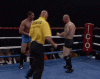
MUSTAFA AZOUFRI
Ah...now it´s gettin´ interestin´... This thread is gonna dig deeper in the NHB scene..and showcase some 'low profile' fighters...
Azoufri, probably a Moroccan from Holland, trained at Dolman Gym.
![Mustafa Azoufri vs Rinie V. Brakel [Rings Holland].png](https://sherdog-data.community.forum/attachments/558/558927-395b4ac4c957349001230321d9c5390d.jpg?hash=OVtKxMlXNJ "Mustafa Azoufri vs Rinie V. Brakel [Rings Holland].png")
Dolman was a Dutch Judoka, who trained fighters like Rutten, Reems brothers, Mousasi etc.
Mainly strikers...who quickly understood the necessity of workin´on their ground game.
Sadly, Azoufri had a pretty short 'career': only 2 fights... Rare MMA opportunities back in the day, indeed...
Here, we can acknowledge some of the results from his work at Dolman Gym:
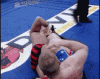
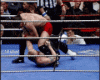
was against Rinie van Brakel, @ Rings Holland - Who's the Boss (!) [Jun / 07 / 1998]




Rings had jus´ started to promote events in Holland.
While most of the competitors there were strikers [KB/MT], who would use mostly devastatin´ kicks & knees (and even some hardcore palm strikes) to win their fights, a significant minority was startin´ to showcase some legit improvements on the ground.
MUSTAFA AZOUFRI
Ah...now it´s gettin´ interestin´... This thread is gonna dig deeper in the NHB scene..and showcase some 'low profile' fighters...
Azoufri, probably a Moroccan from Holland, trained at Dolman Gym.
Dolman was a Dutch Judoka, who trained fighters like Rutten, Reems brothers, Mousasi etc.
Mainly strikers...who quickly understood the necessity of workin´on their ground game.
Sadly, Azoufri had a pretty short 'career': only 2 fights... Rare MMA opportunities back in the day, indeed...
Here, we can acknowledge some of the results from his work at Dolman Gym:
was against Rinie van Brakel, @ Rings Holland - Who's the Boss (!) [Jun / 07 / 1998]
Rings had jus´ started to promote events in Holland.
While most of the competitors there were strikers [KB/MT], who would use mostly devastatin´ kicks & knees (and even some hardcore palm strikes) to win their fights, a significant minority was startin´ to showcase some legit improvements on the ground.
Last edited:


- Joined
- Mar 2, 2018
- Messages
- 15,164
- Reaction score
- 1,742
I didnt wanna jump 2 quickly at him, since he´s obviously a no-brainer:I feel like Marco Ruas should have been mentioned somewhere
[Im gonna progressively add some new fighters ITT...]
> Brazilian Vale Tudo scene:
King of The Streets:
View attachment 576187
Marco Huas interview right before UFC 7 in Black Belt magazine (1995)
BB: When did you start in the Martial Arts?
MR: 13. At first I practiced Judo.
BB: Judo?
MR: Yes, because I was a coward. My father took me to a Judo academy. I soon got to love the fighting arts and have done various things.
BB: What other Martial Arts did you try?
MR: From 16, Tae Kwon Do and Capoeira. From 18, Muay Thai, Boxing, Wrestling, Jiu-Jitsu, and Luta Livre.
BB: Most Vale Tudo fighters know Jiu-Jitsu, but you know many other Martial Arts as well.
MR: Well, the Judo academy was managed by my father. It had classes of Capoeira, Tae Kwon Do, and so on. So I learned alot of Martial Arts. From my late teen years on, I have trained almost everyday in the Martial Arts.
BB: How successful have you been in your matches?
MR: I'm a little bit embarrased, because there have been so many that I can't remember them all.
In Muay Thai, I fought 16 bouts, won them all, and was Heavyweight champion in Brazil. In Capoeira I won the Heavyweight championship. In Boxing I won 8 out of 8 bouts, and was once Middleweight champion in Rio. I won the Wrestling championships in Brazil 5 or 6 times.
BB: Is it your dream to be a champion in evry kind of Martial Art?
MR: No, I just love various fighting arts. I do have another reason that I do so many kinds of Martial Arts. When I continue to win nobody wants to challenge me anymore! If I want to keep fighting I have to turn to a new Martial Art.
Marco Huas interview right before UFC 7 in Black Belt magazine (1995)
BB: When were you born?
MR: January 27, 1961. In Rio.
BB: When did you start in the Martial Arts?
MR: 13. At first I practiced Judo.
BB: Judo?
MR: Yes, because I was a coward. My father took me to a Judo academy. I soon got to love the fighting arts and have done various things.
BB: What other Martial Arts did you try?
MR: From 16, Tae Kwon Do and Capoeira. From 18, Muay Thai, Boxing, Wrestling, Jiu-Jitsu, and Luta Livre.
BB: Most Vale Tudo fighters know Jiu-Jitsu, but you know many other Martial Arts as well.
MR: Well, the Judo academy was managed by my father. It had classes of Capoeira, Tae Kwon Do, and so on. So I learned alot of Martial Arts. From my late teen years on, I have trained almost everyday in the Martial Arts.
BB: How successful have you been in your matches?
MR: I'm a little bit embarrased, because there have been so many that I can't remember them all. In Muay Thai, I fought 16 bouts, won them all, and was Heavyweight champion in Brazil. In Capoeira I won the Heavyweight championship. In Boxing I won 8 out of 8 bouts, and was once Middleweight champion in Rio. I won the Wrestling championships in Brazil 5 or 6 times.
BB: Is it your dream to be a champion in evry kind of Martial Art?
MR: No, I just love various fighting arts. I do have another reason that I do so many kinds of Martial Arts. When I continue to win nobody wants to challenge me anymore! If I want to keep fighting I have to turn to a new Martial Art.
BB: Wow.
MR: I do not want to participate in the Olympics. Actually I want to earn money by doing Vale Tudo matches, or kickboxing in Brazil. Unfortunately there few kickboxing events and I cannot take part in many Vale Tudo matches. That has been a problem.
BB: Why?
MR: Just 12 years ago, I competed in A Vale Tudo match with Pin Dukan, who was said to be the top student in the Carlson Gracie Dojo. I won. So after that bout, nobody wanted to fight with me.
BB: I have heard this before.
MR: So I then participated in Luta Livre events. Luta Livre is like free-style wrestling. It differs from Jiu-Jitsu, because you fight and train without a gi. The grappling technique is like Jiu-Jitsu, but since there is no gi, the skill is a little closer to wrestling. Another difference is that punching and kicking are trained in Luta Livre.
BB: Luta Livre has been called an enemy to Jiu-Jitsu.
MR: People who do these two Martial Arts completely hate each other. I do not care. I only want to be tougher. So I trained in Jiu-Jitsu for 3 years as well as Luta Livre. But that is a big problem in Brazil.
BB: Jiu-Jitsu fighters often say, "I would die for Jiu-Jitsu!". Don't you feel the same way?
MR: No. Essentially, inside of Jiu-Jitsu, Luta Livre, or anything, it must be decided whi is the best.
BB: You are the first Brazillian I have ever met to say such things.
MR: That's why it's so hard to find someone to fight!
BB: But you won in UFC 7.
MR: UFC is one step for me. For about 10 years no one would fight with me. Even the Gracie's would not fight me. So the UFC is the next step into the world of fighting.
BB: Who do you think is the toughest fighter in the UFC?
MR: I have got the tapes of UFC's 1-6. My trainer, Layton and I, have analyzed every fighters technique. Honestly, the level of fighters in UFC's 1-3 is very low. It wasn't until UFC 4 that the level was at last like Vale Tudo. The best? I think it's Shamrock.
BB: Shamrock? Not Royce?
MR: I do not think much of UFC 1-3. Though Royce is an excellent Jiu-Jitsu fighter, I think it would be hard for him to continue to win. But Shamrock can. I myself think that the body must be tough for a fighter to be tough. Shamrock has a tough body. Layton (Ruas' manager): Marco is a wonderfully gentle person. But look at his body. He can bench press 180kg easily. This is no ordinary Jiu-Jitsu fighter you know.
BB: That's right. Marco has a different kind of body from Rickson. He is flexible but stiff, lika a rubber ball, and he's very muscular.
Layton: When black people were forced to go to South America as slaves, 80% of them died from over work and poor living conditions. The 20% who lived must have been tough. The offspring of such men, must have it in their genes to excel. That is Marco's case. His body has superior genes. He trains all day.
BB: I see. You mean Marco naturally has a tough body?
Layton: And Marco knows all the Data on the UFC fighters. We have analyzed Shamrock's, Severn's, and everyone else's tactics. And he has been training with this analysis in mind. Look at this notebook. Here is the plotting of Marco's heart rate when he is using certain tactics. We are researching scientifically what Marco can be.
BB: That is great.
Layton: He knows the weakness of every UFC fighter. He will definately win at UFC 7.
BB: Wow. You have created a monster. But we're curious. Who's better, Marco or Rickson?
MR: I respect Rickson, but he's not perfect. Despite what some say.
Layton: It is my personal opinion that Marco and Rickson have equal grappling skills, with Rickson having perhaps an edge. But standing up, Marco is much better. Marco would have a good chance of winning.
BB: You mean that Marco plans to escape from grappling, and beat him with his standing skills?
MR: If we are even in grappling, than we must fight standing. When you are grappling there is a chance to stand up, if you refuse to be caught in a submission or chikehold. The losers to the Gracie's have so far been taken down. They could not stand up again. That is the problem. The Gracie's adhere to no time limits as they do not want their opponents to stand up again.
BB: I see. Thank you very much Marco.
Latest posts
-

-
 Economy Milei and I: Milei Ends Argentina’s Deficit After 123 Years
- Latest: johnsmithjohnson


