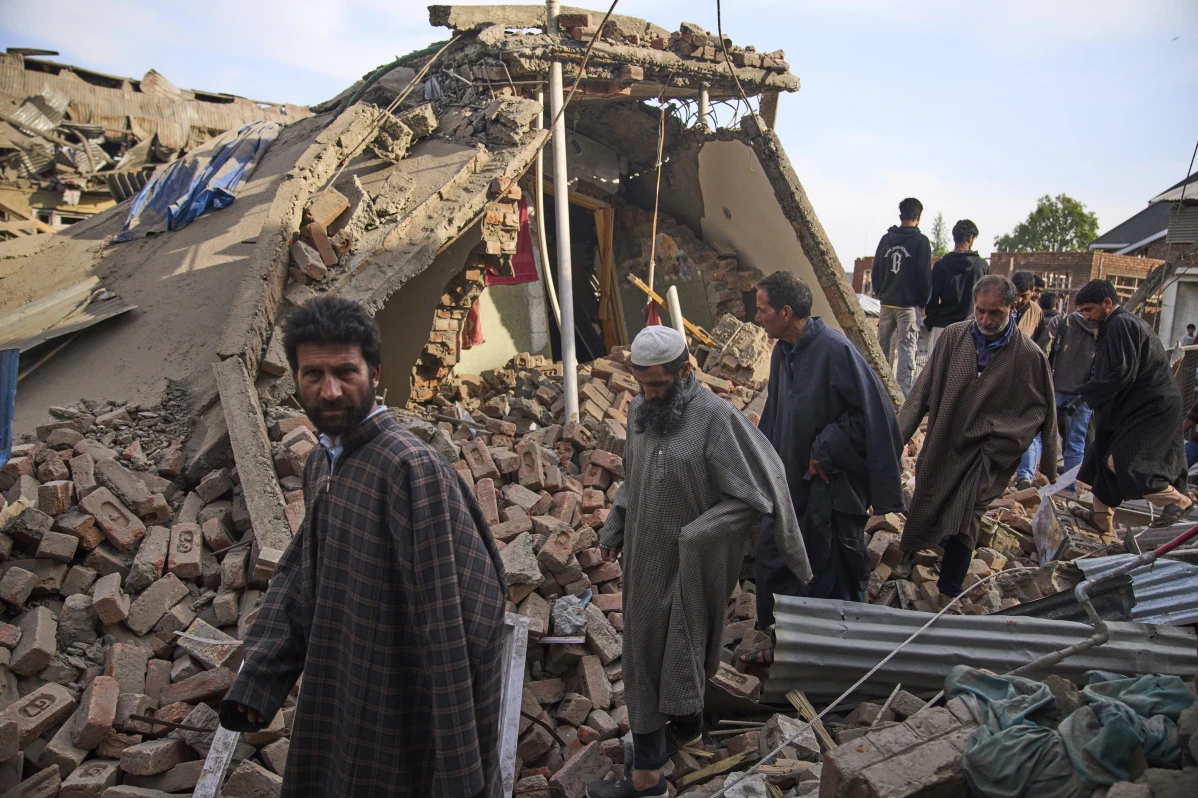
The domestic pressures shaping India’s response to Kashmir attacks
Penelope MacRae in Delhi
Narendra Modi must weigh a response that balances domestic fury with strategic restraint
India’s furious response to the terrorist massacre of 26 men in a popular travel destination is being shaped by public rage at the deadliest civilian attack in
Kashmir in a quarter-century.
The brutality of the assault in one of Muslim-majority Kashmir’s marquee tourist spots – and its national resonance – leaves Prime Minister
Narendra Modi needing to signal strength, but without triggering uncontrolled escalation between nuclear-armed India and Pakistan, analysts say.
“The outpouring of anger has been widespread,” said Brahma Chellaney, a veteran Indian commentator. “The victims came from all over
India, from at least 15 different states. Modi is trying to assuage national anger, which has been intense.”
The attackers reportedly made their victims reveal their religion by reciting the Kalma, the Islamic declaration of faith. Those who could not do so were shot dead.
The brazen assault in a tranquil meadow in Pahalgam, where families were picnicking, shattered Kashmir’s relative calm and struck at the heart of its tourist revival.
In 2019, Modi’s Hindu-nationalist government revoked Kashmir’s semi-autonomous status and split the territory into two federally ruled zones. The government also allowed non-locals to buy land.
An ensuing security clampdown reduced terrorist activity, and tourism surged: a record 3.5 million people visited the Kashmir Valley in 2024. Modi framed Kashmir’s “normalisation” as a political triumph, though simmering local discontent remained amid heavy militarisation.
Chellaney said: “This kind of massacre is deeply embarrassing for any government, and doubly so for the Modi government, which projects itself as strong on national security.”
The government must now weigh a response that balances domestic fury with strategic restraint. India and
Pakistan have fought three wars – two over Kashmir – and have repeatedly come close to the brink. Underscoring the danger, Pakistan’s defence minister, Khawaja Asif, said on Friday there was risk of “all-out war” if India opted for a forceful military response.
Chellaney said: “Modi has made strong statements in the past. But he’s a man who is reluctant to do kinetic action. He might hold back again, seeking instead to ease public anger through actions that stop short of full-scale military retaliation.”
Michael Kugelman, a Washington-based analyst, said that while there was “much anger and tough rhetoric”, the government’s “actual response is likely to be careful and deliberate”. He said the government would “want to ensure any such action is well-planned and effective”.
The memory of the
2019 Pulwama attack, in which 40 Indian paramilitary personnel were killed in a suicide bombing claimed by Pakistan-based Jaish-e-Mohammed, looms large. The episode led to India launching the Balakot airstrikes deep inside Pakistan – its first such incursion since the 1971 war. While hailed domestically as a bold move, critics disputed the effectiveness of the strikes.
Veteran analyst C Raja Mohan wrote in the Indian Express: “There are many imponderables Modi must deal with, including the significant capabilities of the Pakistan army. But given the horrific nature of the attack and the outrage that has convulsed the nation … the PM may have no option but to explore some major risks.”
India believes an obscure group calling itself the Resistance Front, which claimed responsibility for the attack, is an offshoot of the Pakistan-based Islamist group Lashkar-e-Taiba, which was behind the deadly
2008 Mumbai attacks. Pakistan denies any involvement, but India insists it has “clear evidence of cross-border complicity” and has named two of the terrorists as Pakistani nationals.
Modi has vowed to “pursue the attackers and their handlers to the ends of the Earth” and “reduce to dust whatever little land these terrorists have”.
Kugelman said: “It’s crucial to separate rhetoric from intent in this emotionally charged moment.”
Chellaney concurs, noting that “Modi may have a reputation for strength, but in actual practice over 11 years, he has been averse to utilising the military for any cross-border mission”.
That reluctance, however, is now being tested – not just by a shaken domestic audience and anger on social media, but by unusually vocal public grief in the Kashmir Valley itself. “There have been candlelit processions. It really is unprecedented – the anger in Kashmir,” Chellaney said. Kashmiris have flooded into the streets, waving placards saying: “United in Grief.”
Kugelman, meanwhile, says that India’s symbolic moves carry weight. India has suspended the 1960 Indus waters treaty – a rare symbol of bilateral cooperation that had survived previous wars. Pakistan retaliated by suspending the 1972 Simla agreement, the basis for border management and dispute resolution.
That may not be enough to assuage Indian public revulsion at the attack.
“The global landscape – from Gaza to Ukraine – has made previously sacrosanct territorial arrangements seem less permanent. That context may yet embolden a tougher line from Delhi, but for now, Modi is walking a tightrope between nationalist expectations and strategic prudence,” Mohan said.
https://www.theguardian.com/world/2...-india-response-kashmir-attacks-narendra-modi