POSTED ON
FEBRUARY 12, 2019 BY
MATT WILLIAMS
Here’s a Clever idea. Build Moon Bases in Craters and then Fill them in with Lunar Regolith
In the coming decades, multiple space agencies are planning to send astronauts to the lunar surface. More than that, between the European Space Agency (ESA), the China National Space Administration (CNSA) and Roscomos, there are multiple plans to construct permanent outposts on the Moon. Perhaps the best-known of these is the ESA’s plan to build an
International Lunar Village,
As a spiritual successor to the
International Space Station (ISS), this village would serve as a base for teams of astronauts to conduct vital research and experiments. In recent years, some very interesting proposals have been presented as part of this plan, the latest of which comes from the ESA’s European Astronaut Center (EAC), where a student team has developed a proposal for a
sustainable lunar habitat.
The team leader is Angelus Chrysovalantis Alfatzis, an architectural engineering student in his final year of studies at the
National Technical University of Athens, Greece. He and his colleagues are just some of the many young researchers taking part in
Spaceship EAC – an ESA initiative designed to promote networking and collaboration with universities and research institutions throughout Europe.
Alfatzis and his colleagues developed their moon base concept for the
2018 NewSpace2060 International Moon Pitch Competition, a joint initiative with the
Moon Village Association, that took place in the Fall of 2018. Their entry was part of the Moon Village Architectural Concept and Issue category, where participants were encouraged to come up with ideas that would work with existing technology and knowledge of the Moon.
Alfatzis describes his architectural approach as “hyperlocal”, which leverages the concept of in-situ resource utilization (ISRU) to create sustainable living solutions for extreme environments in remote places. As he explained his vision in a recent ESA
press release:
“I always strive to find material and structural solutions in accordance with the resources available on-site. At the moment, my focus is on using unprocessed lunar soil for construction and the architectural applications of this.”
This focus is in keeping with the ESA’s goals for creating the International Lunar Village, which calls for the use of local resources to not only manufacture the base but also to see to the needs of its crew. Working alongside others with the Spaceship EAC initiative, Alfatzis and his teammates came up with a concept called CORE (Crater Outpost for Research and Exploration).
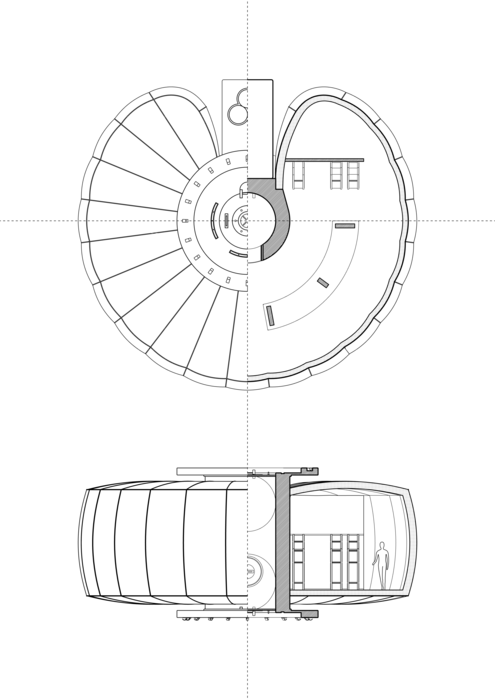
Architecture student Angelus Chrysovalantis Alfatzis’ concept for a lunar base. Credit: ESA
The concept of CORE calls for a modular design that would use the Moon’s own geography and regolith to protect against the elements. The team selected the South Pole-Aitken Basin as the site of their base, which offers the benefits of steady illumination, easy communications with Earth, and proximity to deposits of water ice.
Each module would consist of an inflatable, prefabricated structure with its own life support system and a central tube. In this way, modules could be arranged vertically, with one on top of the other while allowing for transport between them. As Alfatzis
explained:
“Our idea is to transport inflatable modules to the base of a small crater on the South Polar Region of the Moon, and then gradually fill the cavity with lunar soil, until the modules are effectively buried. Meters of shielding will protect those inside from radiation. Building inside a crater will also help insulate due to the stable temperature of the Moon’s underground environment and provides cover from the threat of micrometeoroids.”
The plan also calls for an airlock module to be added at the top of the structure, which would then be covered with more regolith to provide protection. Inside this airlock, Extra-Vehicular Activity (EVA) equipment would be stored and lunar dust would be mitigated with the help of an electromagnetic cleaner, which would take advantage of regolith’s magnetic properties to collect it.
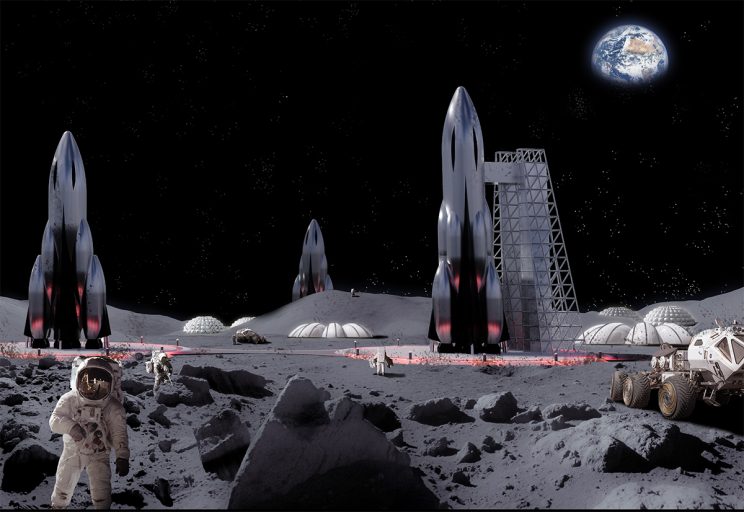
Multi-dome lunar base being constructed, based on the 3D printing concept. Credits: ESA/Foster + Partners
The vertically-stacked modules would all be connected by a centrally-located elevator. The first module next to the surface would house the waste-treatment facilities and would be where the astronauts prepare for EVAs and service missions to the surface. The middle module would be for research and communications, while the lower module would contain the sleeping pods, living quarters and an exercise facility (aka. “lunar gym”).
As Alfatzis noted in the video that was part of their team’s entry, another benefit of the CORE design is the ability to expand it to adjacent craters. “The chosen location for deployment allows for further installations of modules to be delivered and set up, creating a true village of habitats in close residences,” he said. “Realizing the Moon village is an important step for sustainable, manned exploration.”
Ultimately, the main purpose of CORE is to create a habitat that supports human life by protecting its residents from external conditions that could otherwise pose a threat. In that respect, it is not at all unlike habitats built here on Earth, except that special considerations need to be taken into account when designing habitats for the Moon.
These include the lack of a breathable atmosphere, the extremes in temperature, the type of terrain, and the Moon’s low gravity – which is about 16.5% that of Earth’s. The lack of a protective magnetic field also means that any lunar base will also need to be able to shield its inhabitants from solar and cosmic radiation, not to mention tiny meteorites that regularly rain down on the surface.
For their concept, Alfatzis and the Spaceship EAC team were rewarded with a runner-up placing. As Alfatzis indicated, their success was due to the diversified talents that their team brought to the table:
“The multidisciplinary nature of our team – from aerospace engineers to biologists – helped us examine all the different details of construction and energy requirements. The whole experience drove us to think more deeply on the different aspects of lunar construction and habitation, showing us many different possibilities for our future on the Moon.”
At present, the ESA, the CNSA, Roscosmos and NASA are all hoping to build a lunar outpost by the late 2020s or early 2030s. In all likelihood, this base will be the result of cooperation between these and other agencies, all of whom stand to gain from having a permanent research base that will help facilitate future missions to Mars and other locations in the Solar System.