- Joined
- Dec 20, 2016
- Messages
- 31,814
- Reaction score
- 86,251
Love these photos. Thanks for sharing.


Wouldn't surprise me.Sure was. The Atlantieans. They became a water living race and will be coming back to reclaim the earth from us. Who do you think all the water UFOs belong to?
Based on what I’ve seen on YouTube, this is possible; it just takes a very long time using abrasive saws, abrasive pipes, water, and heat. It’s a masterpiece for sure, but it’s made of simple shapes stacked on one another into a complicated form / it’s probably one solid piece in some points which is amazing (at least until you get to the capital). If you took just one of those forms and worked it until it was smoothed out it wouldn’t seem like such a big deal just time consuming.
Also, with several master craftsmen working on these at the same time, it wouldn’t be such a daunting task. As far as a video showing the exact technique of cutting a basalt column there probably isn’t one, but the basic technique needed showed on smaller objects is. I assume a similar technique was used.

Anyone else think there was an ancient global civilization that dominated the planet and had the technology to efficiently cut rock? I personally think there was.
Saudi Arabia:
Mada’in Saleh

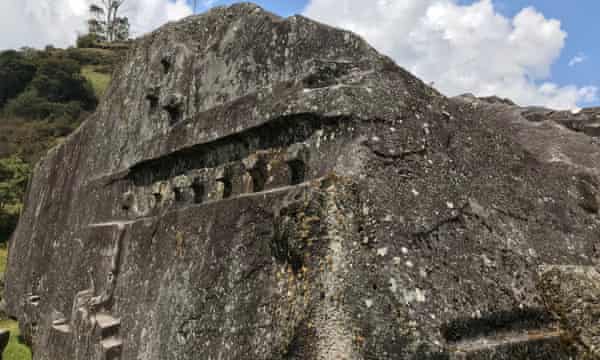
Peru:
Aramu Muru

Rosaspata
Turkey:
Midas

Fethiye

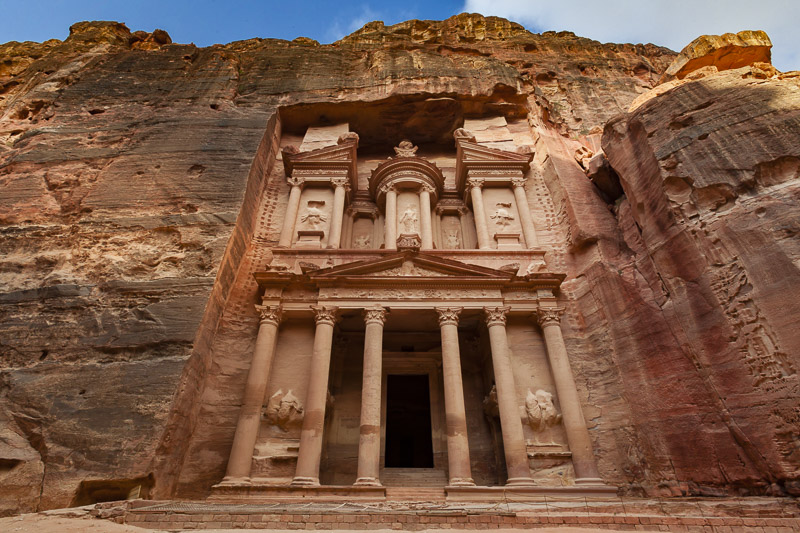
Jordan:
Petra
Iran:
Naqsh-e Rostam

Bali:
Gunung Kawi

India:
Kailasa

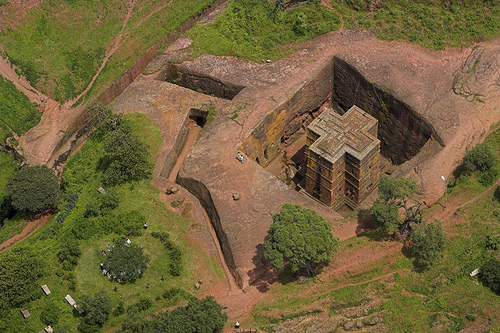
Ethiopia:
Lalibela
China:
Yangshan

Egypt:
Abu Simbel

Afghanistan:
Takht-e Rostam

Feel free to add anything I may have missed!

With all the evidence of machining marks at these sites, the ancient builders clearly didn't use primitive tools to precisely cut and finish/polish monster granite and basalt blocks.

I found these two videos to be very interesting


yes, there are machining marks, but from the abrasive saws and compounds used to smooth out the stone. There are even theories about basic chemistry being used to help soften the stone such as acids or water based mixtures. Over the course of years or decades this could have been done. We are just used to machining marks like this coinciding with advanced machining technology which is not always the case.
No one is spending decades polishing a basalt pillar.
Look at the quarry videos I posted. Those uniform machines marks aren't done with hand chisels .

There's a common theme you'll see at these sites are the extra large doors/false doors. Some of them are high off the ground too which makes no sense.
Armenia:
The spynx enclosure is solid stone.I didn’t say decades polishing a column, I said the whole process might take decades. If that was mis-communicated I apologize. Plus, the columns would have most likely been done together so an entire floor of them could have been done within the same time frame. The final polishing may not have taken all too much longer (maybe a few months to get the final level of smoothness) once the overall form was roughed out.
And you’d be surprised how long ancients spent on their prized projects making sure every detail was correct. Again, with as much time and man power the ancients has, many of these projects were possible.
I mean the Sphinx face / body was said to have taken 3-4 years with hundreds of workers and it didn’t have the level of detail or the hardness of stone that the basalt column had, so I wouldn’t be surprised about years or decades for columns if the outcome had to be flawless.
Even structures like lot of cathedrals out there were completed over decades or hundreds of years and multiple generations of artisans because of the level of detail of the sculptures. That was with better technology as well.
Finally, stone can be quarried pretty smoothly by using a series of shims (wedges) along the axis that you want to split. A lot of times the split face is incredibly smooth. It is time consuming but the end result is amazing. Custom stone masons still use that same idea at times to split large boulders (except with charges instead of shims / “hammers”) Other large sections were most likely cut with large abrasive saws.
The spynx enclosure is solid stone.
you ain’t chiseling that whole damn place out.

There's a common theme you'll see at these sites are the extra large doors/false doors. Some of them are high off the ground too which makes no sense.
Armenia:

We're talking about anal now right?They are magic doors and you have to know how to access them to enter into the secret realm.
<[analyzed}>We're talking about anal now right?
I didn’t say decades polishing a column, I said the whole process might take decades. If that was mis-communicated I apologize. Plus, the columns would have most likely been done together so an entire floor of them could have been done within the same time frame. The final polishing may not have taken all too much longer (maybe a few months to get the final level of smoothness) once the overall form was roughed out.
And you’d be surprised how long ancients spent on their prized projects making sure every detail was correct. Again, with as much time and man power the ancients has, many of these projects were possible.
I mean the Sphinx face / body was said to have taken 3-4 years with hundreds of workers and it didn’t have the level of detail or the hardness of stone that the basalt column had, so I wouldn’t be surprised about years or decades for columns if the outcome had to be flawless.
Even structures like lot of cathedrals out there were completed over decades or hundreds of years and multiple generations of artisans because of the level of detail of the sculptures. That was with better technology as well.
Finally, stone can be quarried pretty smoothly by using a series of shims (wedges) along the axis that you want to split. A lot of times the split face is incredibly smooth. It is time consuming but the end result is amazing. Custom stone masons still use that same idea at times to split large boulders (except with charges instead of shims / “hammers”) Other large sections were most likely cut with large abrasive saws.