• Xenforo Cloud is upgrading us to version 2.3.8 on Monday February 16th, 2026 at 12:00 AM PST. Expect a temporary downtime during this process. More info here

What is the expected variability in strength bands?

Devil's_Advocate

Silver Belt
@Silver
Joined
Feb 13, 2006
Messages
10,512
Reaction score
11,282
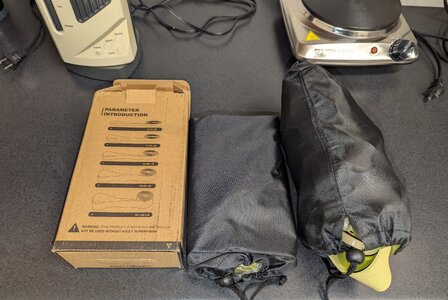
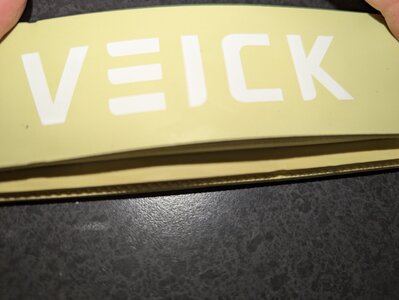
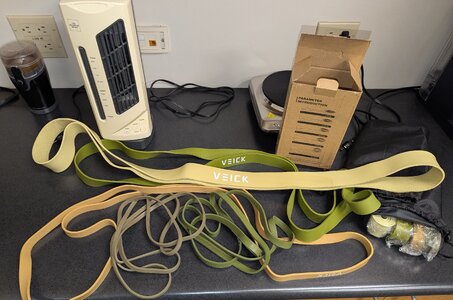
So I got some Vieck strength bands (5 sizes) on temu for 8$ total thanks to a deal (it was 17-18$ otherwise at the time). It later got sold out and relisted at absurd prices 40-100$. So i checked Amazon and saw they had them for 24$ so I jumped on it so I could have a pair of each.

I now tried my largest 50-125lb one and it's around 1cm narrower. The color is also slightly off(but I don't really care about slight color differences). Is this normal? How much weaker is it?

As far as quality they appear notably better than the cheaper generic ones I've bought on Temu recently. The cheaper ones feel clammy (not sure what's the proper word for it).
PXL_20250821_060310201.jpg


PXL_20250821_055417047~3.jpg

PXL_20250821_054912102~2.jpg
 
Last edited:
With bands, you have several factors influencing the resistance curve, including but not limited to material, construction (extruded or dipped), Shore hardness, and size of cross-section. Latex tends to have a fairly linear resistance curve for up to 400+% stretch, silicone is more progressive (softer in the beginning, steeper in the end), TPU can start out much stiffer than the rest (high initial resistanve), mixed materials tend to fall somewhere in between. Higher shore hardness (over 40) means more resistance, but lower flexibility, etc.
In general, I found that most manufacturers seem to either give no resistance ratings or fairly random ones, and usually, they are way too high. If you want to know the actual resistance at a given extension, I would recommend you test them yourself, using either a spring scale, luggage scale or dynamometer, or by seeing how much weight it will hold at a certain extension.
 
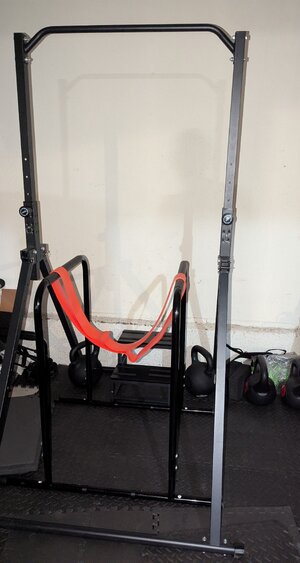
I tried standing on my 250lb band I recently got on Temu and I was able to get it stretch to the floor so clearly it's less than 230lb.

PXL_20250822_080647790~2.jpg
 
Well, with that setup, you de facto doubled the band, so it's actually less than 115 lbs at what I would guess is around 150% stretch.


That's a great point.

I'll try tying it at the top like I normally do and see if there's any major difference.

I got really good training effect though from doing it this way. My lats were spasming afterwards and upper shoulders and back were also smoked.

I got 22 assisted wide grip pull ups (which isn't all that wide on here) and 30 assisted close grip chin ups.
 
I tried standing on my 250lb band I recently got on Temu and I was able to get it stretch to the floor so clearly it's less than 230lb.

View attachment 1109767

That's been my experience as well. I grabbed a band that had "600 lbs of resistance", strapped it to the floor and a barbell, and deadlifted it.

I haven't even cleared 500lb on my deadlift, no way that's accurate.
 
That's been my experience as well. I grabbed a band that had "600 lbs of resistance", strapped it to the floor and a barbell, and deadlifted it.

I haven't even cleared 500lb on my deadlift, no way that's accurate.

The bands are a bit weird. It also comes down to how you hook them on.

When I tied it into a single knot at the top of the pull up bar and tried doing a couple pull ups it actually came to about the claimed value. I still don't know what it is but it was able to support me at 230lb.

However when I draped it this way it only provided part of the claimed resistance.
 
The bands are a bit weird. It also comes down to how you hook them on.

When I tied it into a single knot at the top of the pull up bar and tried doing a couple pull ups it actually came to about the claimed value. I still don't know what it is but it was able to support me at 230lb.

However when I draped it this way it only provided part of the claimed resistance.
It just occured to me that your test may have been more complex than we might think. The way you used the band in your first test is a bit like a hanging bridge, so we would be in the field of rope statics (forces can be significantly greater than in an application perpendicular to a single anchor point). Too tired for the math right now - it's past midnight here - but maybe food for thought.
 
It just occured to me that your test may have been more complex than we might think. The way you used the band in your first test is a bit like a hanging bridge, so we would be in the field of rope statics (forces can be significantly greater than in an application perpendicular to a single anchor point). Too tired for the math right now - it's past midnight here - but maybe food for thought.

That's what it was.

When I tied it like I normally do in a single knot at the top of the pull up bar it held up my weight no problem.

I suspect it provided near the minimum resistance with the way I used it because it's rated 60-250lb iirc. So to get it to stretch at all you need at least 60lb of load/resistance.
 
That's what it was.

When I tied it like I normally do in a single knot at the top of the pull up bar it held up my weight no problem.

I suspect it provided near the minimum resistance with the way I used it because it's rated 60-250lb iirc. So to get it to stretch at all you need at least 60lb of load/resistance.
In my experience, bands will stretch under any load, just in small amounts - they start at zero pull and don't jump start at 60 lbs. They may however not stretch far under less... but I freely admit that's splitting hairs and may be attributed to my band fetishism ;)

The way I understand the physics of hanging bridges, the force is multiplied towards the anchor points, depending on their spacing etc. So by spacing the two anchors out, you increased the load in the band, therefor it stretched more. Just like a hanging rope may support you, but the same rope stretched between two anchor points may break under your weight. Think any Indiana Jones movie ever. That's also what may have cost extreme climber Dan Osman his life a number of years back - he did a bungee jump (using dynamic climbing rope) from a hanging bridge made of climbing rope, and miscalculated the amount of rope he needed apparently.
 
In my experience, bands will stretch under any load, just in small amounts - they start at zero pull and don't jump start at 60 lbs. They may however not stretch far under less... but I freely admit that's splitting hairs and may be attributed to my band fetishism ;)

The way I understand the physics of hanging bridges, the force is multiplied towards the anchor points, depending on their spacing etc. So by spacing the two anchors out, you increased the load in the band, therefor it stretched more. Just like a hanging rope may support you, but the same rope stretched between two anchor points may break under your weight. Think any Indiana Jones movie ever. That's also what may have cost extreme climber Dan Osman his life a number of years back - he did a bungee jump (using dynamic climbing rope) from a hanging bridge made of climbing rope, and miscalculated the amount of rope he needed apparently.

I think I'd give you a run for your money with bands even though I don't use them all that much.

I have them from 5-10lb to 250lb. The 250lb you will not budge with anything less than what it says. It's hefty band. You will not half ass pull it apart...

On machines the more anchor points the less actual weight is being lifted. From what I read a weight stack held up at one point is the whole stack (with the difference in the strength curve still in effect) whereas if there are 2 points then is 1/2 and if there are 4 points it's 1/4. It is why some machines feel a lot easier than others. Not sure if it applies to bands. The band was looped over two handles (dip bars) so I am thinking maybe it was 1/2. I have no clue though. If someone more knowledgeable can weigh in I'd appreciate it.

This is the band in question:

https://share.temu.com/i366JQzQvMC

I got it on sale for around 10$ per band.
 
Last edited:
I think I'd give you a run for your money with bands even though I don't use them all that much.
I would be pleasantly surprised if that's the case - so far, the only people I've come into contact with for whom that was so were Andrew Hunter of Willpower Bands and the folks of Dopamineo.
I have them from 5-10lb to 250lb. The 250lb you will not budge with anything less than what it says. It's hefty band. You will not half ass pull it apart...
A band that is 250 lbs - XXX lbs? Haven't had one of those. And yes, manufacturers give all kinds of ratings for their bands, but in my experience, the first number typically isn't the minimum resistance to stretch the band at all.
On machines the more anchor points the less actual weight is being lifted. From what I read a weight stack held up at one point is the whole stack (with the difference in the strength curve still in effect) whereas if there are 2 points then is 1/2 and if there are 4 points it's 1/4. It is why some machines feel a lot easier than others.
With machines, it's usually fixed or loose rolls; a different form of mechanics applies there (pullies).
Not sure if it applies to bands. The band was looped over two handles (dip bars) so I am thinking maybe it was 1/2. I have no clue though. If someone more knowledgeable can weigh in I'd appreciate it.
As I hinted last night, the math (it falls in the field of rope statics or catenary) is rather complex, even more so because the "rope" in question is stretchy, and therefore some factors of the formula would change during the test. I found a German excel sheet to calculate the necessary breaking force of the rope, and when entering the estimated values of your test (witdth l 0.7 m, hang h 0.3 m, force m 100 kg, tension at rest fs 0 kg) the answer was that the neccessary breaking force was 2860 N (= 291.5 kg) 0 while the neccessary breaking force to suspend 100 kg vertically is only marginally higher than the weight itself. Now, there are some caveats with that - hang h changes during the test, and according to the sheat, the calculated breaking force is supposed to be 3x higher than the actual force (but then again, the "rope" is dynamic, not static, which is bound to have an impact).
 
I would be pleasantly surprised if that's the case - so far, the only people I've come into contact with for whom that was so were Andrew Hunter of Willpower Bands and the folks of Dopamineo.

A band that is 250 lbs - XXX lbs? Haven't had one of those. And yes, manufacturers give all kinds of ratings for their bands, but in my experience, the first number typically isn't the minimum resistance to stretch the band at all.

I believe it's rated 60lb at the lower end so that's probably what it takes and 250lb at full extension. The band is stated to extend 3x
With machines, it's usually fixed or loose rolls; a different form of mechanics applies there (pullies).

As I hinted last night, the math (it falls in the field of rope statics or catenary) is rather complex, even more so because the "rope" in question is stretchy, and therefore some factors of the formula would change during the test. I found a German excel sheet to calculate the necessary breaking force of the rope, and when entering the estimated values of your test (witdth l 0.7 m, hang h 0.3 m, force m 100 kg, tension at rest fs 0 kg) the answer was that the neccessary breaking force was 2860 N (= 291.5 kg) 0 while the neccessary breaking force to suspend 100 kg vertically is only marginally higher than the weight itself. Now, there are some caveats with that - hang h changes during the test, and according to the sheat, the calculated breaking force is supposed to be 3x higher than the actual force (but then again, the "rope" is dynamic, not static, which is bound to have an impact).

I'll take your word for it as it's beyond my knowledge.


Here's what ChatGPT listed given the band attributes I inputed:

"Okay, let’s carefully break this down.

We’ve got:

Band length (unstretched): 81.9 in

Band thickness (width): 3.27 in (I’ll assume you meant width, not literal "thickness," since bands are usually rated by width)

Strength rating: 60 lb (min) – 250 lb (max)

Stretch limit: 3× its original length (so max stretched length = 3 × 81.9 = 245.7 in)


---

Step 1 – Understand what "60–250 lb" means

Resistance bands aren’t constant-force devices. The rating is the force range depending on stretch:

60 lb ≈ at the start of the usable stretch

250 lb ≈ at the maximum safe elongation (here, ~3× length).


So the force ramps up as you pull farther. The band behaves roughly like a non-linear spring, but manufacturers simplify it with a min–max rating.


---

Step 2 – Stretch ratio

Unstretched = 81.9 in
Max stretched = 245.7 in
So total additional stretch = 245.7 − 81.9 = 163.8 in


---

Step 3 – Approximate force per inch

If the band truly ramps from 60 lb → 250 lb across 163.8 in:

\text{slope} = \frac{250 - 60}{163.8} = \frac{190}{163.8} \approx 1.16 \,\text{lb per inch of stretch}

That means:

At 0 stretch (just taut), it’s ~60 lb

At half stretch (81.9 in extra, total length ≈ 164 in), it’s about:


60 + 1.16 \times 81.9 \approx 155 lb


---

Step 4 – Answering your question

Minimum strength: ~60 lb (when just starting to elongate)

Maximum strength: ~250 lb (at 3× length, 245.7 in total)

Force curve: roughly linear at ~1.16 lb per inch of stretch, but in practice the curve is slightly exponential (stiffer near max).


---

✅ So, your band pulls ~60 lb → 250 lb depending on how far it’s stretched, and you can estimate resistance at any length using that slope.

"Here’s the force at each stretch multiple: 1.0× (81.9 in): ~60 lb 1.5× (122.9 in): ~107.5 lb 2.0× (163.8 in): ~155 lb 2.5× (204.8 in): ~202.5 lb 3.0× (245.7 in): ~250 lb That’s the approximate linear progression from its rated 60–250 lb range."

Screenshot_20250930-233609~2.png

Not sure if this helps your calculations....
 
I believe it's rated 60lb at the lower end so that's probably what it takes and 250lb at full extension. The band is stated to extend 3x
If a band is rated 250 lbs @ 300%, it's typically closer to 60 lbs @ 100%; with latex, you usually get a fairly linear strength curve that gets steeper towards the end of the pull. So I would expect something like 130-140 lbs @ 200% and 250 at 300% (ratings will vary according to temperature, though).
But then again, manufacturers are typically fairly intransparent about the strength curve of their bands. I can't really understand why at least the big names don't publish those, it's not like they are that hard to test.
 
Back
Top