
You are using an out of date browser. It may not display this or other websites correctly.
You should upgrade or use an alternative browser.
You should upgrade or use an alternative browser.
vertical jump measurements don't make sense
- Thread starter Fedorgasm
- Start date


- Joined
- Sep 2, 2012
- Messages
- 14,610
- Reaction score
- 2,688
What this means is that they must be measuring the players jump by the distance from the ground to their feet. This seems like a flawed way to measure though, because if I were an athlete and I wanted to ensure I get the highest draft position possible, then I would start practicing pointing my toes upward once I'm in the air. This could add several inches to my published vertical.
1:14
But with the bars that doesn't matter as @HunterSdVa29 pointed out in both posts.
- Joined
- Sep 2, 2012
- Messages
- 14,610
- Reaction score
- 2,688
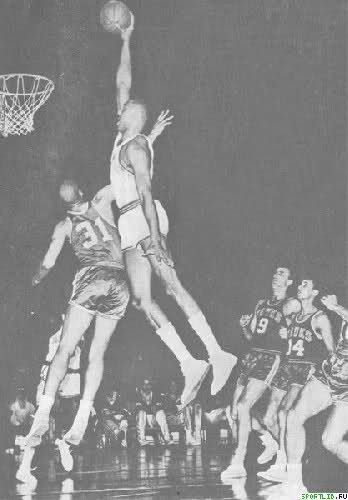
Those pics are certainly impressive but you guys think Wilt's vertical was higher than Jordan's? Because that's what that link I posted is claiming. They list Wilt with a 48"
and Jordan with 46"
Who knows, dude could soar. He did track and field before basketball.

- Joined
- Nov 17, 2006
- Messages
- 51,204
- Reaction score
- 15,880
I still think you can argue he is the GOAT, i'm not sure but wouldn't argue with anyone who said he was.
Wilt was no joke. He wasn't like most plodding clumsy looking 7 footers. That dude was athletic as fuck. I honestly believe that he could compete in any era of basketball.

- Joined
- Sep 28, 2002
- Messages
- 8,315
- Reaction score
- 7
A guy could try to alter his standing measurement to make his vertical jump more impressive but these aren't one time tests. These athletes, especially basketball players, are having their height measured, arm length measured, doing these tests through high school, camps, summer leagues, college, pro combines.Thanks for explaining, I actually didn't know that.
BUT
We effectively have the same problem, right? In that the jumper can alter one of the measurements?
So if I'm standing there and you tell me to stretch my arm up, I'll put it up. But then if you put a gun to my balls and say raise that arm higher, you can bet that my arm would be able to reach an inch or two higher.
So in that first measurement, guys know they can play with shoulder angle and whatnot to make their hand not quite so high, which could add another inch to their vertical.
So, he would need to do the same short arming every time and eventually someone is going to notice.
Plus, why even bother? The slight difference isn't going to make or break your spot on a team.

- Joined
- Jan 15, 2009
- Messages
- 28,856
- Reaction score
- 26,062




The tennis coach at my high school could dunk. He was a 5'3" Asian dude with calves the size of footballs. He was probably in his mid 30's at the time.
It was SPECTACULAR to see. He threw it down hard with two hands.

- Joined
- Jun 13, 2005
- Messages
- 66,682
- Reaction score
- 38,655
The NBA and NFL both make the players do this to measure their vertical jump:
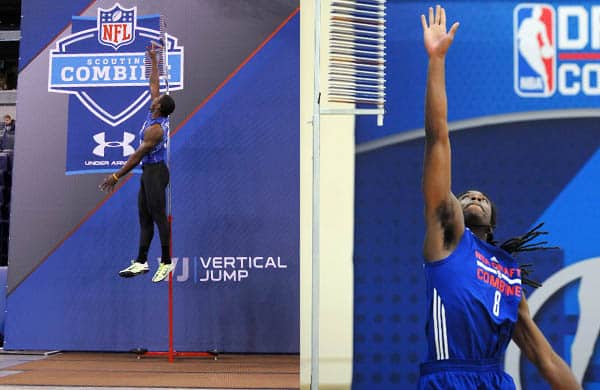
You jump and slap the little bars. Makes sense, right? Except for when they publish your results, they all have measurements in the neighborhood of 38"-48"
That's way too low for it to be the measurements of the little bars they're touching. Those things are like 140" or higher.
What this means is that they must be measuring the players jump by the distance from the ground to their feet. This seems like a flawed way to measure though, because if I were an athlete and I wanted to ensure I get the highest draft position possible, then I would start practicing pointing my toes upward once I'm in the air. This could add several inches to my published vertical.
And if they started measuring from the heel, then I could bend my knees and lift my feet really high, which could add another foot or more to my vertical. Kind of like how guys do box jumps. The guy in the pic below gets his feet 64 inches off the ground.

So how would you measure vertical jumps? If you measure from the highest thing they can reach, then tall guys have an advantage even though they don't appear to be jumping that high. But if you measure from their feet, then the best leg-tuckers would win, even though someone else might jump higher but not be as flexible and quick at tucking their legs.
Two trolls in one thread? Anyone who believes Wilt had the highest vert in NBA history is quite gullible.I assume you're talking about subtracting the person's height, but then Wilt's jump doesn't make sense.
According to this site, Wilt has the highest vertical in NBA history, but once you subtract his height then he shouldn't be at 48"
http://theexercisers.com/how-to-inc...e-vertical-jump/highest-vertical-jump-in-nba/
Ten years old, now. One of the best features ever done on vertical leap in pro basketball. In terms of a combination of spike reach and max vert 6'7" James White almost certainly remains the most remarkable leaper in NBA history:
James White vs. a Jumping Myth

Officially, through recorded combine history, which goes back to the year 2000, despite that some of the best players skip the Draft to avoid negative hype, 6'6" Kenny Gregory still holds the highest recorded max vertical leap ever actually recorded (45.5"). Nevertheless, he went undrafted, and so he never played in the NBA. Still I would estimate James White the greater leaper, but these two would have to be close:

Meanwhile, the obligatory "basketball players ain't shit" vert vid. Old school viral. One of my all-time favorites:
Last edited:
- Joined
- Jun 13, 2005
- Messages
- 66,682
- Reaction score
- 38,655
Even thought 6'9" Dwight couldn't climb as high on the mountain as James White he was no joke in his prime:
The world record is still officially held by the Globetrotter 6'6" Michael Johnson, but Dwight's was more impressive, IMO, because he did it with two hands, his arms were bent, and he actually jammed it. I did see Michael complete an alley-oop on a 12'2" setting over a decade ago, but he didn't put it down to the judging satisfaction, and they didn't count it as a dunk (even though it looked like one to me). I can't find that vid:
The world record is still officially held by the Globetrotter 6'6" Michael Johnson, but Dwight's was more impressive, IMO, because he did it with two hands, his arms were bent, and he actually jammed it. I did see Michael complete an alley-oop on a 12'2" setting over a decade ago, but he didn't put it down to the judging satisfaction, and they didn't count it as a dunk (even though it looked like one to me). I can't find that vid:
Last edited:


