The Star Trek Thread, V5.0

Status
Not open for further replies.
Still haven't watched the new series yet.
As a huge Trek fan, I need the correct moment.
I wonder how it is. Will watch soon.

I think the moment may be now or at least very soon. In any case I would not wait until January because I expect major spoilers to be all over the place then.
 
Good episode, always love a time-loop story. As I said before, Groundhog Day episodes in sci-fi shows always tend to be one of their best.

A few holes though like why wasn't there a scenario where they did NOT beam the space whale on board or Mudd's "victory" at the end where lots of things go have gone wrong for him (and did) after they rejoined the timestream like how easily Mudd was overpowered.
 
Really liked the episode.. Lorca and the new military guy are the best characters on the show..

Would prefer less focus on Michael (dont like her).. the gangly alien dude and the ginger women all are kinda meh.. they should build up some more characters
 
Really liked the episode.. Lorca and the new military guy are the best characters on the show..

Would prefer less focus on Michael (dont like her).. the gangly alien dude and the ginger women all are kinda meh.. they should build up some more characters

I think the characters are fine, but the focus on Burnham means less time for the others. The last episode was technically a Stamets episode, but because Burnham is the focus, she got 'told' most of what the action was by Stamets.
 
Lol Burnham has one of the worst running forms Ive ever seen. It's like she's bouncing or something. ...i feel like Im missing something and it's supposed to be intentional or something. .

Good episode. Im real enjoying this show. Too much focus on Burnham though.
It is a bit weird how they have shown a few other crewmates regularly, but haven't given them any speaking roles yet..
Theres too much Burnham. I love the captain and the security officer guy though.
 
I think the characters are fine, but the focus on Burnham means less time for the others. The last episode was technically a Stamets episode, but because Burnham is the focus, she got 'told' most of what the action was by Stamets.

You like the ginger girl? Yeah i mean i never watched the old star wars series.. but did they have like a few main characters rather then just 1? The doctor and Stamets have grown on me a bit i must say.. Maybe the blue alien will get more shine soon
 
I'm just glad they still like to party in the future. I wonder if Discovery has a 10 forward like area?
 
Encounter on far point was on TV, and it really puts into perspective, how well discovery is actually doing for its 1st season. Encounter is very cringe worthy. The acting is just so stiff and wooden, and trying to show how perfect we have become in the 24th century. Now don't get me wrong, I still love it and think it's great, but other than the controversial first Episode, discovery has been consistent and great TV.

And you gotta love Troi wincing in agony any time there is a emotion....
 
Encounter on far point was on TV, and it really puts into perspective, how well discovery is actually doing for its 1st season. Encounter is very cringe worthy. The acting is just so stiff and wooden, and trying to show how perfect we have become in the 24th century. Now don't get me wrong, I still love it and think it's great, but other than the controversial first Episode, discovery has been consistent and great TV.

And you gotta love Troi wincing in agony any time there is a emotion....

Recently saw TNG 1x04 on German TV and man, that was horrible.
 
Recently saw TNG 1x04 on German TV and man, that was horrible.
farpoint_hd_645.jpg
 
Lol Burnham has one of the worst running forms Ive ever seen. It's like she's bouncing or something. ...i feel like Im missing something and it's supposed to be intentional or something. .
Lol so true. Her jogging is so awkward.
 
Lol Burnham has one of the worst running forms Ive ever seen. It's like she's bouncing or something. ...i feel like Im missing something and it's supposed to be intentional or something. .
yeah, i agree completely. i find awkward running really distracting in tv shows and movies, and it was really bad in these two episodes. i think it's because the camera is moving slowly so she has to jog as though it's at a normal pace when it's actually much slower. i don't know, but it's really bad.


Discovery' interview Sonequa Martin-Green, Jason Isaacs were interviewed on the BBC The One show.
 
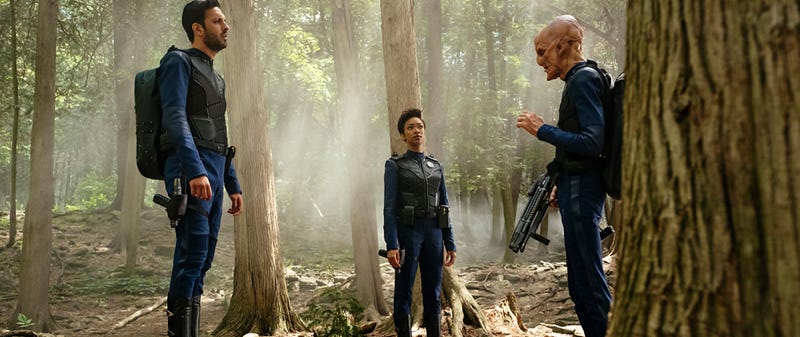
First mission on a planet this week. Pretty amazing cinematography, and some great location shoots for the planet. This isn't the old generic trek cave set, or the paramount back lot. Pretty cool seeing some of Saru's abilities(Stronger than average, can run over 80kph). Interesting to see what happens with L'rell now.

Next week it is the fall finale for Discovery, before it takes the Holiday season off, and comes back in Jan. This show has great so far, and quality seems to build each week.

do5zsm9mjxl58sxfrsc6.jpg
 
Still early but having hard time getting into this, other then the war i'm not seeing much of an arc here except for the captain and would have to see him die but have a bad feeling hes gonna get whacked.

Most characters are brutally bad and so few of them getting focused. It need more space warfare for fucks sake its the klingon war.

Typical ST BS the klingons being total pussies, seriously lol these are warriors.
 
gave up on this series after episode 6
I really dislike episodes where they have multiple timelines and one character has to figure out its the fucking groundhog day and how to revert it (TNG did it the best with Q and picard - that was brilliant writing and execution)

this isnt helped by the fact that acting is poor - burnham and that security officer romance is weak, ginger girl still sucks and they want to sell her as some tough girl that just needs some hardening and that dude from the office, my god, I havent seen a performance so bad on TV for some time now (it was like he was doing a satire of the original star trek overacting)

actors doing the gay couple (engineer and doctor) suck at acting - maybe its just the case of getting into the role and being more relaxed with your coworkers, which takes time (usually in other shows its around season 2 that everyone click together)

even the CGI is bad in shots that dont show discovery

klingons, the starfleet archenemy, still suck and get defeated by unarmed human prisoners of war - which makes this whole war pointless as klingons dont seem all that much trouble (except for cloaking tech which gets nullified by star fleets "teleport to any point in space" tech)

vulkans have become this all powerful race that can communicate over any distance, yet they have trouble dealing with other races

I honestly dont get how anyone can consider this good considering there are so many good TV shows available in this day and age
 
Wow the mid season finale was jammed packed. We had the first Nudity, first man on man kiss, Burnhams redemption, Tylers PTSD/Rape and some epic action and space battles. And I love the many shades of captain Lorca, he brilliantly battles the Klingon's, then send his crew across the galaxy. Its looking like Lorca, could be from the mirror universe. It will be interesting to see, how he arrived in the prime timeline or who sent him.
 
The latest episode is getting quite a bit of buzz, about Male rape survivors. I still think Tyler is Voq in disguise, but this episode is making me question that.

Star Trek: Discovery’s latest episode makes a rare point about male rape survivors


The other conversation about sexual assault we need to have

DJ3TD1sVYAAnOUd.0.jpg


It’s been a long time since a Star Trek television show felt like it was really going where no one had gone before — or even to relatively infrequently visited places. Although the original 1966 series dared to feature an interracial kiss, the franchise as a whole missed the boat on LGBT representation until it was already mainstream. And between Star Trek: Enterprise and the reboot films, the Trek series has spent the last decade flailing around in lackluster retreads of its own tropes.

But in the November 12th episode “Into the Forest I Go” Star Trek: Discovery explored a subject that few mainstream shows have had the guts to tackle meaningfully: the rape and sexual abuse of men. The subject is even more important amid the current conversation about sexual assault, inspired by an avalanche of accusations in the entertainment industry, which are still rolling out at a feverish pitch.

Most of these accusations have been made by women against powerful men, but Star Trek: Discovery actor Anthony Rapp is a reminder that women are not the only victims of predatory sexual advances. Rapp, who plays science officer Lieutenant Paul Stamets, recently accused actor Kevin Spacey, 12 years his senior, of attempting to sexually assault him when he was only 14. Like Rose McGowan’s accusations against Harvey Weinstein, Rapp’s story set off a cascade of reports from more than a dozen other men who say Spacey assaulted them, which led to Netflix cutting ties with the House of Cards star and Ridley Scott replacing Spacey in a completed film. The accusations may even result in criminal charges for Spacey.

As our culture grapples with the endemic nature of sexual abuse, we cannot ignore the assaults experienced by men, or the way they are often silenced by stigmas and myths: that being raped is emasculating and signifies weakness; that it is impossible for women to rape boys or men; or that men are not traumatized by unwanted come-ons from women, because they are always eager for sex.

The unexpected poster child for this conversation on Star Trek: Discovery is the ship’s chief of security, Lieutenant Ash Tyler (Shazad Latif). Tyler is first seen in the episode “Choose Your Pain” where he shares a cell in a Klingon prison with the captured Captain Lorca (Jason Isaacs). When Tyler reveals that he’s been held captive for more than seven months, Lorca is incredulous. No one survives Klingon torture that long, he insists. Tyler pauses. “The captain of this ship — she’s taken a liking to me,” he says. Lorca’s expression tightens; he knows what that means.

Like many survivors before him, Tyler finds that escaping from his abuser isn’t easy — physically or psychologically. During the inevitable prison break, as he tries to limp to the escape ship, the Klingon captain L’rell appears to block his way. “Did you really think you could leave me?” she hisses, looming in front of him. “After all we’ve been through?” He grapples with her, punches her with a wild fury, and makes his way out, clearly shaken.

On television, personal trauma has a way of disappearing at the end of an episode, once the immediate drama and emotional impact has passed. But with the mid-season finale “Into the Forest I Go,” Discovery acknowledged the ugly reality that it’s rarely easy to move on after sexual assault. Although Tyler seems to thrive in his new life on Discovery, and his role as security chief, even starting a romance with Michael Burnham (Sonequa Martin-Green), his scars persist beneath his affable surface.

“You put on a facade, like everything that happens to you just washes off,” Burnham tells him. But the lasting impact of his wounds come into play when Tyler surreptitiously beams to a Klingon flagship for a mission, and comes face-to-face yet again with the woman who raped and tortured him. This time, his reaction is even more profound. Despite all his battle training, he freezes, unable to fire his weapon, and he loses himself in a series of horrifying flashbacks.

Later, he tells Burnham that his former captor is “the reason I’ve had nightmares every night since Captain Lorca and I fled her ship.” His voice starts to break. “She’s also the only reason I'm still alive. Two hundred and twenty-seven days. But it only took one to realize I wasn’t going to make it out alive. Not unless I made a choice.” That choice is familiar to many abuse survivors: resist and face violence or death, or cooperate with an abuser and try to get out alive.

“I encouraged it,” he says, tears in his eyes. “Her sick affections, her obsession with me, because if I hadn’t, I’d be dead like all the others. And I got out. I get to keep living my life.” Although he doesn’t seem ashamed, per se, he’s clearly haunted by his decision, and by the violations he had to suffer to save himself.

alleged that a male Hollywood executive groped his genitals at an event in 2016. Even though Crews is six-foot-three, 245 pounds, and known for his muscular physique, he did not feel he could fight back: “I didn’t want [to be] ostracized — par [for] the course when the predator has power [and] influence.”

Unlike the experiences Rapp and Crews describe — and the one Discovery depicts — the sexual assault of men is often played as a joke in media, where the punchline is that the man probably wanted it, or at least didn’t mind that much. Even Star Trek itself hasn’t always been immune to this pernicious myth. In “First Contact,” a 1991 Star Trek: The Next Generation episode, Commander Riker is imprisoned in a hospital on an alien planet, surrounded by a xenophobic populace that’s about to turn on him, and possibly kill him. He’s approached by a bespectacled female alien who offers to help him escape, but only if he has sex with her.

“I’ve always wanted to make love with an alien. It’s not so much to ask,” she wheedles, grabbing his hand as he pulls back. When he tries to make excuses to extract himself from the situation — he’s in a hurry, their biology might be incompatible — she keeps pressing, refusing to take no for an answer. “It’s your only way out of here,” she concludes.

The woman’s coercive ultimatum should send a chill down anyone’s spine, but instead, it’s staged as a minor bit of comedy, and Riker rolls his eyes and makes an “Oh well” expression before going along with it. Riker is, after all, a notorious womanizer, and it’s implied that he doesn’t mind entirely. This is just an amusing speed bump en route to his escape, rather than a serious incident of sexual abuse. (Male-on-male rape is often treated with similar levity, hence the prevalence of “don’t drop the soap” humor.) The show cuts to the woman aiding his escape, presumably after extracting whatever sexual acts she desired. It is never discussed again.

Like Tyler, Riker is trying to stay alive in a potentially fatal situation. Like Tyler, he is forced to trade sex for survival. But the implication is that his libido is so omnivorous that he has no boundaries to violate, and that even the most coercive and controlling sex is still a minor inconvenience at most. This scene is played for comedy, but it’s sickening — not only for its inherent awfulness, but also for the message it sends to male survivors who have been told that their assaults are laughable, hardly to be considered assaults at all.

Bravo to Star Trek: Discovery for acknowledging what men like Rapp and Crews already know, and that the rest of us have a moral imperative to recognize: sexual abuse can happen to anyone, even strong, heroic men; that it isn’t their fault, and perhaps most importantly, they aren’t alone.

 
The latest episode is getting quite a bit of buzz, about Male rape survivors. I still think Tyler is Voq in disguise, but this episode is making me question that.

Star Trek: Discovery’s latest episode makes a rare point about male rape survivors


The other conversation about sexual assault we need to have

DJ3TD1sVYAAnOUd.0.jpg


It’s been a long time since a Star Trek television show felt like it was really going where no one had gone before — or even to relatively infrequently visited places. Although the original 1966 series dared to feature an interracial kiss, the franchise as a whole missed the boat on LGBT representation until it was already mainstream. And between Star Trek: Enterprise and the reboot films, the Trek series has spent the last decade flailing around in lackluster retreads of its own tropes.

But in the November 12th episode “Into the Forest I Go” Star Trek: Discovery explored a subject that few mainstream shows have had the guts to tackle meaningfully: the rape and sexual abuse of men. The subject is even more important amid the current conversation about sexual assault, inspired by an avalanche of accusations in the entertainment industry, which are still rolling out at a feverish pitch.

Most of these accusations have been made by women against powerful men, but Star Trek: Discovery actor Anthony Rapp is a reminder that women are not the only victims of predatory sexual advances. Rapp, who plays science officer Lieutenant Paul Stamets, recently accused actor Kevin Spacey, 12 years his senior, of attempting to sexually assault him when he was only 14. Like Rose McGowan’s accusations against Harvey Weinstein, Rapp’s story set off a cascade of reports from more than a dozen other men who say Spacey assaulted them, which led to Netflix cutting ties with the House of Cards star and Ridley Scott replacing Spacey in a completed film. The accusations may even result in criminal charges for Spacey.

As our culture grapples with the endemic nature of sexual abuse, we cannot ignore the assaults experienced by men, or the way they are often silenced by stigmas and myths: that being raped is emasculating and signifies weakness; that it is impossible for women to rape boys or men; or that men are not traumatized by unwanted come-ons from women, because they are always eager for sex.

The unexpected poster child for this conversation on Star Trek: Discovery is the ship’s chief of security, Lieutenant Ash Tyler (Shazad Latif). Tyler is first seen in the episode “Choose Your Pain” where he shares a cell in a Klingon prison with the captured Captain Lorca (Jason Isaacs). When Tyler reveals that he’s been held captive for more than seven months, Lorca is incredulous. No one survives Klingon torture that long, he insists. Tyler pauses. “The captain of this ship — she’s taken a liking to me,” he says. Lorca’s expression tightens; he knows what that means.

Like many survivors before him, Tyler finds that escaping from his abuser isn’t easy — physically or psychologically. During the inevitable prison break, as he tries to limp to the escape ship, the Klingon captain L’rell appears to block his way. “Did you really think you could leave me?” she hisses, looming in front of him. “After all we’ve been through?” He grapples with her, punches her with a wild fury, and makes his way out, clearly shaken.

On television, personal trauma has a way of disappearing at the end of an episode, once the immediate drama and emotional impact has passed. But with the mid-season finale “Into the Forest I Go,” Discovery acknowledged the ugly reality that it’s rarely easy to move on after sexual assault. Although Tyler seems to thrive in his new life on Discovery, and his role as security chief, even starting a romance with Michael Burnham (Sonequa Martin-Green), his scars persist beneath his affable surface.

“You put on a facade, like everything that happens to you just washes off,” Burnham tells him. But the lasting impact of his wounds come into play when Tyler surreptitiously beams to a Klingon flagship for a mission, and comes face-to-face yet again with the woman who raped and tortured him. This time, his reaction is even more profound. Despite all his battle training, he freezes, unable to fire his weapon, and he loses himself in a series of horrifying flashbacks.

Later, he tells Burnham that his former captor is “the reason I’ve had nightmares every night since Captain Lorca and I fled her ship.” His voice starts to break. “She’s also the only reason I'm still alive. Two hundred and twenty-seven days. But it only took one to realize I wasn’t going to make it out alive. Not unless I made a choice.” That choice is familiar to many abuse survivors: resist and face violence or death, or cooperate with an abuser and try to get out alive.

“I encouraged it,” he says, tears in his eyes. “Her sick affections, her obsession with me, because if I hadn’t, I’d be dead like all the others. And I got out. I get to keep living my life.” Although he doesn’t seem ashamed, per se, he’s clearly haunted by his decision, and by the violations he had to suffer to save himself.

alleged that a male Hollywood executive groped his genitals at an event in 2016. Even though Crews is six-foot-three, 245 pounds, and known for his muscular physique, he did not feel he could fight back: “I didn’t want [to be] ostracized — par [for] the course when the predator has power [and] influence.”

Unlike the experiences Rapp and Crews describe — and the one Discovery depicts — the sexual assault of men is often played as a joke in media, where the punchline is that the man probably wanted it, or at least didn’t mind that much. Even Star Trek itself hasn’t always been immune to this pernicious myth. In “First Contact,” a 1991 Star Trek: The Next Generation episode, Commander Riker is imprisoned in a hospital on an alien planet, surrounded by a xenophobic populace that’s about to turn on him, and possibly kill him. He’s approached by a bespectacled female alien who offers to help him escape, but only if he has sex with her.

“I’ve always wanted to make love with an alien. It’s not so much to ask,” she wheedles, grabbing his hand as he pulls back. When he tries to make excuses to extract himself from the situation — he’s in a hurry, their biology might be incompatible — she keeps pressing, refusing to take no for an answer. “It’s your only way out of here,” she concludes.

The woman’s coercive ultimatum should send a chill down anyone’s spine, but instead, it’s staged as a minor bit of comedy, and Riker rolls his eyes and makes an “Oh well” expression before going along with it. Riker is, after all, a notorious womanizer, and it’s implied that he doesn’t mind entirely. This is just an amusing speed bump en route to his escape, rather than a serious incident of sexual abuse. (Male-on-male rape is often treated with similar levity, hence the prevalence of “don’t drop the soap” humor.) The show cuts to the woman aiding his escape, presumably after extracting whatever sexual acts she desired. It is never discussed again.

Like Tyler, Riker is trying to stay alive in a potentially fatal situation. Like Tyler, he is forced to trade sex for survival. But the implication is that his libido is so omnivorous that he has no boundaries to violate, and that even the most coercive and controlling sex is still a minor inconvenience at most. This scene is played for comedy, but it’s sickening — not only for its inherent awfulness, but also for the message it sends to male survivors who have been told that their assaults are laughable, hardly to be considered assaults at all.

Bravo to Star Trek: Discovery for acknowledging what men like Rapp and Crews already know, and that the rest of us have a moral imperative to recognize: sexual abuse can happen to anyone, even strong, heroic men; that it isn’t their fault, and perhaps most importantly, they aren’t alone.

I thought that whole scene was kinda lame TBH. They portrayed him as a much stronger character up until that moment.
 
I thought that whole scene was kinda lame TBH. They portrayed him as a much stronger character up until that moment.
But the point was to show how PTSD can effect one. Even someone who has been a badass until this point.
 
Status
Not open for further replies.
Back
Top