International Nepal: Anti-Corruption Crusader Named Nepal’s Leader After Gen Z Protests

Arkain2K

Si vis pacem, para bellum
@Steel
Joined
Dec 6, 2010
Messages
33,652
Reaction score
6,118

19 killed in Nepal in 'Gen Z' protest over social media ban, corruption


KATHMANDU, Sept 8 (Reuters) - At least 19 people in two cities died on Monday in Nepal's worst unrest in decades, authorities said, as police in the capital fired tear gas and rubber bullets at protesters trying to storm parliament in anger at a social media shutdown and corruption.

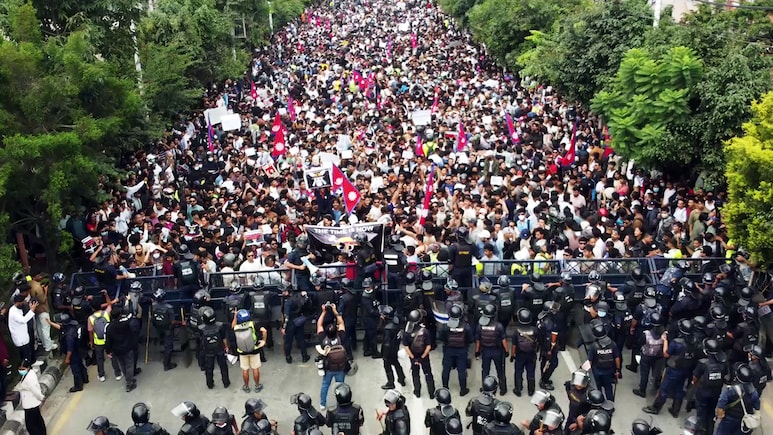
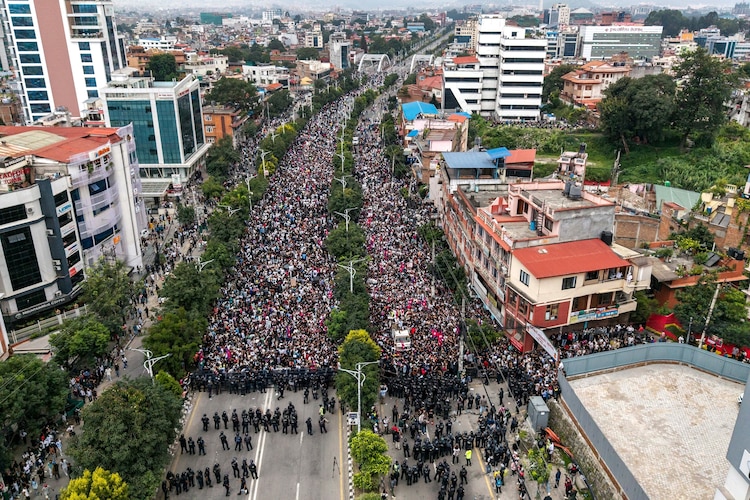
Some of the protesters, most of them young, forced their way into the parliament complex in Kathmandu by breaking through a barricade, a local official said, setting fire to an ambulance and hurling objects at lines of riot police guarding the legislature.

"The police have been firing indiscriminately," one protester told the ANI news agency. "(They) fired bullets which missed me but hit a friend who was standing behind me. He was hit in the hand."

More than 100 people including 28 police personnel were receiving medical treatment for their injuries, police officer Shekhar Khanal told Reuters. Protesters were ferrying the injured to hospital on motorcycles.

A government decision last week to block access to several social media platforms, including Meta Platforms' Facebook, has fuelled anger among the young. About 90% of Nepal's 30 million people use the internet.

Officials said they imposed the ban because platforms had failed to register with authorities in a crackdown on misuse, including false social media accounts used to spread hate speech and fake news, and commit fraud.

Two of the 19 people were killed when protests in the eastern city of Itahari turned violent, police said.

Home (interior) Minister Ramesh Lekhak resigned from the government after taking "moral responsibility" for the violence, another government minister, who requested anonymity because he was not authorised to speak with the media, told Reuters.

Prime Minister K.P. Sharma Oli called an emergency cabinet meeting to discuss the unrest, which erupted after thousands of young people, including many wearing their school or college uniforms, took to the streets earlier on Monday.

Many carried flags and placards with slogans such as "Shut down corruption and not social media," "Unban social media," and "Youths against corruption" as they marched through Kathmandu.

Organisers of the protests, which spread to other cities in the Himalayan country, have called them "demonstrations by Gen Z." They say the protests reflect young people's widespread frustration with the government's perceived lack of action to tackle corruption and boost economic opportunities.
"This is the protest by the new generation in Nepal," another protester told ANI.

International nonprofit organization Human Rights Watch said the government of Nepal should avoid perceiving these protests primarily through a law enforcement perspective and recognize that demonstrators’ mass outpourings of criticism reflect deep frustrations throughout Nepal with entrenched corruption, nepotism, and poor governance.

“Nonviolent means should be utilized before resorting to force," it said in a statement. "The use of force is only appropriate if other measures to address a genuine threat have proved ineffective.”

Police had orders to use water cannons, batons and rubber bullets to control the crowd and the army was deployed in the parliament area to bolster law enforcement officers, Muktiram Rijal, a spokesperson for the Kathmandu district office, told Reuters.

Violence abated later in the evening although protesters remained in the area outside parliament.

Police said similar protests were also held in Biratnagar and Bharatpur in the southern plains and in Pokhara in western Nepal.

Many people in Nepal think corruption is rampant, and the Oli government has been criticised by opponents for failing to deliver on its promises to tackle graft or make progress to address longstanding economic issues.

The Oli government has said the economy was recovering because of corrective measures it had taken.

Thousands of young Nepalis go abroad every year for work and education.

Nepal has been politically unstable since it abolished a 239-year-old monarchy in 2008. There have been 14 governments since 2008, not one of which has completed a full five-year term. Oli, 73, was sworn in to his fourth term last year.

Rameshwore Khanal, a former finance secretary, said although job creation is not up to expectations, popular anger appears to stem more from unhappiness with government appointments and its inability to stamp out corruption.

Nepal's social media shutdown comes as governments worldwide take steps to tighten oversight of social media and Big Tech due to growing concern about issues such as misinformation, data privacy, online harm and national security.

Critics say many of these measures risk stifling free expression, but regulators say stricter controls are needed to protect users and preserve social order.

 
Nepal Lifts Ban On Social Media Apps After Deadly Protests
Nepal's Minister for Communications and Information Technology Prithvi Subba Gurung announced the decision and said the government has appealed to the Gen Z to call off the protests.


Nepal Lifts Ban On Social Media Apps After Deadly Protests


The Nepal government was the first to blink. In a late-night decision, the government lifted the ban on social media apps after protests, led by Gen Z, turned violent, resulting in clashes with the police that led to the death of 19 people.

Nepal Minister for Communication, Information and Broadcasting Prithvi Subba Gurung announced that the government has withdrawn its earlier decision to ban social media sites.

"The government has already decided to open social media by addressing the demand of Gen-Z," said the minister, following an emergency cabinet meeting.

However, Mr Gurung also stated that the government does not regret its earlier decision to shut the social media platforms down.

"Since protests were being staged using this issue as a pretext, the decision has been taken to reopen social media sites," he said.

Mr Gurung also requested the 'Gen Z' group to call off their protest.

The cabinet also formed an investigation committee to look into the day's violence. It has been given 15 days' time to prepare a report.

During the cabinet briefing, Prime Minister KP Sharma Oli had said that one of the banned social media platforms, X, had responded in a manner that disrespected Nepal's national sovereignty.

According to a minister, X had stated that it would not register in Nepal at all.

"We had been saying this for one and a half years. We had asked them to get listed. We had asked them to comply with Nepal's laws. It is a matter of respecting our national sovereignty," Prime Minister Oli had said.

Last week, Nepal's government blocked access to several social media platforms after the companies missed the deadline to register under new regulations, aimed at cracking down on misuse.

Nepal's government has said social media users create fake IDs and use them to spread hate speech and fake news, commit fraud and other crimes on these platforms.

A government notice directed the regulator, Nepal Telecommunications Authority, to deactivate unregistered social media but gave no details of which platforms faced action.

Local media reported that the banned platforms include Meta's Facebook, Instagram and WhatsApp, Alphabet's YouTube, China's Tencent and Snapchat, Pinterest and X.

Earlier today, authorities imposed a curfew around the parliament building after thousands of the protesters tried to enter the legislature by breaking a police barricade. Police had orders to use water cannons, batons and rubber bullets to control the crowd.

Protesters carried placards carrying slogans such as "Shut down corruption and not social media", "Unban social media", and "Youths against corruption", as they marched through Kathmandu.

Many people in the Himalayan nation think corruption is rampant, and opponents have criticised the government of Prime Minister KP Sharma Oli for failing to deliver on its promises.

There have been several corruption cases reported in the last few years involving ministers, former ministers and high-profile officials.

Since the ban, videos contrasting the struggles of ordinary Nepalis with the children of politicians flaunting luxury goods and expensive vacations have gone viral on TikTok, which was not part of the banned social media platforms.

"There have been movements abroad against corruption, and they are afraid that might happen here as well," protester Bhumika Bharati told AFP.

In July, the government blocked access to the Telegram messaging app, citing a rise in online fraud and money laundering. It lifted a nine-month ban on TikTok in August last year after the platform agreed to comply with Nepali regulations.

The United Nations has demanded a swift and transparent probe of the violence.

"We are shocked by the killings and injury of protesters in Nepal today and urge a prompt and transparent investigation," UN rights office spokeswoman Ravina Shamdasani said in a statement.

 
This is a fascinating part of the world IMO.
I was there many years ago, on a guided 'trek' to base camp.

I also spent some time in Tibet, when Westerners were even allowed there, and the presence of Chinese troops
and subsequent oppression was palpable.
Totalitarian regimes must fall.
 
This is a fascinating part of the world IMO.
I was there many years ago, on a guided 'trek' to base camp.

I also spent some time in Tibet, when Westerners were even allowed there, and the presence of Chinese troops
and subsequent oppression was palpable.
Totalitarian regimes must fall.


Yeah I'm gonna go to Nepal for a month in the spring. It seems like a place that can flare up though.
 
It's the third world. If the west is corrupt but somehow functional, the third world is not.

Not surprised at all.

Social Media can be used to ignite or support a revolution, the elite in place are scared of that risk, they can't control social media potential to lead to a social uproar, censor is still a poor hand to play.
 
Nepal Lifts Ban On Social Media Apps After Deadly Protests
Nepal's Minister for Communications and Information Technology Prithvi Subba Gurung announced the decision and said the government has appealed to the Gen Z to call off the protests.


Nepal Lifts Ban On Social Media Apps After Deadly Protests


The Nepal government was the first to blink. In a late-night decision, the government lifted the ban on social media apps after protests, led by Gen Z, turned violent, resulting in clashes with the police that led to the death of 19 people.

Nepal Minister for Communication, Information and Broadcasting Prithvi Subba Gurung announced that the government has withdrawn its earlier decision to ban social media sites.

"The government has already decided to open social media by addressing the demand of Gen-Z," said the minister, following an emergency cabinet meeting.

However, Mr Gurung also stated that the government does not regret its earlier decision to shut the social media platforms down.

"Since protests were being staged using this issue as a pretext, the decision has been taken to reopen social media sites," he said.

Mr Gurung also requested the 'Gen Z' group to call off their protest.

The cabinet also formed an investigation committee to look into the day's violence. It has been given 15 days' time to prepare a report.

During the cabinet briefing, Prime Minister KP Sharma Oli had said that one of the banned social media platforms, X, had responded in a manner that disrespected Nepal's national sovereignty.

According to a minister, X had stated that it would not register in Nepal at all.

"We had been saying this for one and a half years. We had asked them to get listed. We had asked them to comply with Nepal's laws. It is a matter of respecting our national sovereignty," Prime Minister Oli had said.

Last week, Nepal's government blocked access to several social media platforms after the companies missed the deadline to register under new regulations, aimed at cracking down on misuse.

Nepal's government has said social media users create fake IDs and use them to spread hate speech and fake news, commit fraud and other crimes on these platforms.

A government notice directed the regulator, Nepal Telecommunications Authority, to deactivate unregistered social media but gave no details of which platforms faced action.

Local media reported that the banned platforms include Meta's Facebook, Instagram and WhatsApp, Alphabet's YouTube, China's Tencent and Snapchat, Pinterest and X.

Earlier today, authorities imposed a curfew around the parliament building after thousands of the protesters tried to enter the legislature by breaking a police barricade. Police had orders to use water cannons, batons and rubber bullets to control the crowd.

Protesters carried placards carrying slogans such as "Shut down corruption and not social media", "Unban social media", and "Youths against corruption", as they marched through Kathmandu.

Many people in the Himalayan nation think corruption is rampant, and opponents have criticised the government of Prime Minister KP Sharma Oli for failing to deliver on its promises.

There have been several corruption cases reported in the last few years involving ministers, former ministers and high-profile officials.

Since the ban, videos contrasting the struggles of ordinary Nepalis with the children of politicians flaunting luxury goods and expensive vacations have gone viral on TikTok, which was not part of the banned social media platforms.

"There have been movements abroad against corruption, and they are afraid that might happen here as well," protester Bhumika Bharati told AFP.

In July, the government blocked access to the Telegram messaging app, citing a rise in online fraud and money laundering. It lifted a nine-month ban on TikTok in August last year after the platform agreed to comply with Nepali regulations.

The United Nations has demanded a swift and transparent probe of the violence.

"We are shocked by the killings and injury of protesters in Nepal today and urge a prompt and transparent investigation," UN rights office spokeswoman Ravina Shamdasani said in a statement.

Power to the people
 
Nepal ain't fucking around.


"
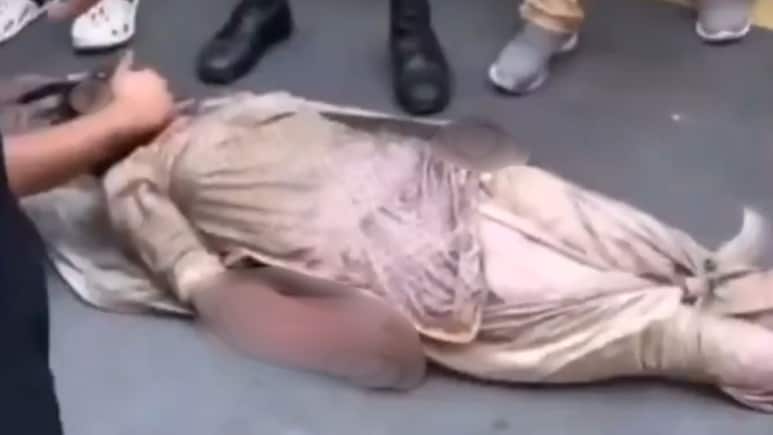
Rajyalaxmi Chitrakar, the wife of Nepal's ex-prime minister Jhalanath Khanal, died on Tuesday, say media reports, after protesters, led by Gen Z, trapped her in their home and set the house on fire.

The incident took place at their home in Dallu area in the state capital Kathmandu.

Ms Chitrakar was rushed to Kirtipur Burn Hospital but died during the treatment, say family sources.

Nepal's prime minister KP Sharma Oli, whose own house was set on fire, resigned Tuesday as protests against a short-lived ban on social media grew increasingly violent and expanded into broader criticism of his government and accusations of corruption among the Himalayan country's political elite.

Mr Oli's finance minister Bishnu Prasad Paudel, 65, was chased through the streets of the capital, showed a disturbing video. The minister, showed the video, was kicked and thrashed brutally."


qs4fnt6_nepal-ex-pm-wife-burnt-alive-_650x400_09_September_25.jpg
 
This is a fascinating part of the world IMO.
I was there many years ago, on a guided 'trek' to base camp.

I also spent some time in Tibet, when Westerners were even allowed there, and the presence of Chinese troops
and subsequent oppression was palpable.
Totalitarian regimes must fall.
- Jago?
 
KATHMANDU: More than 13,500 inmates have escaped from prisons across Nepal, authorities say, following widespread violence and destruction during Gen-Z protests.


According to Binod Ghimire, spokesperson and DIG of the Nepal Police, a total of 13,572 prisoners have fled from correctional facilities nationwide. In addition, 560 detainees who were in police custody for investigation of various cases have also escaped.


“These escapes occurred amid the chaos caused by demonstrations, vandalism, and arson carried out by Gen-Z protesters on Tuesday,” Ghimire added.
Seems like the social media stuff was only the trigger, there's more shit going on there.
 
Power to the people
You have to understand, most of these people are not ready to be unplugged. And many of them are so inured, so hopelessly dependent on the system, that they will fight to protect it..
 
You have to understand, most of these people are not ready to be unplugged. And many of them are so inured, so hopelessly dependent on the system, that they will fight to protect it..
It's mostly backlash against nepo babies flexing their life style on social media on tax payers dime.

The protests began following a nationwide ban on many popular social media platforms, but had their origin in the public's frustration with the perceived corruption of and display of wealth by government officials and their families, as well as allegations of mismanagement of public funds.
 

Nepali Prime Minister resigns amid protests: Why are ‘nepo kids’ angering youth?​

Nepali PM resigns amid anticorruption protests that escalated on Monday, killing 19 demonstrators.

nepal-embed_1757409188336_hpEmbed_3x2.jpg


Nepal’s Prime Minister Khadga Prasad Sharma Oli resigned on Tuesday amid surging protests that began as a movement against corruption and inequality but exploded into broader calls for change after 19 youths were shot dead by security forces during clashes on Monday.

Protests continued on Tuesday morning, with agitators torching several buildings seen as associated with Nepal’s elite, even as ministers resigned and pressure built on Oli to follow suit.

However, despite Oli’s resignation, Nepal remains on edge, with protesters seeking sweeping changes to the country’s political landscape. Kathmandu’s international airport cancelled all flights scheduled for Tuesday.

Here’s the latest on the churn in Nepal, and the triggers driving the anger that has fuelled these protests:

What happened during the protests on Monday?​

Protests began at 9am (03:15 GMT) on Monday in Kathmandu’s Maitighar neighbourhood. Thousands of young protesters, including high school students in their uniforms, took to the streets.

Dubbed the “Gen Z protest”, it was organised by the nonprofit organisation Hami Nepal, meaning “We are Nepal”. According to the Kathmandu District Administration Office, the NGO had secured approval for it. The protest spread to other cities.

Within hours, some protesters broke barricades set up by the police and entered the parliament premises in New Baneshwor. This resulted in clashes with the police, who opened fire on the protesters. Authorities imposed a curfew in the area until the evening.

At least 17 people were killed in Kathmandu, while two were killed in the eastern city of Itahari after protests turned violent, according to the police.

More than 100 people, including 28 police officers, were being treated for their injuries, according to police officer Shekhar Khanal, the Reuters news agency reported.

In a statement released late on Monday night, Oli said he was “deeply saddened” by the protesters’ deaths and called for an investigation into the violence.

What’s the latest on the ground in Nepal?​

Authorities have imposed an indefinite curfew, which now covers Kathmandu, Lalitpur and Bhaktapur districts. The curfew order bars public gatherings, sit-ins and protests.

Oli resigned from his position on Tuesday, his secretariat confirmed.

However, on Tuesday, young protesters continued to rally on the streets of Kathmandu. They gathered near the parliament building, but did not carry any posters, local media reported.

They burned tyres while demonstrating in Kathmandu’s Kalanki area.

They also set fire to the Nepali Congress (NC) party’s central office in Sanepa, a neighbourhood in Lalitpur, about 5km (3 miles) from Kathmandu. Since last year, the NC — one of Nepal’s largest political parties — has been a coalition partner of Oli’s governing Communist Party of Nepal (Unified Marxist-Leninist).

Oli’s resignation came after some of his ministers stepped down in the aftermath of Monday’s deaths. On Monday, Home Minister Ramesh Lekhak resigned. Agriculture Minister Ramnath Adhikari quit his post on Tuesday.

Who are ‘nepo kids’ and why are they upsetting Nepali youth?​

A key trigger for the protests, say activists and experts, has been a growing perception that the families of the ruling elite live lives of relative luxury in an otherwise poor nation, exposing deep inequalities.

On Nepali social media, the term “nepo kids” — a play on nepotism — was viral in the weeks leading up to Monday’s protests. The term is commonly used to refer to the children of top government officials and ministers.

Nepal’s government officials and politicians have long faced accusations of widespread corruption, opacity over how public money is spent, and whether parts of it are used to fund the lavish lifestyles that their families appear to enjoy, despite modest official salaries.

Several videos on social media platforms such as TikTok and Instagram show the relatives of government officials and ministers travelling in or posing next to expensive cars and wearing designer brands.

“The anger over ‘nepo kids’ in Nepal reflects deep public frustration,” said Yog Raj Lamichhane, an assistant professor at the School of Business in Nepal’s Pokhara University. What strikes ordinary Nepalis is how political leaders — the parents of the so-called nepo kids — who once lived modestly as party workers “now flaunt extravagant lifestyles as established figures,” Lamichhane told Al Jazeera.

That is why protesters are demanding the formation of a special investigation commission to “thoroughly investigate the sources of their [politicians’] property, highlighting broader concerns about corruption and economic disparity in the country”, he said.

Nepal has traditionally been a deeply feudal society, with a monarchy in place until less than two decades ago, pointed out Dipesh Karki, an assistant professor at Kathmandu University’s School of Management.

Throughout the country’s history, “those who came into power have wielded their control over the resources and the wealth of the nation, resulting in what we can dub as an elite capture”, Karki told Al Jazeera.

Earlier this week, a video on TikTok showed images of Sayuj Parajuli, the son of former Nepali Supreme Court Chief Justice Gopal Parajuli, posing next to cars and in fancy restaurants. “Openly flexing luxury cars and watches on social media. Aren’t we tired of them by now?” the caption read.

Another video showed similar images of Saugat Thapa, son of Bindu Kumar Thapa, the law and parliamentary affairs minister in Oli’s government.

Karki said urban wealth and businesses, as well as educational opportunities, are largely concentrated among elite families, particularly those with political connections.

“The children of politicians are living off the political dividend.”

 
Back
Top