Kicking the heavy bag

Nice to see you training, man! Are you attending muay thai classes anywhere? If not I can ask around what are some good places to train legit Muay Thai in your city (if you still live in the same place you told me some months ago).

Now for your kick, for me what really made a difference in understanding the muay thai kick was something @SAAMAG told me years ago: Lead with your hips! Stepping facilitates that, for sure. If you pay attention to the video Shincheckin posted above you'll see a couple things happening simultaneously while the kicker steps:
- extension of his right hip
- flexion of the supporting leg with the foot planted
- turning of the torso
- arm positioning, same side arm goes across both to guard the face and to prepare the swing (I like it more horizontal than he does, like really hiding your shin and nose, only the eyes uncovered) the other arm drops close to the body

He does all those thing slightly different when he kicks multiple times, but you get the concept. See, all this lead to positioning yourself in an optimal way to fire the kick itself. At the end of the day I personally see the Muay Thai kick as a two phases technique: loading/positioning and the kick itself


In my last clip you can see that the right hip goes forward with the first kick and doesn't come back. The hips are already in position to facilitate the kick. The foot should land behind the supporting leg, which causes the extension in the right hip. Makes sense?


Thanks for taking the time to reply man. The last 2 years I'm constantly alternating between muay thai and leg strength and conditioning because I have a fucked up knee and I can't do both (need to have a couple free nights on the week due to work and studying).

I'm in the same city and pretty sure that there is only one place that teaches legit Muay Thai here. I insisted on coming back to my old gym last time out but due to work schedule when I return I'll stick to the legit Muay Thai gym even though I don't agree with somethings they do there - mainly mindless hard sparring every time out.

I'll get in touch with you via PM. Also that's a sweet kick you do there.
 
hats off to you for having the balls to put a video of yourself up on sherdog. So the video looks like you have the basic concept of kicking down. Its really hard to give you an solid advice without being able to see your supporting leg. That being said what I noticed, is your to herky jerky, it looks like your throwing your kick and then going ok its time to pivot, and trying to pivot hard.......as if you are breaking the kick down into 2 motions, the kick can be broken down into multiple motions to help you get the concept and movements down, but they should all be perform simultaneous or smoothly. Think of shooting a basketball it travels in a smooth arc, not up, and then sharply down. I am not saying your kicking sharply down, just trying to emphasize making your kick one smooth motion, rather than 2.

The next thing would be when you are kicking the bag.....once the bag starts swinging, you should be kicking it when its swinging your direction, not while its swinging away...think of the timing on hitting a baseball with a bat, its the same concept on the bag.

Lastly I would have to disagree with not stepping to the side, stepping to the side is the most important aspect of kicking IMO. If you get into the habit of not stepping to the side now, it will be a bad habit harder to break later on. Also stepping to the side, generates more power, and you also have to pivot less than if you didnt. The way I teach my students to kick is similar to the fight club movie quote of rule number 1 is dont talk about fight club and rule number 2 is dont talk about fight club.......well my rules are 1) step to the side 2) STEP TO THE SIDE!!

that being said, theres a ton of different minor variations on kicking, I prefer to kick the way bas rutten explains in his tutorial I can never seem to find online again....anywayss just shoot for nailing the basics first, than you can play with the little variations later. It can be hard to sort whats what with all the bullshit on youtube because theres a ton of wrong information on there. I would suggest using this for your basic guideline.


Thanks for your input man. sherdog has a bad reputation but you do get good advice here.
 
Thanks for your input man. sherdog has a bad reputation but you do get good advice here.

Yeah, i had avoided sherdog for years because of its reputation, however once I joined and became a regular I was quite surprised to have good conversations, learn, and share alot of knoweldge. I have had my share of people deciding to "pick fights" and talk all kinds of shit to me for no reason, im just as guilty for retaliating, but overall its been a pretty good place with a good group of people, stand up forum seems to be the best place. Its too bad it wasnt what it once was a year or so ago. I kinda feel like it went to shit after my karate fiasco thread. If everyone could just get along, not feel the need to insult each other and if disagreeing, disagree in a polite and respectful manner it would be great. But that doesnt happen on the internet unfortunately. Anyways I am always down to help share what I can with anyone willing to learn/listen.......feel free to hmu anytime.
 
As you just said, stepping to the side makes it so that you have to pivot less. It's a way to shortcut the movements one has to make. As such, it's very good for people who have already learned how to engage their hips properly but very bad for people who haven't learned it yet.

Stepping in muay thai is like stepping in boxing. You're supposed to step on the punch but if you can't even punch without stepping then learn to do it correctly first before incorporating the step.

Bas Rutten is the last person I would go to for striking advice. I've watched his instructional series. His motto is "every coach recommends to do this but you don't have to". He advocates not turning the fist on the jab and cross, not pivoting the supporting leg on the roundhouse kick and standing almost completely square with both feet pointing at the opponent. That's the exact opposite of what all the coaches in the world teach.

Yeah I read your previous post regarding stepping to the side, and I can understand the concept behind what you are saying. I still prefer to teach to step to the side, IMO its the most important aspect of the kick, the rest of the mechanics can be learned, and Im sure you read my previous post as to how creating the habit of not stepping to the side, can be hard to break, as we all know the saying, bad habits are harder to break than creating a new one. I referred to bas rutten as his video does a great job of explaining why its important to step to the side, as its a mouthful I dont feel like typing. I am not familiar with his punching methods, you dont have to turn the punches but as you said, its generally not taught that way. Regarding not pivoting on the kick, its because the way he steps, its a pre-pivoted step, so rather than stepping and spinning on your toes like a "top", the foot is already pivoted when it lands, you still rotate the hips and all the other stuff, but yeah its not the way its generally taught. Its an alternate way of kicking. I prefer it though. You dont see it a lot, but if you look for it, you will find it. heres a vid of my coach holding pads for a thai fighter, you can see it being used here.


anyways dude yeah either way we can both agree that stepping to the side is important and both also agree that pivoting as you have mentioned is important as well and I can totally understand the concept and reasoning of teaching it the way you have mentioned and while I may not prefer to teach it that way, I can definitely understand while others may choose to do it that way.
 
Last edited:
Yes, beginners and guys with background in other arts. I have a Sanda guy now and he does it a lot. Seems that a bent leg, pivoting on the spot instead of stepping can give you some speed, but still, I prefer the thai method (little bend on the entry/step and extends as you fire the kick) and in a fight its all about timing and disguising it with footwork and feints, not pure speed

only time its ok is for the leg kick.
 
Yeah I read your previous post regarding stepping to the side, and I can understand the concept behind what you are saying. I still prefer to teach to step to the side, IMO its the most important aspect of the kick, the rest of the mechanics can be learned, and Im sure you read my previous post as to how creating the habit of not stepping to the side, can be hard to break, as we all know the saying, bad habits are harder to break than creating a new one. I referred to bas rutten as his video does a great job of explaining why its important to step to the side, as its a mouthful I dont feel like typing. I am not familiar with his punching methods, you dont have to turn the punches but as you said, its generally not taught that way. Regarding not pivoting on the kick, its because the way he steps, its a pre-pivoted step, so rather than stepping and spinning on your toes like a "top", the foot is already pivoted when it lands, you still rotate the hips and all the other stuff, but yeah its not the way its generally taught. Its an alternate way of kicking. I prefer it though. You dont see it a lot, but if you look for it, you will find it. heres a vid of my coach holding pads for a thai fighter, you can see it being used here.


anyways dude yeah either way we can both agree that stepping to the side is important and both also agree that pivoting as you have mentioned is important as well and I can totally understand the concept and reasoning of teaching it the way you have mentioned.


I think there's a place for both kicking straight from the stance with a pivot as well as stepping to the side and kicking, but it's more important to understand the context and why it's done rather than arguing over what the "proper" method is.

Both methods aim to align the hips such that they point at the target so that you can get good power transfer into the kick. With the way you teach the kick, the hips don't come all the way through since the base leg isn't pivoted fully around to open up the hips. The power in the kick is maybe a foot, foot & half to the right of the target, stepping left brings that power zone into the target. Pivoting fully lines up the hips with the target so that the power is right there as well. Different method, same end result; puts the power zone on the target.

In kickboxing & MMA the usual method is stepping in and to the left to kick. The range is longer than in stadium MT since fighters generally aren't looking to clinch, and you need to take a step in to get into range anyway. Stepping in & to the left closes the distance and skips some of the more difficult mechanics so that fighters can close the gap and kick in one smooth motion.

In MT the distance is closer, fighters generally setup inside kicking range most of the time so there's no need to step in before kicking. Also, kick defence is a hell of a lot better than in kickboxing and MMA. In this context, stepping to the side to kick is a dead giveaway and asking for your kicks to get blocked & countered hard. Which is why they prefer to kick straight from their stance with a pivot rather than using a setup step for the kick. Doesn't mean that they can't, all the Thais I've seen in international rules kickboxing or other fights outside of the Thai stadiums have little difficulty stepping into and/or to the side as needed to line up their kicks.


this one is not very good either but you can see different things.


1) The standing leg doesn't look that it's pivoting or too little = not enough rotation of the hips for max power. Are you completely off of your heel when kicking?

2) The torso is too upright and needs to bend away from the kick = more power, more points of defense b/c head will be off of train tracks.

2a) If kicking with a straight upright torso like this, then it's better to hop & pivot -> kick = flying kick for more power & speed to lessen the chances of getting countered (as your head is right on the train tracks).

3) Other little things for better defense would be shrugging the shoulder up into the chin when swinging down the arm, use the guard hand in front or to the temple (depending on the variation of the RH), etc.
 
I think there's a place for both kicking straight from the stance with a pivot as well as stepping to the side and kicking, but it's more important to understand the context and why it's done rather than arguing over what the "proper" method is.

Both methods aim to align the hips such that they point at the target so that you can get good power transfer into the kick. With the way you teach the kick, the hips don't come all the way through since the base leg isn't pivoted fully around to open up the hips. The power in the kick is maybe a foot, foot & half to the right of the target, stepping left brings that power zone into the target. Pivoting fully lines up the hips with the target so that the power is right there as well. Different method, same end result; puts the power zone on the target.

In kickboxing & MMA the usual method is stepping in and to the left to kick. The range is longer than in stadium MT since fighters generally aren't looking to clinch, and you need to take a step in to get into range anyway. Stepping in & to the left closes the distance and skips some of the more difficult mechanics so that fighters can close the gap and kick in one smooth motion.

In MT the distance is closer, fighters generally setup inside kicking range most of the time so there's no need to step in before kicking. Also, kick defence is a hell of a lot better than in kickboxing and MMA. In this context, stepping to the side to kick is a dead giveaway and asking for your kicks to get blocked & countered hard. Which is why they prefer to kick straight from their stance with a pivot rather than using a setup step for the kick. Doesn't mean that they can't, all the Thais I've seen in international rules kickboxing or other fights outside of the Thai stadiums have little difficulty stepping into and/or to the side as needed to line up their kicks.

well said....may different minor variations in kicking but the majority of the main principles of the technique remain. Best to learn and use all at the appropriate time......i have been working my full switch more lately than the half switch...for the switch kick for example.
 
What is the difference, @shincheckin ? I'm not familiar with those terms (half switch/full switch)

check this clip, pay attention to the distance of the "switch" meaning how far back does he "switch" his left foot on the switch kick. Half switch would be switching to about bringing your feet together so your "square" vs a full switching meaning switching all the way into southpaw.

pay attention to the first switch in the combo, vs the second switch into full southpaw for the fake.

 
I think there's a place for both kicking straight from the stance with a pivot as well as stepping to the side and kicking, but it's more important to understand the context and why it's done rather than arguing over what the "proper" method is.

Both methods aim to align the hips such that they point at the target so that you can get good power transfer into the kick. With the way you teach the kick, the hips don't come all the way through since the base leg isn't pivoted fully around to open up the hips. The power in the kick is maybe a foot, foot & half to the right of the target, stepping left brings that power zone into the target. Pivoting fully lines up the hips with the target so that the power is right there as well. Different method, same end result; puts the power zone on the target.

In kickboxing & MMA the usual method is stepping in and to the left to kick. The range is longer than in stadium MT since fighters generally aren't looking to clinch, and you need to take a step in to get into range anyway. Stepping in & to the left closes the distance and skips some of the more difficult mechanics so that fighters can close the gap and kick in one smooth motion.

In MT the distance is closer, fighters generally setup inside kicking range most of the time so there's no need to step in before kicking. Also, kick defence is a hell of a lot better than in kickboxing and MMA. In this context, stepping to the side to kick is a dead giveaway and asking for your kicks to get blocked & countered hard. Which is why they prefer to kick straight from their stance with a pivot rather than using a setup step for the kick. Doesn't mean that they can't, all the Thais I've seen in international rules kickboxing or other fights outside of the Thai stadiums have little difficulty stepping into and/or to the side as needed to line up their kicks.


Here you have several thais advocating a big step in to close distance. A lot of muay thai fighters like to fight from distance just outside of kicking range (Panpayak, Tawanchai). My point is they don't always throw a textbook perfect round kick according to a manual somewhere.

IMO a lot of the time they actually throw kicks that don't look very good but they throw with accuracy at the time when the other guy can't check. Not sure I even understand the argument about not stepping to the side - it sounds to me like it's implied in the thread that if you step to the side then you don't pivot the foot. the way I see it whether you step to the side and pivot or if you pivot from the stance you do the exact same motion except when you step you stand there for a split second with the foot pointing at 45 degrees angle to the target. if you're referring to the style where you step with the foot completely sideways to the target then I agree that's not good.


Here you have several thais advocating a big step in to close distance. A lot of muay thai fighters like to fight from distance just outside of kicking range (Panpayak, Tawanchai). My point is they don't always throw a textbook perfect round kick according to a manual somewhere.

IMO a lot of the time they actually throw kicks that don't look very good but they throw with accuracy at the time when the other guy can't check. Not sure I even understand the argument about not stepping to the side - it sounds to me like it's implied in the thread that if you step to the side then you don't pivot the foot. the way I see it whether you step to the side and pivot or if you pivot from the stance you do the exact same motion except when you step you stand there for a split second with the foot pointing at 45 degrees angle to the target. if you're referring to the style where you step with the foot completely sideways to the target then I agree that's not good.


I nearly posted that video, but if you pay close attention, he doesnt step to the side much, he steps to the side but not much, almost straight in with a pre-pivoted foot.
 
I nearly posted that video, but if you pay close attention, he doesnt step to the side much, he steps to the side but not much, almost straight in with a pre-pivoted foot.

Yes they mostly do a forward step which doesn't play at all into the different distances in MMA and Muay Thai and the giveaway theories from above. They actually step in to close distance and they do a couple motions that are a huge tell but they still have the best kicks in the world.
 
In the little clip showing Manop holding pads for Singdam and Saenchai both of them kick diagonally upwards. Same for the instructional posted by Shincheckin.

Buakaw doesn't kick in the most traditional way for a thai but even in the photo posted by StopDucking (Buakaw vs Askerov) if you watch to where his knee is pointing you can guess the trajectory of his kick.

/

The second Buakaw photo posted by StopDucking have an arched arrow drawn, but watch any clip of Buakaw kicking in shadowboxing and you'll see that any downward arch happens past the kick going through the target. Quickest way to return to base if you're practicing the kick going through.

Not trying to start an argument, nor trying to disqualify anyone's opinion and tips. Just passing along my perspective. I attended a seminar with Manop and he demonstrated every basic strike there is, including shin kicks and that was how he taught them. I'll stick to it.

Coming up and then horizontal is not the way most thai fighters will kick.
Everybody kicks diagonally upwards on the pads. There are 2 reasons for that:
- The pads being inclined and away from the holder's body, you don't get to complete the kick as the pads meet it halfway through.
- The usual purpose of padwork as it pertains to kicks is to train speed and endurance. Perfect technique should be drilled on the bag. Note that you can also train exclusively speed and endurance on the bag by throwing multiple half-kicks in a row.

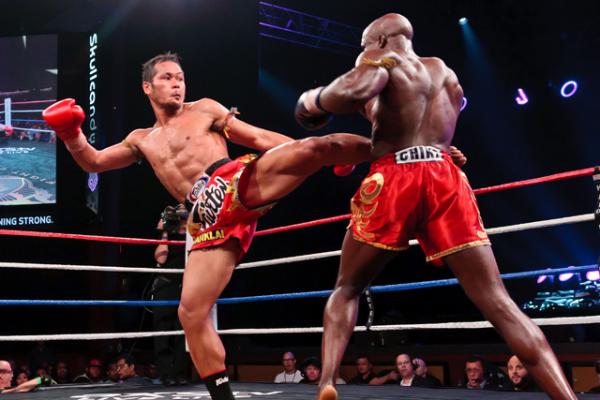
If you watch Yodsanklai on the pads, he's almost kicking straight up:


But watch him throw a real kick during fights and this is what it looks like:
Yodsanklai-Fairtex-IMGL6812.jpg


20140810064030__62D8853.JPG


I also wanna say, it's not so much about how you start the kick but how you finish it. You can throw some touch-kicks once in a while to gauge distance if you want but an actual textbook kick should end with the hips completely turned towards the opponent and the shin traveling horizontally.
 
Last edited:
Back
Top